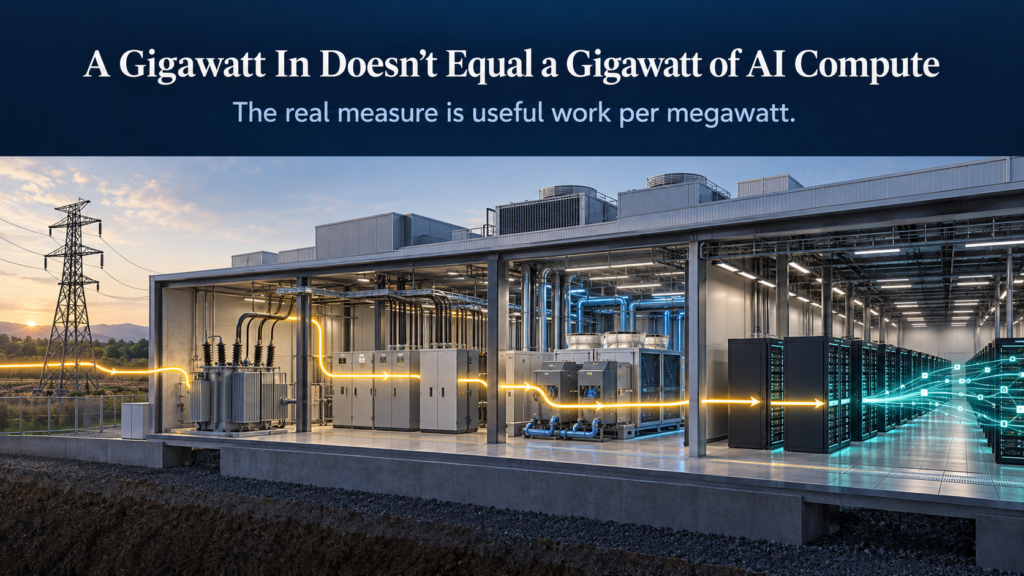
A data center’s power capacity tells us how much electricity it can draw. It does not tell us how much useful AI work the facility will produce.
That difference matters as companies compete for power, build larger campuses, and commit billions of dollars to AI infrastructure. A megawatt secured at the grid connection is only the beginning of the measurement.
Power has to travel through the system
Electricity entering a data center must be converted and distributed before it reaches computing equipment. The facility also needs cooling, monitoring, backup systems, and other infrastructure to operate reliably.
Then there is the equipment itself. A GPU can be installed and powered without running at full utilization. A poorly configured rack, a failed component, or a system restart can reduce productive output even while the facility continues to draw power.
The result is a gap between electricity consumed and useful computation delivered.
What the reported 60–70% estimate tells us
On October 14, TechRadar reported remarks from NVIDIA representatives at a Vertiv event suggesting that roughly 60–70% of electricity drawn by some AI data centers supports AI processing. The report described the remaining share as associated with cooling, power distribution and conversion, equipment configuration, failures, and restarts.
That figure is an industry estimate reported from executive remarks. It is not an independently audited average for all data centers. Facility design, workload, equipment, climate, operating practices, and the way “AI processing” is measured can all affect the result.
The estimate is still useful as a prompt: capacity figures alone do not reveal how efficiently a facility turns electricity into productive work.
“Non-compute” power is not automatically waste
Cooling and backup systems are necessary to keep high-density computing equipment within operating limits and protect service continuity. Power conversion and distribution are also part of delivering electricity safely to the IT load.
The goal is not to eliminate every watt that does not go directly to a processor. The goal is to understand the full system, reduce avoidable losses, and make sure the infrastructure investment supports dependable output.
A facility designed for peak demand and contingencies may also have capacity that is not used continuously. That may be appropriate for resilience, but it raises a management question: how much of the available infrastructure is producing useful work under typical operating conditions?
Measure the output, not just the input
“Gigawatt of AI compute” is shorthand. A gigawatt measures electrical power; compute output is measured through completed work and system performance.
For executives, that means asking for more than a facility’s contracted power or nameplate capacity. Useful measures could include:
- Electricity delivered to the facility and to IT equipment
- AI workload throughput, such as completed jobs or tokens generated
- Accelerator utilization and periods of idle or degraded operation
- Cooling and power-system overhead
- Availability, restart frequency, and time spent operating below target
These measures need consistent definitions and a clear time period. A peak result, a design target, and an observed operating average are different kinds of evidence.
The strategic implication
When power is scarce, improving the amount of useful computation produced from existing electricity can be as important as securing more supply.
That makes infrastructure efficiency an operating and capital-allocation issue. Better power delivery, cooling, equipment configuration, workload scheduling, and maintenance may help increase productive output without assuming that every problem can be solved by adding another megawatt.
The reported 60–70% estimate should be treated as a signal to investigate, not a benchmark to apply blindly. Each operator needs facility-level evidence to understand where power goes and what work it enables.
The executive question is therefore not only, “How much power can this data center draw?”
It is: How much useful, reliable AI work does each megawatt deliver—and how do we know?
Leave a Reply