Category: InfrastructureDevelopment

  • Time to Power: Why Grid Delays Can Become Contract Risk for AI Infrastructure

    AI infrastructure projects are often described through large, attention-grabbing numbers: megawatts, GPUs, investment totals and planned opening dates. But those figures only tell part of the story. For a customer planning cloud or AI services, capacity matters when it is ready to use.

    The planned Nscale site in Loughton, Essex, offers a concrete example of how the schedule can break down.

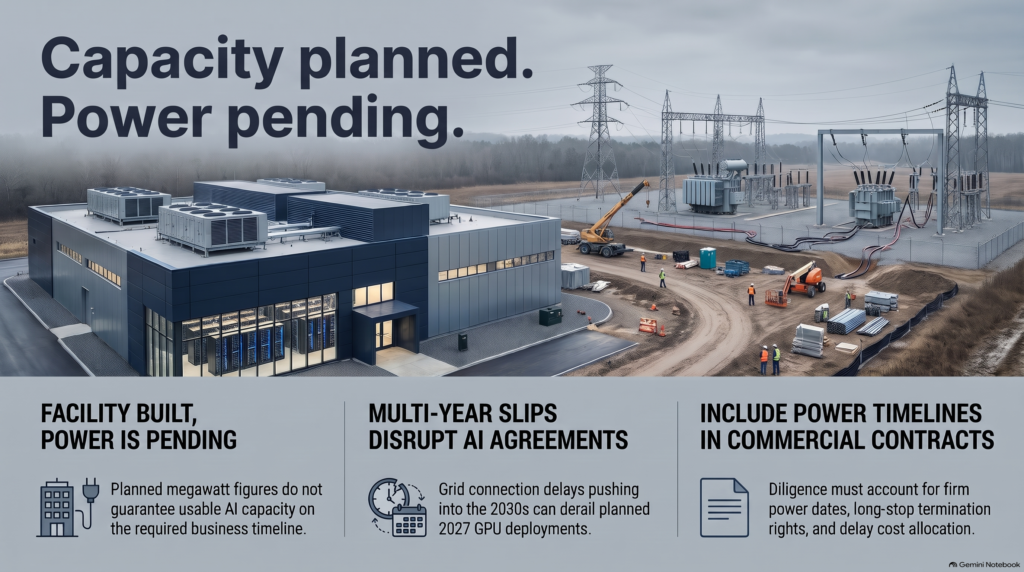
    Reuters reported that Microsoft withdrew from its agreement for capacity at the site after the expected grid connection slipped into the 2030s. Nscale had planned a facility with 50 MW of AI capacity, scalable to 90 MW, and approximately 23,040 Nvidia GB300 GPUs for Microsoft Azure. The original announcement anticipated GPU delivery beginning in early 2027. 

    Microsoft said its decision related to one site and reaffirmed its wider partnership with Nscale. Nscale said it remained committed to Loughton and was exploring alternative power sources and other UK expansion sites. The public reporting does not disclose the contract’s terms, the exact termination provision or the financial consequences for either party. 

    A project schedule depends on more than construction

    Data centre readiness depends on several linked pieces: the building, electrical equipment, cooling, network connectivity, hardware and sufficient power. If one critical dependency arrives years later than planned, the rest of the investment may not produce its expected value on schedule.

    That creates commercial consequences. A late power connection can postpone the point when a customer can use capacity, delay revenue, extend the time capital is tied up and create uncertainty about whether demand will still be there when the site is ready. These are general project risks; the publicly available details do not establish which of them applied to this specific agreement.

    Why this can become a contract issue

    Long-term infrastructure agreements have to allocate the risks of delay. Executives and project teams should understand how the contract treats power availability, delivery milestones, delay thresholds, customer remedies and termination rights.

    The questions are practical:

    • Is the power date confirmed, estimated or dependent on future grid work?
    • What happens if service begins later than the customer’s required date?
    • Is there a defined long-stop date after which a party can exit?
    • Can capacity be moved to another site or supplied from another source?
    • Who bears added costs while the project waits?

    These are questions to raise during commercial and legal review—not assumptions about the terms of Microsoft’s agreement.

    The executive takeaway

    A planned megawatt figure doesn’t guarantee usable capacity on the date a business needs it. Time to power affects whether a project can support customer commitments and whether its economics still work when the facility is ready.

    The better diligence question is not only, “How much AI capacity will this project deliver?” It is also, “When will power be available, how certain is that date, and what happens contractually if it moves?”

    In AI infrastructure, the power schedule belongs in the commercial plan from the start.
  • The Next AI Infrastructure Bottleneck May Be Electrical Cable

    AI infrastructure is often discussed through its most visible assets: advanced chips, enormous data centers and new sources of power. But those assets only become a functioning system when the supporting electrical infrastructure is available and connected.

    Electrical cable is one of those less visible dependencies—and it may be harder to scale quickly than project announcements suggest.

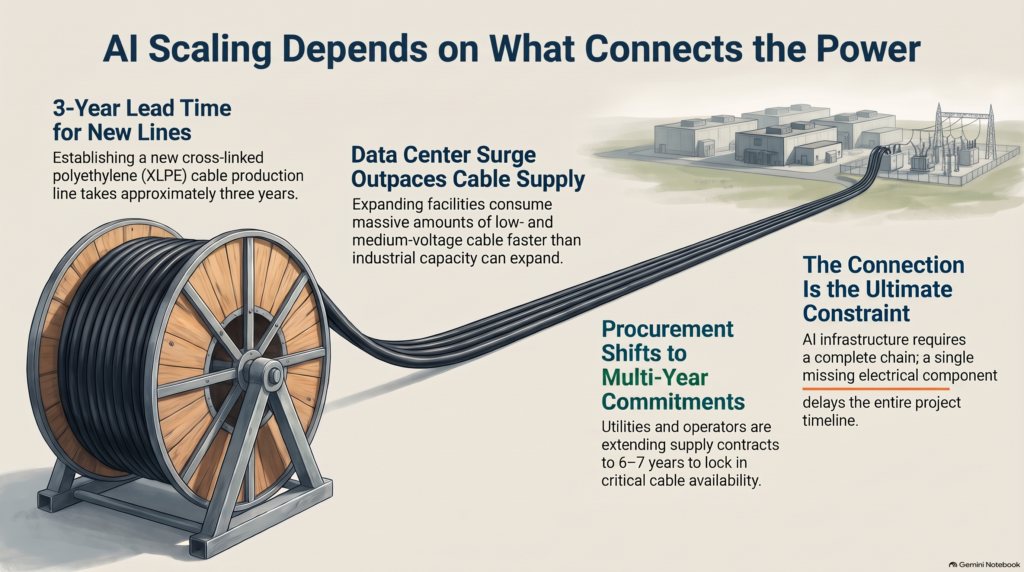
    On October 22, Reuters reported that Nexans CFO Vincent Piquet said cable production capacity is emerging as a bottleneck for AI-driven data-center construction. He described global capacity as tight and said that establishing a new cross-linked polyethylene (XLPE) cable production line, known in the industry as a CV line, takes around three years. 

    That estimate needs to be read precisely. It concerns the time required to establish a new production line. It does not mean that every cable order has a three-year delivery time, nor does it establish that all cable categories are constrained to the same degree.

    Why cable matters to data-center construction

    A data center is not simply a building filled with servers. It needs electrical systems that bring power into the site and distribute it through the facility. Reuters reported that data centers require large amounts of low- and medium-voltage cable for those connections, with larger facilities consuming proportionately more medium-voltage cable. 

    That creates a timing challenge. Demand for a project’s power infrastructure can rise faster than manufacturers can add capacity. Even when a developer has secured land, financing or computing equipment, the project still depends on the availability of components needed to connect and distribute electricity.

    The mismatch is between project urgency and industrial lead time. Data-center developers may want to move quickly, while manufacturing expansion requires investment, equipment, skilled labor and time to bring new lines into service.

    Procurement is already adapting

    The Reuters report also described a change in procurement behavior: French distribution network operator Enedis has moved from annual agreements to contracts lasting six or seven years to secure cable supply. That is one example of a buyer seeking more certainty through longer commitments; it should not be generalized to every market or customer. 

    Still, it points to a wider planning question. When essential components are scarce or slow to expand, procurement becomes part of infrastructure strategy. Buyers may need earlier demand forecasts, longer supplier relationships and clearer visibility into which projects will actually proceed.

    Where the opportunity may be

    The opportunity is broader than cable manufacturing alone. It may include:

    • Manufacturers able to expand the specific cable capacity the market needs.
    • Suppliers of specialized materials, production equipment and related components.
    • Procurement teams that secure supply early and coordinate across project schedules.
    • Developers and utilities that identify long-lead electrical components before construction is underway.

    These are possible areas of opportunity, not guarantees of demand or financial returns. The specific product, market, customer commitments and ability to deliver all matter.

    Nexans’ own October 22 financial release provides a concrete company response: it said it is investing to expand medium-voltage production capacity in Europe and the United States, with data centers among the markets it aims to serve. That confirms Nexans is adding capacity in that area; it does not show that the broader supply constraint has been resolved. 

    The bigger lesson for AI scaling

    The cable story fits a recurring pattern in infrastructure development: the component that limits progress may not be the one receiving the most attention.

    AI capacity depends on a sequence of linked systems—generation, grid connections, substations, electrical distribution, cooling, buildings and computing equipment. A delay in one essential layer can affect the schedule of the whole project.

    For executives, the practical question is not only how much capacity has been announced. It is whether the critical components can be manufactured, delivered and installed on the timeline the project assumes.

    A data center can be planned in megawatts. It still has to be built one connection at a time.

  • AI Infrastructure Debt Is Becoming an Executive Risk Indicator

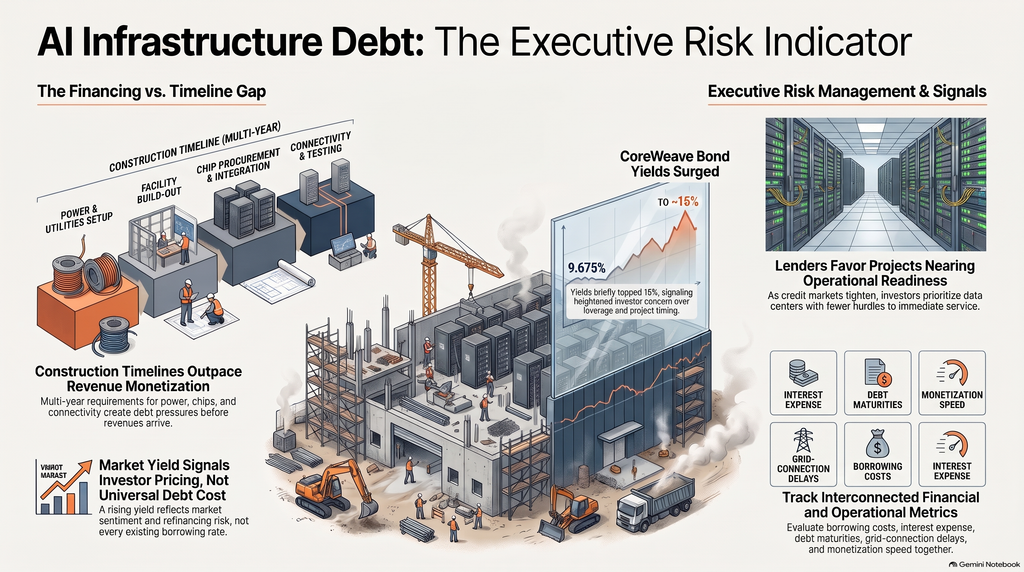
    The market for AI infrastructure is sending a signal executives should watch: the cost of financing the buildout can change faster than the infrastructure can produce revenue.

    On October 16, Reuters reported that CoreWeave bonds issued in June at a 9.675% yield had repriced to roughly 15%. The yield briefly moved above 16% during the week. That shift reflects investors demanding much more compensation to hold the company’s debt amid concerns about leverage, borrowing costs, execution risk, and the time required for large infrastructure investments to generate returns. reuters.com

    For executives, the point is not that one bond price predicts the future of AI. It is that financing conditions are becoming a useful indicator of which projects and business models the market considers more exposed. A data center can be strategically important and still face pressure if its debt costs rise before customer revenue catches up.

    That timing matters. AI infrastructure requires substantial investment in chips, power, cooling, buildings, and connectivity. Those assets may take years to plan, build, connect, and bring into productive use. During that period, a company still has to fund construction, service debt, and manage the possibility that equipment or market conditions change.

    A higher market yield does not automatically mean the company will pay that rate on all of its debt. But it can make future borrowing more expensive, complicate refinancing, and influence how investors assess new projects. As credit tightens, lenders may favor projects closer to completion, with clearer paths to service and revenue. Reuters reported that investors were showing preference for data center financings with fewer hurdles before entering operation. reuters.com

    This is a financing signal, not proof that AI demand is collapsing. Demand can remain strong while the economics of building capacity become harder to underwrite. The distinction matters: demand answers whether customers want compute; credit markets help answer whether the infrastructure can be financed at an acceptable cost and on a viable timeline.

    Executives tracking the market should watch several indicators together: borrowing costs, debt maturities, interest expense, construction and grid-connection timelines, customer commitments, and the pace at which new capacity becomes revenue-producing. A rising yield on one issuer is a data point. A pattern across financing costs, project delays, and customer economics would be a stronger signal.

    The executive question is not simply, “Is AI demand growing?” It is: Can this infrastructure be financed, delivered, and monetized before its costs or assumptions change?

    AI infrastructure debt is becoming an executive risk indicator because it makes the distance between planned capacity and productive capacity visible to the market.

  • The Next AI Power Plant May Not Look Like a Traditional Power Plant

    AI infrastructure is changing the conversation about electricity supply. Data centers need large, dependable amounts of power, while new generation and transmission can take years to plan and build. As a result, utilities and technology companies are considering a wider set of generation options.

    American Electric Power’s planned fuel-cell project near Cheyenne, Wyoming, is one example. Announced on October 14, the project is expected to provide 702 megawatts of generation for Google under a 20-year power purchase agreement. AEP estimates the investment at approximately $4 billion. Construction is planned to start in 2026, with the facility expected to be fully operational by the end of 2028. The project company, Cheyenne Fuel Cell LLC, is approximately 92% owned and controlled by AEP, with the remaining ownership held by funds advised by Basalt Infrastructure Partners. 

    Why fuel cells enter the AI power conversation

    Fuel cells generate electricity through an electrochemical process. Unlike a combustion-based generator, they do not burn fuel to produce electricity. Bloom Energy’s solid oxide systems can operate on natural gas, biogas, or hydrogen. This gives developers several possible fuel pathways, though the project’s actual fuel choice and supply arrangements matter to its cost and emissions. 

    The technology can therefore broaden the generation toolkit. A large customer may be able to contract for a dedicated source of on-demand electricity without relying solely on new conventional generation or waiting for grid upgrades to serve every increment of demand. That does not mean fuel cells replace the grid. It means they may become one part of a portfolio that includes grid supply, renewables, storage, conventional generation, and other emerging technologies.

    The scale of this project is also significant. At 702 MW, it is not a small backup installation. It is a large generation development with a substantial capital commitment and a long-term customer relationship. The structure links an energy supplier, a technology provider, an infrastructure investor, and a major electricity customer.

    The contract creates visibility, not certainty

    A 20-year power purchase agreement provides a long-term commercial framework. It signals that Google expects a sustained electricity need in the Cheyenne area and that AEP sees an opportunity to invest in dedicated generation for a large customer. Reuters also reported that Google has a separate arrangement with Black Hills Corp. for generation supporting its proposed data center in the area. 

    However, a long-term agreement does not by itself establish the final price of electricity, the project’s full risk allocation, or its performance over time. The economics will depend on details such as fuel procurement, financing, maintenance, operating costs, construction execution, and the terms that govern availability and performance. Those details are not all provided in the public announcement.

    Emissions claims need to be measured in operation

    AEP says the technology generates electricity without combustion of natural gas and that the project includes plans to integrate carbon-capture technology, with the goal of delivering near-zero-emissions power. Those statements describe the project’s design intent. They are not a published, measured operating emissions result. 

    Fuel-cell generation should not be described as inherently zero-carbon. Bloom notes that systems running on natural gas produce carbon emissions, while fuel choice affects the emissions outcome. The project’s eventual impact will depend on what fuel it uses, how that fuel is sourced, and whether carbon capture is installed and performs as expected. 

    For executives and policymakers, the useful questions are concrete:

    • What fuel will the facility use, and how secure is the supply?
    • What will the delivered power cost over the contract term?
    • What availability and reliability levels are guaranteed?
    • What emissions will be measured at the facility, including any upstream fuel impacts?
    • What carbon-capture system is planned, and how will its performance be verified?
    • What happens if construction, fuel delivery, or equipment performance falls behind plan?

    The broader signal: diversify generation, then verify performance

    The AEP–Google project illustrates a broader shift. AI-related electricity demand is encouraging new commercial arrangements and more varied generation technologies. The potential value of fuel cells is not that they solve every power constraint. It is that they add another possible source of dependable generation that can be evaluated alongside other options.

    The decision standard should remain consistent across technologies: compare delivered cost, dependable output, fuel risk, construction schedule, emissions, and operational performance. A promising configuration becomes useful infrastructure only when it can demonstrate those outcomes.

    The power plant of the AI era may look different from the traditional model. Its business case still has to pass familiar tests.

    How much dependable power will it deliver, at what cost, with what fuel and emissions profile—and can the project prove those results over time?

  • Why a Gigawatt of Electricity Doesn’t Mean a Gigawatt of AI Compute

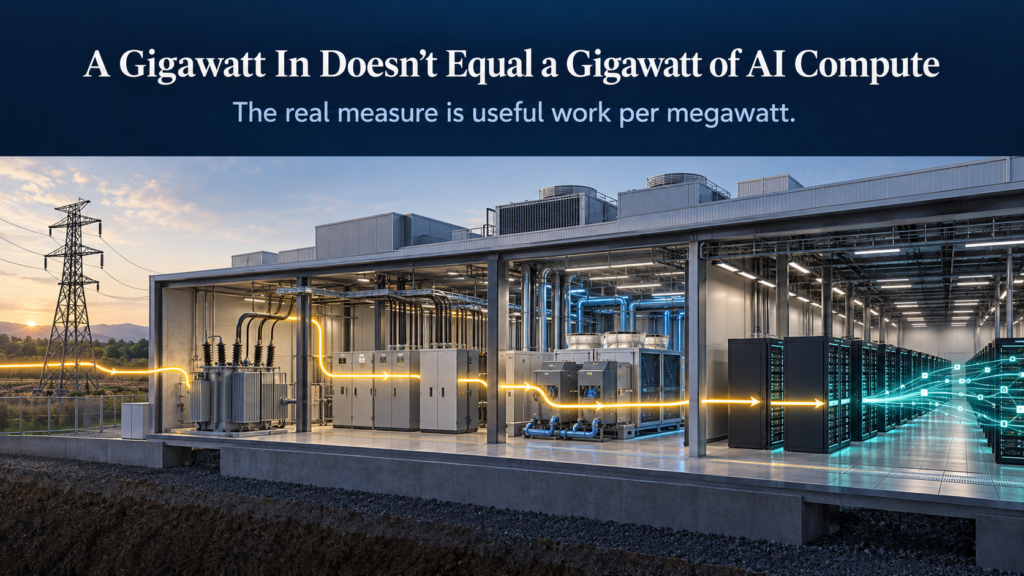
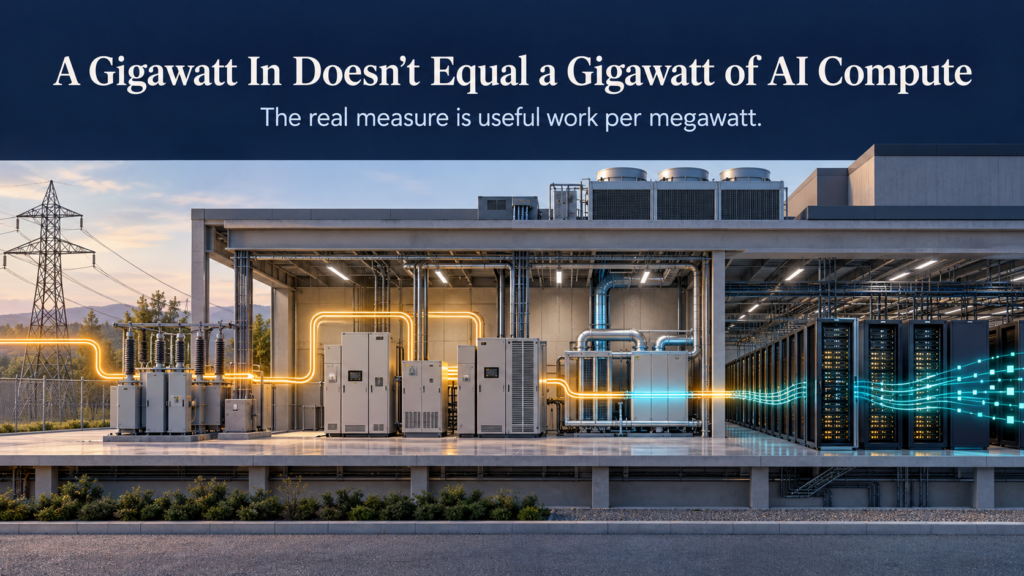
    A data center’s power capacity tells us how much electricity it can draw. It does not tell us how much useful AI work the facility will produce.

    That difference matters as companies compete for power, build larger campuses, and commit billions of dollars to AI infrastructure. A megawatt secured at the grid connection is only the beginning of the measurement.

    Power has to travel through the system

    Electricity entering a data center must be converted and distributed before it reaches computing equipment. The facility also needs cooling, monitoring, backup systems, and other infrastructure to operate reliably.

    Then there is the equipment itself. A GPU can be installed and powered without running at full utilization. A poorly configured rack, a failed component, or a system restart can reduce productive output even while the facility continues to draw power.

    The result is a gap between electricity consumed and useful computation delivered.

    What the reported 60–70% estimate tells us

    On October 14, TechRadar reported remarks from NVIDIA representatives at a Vertiv event suggesting that roughly 60–70% of electricity drawn by some AI data centers supports AI processing. The report described the remaining share as associated with cooling, power distribution and conversion, equipment configuration, failures, and restarts.

    That figure is an industry estimate reported from executive remarks. It is not an independently audited average for all data centers. Facility design, workload, equipment, climate, operating practices, and the way “AI processing” is measured can all affect the result.

    The estimate is still useful as a prompt: capacity figures alone do not reveal how efficiently a facility turns electricity into productive work.

    “Non-compute” power is not automatically waste

    Cooling and backup systems are necessary to keep high-density computing equipment within operating limits and protect service continuity. Power conversion and distribution are also part of delivering electricity safely to the IT load.

    The goal is not to eliminate every watt that does not go directly to a processor. The goal is to understand the full system, reduce avoidable losses, and make sure the infrastructure investment supports dependable output.

    A facility designed for peak demand and contingencies may also have capacity that is not used continuously. That may be appropriate for resilience, but it raises a management question: how much of the available infrastructure is producing useful work under typical operating conditions?

    Measure the output, not just the input

    “Gigawatt of AI compute” is shorthand. A gigawatt measures electrical power; compute output is measured through completed work and system performance.

    For executives, that means asking for more than a facility’s contracted power or nameplate capacity. Useful measures could include:

    • Electricity delivered to the facility and to IT equipment
    • AI workload throughput, such as completed jobs or tokens generated
    • Accelerator utilization and periods of idle or degraded operation
    • Cooling and power-system overhead
    • Availability, restart frequency, and time spent operating below target

    These measures need consistent definitions and a clear time period. A peak result, a design target, and an observed operating average are different kinds of evidence.

    The strategic implication

    When power is scarce, improving the amount of useful computation produced from existing electricity can be as important as securing more supply.

    That makes infrastructure efficiency an operating and capital-allocation issue. Better power delivery, cooling, equipment configuration, workload scheduling, and maintenance may help increase productive output without assuming that every problem can be solved by adding another megawatt.

    The reported 60–70% estimate should be treated as a signal to investigate, not a benchmark to apply blindly. Each operator needs facility-level evidence to understand where power goes and what work it enables.

    The executive question is therefore not only, “How much power can this data center draw?”

    It is: How much useful, reliable AI work does each megawatt deliver—and how do we know?

  • Financial Regulators Are Moving from AI Risk Plans to Resilience Exercises

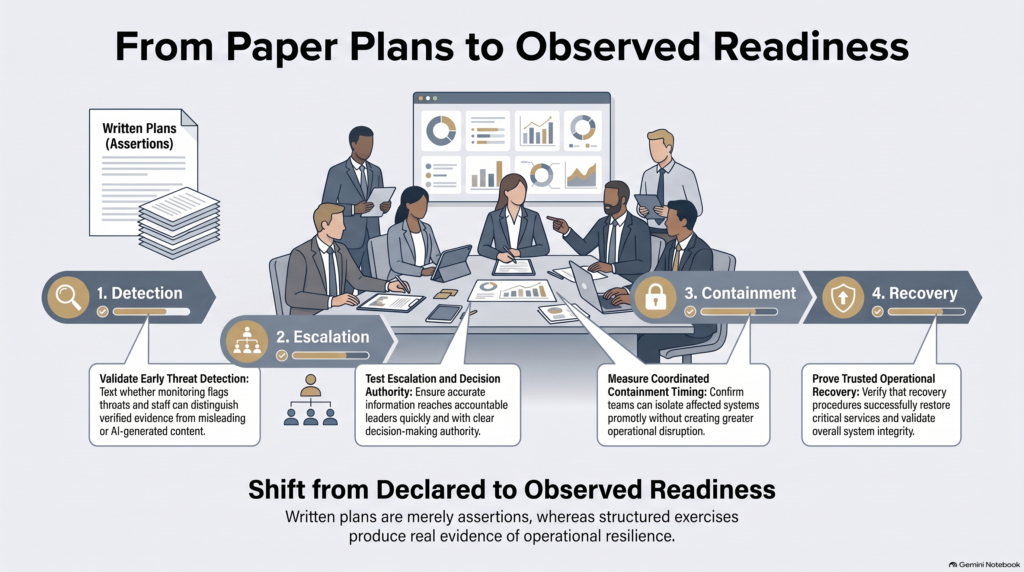
    A response plan can look complete on paper and still fail under pressure.

    That is why the G7’s agreement to conduct tabletop exercises simulating AI-enabled cyberattacks on the financial sector matters. Finance ministers and central bank governors have backed exercises designed to test existing response procedures. Depending on the scenarios, private financial institutions may also take part. The results are expected to help assess current protocols and identify improvements. (reuters.com)

    The announcement does not mean the G7 has already tested those procedures. It does show that the conversation is moving toward operational readiness: asking whether people, processes, and systems can work together during a realistic incident.

    A plan is not proof of readiness

    A written incident-response plan can describe who should be notified, who has authority to act, and how systems should be restored. But those instructions are only useful if they work in practice.

    During a fast-moving cyber incident, teams may need to determine whether an alert is credible, understand which services and third parties are affected, escalate to the right decision-makers, contain the threat, communicate accurately, and restore critical operations. Each step depends on clear ownership, timely information, and decisions that can be made under pressure.

    An AI-enabled scenario adds questions that organizations should be prepared to answer. Did monitoring identify the activity? Could staff distinguish verified evidence from misleading or AI-generated content? Were decision-makers given reliable information quickly enough? Could the organization isolate affected systems without creating greater disruption? Did recovery procedures restore trusted operations?

    The exercise is valuable because it can expose gaps between the documented process and the organization’s ability to carry it out.

    What a useful exercise should reveal

    A tabletop exercise should do more than confirm that participants attended and discussed a scenario. It should create evidence about how the response actually unfolded.

    For example, an organization can record:

    • When the incident was detected and when it was escalated.
    • Who made key decisions, what information they had, and whether authority was clear.
    • Whether containment actions were timely and coordinated across teams and providers.
    • How the organization maintained or restored critical services.
    • Which assumptions, dependencies, or communication paths failed.
    • What corrective actions were assigned, to whom, and by when.

    Those records help distinguish a rehearsed response from a demonstrated capability. They also give leadership a practical way to track whether identified weaknesses are fixed and retested.

    The governance question is whether the controls connect

    Detection, escalation, containment, and recovery are often described as separate capabilities. In a real incident, they form a chain. A strong detection tool has limited value if the alert reaches no accountable decision-maker. A clear escalation path cannot help if teams lack authority to contain the incident. Recovery plans are difficult to trust if the organization has not tested whether it can restore systems and validate their integrity.

    That is where exercises can help leaders see whether controls work together across business units, technical teams, senior management, and external partners. They can also test how participants make decisions when facts are incomplete and the incident is still developing.

    The G7 agreement is a meaningful step toward operational testing. The next measure of progress will be what the exercises uncover, what changes follow, and whether those changes are tested again.

    For financial institutions, the broader lesson is straightforward: a procedure is an assertion about readiness. A well-designed exercise produces evidence about readiness.

    Entrepreneur question: How can your organization show that its AI risk-management procedures work when the situation is uncertain, time-sensitive, and shared across teams?

  • The Grid Can Track AI Demand. But Who Has Authority to Control It?

    FERC’s PJM decision separates load visibility from curtailment authority

    The growth of AI infrastructure is making electricity demand harder to forecast and plan around. Large data centers can require hundreds of megawatts, ramp up over time, and depend on power arrangements that affect regional reliability planning.

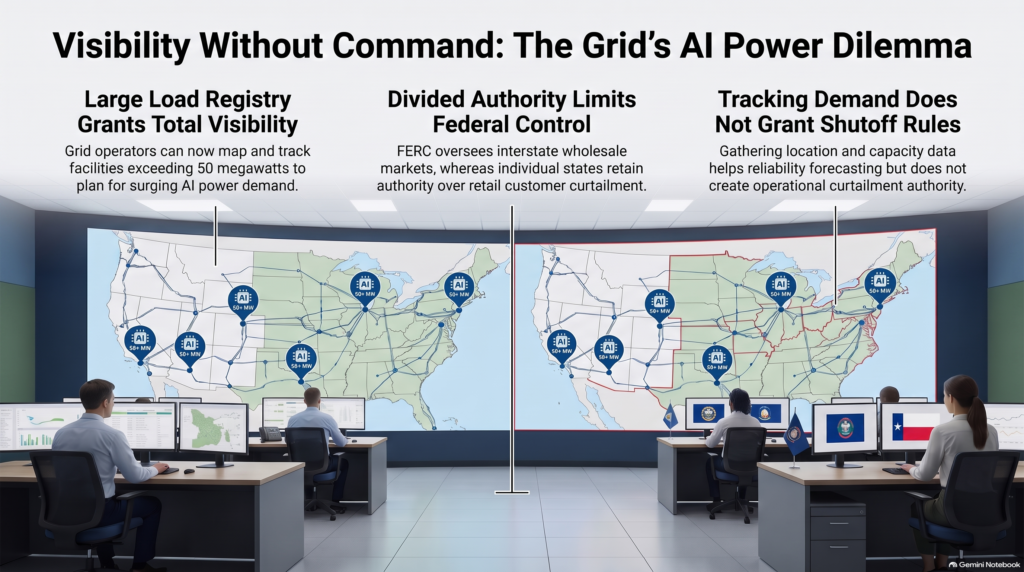
    On October 9, 2026, the Federal Energy Regulatory Commission (FERC) took a step toward improving visibility into that demand. It approved PJM Interconnection’s definition of a “Large Load” and its proposed Large Load Registry. At the same time, FERC rejected much of PJM’s broader proposal for providing interim service to new large loads, including provisions related to curtailment. (elibrary.ferc.gov, utilitydive.com)

    The decision highlights an important regulatory distinction: collecting information about large electricity users is different from deciding when their service can be interrupted.

    What the registry is meant to show

    PJM’s approved definition covers end-use customer load with a cumulative peak of at least 50 megawatts at a single electrical site. The registry is designed to collect information such as a facility’s location, ramp schedule and capacity supply. That information can help PJM understand how large loads may affect forecasts and reliability planning. (elibrary.ferc.gov, utilitydive.com)

    A registry improves visibility. It can help answer questions such as:

    • Where is major new demand expected to connect?
    • How quickly is that demand expected to ramp up?
    • What capacity supply is associated with the load?

    Those are important planning questions. But data collection does not itself create an operational curtailment rule or settle which regulator has authority over a retail customer’s service.

    Why FERC rejected the broader proposal

    PJM’s filing also proposed an Interim Resource Adequacy Service framework for certain new large loads. Under parts of that proposal, eligible loads that did not bring their own new capacity could face load-reduction requests as the system approached an emergency.

    FERC rejected that framework. The Commission said several provisions appeared to place obligations directly on large loads that are, for the most part, retail customers; to dictate which retail customers would be curtailed; and to establish a retail compensation rate. It also found that PJM had not adequately shown that the proposed treatment of those loads would avoid undue discrimination. (utilitydive.com)

    This is where jurisdiction matters. FERC oversees interstate transmission and wholesale market rules. States have a central role in regulating retail electricity service, including determining which retail customers may be curtailed when the system is stressed. FERC’s order treated the issue as a shared regulatory challenge, not as a simple question of whether grid operators can see or manage demand. (utilitydive.com)

    What the decision does—and does not—mean

    The order does not mean large data centers are exempt from every form of curtailment, or that emergency load reduction is off the table. It addresses the specific tariff framework PJM proposed in this filing. FERC also gave PJM direction on issues it would need to address if it revises and resubmits parts of the proposal. (utilitydive.com, headwaterswire.com)

    The distinction is between three separate layers:

    1. Visibility: identifying large loads and gathering information about them.
    2. Grid operations: maintaining system reliability as supply and demand change.
    3. Decision rights: determining which customers can be asked or required to reduce demand, under what rules, and with what protections.

    The registry advances the first layer. The order shows that the third requires careful coordination across federal and state authority, as well as rules that can be defended as fair.

    The governance question behind AI power demand

    For AI infrastructure, the practical issue is not only how much electricity a facility may use. It is also whether the grid and regulators have clear, workable rules for what happens when demand exceeds available supply.

    That requires a complete chain: reliable information about large loads, transparent criteria for reliability actions, clear responsibility for issuing those actions, and consistent treatment across customer classes. Without that chain, the grid may know where demand is growing while decision-makers remain uncertain about who can require it to change.

    The registry can help the grid see the load. It cannot, by itself, determine who has authority to control it.

    Source: FERC, Docket ER26-3515-000, order issued October 9, 2026.

  • The Next AI Megawatt May Come From a Power Plant We Already Built

    As demand for electricity grows, the conversation often turns to new generation: new plants, new transmission, and new infrastructure. Those investments matter. But a recent Google–Constellation agreement points to another part of the supply equation: increasing output from assets that are already operating.

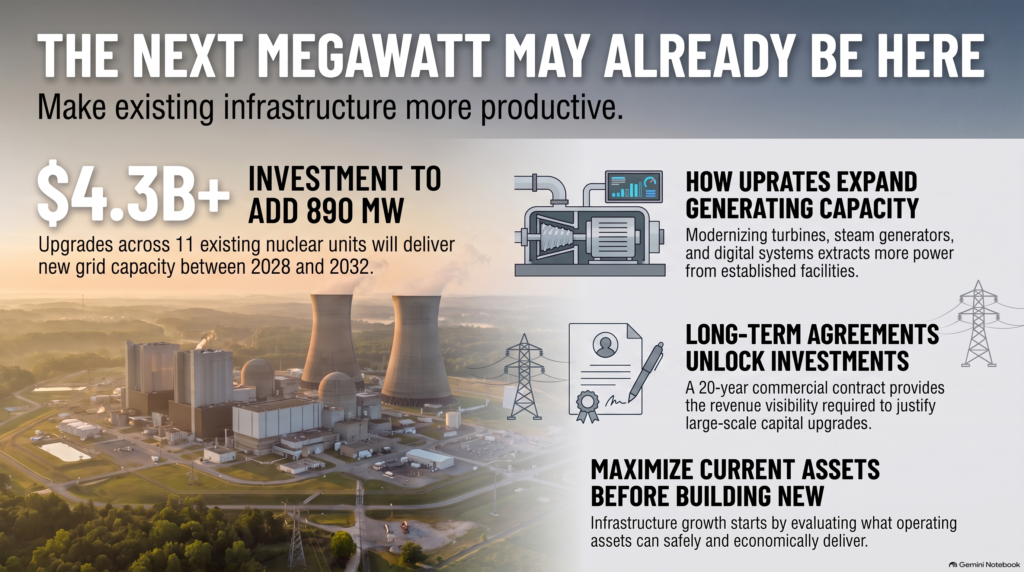
    Announced October 6, the companies’ 20-year power purchase agreement supports upgrades at 11 existing Constellation nuclear units across six sites in Illinois, Pennsylvania, and New Jersey. The upgrades are expected to add 890 megawatts of nuclear capacity to the PJM grid. Constellation says it plans to invest more than $4.3 billion in the work. The first uprate is expected in 2028, with the full 890 MW planned by the end of 2032. 

    This is not a new nuclear plant coming online today. It is a long-term investment plan to increase output from existing reactors.

    What an uprate changes

    A nuclear uprate increases a plant’s generating capacity by upgrading equipment and systems. The companies cite work involving turbines, steam generators, and digital control systems. The goal is to produce more electricity from an existing facility while maintaining the requirements that govern its safe and reliable operation. 

    That distinction matters. An operating plant already has a site, grid connections, and much of the supporting infrastructure. Upgrading it may offer a different development path from building a new facility. But it still requires substantial capital, specialized engineering, regulatory work, construction planning, and time.

    Why the commercial structure matters

    The 20-year agreement provides a long-term customer commitment associated with the planned upgrades. That kind of revenue visibility can help a generator justify capital investment in equipment and capacity improvements.

    The agreement also sits within a larger power arrangement. Google and Constellation signed a separate 15-year supply contract for another 2,700 MW from Constellation’s PJM generation fleet. That supply is not linked to a specific generating source, so it should not be counted as part of the 890 MW of new nuclear capacity. 

    The distinction between the two agreements is useful: one supports planned incremental nuclear capacity; the other provides long-term revenue certainty for existing generation assets.

    The capital-efficiency lesson

    Capital efficiency does not mean avoiding investment. In this case, the announced program includes more than $4.3 billion in planned investment. The efficiency question is whether targeted upgrades to existing assets can add useful capacity while making productive use of infrastructure already in place.

    That is a different question from simply asking how quickly a new plant can be built. It asks whether the current system contains assets with additional potential—and what investment, operational changes, and approvals are needed to realize it.

    The answer will vary by asset and location. An upgrade is not automatically faster, cheaper, or feasible everywhere. The 890 MW is a target for future delivery, with the first uprate expected in 2028 and the full capacity planned by the end of 2032. 

    A broader infrastructure principle

    For executives assessing electricity needs, the agreement offers a useful lens: examine both new supply and the productivity of existing assets. In power, that can mean evaluating uprates, reliability, grid connections, operating performance, and demand flexibility alongside new construction.

    The broader lesson applies across infrastructure. Growth does not always begin with acquiring or building another asset. Sometimes it begins by asking what the current asset base can safely and economically deliver—and what commitment will make the required investment possible.

    The next megawatt may come from a new plant. It may also come from making an existing one work harder.

    Source note: Constellation’s announcement says 890 MW will be added to the PJM grid through the planned nuclear upgrades; Google’s post provides the end-of-2032 target. The separate 2,700 MW agreement is not source-specific. 

  • AI Can Help Design the Chip. Verification Still Has the Final Word.

    AI is moving deeper into technical work. The latest example is a September 30 announcement from Synopsys and OpenAI: the companies plan to develop GPT-Synopsys, a specialized model for semiconductor design.

    The model is intended to combine OpenAI’s AI capabilities with Synopsys’ electronic design automation tools and chip-design expertise. Synopsys says it is being developed to reason about chip design and verification and to operate its tools. 

    That development points to a practical question for companies adopting AI in engineering and other high-consequence work:

    How do you use AI to increase the pace of work while preserving confidence in the result?

    A design proposal is not a verified design

    Chip design is not complete when a system produces a candidate solution. A design must satisfy engineering requirements and physical constraints before it can be accepted for manufacturing.

    Reuters reported that Synopsys expects traditional computing tools to check the model’s work and determine whether a chip will function. Synopsys’ CEO emphasized the need for high-fidelity validation and sign-off. 

    That is the key governance signal. AI can help generate or refine a solution, but the model’s output does not establish that the solution is correct.

    The same distinction applies in other settings. A system may draft a code change, recommend a credit decision, identify a potential defect, or suggest an engineering configuration. Those outputs may be useful. They still need to be tested against requirements that are explicit, relevant, and independently assessable.

    Keep the roles clear

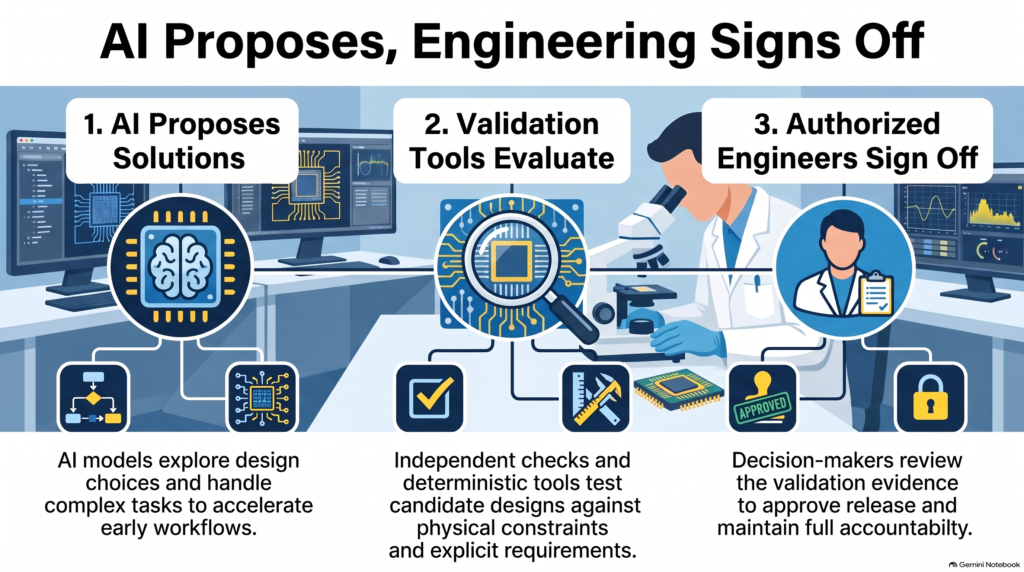
    A sound workflow gives each stage a distinct responsibility:

    1. AI proposes or assists. It can help explore design choices, handle complex tasks, and accelerate parts of the workflow.
    2. Validation tools evaluate. Defined checks test the output against relevant requirements and constraints. Depending on the task, that may involve simulation, deterministic checks, formal methods, or established sign-off processes.
    3. An authorized decision-maker accepts or escalates. The person or team with release authority reviews the evidence and decides what happens next.

    “Formal verification” should be used precisely: it refers to specific methods for proving properties of a system. It is not a generic label for every validation step. In this case, the broader and better-supported point is that established verification and sign-off remain part of the engineering process.

    What governance should make visible

    For a workflow like this to be governable, an organization should be able to answer:

    • What output did the AI produce, and which model or tool version produced it?
    • Which requirements and constraints were used to evaluate it?
    • What checks were run, and what were their results?
    • What happens when a check fails, produces an inconclusive result, or conflicts with another check?
    • Who has authority to accept the result or approve its release?
    • Can the organization connect the accepted result to the evidence reviewed at the time?

    These questions turn “human oversight” from a slogan into an operational control. A person’s name on an approval is not enough if the evidence, artifact, or criteria behind that approval cannot be identified later.

    Faster work still needs defensible decisions

    The point is not to slow down AI-assisted engineering. It is to keep speed from outrunning the organization’s ability to establish whether a result is fit for use.

    The emerging pattern is straightforward:

    AI proposes. Deterministic or otherwise established validation checks. Authorized decision-makers accept.

    That pattern can help organizations capture AI’s contribution while preserving accountability for outcomes. The AI may expand the range of solutions engineers can explore. Validation provides evidence about whether a candidate meets requirements. Decision authority determines whether that evidence is sufficient for release.

    The model can participate in the work. The organization still needs a process that can explain why the work was accepted.

    Capability creates options. Verification creates evidence. Authority turns evidence into an accountable decision.

    Sources

  • The Electrical Bottleneck Inside the AI Data Center

    AI power discussions often begin outside the data center: Can the grid serve the load? Is generation available? How long will interconnection take? Can transmission capacity reach the site?

    Those questions remain central. But they aren’t the only ones.

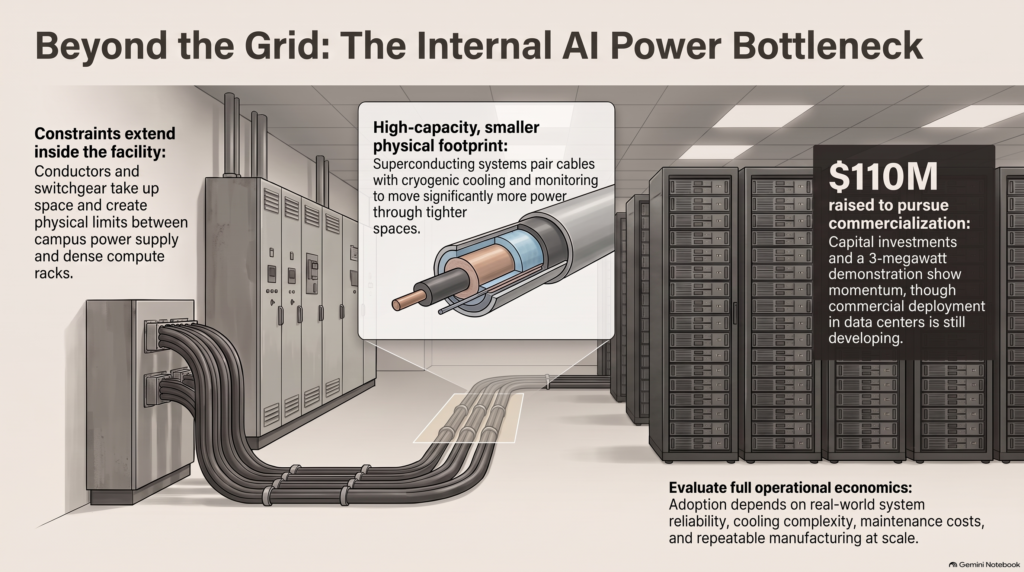
    After electricity reaches a campus, it must still pass through the facility’s electrical infrastructure and arrive at the equipment that performs the computing. That pathway has physical limits. Conductors, switchgear and other equipment take up space, require installation labor and must operate reliably under demanding conditions. As data centers add more power-dense computing, the electrical system inside the facility becomes part of the scaling challenge.

    VEIR’s October 8 financing announcement is a signal that investors see an opportunity in this layer. The company announced a $110 million Series C, bringing its reported total capital raised to $225 million. It says the funding will support manufacturing, product development and preparation for commercial deployments. VEIR also reports a 3-megawatt demonstration and says it is working with customers and industry partners on reference designs for AI facilities. 

    The approach centers on superconducting power-delivery systems. In VEIR’s description, the system includes more than the superconducting cable: it also requires cryogenic cooling, controls, terminations and monitoring. The goal is to move more power through a smaller physical footprint than conventional power-delivery infrastructure. 

    That could matter where space and power density are becoming linked. A smaller footprint could give designers more flexibility inside a facility or campus. But a compact cable alone doesn’t establish an operational advantage. The complete installation has to work as a system, and its economics must account for cooling, controls, installation, maintenance and the consequences of equipment failure.

    The technology also addresses a specific point in the power chain. It may improve how electricity is distributed within a data center. It does not supply the electricity, secure an interconnection or expand the grid. Those are separate constraints, and they remain part of the larger project.

    That distinction is useful because “AI needs more power” can make every proposed solution sound interchangeable. They aren’t. Some investments add generation. Some expand transmission. Others improve the way power is delivered inside a facility. A project may need progress at several of these layers at once.

    The commercial evidence is still developing. VEIR’s reported 3-megawatt demonstration is a technical milestone, while the company’s announcement describes initial commercial deployments as something it is preparing for. Reuters reported earlier this year that superconducting cables were not yet being used in data centers and that cost and manufacturing constraints had limited adoption. 

    For operators and infrastructure investors, the next questions are practical:

    • How reliably does the full system operate under real data-center loads?
    • What does it cost to install and maintain compared with conventional alternatives?
    • How does the cooling and control equipment affect operating complexity?
    • Can the system be manufactured, installed and serviced repeatedly at commercial scale?

    The $110 million round indicates investor confidence in the opportunity and provides capital to pursue commercialization. The test of the thesis will be what commercial deployments show about reliability, economics and repeatability.

    AI infrastructure can be constrained at more than one point between the grid and the server. Power availability gets attention because it is visible and difficult to solve. Power delivery inside the facility may be less visible, but it can also shape how densely and efficiently a campus grows.

    The useful question is not just how much electricity a data center can secure. It is how dependably and economically that electricity can be delivered to the compute.

    Source note: VEIR’s financing and technical milestones are company-reported; treat commercial performance claims as unproven until supported by operating data.