Category: InfrastructureDevelopment

  • The Electrical Bottleneck Inside the AI Data Center

    AI power discussions often begin outside the data center: Can the grid serve the load? Is generation available? How long will interconnection take? Can transmission capacity reach the site?

    Those questions remain central. But they aren’t the only ones.

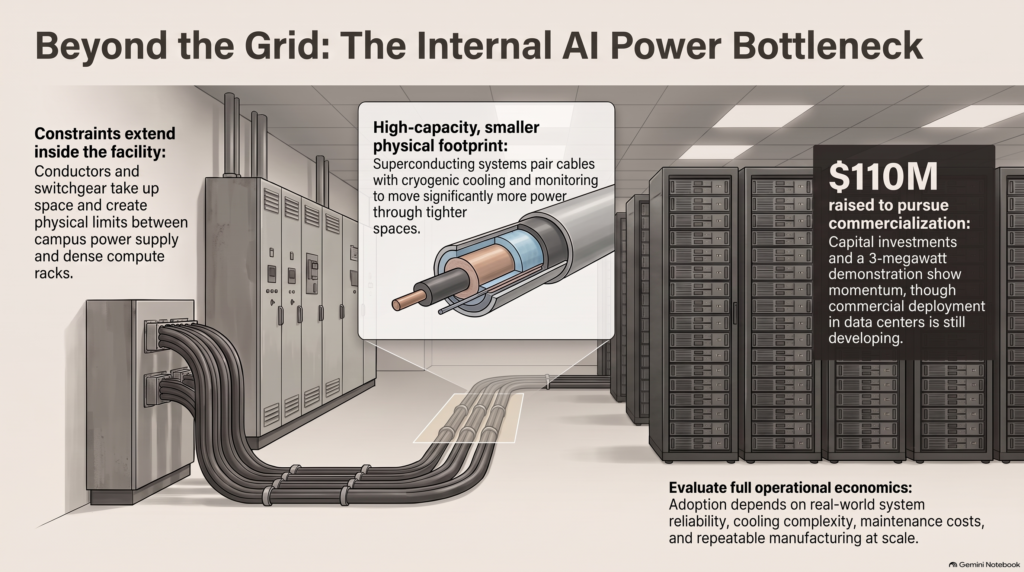
    After electricity reaches a campus, it must still pass through the facility’s electrical infrastructure and arrive at the equipment that performs the computing. That pathway has physical limits. Conductors, switchgear and other equipment take up space, require installation labor and must operate reliably under demanding conditions. As data centers add more power-dense computing, the electrical system inside the facility becomes part of the scaling challenge.

    VEIR’s October 8 financing announcement is a signal that investors see an opportunity in this layer. The company announced a $110 million Series C, bringing its reported total capital raised to $225 million. It says the funding will support manufacturing, product development and preparation for commercial deployments. VEIR also reports a 3-megawatt demonstration and says it is working with customers and industry partners on reference designs for AI facilities. 

    The approach centers on superconducting power-delivery systems. In VEIR’s description, the system includes more than the superconducting cable: it also requires cryogenic cooling, controls, terminations and monitoring. The goal is to move more power through a smaller physical footprint than conventional power-delivery infrastructure. 

    That could matter where space and power density are becoming linked. A smaller footprint could give designers more flexibility inside a facility or campus. But a compact cable alone doesn’t establish an operational advantage. The complete installation has to work as a system, and its economics must account for cooling, controls, installation, maintenance and the consequences of equipment failure.

    The technology also addresses a specific point in the power chain. It may improve how electricity is distributed within a data center. It does not supply the electricity, secure an interconnection or expand the grid. Those are separate constraints, and they remain part of the larger project.

    That distinction is useful because “AI needs more power” can make every proposed solution sound interchangeable. They aren’t. Some investments add generation. Some expand transmission. Others improve the way power is delivered inside a facility. A project may need progress at several of these layers at once.

    The commercial evidence is still developing. VEIR’s reported 3-megawatt demonstration is a technical milestone, while the company’s announcement describes initial commercial deployments as something it is preparing for. Reuters reported earlier this year that superconducting cables were not yet being used in data centers and that cost and manufacturing constraints had limited adoption. 

    For operators and infrastructure investors, the next questions are practical:

    • How reliably does the full system operate under real data-center loads?
    • What does it cost to install and maintain compared with conventional alternatives?
    • How does the cooling and control equipment affect operating complexity?
    • Can the system be manufactured, installed and serviced repeatedly at commercial scale?

    The $110 million round indicates investor confidence in the opportunity and provides capital to pursue commercialization. The test of the thesis will be what commercial deployments show about reliability, economics and repeatability.

    AI infrastructure can be constrained at more than one point between the grid and the server. Power availability gets attention because it is visible and difficult to solve. Power delivery inside the facility may be less visible, but it can also shape how densely and efficiently a campus grows.

    The useful question is not just how much electricity a data center can secure. It is how dependably and economically that electricity can be delivered to the compute.

    Source note: VEIR’s financing and technical milestones are company-reported; treat commercial performance claims as unproven until supported by operating data.
  • FERC’s Pause on PJM’s Backstop Plan Shows Why Speed Needs Structure

    A regulatory fast-track can shorten a process. It cannot make unresolved obligations disappear.

    On September 29, FERC acted on PJM Interconnection’s proposed Reliability Backstop Procurement, or RBP. PJM designed the one-time procurement to secure additional capacity after its 2028/2029 capacity auction fell approximately 6,800 MW short of the region’s reliability target. The plan was intended to help address a near-term supply gap amid rapid load growth, including demand from data centers. 

    FERC accepted parts of PJM’s proposal but suspended it for five months, with an effective date of February 28, 2027, while opening further proceedings on unresolved provisions. PJM confirmed that the procurement would not begin on September 30 as originally planned. The commission also asked PJM to improve its data-center demand forecasts. 

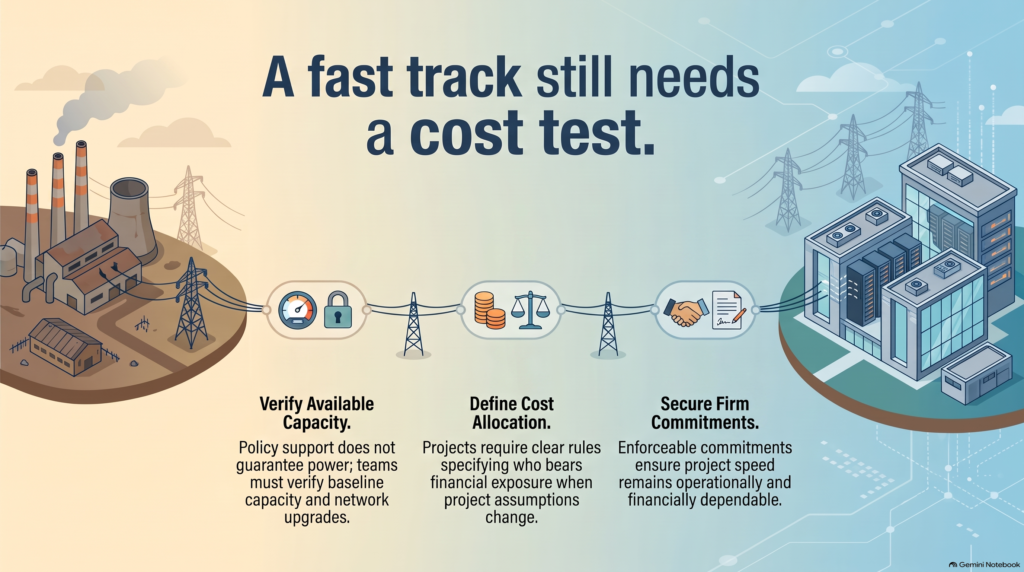
    The issues are practical, not procedural trivia. PJM identified concerns around cost allocation, transmission-owner exit rules, and collateral requirements for load-serving entities. Those rules shape who bears financial exposure if the procurement moves forward, and whether the obligations remain dependable over time. 

    That makes this a useful infrastructure-planning signal: a mechanism designed to move quickly can still be delayed if its allocation of costs and risks is not sufficiently defined. FERC did not say the region does not need new capacity. Its order accepted core elements while requiring more work on how the proposal would function.

    The distinction between this case and “fast-track interconnection” also matters. The RBP is a capacity procurement. PJM’s Expedited Interconnection Track is a separate process for qualifying new generation projects, and FERC approved that track separately. Calling the RBP pause the “death of shortcut interconnections” would merge two different mechanisms and draw a broader conclusion than the order supports. 

    For developers and large energy users, the practical takeaway is to treat policy support as one input to a project plan—not as proof of available power. Before relying on a site or procurement pathway, teams should verify the relevant capacity, interconnection status, needed network upgrades, enforceable commitments, and who carries the costs if assumptions change.

    PJM’s case illustrates a broader principle: speed can help a project move, but clear rules make that speed usable. The next advantage may belong to developers who can show not only that they have a path to power, but that the path is operationally and financially credible.

  • AI Infrastructure Is Moving From Maximum Capacity to Maximum Certainty

    The AI infrastructure conversation has been dominated by scale: more data centers, more generation, more chips, more gigawatts.

    Scale is still essential. AI workloads need enormous amounts of compute and power. But a large capacity announcement does not, by itself, mean a project can be financed, built, connected, and operated on a dependable schedule.

    That gap is moving to the center of the conversation.

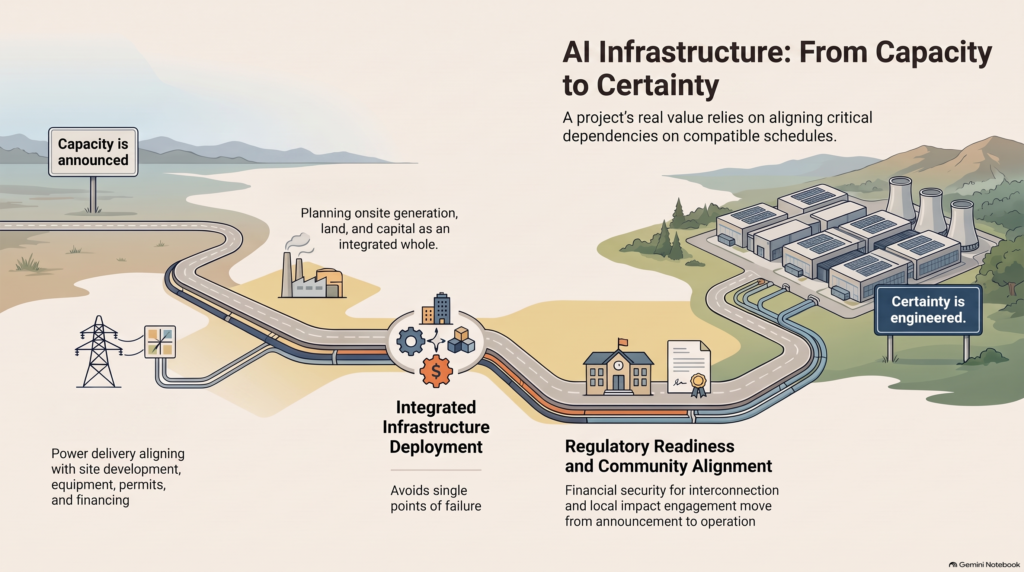
    A project’s real value depends on several linked conditions: a site that can be developed, power that can be delivered, equipment that can be procured, financing that can support the timeline, permits that can be secured, and a community willing to live with the project. If one critical dependency remains uncertain, the announced capacity may be far from usable compute.

    The signals are converging

    Recent developments point toward a more coordinated approach to AI infrastructure.

    In the United States, utility and regulatory processes are placing greater emphasis on whether large-load projects are financially ready and accountable for the infrastructure costs they create. Texas has adopted financial security requirements for large-load interconnection requests, while federal regulators have also focused on cost recovery and protections for existing customers.

    In Japan, a project involving JERA, Dell, and RHAELM brings together power capabilities, a site, data-center development, financing, and AI infrastructure. The project illustrates the appeal of planning these components as an integrated deployment rather than treating them as separate problems to solve one by one.

    Developers are also pursuing onsite generation. Recent reporting describes growing interest in smaller gas turbines and other behind-the-meter options, partly in response to equipment lead times and the challenge of securing grid connections. Onsite power may offer a different schedule path, but it does not erase the trade-offs: fuel supply, permitting, emissions, cost, and the eventual relationship with the grid still matter.

    Community relationships are becoming a more visible part of the infrastructure strategy as well. AWS recently announced a multiyear investment in programs for communities near its U.S. data centers. These commitments do not guarantee public support, but they show that local impact and engagement are now part of the deployment conversation.

    From announced capacity to predictable dependencies

    These examples are different, but they point in the same direction: the challenge is no longer just assembling enough capacity. It is coordinating the conditions that allow capacity to become operational.

    That means executives may need to ask a broader set of questions:

    • Is the power timeline credible, and what assumptions does it depend on?
    • Who pays for the upgrades needed to serve the load?
    • Are land, permits, equipment, and financing progressing on compatible schedules?
    • If grid power is delayed, what alternatives are available—and what new risks do they create?
    • How are local costs, benefits, and concerns being addressed?

    These questions do not replace the traditional focus on capacity. They make the capacity claim more useful by connecting it to execution.

    Certainty as a competitive advantage

    “Certainty” here does not mean that every project outcome is guaranteed. Large infrastructure projects will always involve uncertainty.

    It means that fewer critical dependencies are left unresolved, that assumptions are visible, and that decision-makers have a credible plan for what happens when conditions change.

    As AI infrastructure scales, the strongest projects may not be the ones with the largest headline number. They may be the ones that can show how power, capital, land, equipment, compute, and community considerations fit together—and how the project can move from announcement to operation.

    The optimization target is shifting from “How many gigawatts can we announce?” to “How many dependencies can we make predictable?”

    In AI infrastructure, certainty is becoming part of the product.

  • The New AI Infrastructure Product May Be the Repeatable Campus

    The conversation about AI infrastructure often centers on visible constraints: access to electricity, data center capacity, land, and advanced computing equipment.

    A new partnership in Japan points to a less visible constraint: the complexity of coordinating those pieces into a functioning project.

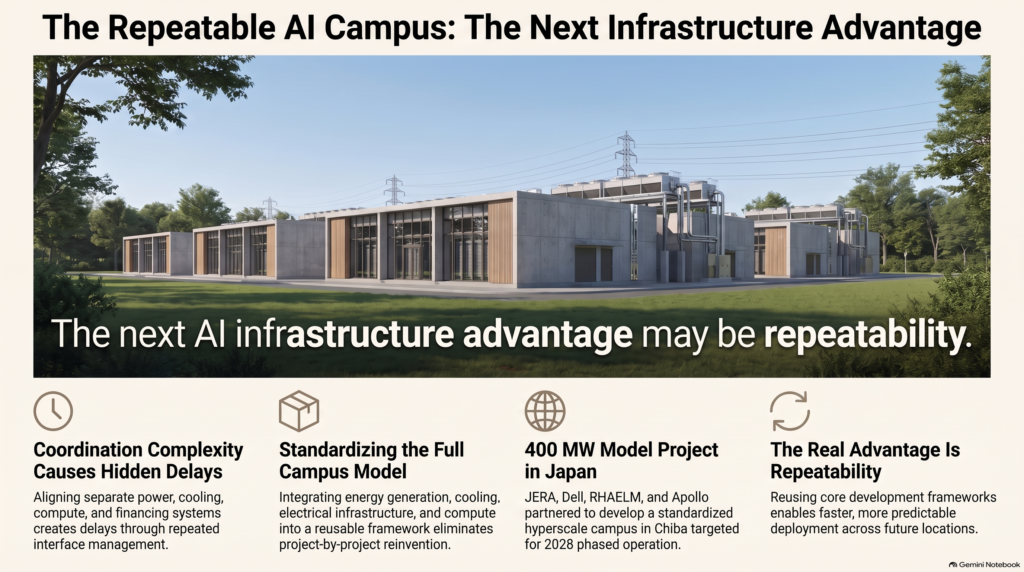
    JERA, Dell Technologies, and RHAELM have signed a memorandum of understanding to develop a standardized model for AI infrastructure in Japan. The model is planned to start with a 400 MW class hyperscale data center project in Chiba. JERA is expected to provide the site and power capacity; RHAELM leads project delivery; and Dell contributes standardized, rack scale AI infrastructure. Apollo is expected to serve as RHAELM’s strategic investment and financing partner. 

    The announcement is notable not simply because of the project’s size. It is also an attempt to treat infrastructure development as a model that could be repeated.

    Project complexity is a constraint of its own

    A large AI campus brings together systems that are often planned and delivered by different organizations. The project has to align its site, energy supply, electrical infrastructure, cooling, computing equipment, financing, construction, and operating model.

    Each interface creates work: decisions to coordinate, dependencies to manage, and potential delays to resolve. If every project requires partners to define those interfaces from the beginning, the development process can remain slow even when the necessary equipment and capital are available.

    Standardization aims to reduce some of that repeated design and coordination work. JERA describes the initiative as a standardized, repeatable model intended to integrate power generation, electrical infrastructure, cooling, and AI computing. Dell’s rack scale infrastructure is meant to standardize the compute layer, while RHAELM leads project delivery. 

    In practical terms, the goal is not necessarily to make every campus identical. It is to identify which components, decisions, and working relationships can be reused—and which must be adapted to local conditions.

    The campus as a coordinated product

    This suggests a broader way to think about AI infrastructure. The product being delivered may not be only a building, a power contract, or a rack of servers. It may be a coordinated campus model that combines those elements in a form that can be developed again.

    That model could have value if it makes future projects easier to scope, finance, engineer, and deliver. Reusing parts of the development approach could reduce the amount of project-by-project reinvention.

    This is an inference about the potential of the model, not a result the announcement has demonstrated. The MoU sets out a plan. The Chiba project will be an early test of whether the approach works in practice.

    Standardization does not erase local constraints

    A repeatable framework cannot make every location interchangeable. Each site still has its own power and grid conditions, permitting requirements, cooling needs, construction environment, financing terms, and operating considerations.

    Standardized compute infrastructure also does not, by itself, guarantee that power will be deliverable when needed or that every other part of the project will arrive on schedule. It can address a portion of the development challenge while leaving other constraints to be solved.

    That is why the most useful question is not whether standardization eliminates complexity. It is whether the partners can reduce enough of the repeated complexity to make later projects faster and more predictable.

    The real test is repeatability

    Reuters reports that the Chiba facility is expected to begin operating in phases in 2028 and reach full capacity in 2029. The companies have also described broader ambitions to develop additional AI data center capacity in Japan. Those are plans and targets; the delivery record is still ahead. 

    The evidence to watch will be concrete: whether the project advances on schedule, whether the partners reuse the model at other sites, and whether later deployments show less development friction.

    AI infrastructure still needs more power, equipment, capital, and sites. But the industry may also need a more repeatable way to combine them.

    The next AI infrastructure advantage may come from turning a complex campus project into a model that can be delivered again.

    Source note: The partnership details above are based on JERA’s October 1 announcement and Reuters’ reporting. The assessment of standardization’s potential benefits is analysis; the proposed model has not yet demonstrated repeat deployments.