The conversation about AI infrastructure often centers on visible constraints: access to electricity, data center capacity, land, and advanced computing equipment.
A new partnership in Japan points to a less visible constraint: the complexity of coordinating those pieces into a functioning project.
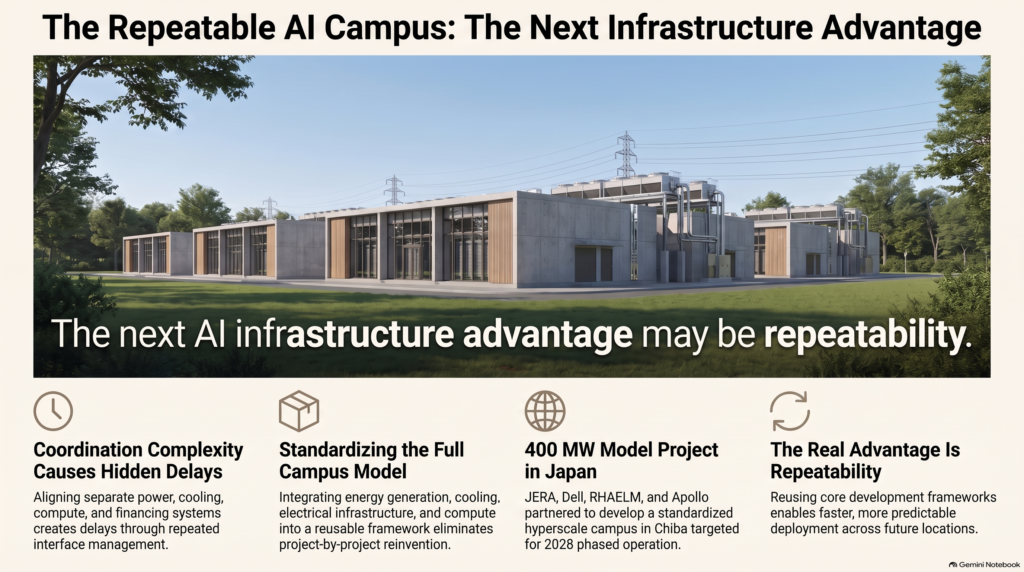
JERA, Dell Technologies, and RHAELM have signed a memorandum of understanding to develop a standardized model for AI infrastructure in Japan. The model is planned to start with a 400 MW class hyperscale data center project in Chiba. JERA is expected to provide the site and power capacity; RHAELM leads project delivery; and Dell contributes standardized, rack scale AI infrastructure. Apollo is expected to serve as RHAELM’s strategic investment and financing partner.
The announcement is notable not simply because of the project’s size. It is also an attempt to treat infrastructure development as a model that could be repeated.
Project complexity is a constraint of its own
A large AI campus brings together systems that are often planned and delivered by different organizations. The project has to align its site, energy supply, electrical infrastructure, cooling, computing equipment, financing, construction, and operating model.
Each interface creates work: decisions to coordinate, dependencies to manage, and potential delays to resolve. If every project requires partners to define those interfaces from the beginning, the development process can remain slow even when the necessary equipment and capital are available.
Standardization aims to reduce some of that repeated design and coordination work. JERA describes the initiative as a standardized, repeatable model intended to integrate power generation, electrical infrastructure, cooling, and AI computing. Dell’s rack scale infrastructure is meant to standardize the compute layer, while RHAELM leads project delivery.
In practical terms, the goal is not necessarily to make every campus identical. It is to identify which components, decisions, and working relationships can be reused—and which must be adapted to local conditions.
The campus as a coordinated product
This suggests a broader way to think about AI infrastructure. The product being delivered may not be only a building, a power contract, or a rack of servers. It may be a coordinated campus model that combines those elements in a form that can be developed again.
That model could have value if it makes future projects easier to scope, finance, engineer, and deliver. Reusing parts of the development approach could reduce the amount of project-by-project reinvention.
This is an inference about the potential of the model, not a result the announcement has demonstrated. The MoU sets out a plan. The Chiba project will be an early test of whether the approach works in practice.
Standardization does not erase local constraints
A repeatable framework cannot make every location interchangeable. Each site still has its own power and grid conditions, permitting requirements, cooling needs, construction environment, financing terms, and operating considerations.
Standardized compute infrastructure also does not, by itself, guarantee that power will be deliverable when needed or that every other part of the project will arrive on schedule. It can address a portion of the development challenge while leaving other constraints to be solved.
That is why the most useful question is not whether standardization eliminates complexity. It is whether the partners can reduce enough of the repeated complexity to make later projects faster and more predictable.
The real test is repeatability
Reuters reports that the Chiba facility is expected to begin operating in phases in 2028 and reach full capacity in 2029. The companies have also described broader ambitions to develop additional AI data center capacity in Japan. Those are plans and targets; the delivery record is still ahead.
The evidence to watch will be concrete: whether the project advances on schedule, whether the partners reuse the model at other sites, and whether later deployments show less development friction.
AI infrastructure still needs more power, equipment, capital, and sites. But the industry may also need a more repeatable way to combine them.
The next AI infrastructure advantage may come from turning a complex campus project into a model that can be delivered again.
Source note: The partnership details above are based on JERA’s October 1 announcement and Reuters’ reporting. The assessment of standardization’s potential benefits is analysis; the proposed model has not yet demonstrated repeat deployments.
Leave a Reply