Category: DataCenters

  • The Grid as the AI Business Model

    The Grid Is Becoming Part of the AI Business Model
    DataCenters, Energy, PowerGrid

    Most conversations about the infrastructure required for artificial intelligence eventually arrive at electricity.

    AI models require compute. Compute requires data centers. Data centers require enormous amounts of power.

    But even that description misses an important layer of the infrastructure stack.

    Generating electricity and delivering electricity are not the same problem.

    As AI infrastructure expands, that distinction could become increasingly important to the economics of the industry.

    The Bottleneck Beneath the Data Center

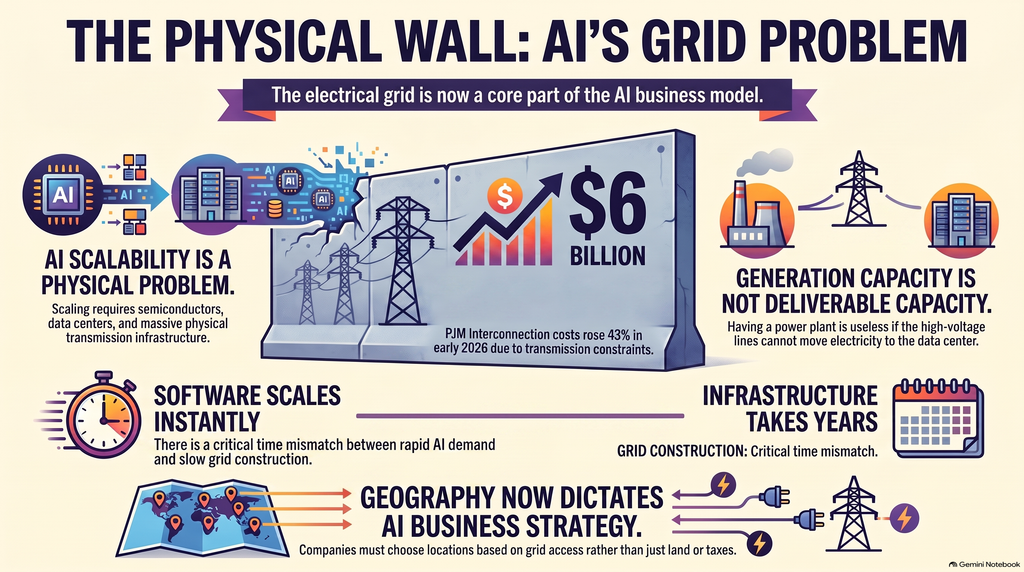
    On August 21, Reuters reported that transmission-congestion costs on PJM Interconnection reached approximately $6 billion during the first half of 2026, an increase of 43%.

    PJM operates the largest U.S. power grid, serving roughly 67 million people across a territory extending from Washington, D.C. to Chicago.

    The problem wasn’t simply whether enough electricity could theoretically be generated.

    High-voltage transmission lines were increasingly becoming constrained.

    That creates an important distinction for anyone thinking about the future of AI infrastructure:

    Generation capacity is not the same thing as deliverable capacity.

    A power plant can generate electricity hundreds of miles away from a data center.

    That electricity still has to move through transmission infrastructure before reaching the location where it will actually be consumed.

    When parts of that network become congested, electricity becomes more difficult — and potentially more expensive — to move across the system.

    The grid therefore starts behaving much like any other constrained network.

    Adding supply at one point does not necessarily eliminate a bottleneck somewhere else.

    AI Is Becoming a Location Problem

    For years, technology companies could think about infrastructure primarily through familiar variables:

    Compute availability.

    Network connectivity.

    Real estate.

    Labor.

    Taxes.

    Capital.

    Electricity increasingly adds another set of questions.

    Where is generation available?

    Where does transmission capacity exist?

    How quickly can new load actually be interconnected?

    What infrastructure upgrades will be required?

    Who pays for those upgrades?

    And how long will they take?

    Those questions can affect where infrastructure gets built and ultimately how much that infrastructure costs to operate.

    That means the geography of AI may increasingly follow the geography of available infrastructure.

    The cheapest land isn’t necessarily the best land.

    The closest generation isn’t necessarily usable generation.

    And announcing a new power plant doesn’t automatically mean the transmission system can deliver that additional electricity to a rapidly growing cluster of data centers.

    Congestion Becomes an Economic Variable

    This is where grid infrastructure begins crossing into business strategy.

    Transmission congestion isn’t merely an engineering problem.

    It can influence wholesale electricity prices, infrastructure investment requirements, project timelines and ultimately the economics of operating large computing facilities.

    That creates another layer of risk for AI expansion.

    Companies can secure chips.

    They can raise capital.

    They can purchase land.

    They can construct data centers.

    But those investments still depend on infrastructure outside the walls of the facility.

    If that infrastructure cannot expand at approximately the same pace as computing demand, the bottleneck simply moves farther down the stack.

    We’ve already watched parts of this progression happen.

    The AI conversation moved from models to chips.

    From chips to data centers.

    From data centers to electricity generation.

    And now electricity demand is forcing greater attention toward transmission and grid capacity.

    Each layer reveals another dependency underneath the previous one.

    The Physical Economy Underneath AI

    AI is often described as a digital technology.

    Economically, however, its expansion is becoming increasingly physical.

    Scaling AI requires semiconductors manufactured in physical facilities, servers installed inside physical buildings, electricity generated by physical assets and transmission infrastructure capable of moving that electricity across geographic regions.

    Then there is land, cooling, water, construction equipment, transformers, substations and capital.

    The software may operate in milliseconds.

    The infrastructure underneath it can take years to build.

    That mismatch matters.

    AI demand can accelerate extremely quickly.

    Transmission infrastructure generally cannot.

    Which means some of the most important constraints on future AI growth may not come from model architecture at all.

    They may come from infrastructure that existed long before generative AI entered the conversation.

    AI Strategy Is Becoming Infrastructure Strategy

    This doesn’t mean technology executives suddenly need to become grid operators.

    It does mean the boundary between technology strategy and infrastructure strategy is becoming harder to maintain.

    When electricity availability affects where computing infrastructure can be built, how quickly it can expand and what it costs to operate, energy infrastructure becomes part of the business calculation.

    The companies building the next generation of AI infrastructure therefore aren’t simply competing for GPUs.

    Increasingly, they are competing for an entire stack of scarce resources:

    Compute.
    Land.
    Power.
    Transmission access.
    Capital.
    Time.

    And perhaps that is the larger lesson.

    We tend to think of technological progress as moving upward into increasingly sophisticated software.

    AI is showing us something different.

    The further we scale the digital layer, the more important the physical layers underneath it become.

    The grid isn’t sitting outside the AI economy anymore.

    It’s becoming part of the AI business model.
  • Beyond The Model: The AI Dependency Stack

    I Started Studying AI and Somehow Ended Up Studying the Power Grid

    I didn’t start studying artificial intelligence because I wanted to understand the electrical grid.

    Yet somehow, that’s where the trail led.

    What began as an effort to better understand AI models gradually expanded into compute infrastructure, data centers, electricity generation, transmission constraints, capital investment and eventually governance.

    Looking back, the progression makes perfect sense.

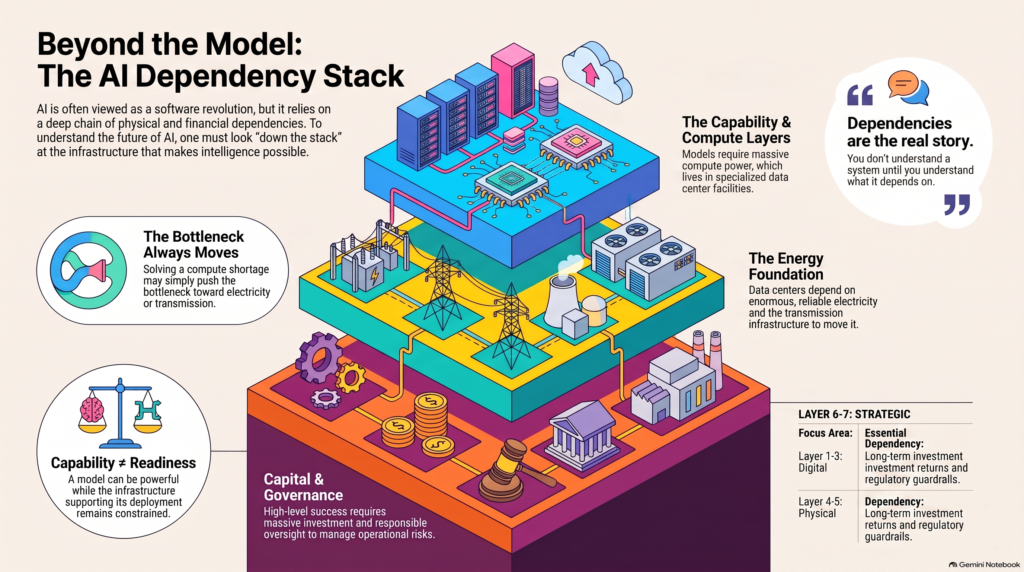
    Models → Compute → Data Centers → Electricity → Transmission → Capital → Governance

    Each subject exposed a dependency underneath the previous one.

    And that has changed the way I think about AI.

    Follow the Dependency

    When most conversations about artificial intelligence begin, they start with the model.

    How capable is it?

    How quickly is performance improving?

    What tasks can it automate?

    What happens when agents become more autonomous?

    Those are important questions. But eventually I started asking another one:

    What does this depend on?

    AI models depend on compute.

    Compute depends on chips, servers, cooling systems and data centers.

    Data centers depend on enormous amounts of reliable electricity.

    Electricity depends on generation capacity and the infrastructure required to move that power where it is needed.

    That means transmission capacity, substations, interconnection queues, permitting and infrastructure investment suddenly become part of the AI conversation.

    Keep following the chain and another layer appears.

    Capital.

    Someone has to finance all of this infrastructure.

    Companies have to decide how much capacity to build, where to build it, what assumptions justify the investment and whether expected AI demand will generate sufficient returns.

    Now the conversation isn’t simply technological.

    It is operational, financial and strategic.

    And eventually it becomes a governance problem.

    Capability Is Only One Layer of the System

    One of the most important lessons I’ve taken from this progression is that technological capability doesn’t guarantee system-level capability.

    A model might become significantly more powerful while the infrastructure supporting its deployment remains constrained.

    More demand for compute can create pressure on data-center capacity.

    Additional data centers increase electricity demand.

    New generation capacity doesn’t necessarily solve the problem if transmission infrastructure cannot deliver that electricity where demand is growing.

    And even if every physical constraint could be removed, organizations still have to determine whether the resulting investments make economic sense and whether the systems being deployed can be governed responsibly.

    This creates an interesting possibility:

    The biggest constraint on the next stage of AI might not always be AI.

    It could appear somewhere else in the dependency chain.

    Systems Don’t Respect Industry Categories

    We tend to organize knowledge into categories.

    Artificial intelligence.

    Energy.

    Finance.

    Infrastructure.

    Risk.

    Governance.

    But real systems don’t care about those categories.

    Their dependencies cross them constantly.

    An AI strategy can become an infrastructure strategy.

    An infrastructure strategy can become an energy strategy.

    An energy constraint can become a capital-allocation problem.

    A capital decision can create new operational risks.

    And those risks eventually require governance.

    What looked like several unrelated subjects was actually one interconnected system viewed from different layers.

    That’s what systems thinking started changing for me.

    Instead of asking only:

    What can this technology do?

    I became increasingly interested in another question:

    What has to remain true for this entire system to work?

    That question exposes a very different landscape.

    The Bottleneck Moves

    Another realization followed.

    Bottlenecks don’t disappear simply because technology improves.

    They move.

    If models become more efficient, another constraint may become more important.

    If compute capacity expands, electricity availability may become the limiting factor.

    If generation expands, transmission may become the constraint.

    If infrastructure expands rapidly, capital discipline or governance may become the limiting factor.

    This means leaders evaluating AI cannot look exclusively at technological capability.

    They also have to understand the dependency chain supporting that capability.

    Otherwise, it becomes easy to mistake progress in one layer for readiness across the entire system.

    The Infrastructure Underneath the Intelligence

    I still study AI.

    But now I find myself paying much more attention to what surrounds it.

    Energy infrastructure.

    Data-center development.

    Transmission.

    Capital allocation.

    Operational risk.

    Governance.

    Not because I abandoned the original subject, but because following it seriously kept expanding the boundaries of the system.

    That’s probably the biggest lesson this journey has taught me:

    You don’t really understand a system until you understand what it depends on.

    AI may appear to be a software revolution when viewed from the surface.

    Follow the dependency chain downward, however, and you eventually reach physical infrastructure, energy, economics and governance.

    And sometimes the most important part of a technology isn’t the technology itself.

    It’s everything that has to work underneath it.