Tag: EnergyInfrastructure

  • The Electrical Bottleneck Inside the AI Data Center

    AI power discussions often begin outside the data center: Can the grid serve the load? Is generation available? How long will interconnection take? Can transmission capacity reach the site?

    Those questions remain central. But they aren’t the only ones.

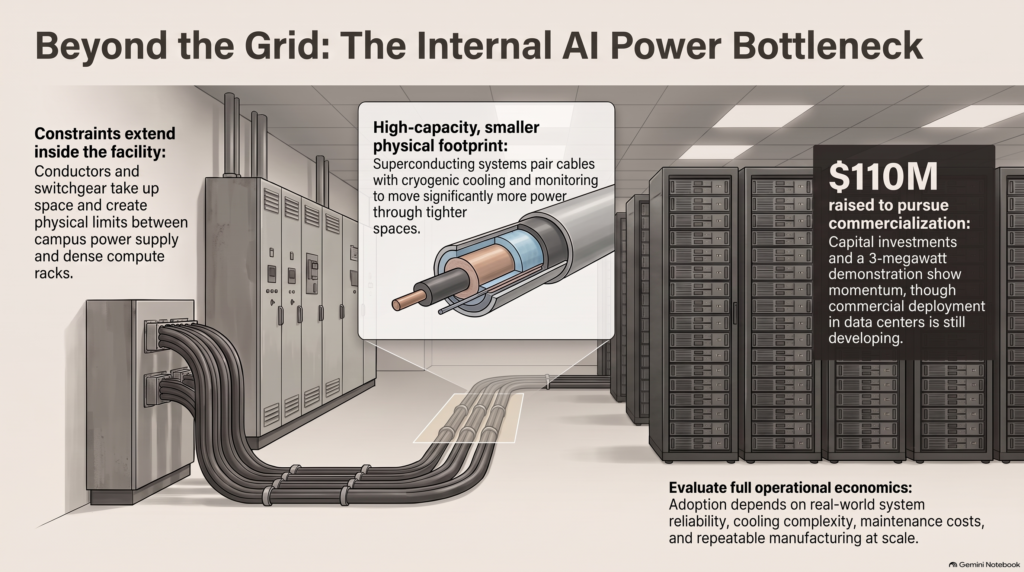
    After electricity reaches a campus, it must still pass through the facility’s electrical infrastructure and arrive at the equipment that performs the computing. That pathway has physical limits. Conductors, switchgear and other equipment take up space, require installation labor and must operate reliably under demanding conditions. As data centers add more power-dense computing, the electrical system inside the facility becomes part of the scaling challenge.

    VEIR’s October 8 financing announcement is a signal that investors see an opportunity in this layer. The company announced a $110 million Series C, bringing its reported total capital raised to $225 million. It says the funding will support manufacturing, product development and preparation for commercial deployments. VEIR also reports a 3-megawatt demonstration and says it is working with customers and industry partners on reference designs for AI facilities. 

    The approach centers on superconducting power-delivery systems. In VEIR’s description, the system includes more than the superconducting cable: it also requires cryogenic cooling, controls, terminations and monitoring. The goal is to move more power through a smaller physical footprint than conventional power-delivery infrastructure. 

    That could matter where space and power density are becoming linked. A smaller footprint could give designers more flexibility inside a facility or campus. But a compact cable alone doesn’t establish an operational advantage. The complete installation has to work as a system, and its economics must account for cooling, controls, installation, maintenance and the consequences of equipment failure.

    The technology also addresses a specific point in the power chain. It may improve how electricity is distributed within a data center. It does not supply the electricity, secure an interconnection or expand the grid. Those are separate constraints, and they remain part of the larger project.

    That distinction is useful because “AI needs more power” can make every proposed solution sound interchangeable. They aren’t. Some investments add generation. Some expand transmission. Others improve the way power is delivered inside a facility. A project may need progress at several of these layers at once.

    The commercial evidence is still developing. VEIR’s reported 3-megawatt demonstration is a technical milestone, while the company’s announcement describes initial commercial deployments as something it is preparing for. Reuters reported earlier this year that superconducting cables were not yet being used in data centers and that cost and manufacturing constraints had limited adoption. 

    For operators and infrastructure investors, the next questions are practical:

    • How reliably does the full system operate under real data-center loads?
    • What does it cost to install and maintain compared with conventional alternatives?
    • How does the cooling and control equipment affect operating complexity?
    • Can the system be manufactured, installed and serviced repeatedly at commercial scale?

    The $110 million round indicates investor confidence in the opportunity and provides capital to pursue commercialization. The test of the thesis will be what commercial deployments show about reliability, economics and repeatability.

    AI infrastructure can be constrained at more than one point between the grid and the server. Power availability gets attention because it is visible and difficult to solve. Power delivery inside the facility may be less visible, but it can also shape how densely and efficiently a campus grows.

    The useful question is not just how much electricity a data center can secure. It is how dependably and economically that electricity can be delivered to the compute.

    Source note: VEIR’s financing and technical milestones are company-reported; treat commercial performance claims as unproven until supported by operating data.
  • The New AI Infrastructure Product May Be the Repeatable Campus

    The conversation about AI infrastructure often centers on visible constraints: access to electricity, data center capacity, land, and advanced computing equipment.

    A new partnership in Japan points to a less visible constraint: the complexity of coordinating those pieces into a functioning project.

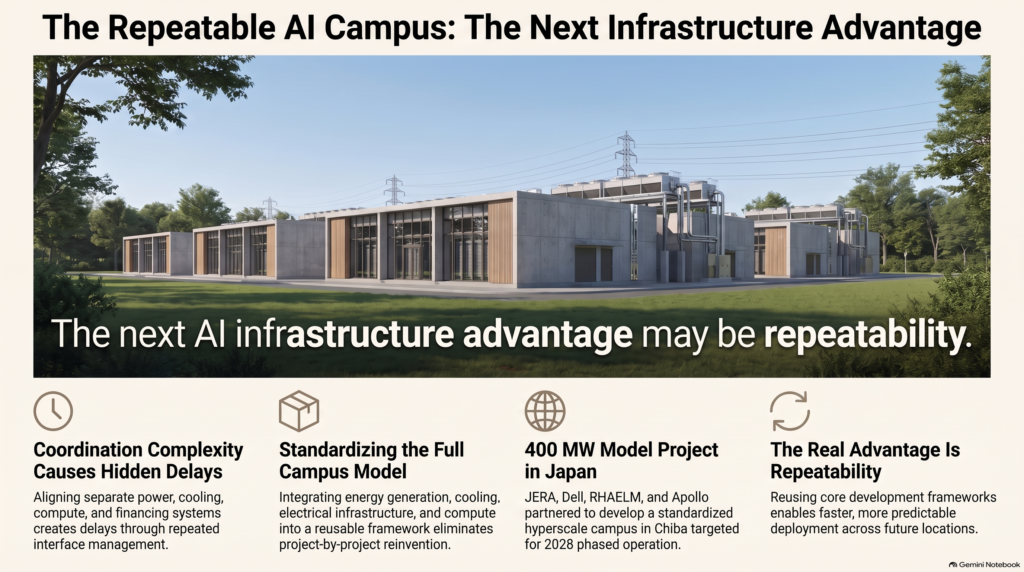
    JERA, Dell Technologies, and RHAELM have signed a memorandum of understanding to develop a standardized model for AI infrastructure in Japan. The model is planned to start with a 400 MW class hyperscale data center project in Chiba. JERA is expected to provide the site and power capacity; RHAELM leads project delivery; and Dell contributes standardized, rack scale AI infrastructure. Apollo is expected to serve as RHAELM’s strategic investment and financing partner. 

    The announcement is notable not simply because of the project’s size. It is also an attempt to treat infrastructure development as a model that could be repeated.

    Project complexity is a constraint of its own

    A large AI campus brings together systems that are often planned and delivered by different organizations. The project has to align its site, energy supply, electrical infrastructure, cooling, computing equipment, financing, construction, and operating model.

    Each interface creates work: decisions to coordinate, dependencies to manage, and potential delays to resolve. If every project requires partners to define those interfaces from the beginning, the development process can remain slow even when the necessary equipment and capital are available.

    Standardization aims to reduce some of that repeated design and coordination work. JERA describes the initiative as a standardized, repeatable model intended to integrate power generation, electrical infrastructure, cooling, and AI computing. Dell’s rack scale infrastructure is meant to standardize the compute layer, while RHAELM leads project delivery. 

    In practical terms, the goal is not necessarily to make every campus identical. It is to identify which components, decisions, and working relationships can be reused—and which must be adapted to local conditions.

    The campus as a coordinated product

    This suggests a broader way to think about AI infrastructure. The product being delivered may not be only a building, a power contract, or a rack of servers. It may be a coordinated campus model that combines those elements in a form that can be developed again.

    That model could have value if it makes future projects easier to scope, finance, engineer, and deliver. Reusing parts of the development approach could reduce the amount of project-by-project reinvention.

    This is an inference about the potential of the model, not a result the announcement has demonstrated. The MoU sets out a plan. The Chiba project will be an early test of whether the approach works in practice.

    Standardization does not erase local constraints

    A repeatable framework cannot make every location interchangeable. Each site still has its own power and grid conditions, permitting requirements, cooling needs, construction environment, financing terms, and operating considerations.

    Standardized compute infrastructure also does not, by itself, guarantee that power will be deliverable when needed or that every other part of the project will arrive on schedule. It can address a portion of the development challenge while leaving other constraints to be solved.

    That is why the most useful question is not whether standardization eliminates complexity. It is whether the partners can reduce enough of the repeated complexity to make later projects faster and more predictable.

    The real test is repeatability

    Reuters reports that the Chiba facility is expected to begin operating in phases in 2028 and reach full capacity in 2029. The companies have also described broader ambitions to develop additional AI data center capacity in Japan. Those are plans and targets; the delivery record is still ahead. 

    The evidence to watch will be concrete: whether the project advances on schedule, whether the partners reuse the model at other sites, and whether later deployments show less development friction.

    AI infrastructure still needs more power, equipment, capital, and sites. But the industry may also need a more repeatable way to combine them.

    The next AI infrastructure advantage may come from turning a complex campus project into a model that can be delivered again.

    Source note: The partnership details above are based on JERA’s October 1 announcement and Reuters’ reporting. The assessment of standardization’s potential benefits is analysis; the proposed model has not yet demonstrated repeat deployments.

  • Declared Flexibility vs. Observed Flexibility: The Next Credibility Test for AI Infrastructure

    The AI infrastructure conversation is beginning to mature.

    For much of the current buildout, attention has centered on announced investments, proposed data-center capacity, land acquisitions, power agreements, and projected electricity demand. But as projects move closer to construction and operation, the market is learning to distinguish what has been declared from what is actually available.

    Announced capacity is not the same as energized capacity.

    A similar distinction is now emerging around power flexibility.

    Data-center developers increasingly describe their facilities as flexible loads capable of shifting computing workloads, discharging batteries, using on-site generation, or reducing electricity consumption when the grid becomes constrained.

    Those capabilities could create significant value. They may allow utilities to connect large facilities faster, use existing grid infrastructure more efficiently, protect reliability during periods of stress, and defer some expensive system upgrades.

    But a stated ability to curtail power is still only a claim.

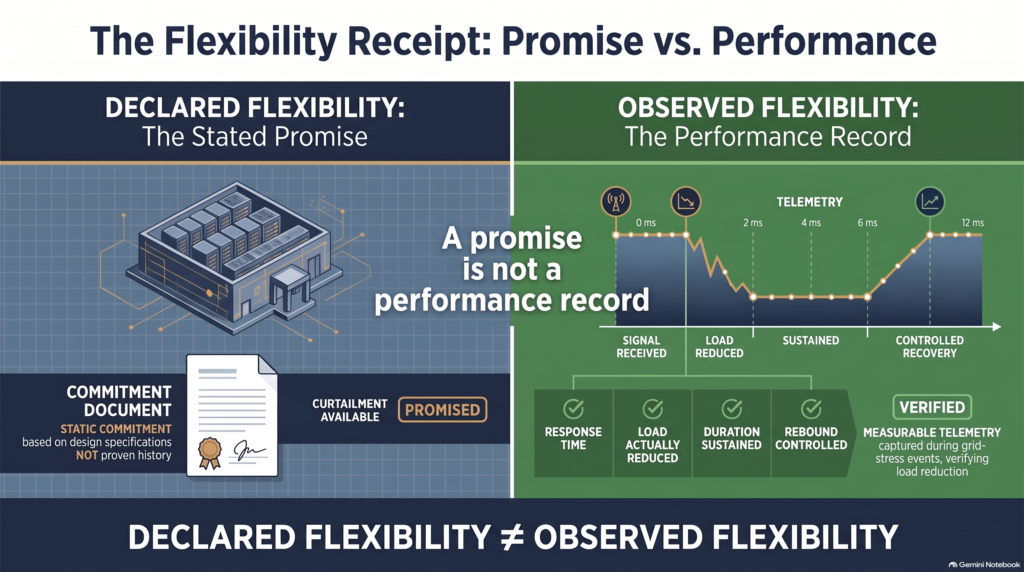
    The more important question is whether that flexibility can be observed, measured, and repeated during actual grid events.

    From Flexible Design to Verified Performance

    The AI Energy Management Alliance, launched by Emerald AI, Google, and NVIDIA, is advancing data centers that can dynamically manage their electricity use in response to grid conditions.

    Its approach is notable because it is described as technology-neutral and performance-based. The focus is not limited to which batteries, generators, workload-management platforms, or cooling systems a facility installs. The focus is on the measurable service the facility can deliver.

    That includes response speed, duration, predictability, and behavior during emergencies.

    This is an important shift.

    A data center may be technically capable of reducing its electricity demand under controlled conditions. That does not automatically prove it will deliver the promised reduction when the regional grid is under stress, temperatures are extreme, equipment availability has changed, and computing demand is high.

    Technical capability must eventually become operational evidence.

    What Observed Flexibility Should Show

    If a facility commits to curtailing 100 megawatts during a grid emergency, verification should extend beyond confirming that a control system received the request.

    Operators and regulators may need evidence showing:

    • The facility’s electricity demand before the event
    • The amount of load actually reduced
    • The time between the grid signal and the response
    • How long the reduction was maintained
    • Which energy resources or workloads produced the reduction
    • Whether essential computing services remained within agreed performance limits
    • Whether electricity demand rebounded sharply after the event
    • Whether the facility can reproduce the result across multiple events
    • Which exceptions, failures, or overrides occurred
    • Whether the supporting telemetry and records are complete and auditable

    The baseline also matters.

    A facility should not receive full credit for a reduction that would have occurred anyway because workloads had already declined. Without a credible baseline, flexibility measurements could become another version of inflated announced capacity: technically documented but operationally misleading.

    Benefits Should Follow Evidence

    The alliance argues that credible and verifiable flexibility commitments could support faster, risk-adjusted interconnection pathways.

    That proposition makes sense. A data center that can reliably reduce its load during a limited number of critical hours may impose a different risk on the power system than a facility requiring maximum electricity delivery around the clock.

    However, any preferential treatment should be connected to continuing performance.

    Faster interconnection should not be granted solely because a developer includes flexible-load language in an application. The commitment should be defined before connection, monitored during operation, and reassessed as equipment, workloads, software, ownership, and grid conditions change.

    Otherwise, flexibility becomes a one-time qualification rather than an ongoing operating obligation.

    A defensible model would connect the lifecycle:

    Declared capability → tested capability → observed grid-event performance → verified record → continued authorization

    If performance falls outside the agreed limits, the system should identify the variance and determine whether operating conditions, interconnection terms, or incentives need to change.

    Flexibility Is Becoming a Governance Question

    This issue extends beyond electrical engineering.

    Once data-center flexibility influences interconnection priority, infrastructure spending, electricity rates, or reliability planning, the underlying evidence becomes a governance concern.

    Someone must establish:

    • What was promised
    • How performance is measured
    • Who can verify the result
    • What exceptions are permitted
    • How failures are recorded
    • When a commitment must be retested
    • What happens when observed performance no longer matches the declaration

    That is the same pattern appearing across AI governance more broadly.

    A policy is not proof of enforcement.

    A control is not proof of execution.

    A resolved incident is not proof of correction.

    And a declared flexible load is not proof of grid-responsive performance.

    The Next Infrastructure Advantage

    Flexible AI data centers could become valuable grid participants rather than passive sources of rapidly growing demand. The technical potential is increasingly credible: research and demonstrations have shown that AI workloads can be shifted or curtailed while protecting priority services. (arxiv.org)

    But the long-term value will depend on whether flexibility survives contact with real operating conditions.

    The data centers that gain an advantage may not be those making the largest flexibility promises. They may be those capable of producing a consistent, independently reviewable record showing what happened when the grid actually needed them.

    The market is moving from declarations toward evidence.

    Announced capacity must become energized capacity.

    Flexible design must become verified response.

    And declared flexibility must become observed flexibility.