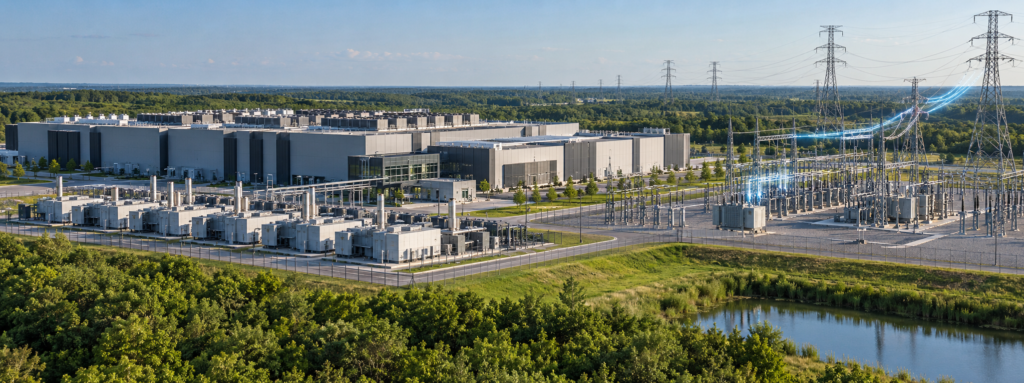
A facility’s protection systems are designed to respond when power conditions move outside safe limits. But when a very large load disconnects or transfers to backup power at once, that protective response can become a grid-level event.
That is the issue behind PJM’s proposed ride-through requirements for large computational loads, including data centers and cryptocurrency-mining facilities.
In July 2026, about 3,800 MW of data-center load in northern Virginia transferred from the PJM grid to on-site backup generation after a transmission fault. PJM and Dominion reported voltage and frequency spikes. Operators took action to restore the balance between generation and demand, and PJM reported no significant reliability impacts from the event.
The mechanism is straightforward. If a large amount of demand suddenly leaves the grid while generation remains online, generation temporarily exceeds load. That imbalance can push frequency upward. Voltage can also rise, with the system response depending on the location, size, and timing of the load change.
This does not mean every sudden load transfer will destabilize the grid or cause an outage. The July event was managed. The concern is that repeated or larger events can create operational challenges, especially when the grid has little time to adjust.
PJM presented a proposal, not a final rule, on September 8. It would set performance expectations for how large computational loads respond within defined voltage and frequency disturbance ranges. It also addresses recovery: after voltage returns to an acceptable range, the proposal calls for load consumption to recover to more than 90% of its pre-disturbance level within two seconds, subject to the proposed conditions.
The regulatory status matters. FERC’s June 18 show-cause order asked PJM to address questions about its large-load processes, including whether tariff requirements are needed for ride-through, ramp rates, and load restoration. PJM says it plans to file proposed solutions with FERC in November. The specific ride-through requirements remain under review.
For facility owners and engineers, this shifts the design conversation. The question is not only whether the facility can ride through a disturbance internally. It is whether the combined facility response—its protection settings, power systems, backup transfer, and recovery behavior—will be predictable and compatible with grid needs.
The distinction is important: a protective action can make sense for a single facility and still create a larger system challenge when many facilities react together. As large loads become a bigger part of grid planning, their disturbance response is becoming part of the infrastructure performance discussion.
Source note: PJM proposal and FERC filing timeline; PJM’s account of the July 22 event. Citations above.
Leave a Reply