Grid flexibility can shift the emissions question
As electricity demand grows, grid operators are looking for ways to manage periods when supply is tight. Data centers may be asked to reduce demand, and some emergency reliability measures can direct large customers to use onsite backup generation as a last resort.
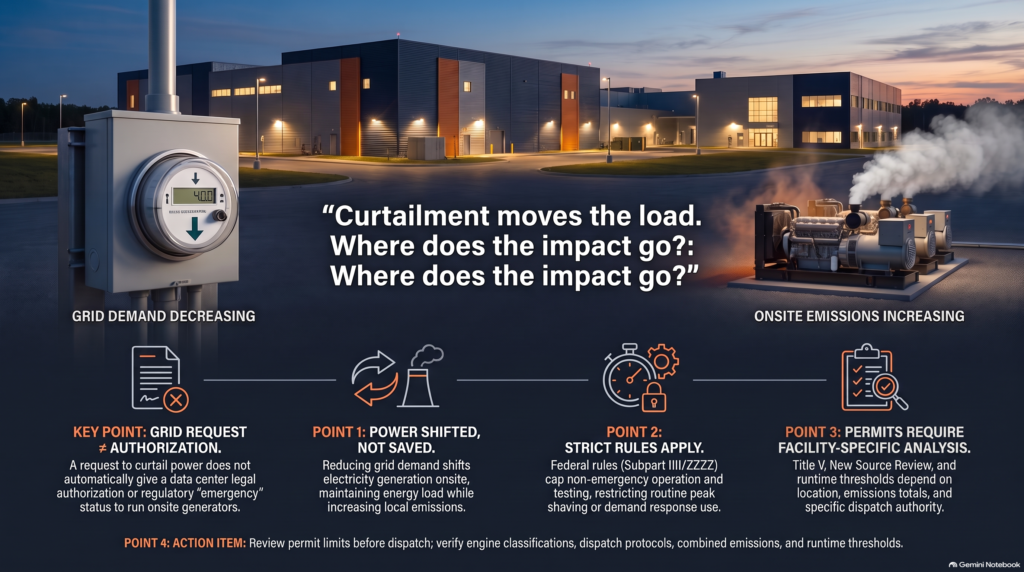
That creates an important distinction. A facility can reduce the electricity it draws from the grid without reducing its total energy use. If onsite engines take over some or all of the load, the grid sees a reduction in demand—but the facility has shifted where its electricity is produced.
That shift raises an air-permitting question alongside the electrical one: What operating rules and permit conditions apply to the generators during the event?
“Emergency generator” is a regulatory status with conditions
Stationary engines are subject to federal requirements that can include the New Source Performance Standards for compression-ignition engines under 40 CFR Part 60, Subpart IIII, and the RICE NESHAP under 40 CFR Part 63, Subpart ZZZZ.
For engines regulated under Subpart IIII, the rules distinguish emergency operation from other use. They generally allow up to 100 hours per calendar year for maintenance and testing, with certain non-emergency use limited to as much as 50 hours within that total. The rules restrict using that allowance for ordinary peak shaving or non-emergency demand response, while providing a narrow exception for specified local reliability dispatches.
The details of a particular grid event matter. EPA has also stated that operation under certain 2026 Department of Energy emergency orders is considered emergency operation for covered stationary engines. Those orders apply in defined circumstances; they do not establish that every curtailment request qualifies as an emergency.
So “the grid asked us to curtail” is not, by itself, a complete answer. The operator needs to know who issued the dispatch, under what authority or protocol, and how the facility’s permit addresses the proposed operation.
Permitting consequences require a facility-specific analysis
A generator’s operating classification is only one part of the permitting picture. Title V and New Source Review requirements depend on factors such as the facility’s potential to emit, pollutant totals, source aggregation, location, and applicable state rules.
A major-source determination does not automatically mean that every facility will need the same controls. PSD applicability and its requirements—including any BACT determination—depend on the source and the proposed construction or modification. SCR, diesel particulate filters, continuous emissions monitoring, or dispersion modeling may be relevant in particular cases, but they are not universal consequences of a generator being used during a grid event.
The same care applies to temporary generation. A portable engine used or intended to remain at one location for 12 months or longer can cease to qualify as a nonroad engine under federal rules. That fact alone does not answer every permitting question: source status, emissions aggregation, permit obligations, and enforcement depend on the circumstances and applicable requirements.
Treat the dispatch plan as an air-permitting input
Before relying on onsite generation as part of a demand-response or emergency plan, engineering and environmental teams should review:
- The facility’s permit conditions and engine classifications.
- The dispatch authority, purpose, and applicable reliability protocol.
- Runtime limits and how testing or other operation counts toward them.
- Potential emissions from the engines operating together.
- Whether planned changes require agency review or a permit revision.
There may be other ways to manage a grid event, including reducing flexible workloads, shifting computing tasks, using stored energy, or combining approaches. The right mix depends on the facility’s design, reliability obligations, grid program, and permits.
Curtailment can help manage grid reliability. But the effect depends on what the site actually does. If the response transfers load from the grid to onsite combustion, the plan should account for the emissions and permit implications as carefully as it accounts for electrical continuity.
The practical question is not only whether the data center can stay online. It is what powers it during the event—and whether that operating plan fits the facility’s air permit.
Regulatory references
Leave a Reply