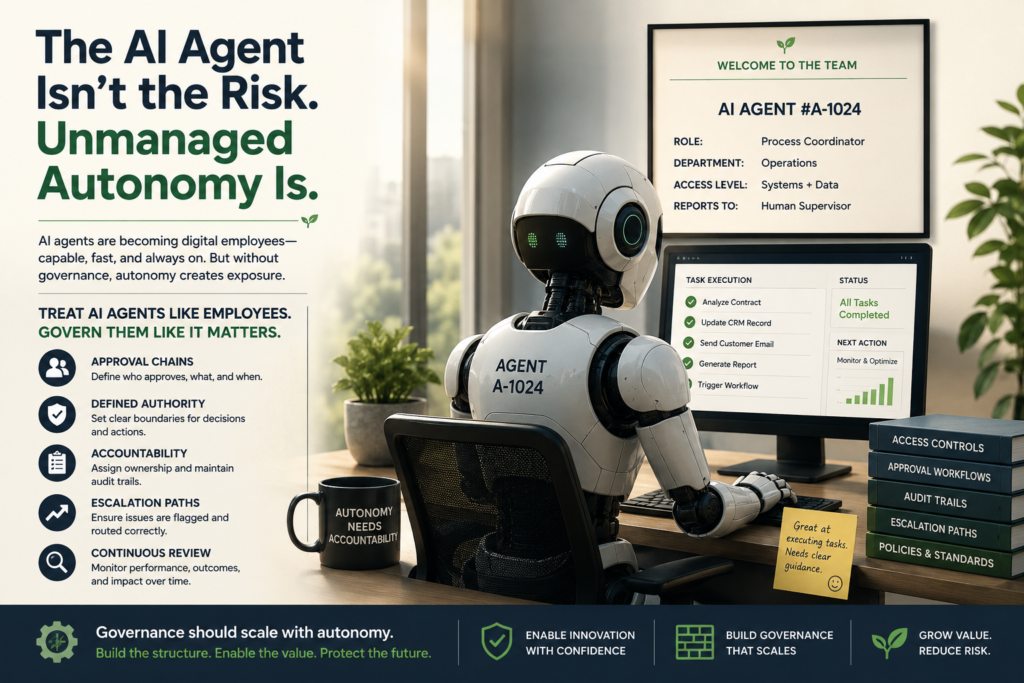
A Shift Most Organizations Haven’t Fully Recognized
For the past two years, artificial intelligence has largely been associated with chat interfaces. Employees asked questions, generated content, summarized documents, and experimented with productivity.
That phase is ending.
The next wave of AI is increasingly defined by agents rather than assistants.
Unlike traditional chatbots, AI agents perform tasks. They don’t simply recommend actions—they increasingly execute them.
This represents a meaningful shift in enterprise risk.
From Information to Action
A chatbot produces information.
An AI agent may:
- Send customer emails
- Update CRM records
- Analyze financial reports
- Trigger automated workflows
- Coordinate across multiple applications
- Make recommendations that are immediately acted upon
The transition from generating information to executing business processes fundamentally changes the governance requirements.
Execution introduces accountability.
The HR Analogy
Imagine hiring a new employee.
Before their first day, HR and management establish:
- Job responsibilities
- Access permissions
- Reporting structure
- Performance expectations
- Approval authority
- Escalation procedures
- Documentation requirements
These controls exist because organizations recognize that autonomy requires oversight.
Ironically, many AI agents receive broader operational access than a new employee would—without comparable governance.
Governance Must Scale With Autonomy
As organizations deploy more capable AI agents, governance maturity must evolve alongside them.
Key questions include:
Who approves the agent?
Who authorized deployment?
Who owns ongoing oversight?
What decisions can it make independently?
Every autonomous action should have clearly defined boundaries.
Not every task deserves full automation.
What systems can it access?
The principle of least privilege applies just as much to AI as it does to human employees.
Who reviews its work?
Human oversight remains critical for high-impact decisions.
The objective is not removing humans.
The objective is placing humans at the correct control points.
How are mistakes investigated?
Without logging, documentation, and audit trails, organizations cannot determine:
- What occurred
- Why it occurred
- Whether it has happened before
- How to prevent recurrence
AI Governance Is Becoming Operational Governance
The discussion around AI often focuses on models, algorithms, and technical performance.
Those remain important.
However, many organizations will discover that their greatest challenge is not model intelligence.
It is operational accountability.
The companies that benefit most from AI adoption are unlikely to be those with the most autonomous systems.
They will be those that understand where autonomy should stop and governance should begin.
Final Thought
Every technological leap eventually forces organizations to revisit familiar management principles.
AI agents are no exception.
The question isn’t whether AI can perform work.
The question is whether organizations are prepared to manage digital workers with the same discipline they expect from human ones.
Because as AI gains autonomy, governance can no longer remain optional.
Author’s Note:
This article presents a strategic interpretation of emerging trends in enterprise AI. While individual organizations will vary, the observations reflect broader shifts in compute demand, infrastructure investment, energy planning, and AI governance that are increasingly influencing enterprise adoption.