Tag: GridReliability

  • AI Data Centers Are Becoming Large Enough to Require New Reliability Rules

    The growth of large computational loads is changing the operating relationship between data centers and the electric grid. NERC’s new standards point toward a more formal governance model—one that connects facility operations, engineering, and executive oversight to bulk-power-system reliability.

    A data center can be highly resilient inside its fence and still create risks at the grid interface.

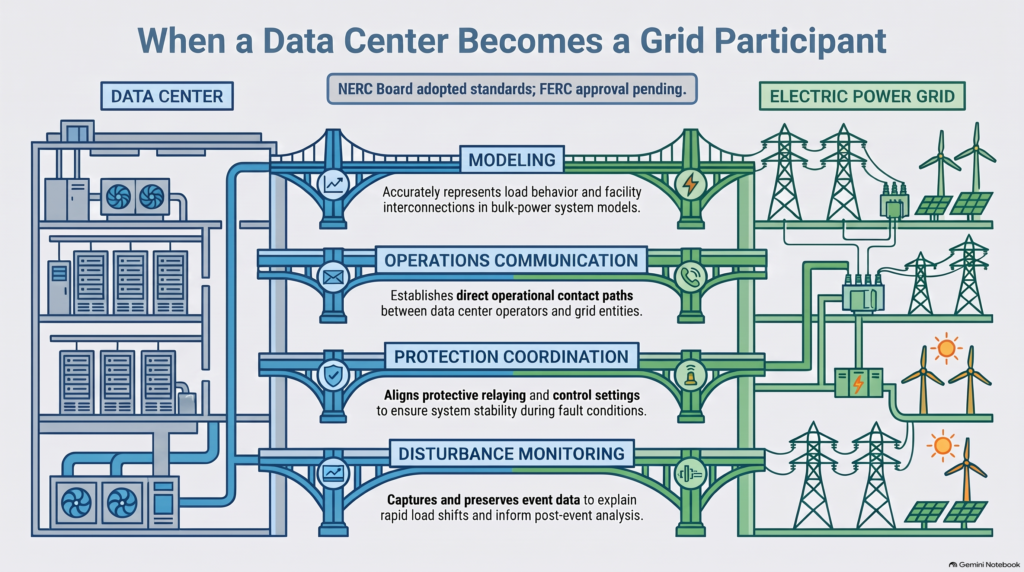
    That distinction matters as AI facilities, data centers, and other computational loads grow in scale and connect to the bulk power system. Their electrical demand can change quickly, and their response during a disturbance can affect more than the facility itself. Grid operators need timely information about the load, credible models of its behavior, and clear communication with the people who operate it.

    NERC’s proposed computational-load reliability standards are an effort to establish that foundation.

    From stakeholder ballot to regulatory review

    On October 15, NERC announced that the standards and their implementation plans had passed their final stakeholder ballot. On October 26, NERC’s Board of Trustees adopted the standards. NERC has said it will submit them to the Federal Energy Regulatory Commission for approval in the United States. Until FERC approves them and the applicable implementation period arrives, they are not enforceable U.S. reliability standards. (nerc.com, nerc.com)

    The proposed registry criteria would apply to Computational Load Owners and Computational Load Operators at sites with total connected load of at least 50 MW, supplied through electrical equipment connected at 100 kV or higher. This is a proposed registration threshold—not a claim that every data center or large electricity customer is covered. The related registry criteria also have a separate approval path. (publicpower.org, nerc.com)

    What the standards address

    NERC’s first phase centers on basic capabilities needed to integrate large computational loads reliably. The proposed standards address how loads are interconnected and represented in system models; how facility operators communicate with relevant grid entities; and how protection coordination and disturbance monitoring support reliable operation. The project materials identify three foundational standards—CLO-001-1, CLO-002-1, and CLO-003-1—alongside related revisions to interconnection requirements and studies. (nerc.com)

    These requirements matter because grid reliability depends on a shared operational picture. If the load changes unexpectedly, operators need to understand what happened, how the facility responded, and whether similar behavior could recur. Reliable models, clear communications, coordinated protection, and usable disturbance records help make that possible.

    The governance question for executives

    The standards create a practical governance challenge: responsibility may be split among the entity that owns the site, the entity that operates it, the data-center tenant, the utility, and other grid participants. NERC’s registry revisions establish distinct Computational Load Owner and Computational Load Operator roles, underscoring the need to identify who is accountable for each operational duty. The proposed registry criteria remain subject to FERC approval. (nerc.com)

    Executives should begin with a clear map of ownership and accountability:

    • Assign a responsible executive. Give one leader authority to coordinate energy, engineering, operations, compliance, and external grid relationships.
    • Clarify owner and operator responsibilities. Document who maintains models and protection settings, who communicates with grid entities, who responds to disturbances, and who preserves records.
    • Assess operational readiness. Review procedures, contact paths, escalation authority, and after-hours coverage. A contact list that works only during business hours is not an operating plan.
    • Review data and model quality. Confirm that technical information shared with grid operators reflects current facility design and actual operating behavior.
    • Connect contracts to operating reality. Agreements with tenants, operators, utilities, and service providers should support timely information sharing and coordinated action.
    • Prepare evidence of control. Keep records that show how the facility manages communications, models, protection coordination, and disturbance response.

    This work is useful before a rule becomes enforceable. The goal is not to guess at final compliance obligations; it is to identify gaps early enough to resolve unclear responsibilities, missing data, and fragile operating procedures.

    A first phase, not the finish line

    NERC describes the adopted standards as the first phase of its broader large-load action plan. Additional standards work is underway around computational-load performance, planning and reliability studies, event reporting, and model quality. (nerc.com)

    That points to a wider shift in how data-center readiness will be judged. Power availability, backup generation, and facility uptime remain essential. But large computational facilities also need to show that their grid-facing behavior is understood, communicated, and governed.

    For boards and executive teams, the strategic question is straightforward: Can the organization explain who is responsible for the facility’s effects on the grid, how those responsibilities are carried out, and what evidence shows the controls work?

    As computational loads grow, reliability will depend on that answer being clear before the next disturbance—not reconstructed afterward.

  • The Next AI Power Plant May Not Look Like a Traditional Power Plant

    AI infrastructure is changing the conversation about electricity supply. Data centers need large, dependable amounts of power, while new generation and transmission can take years to plan and build. As a result, utilities and technology companies are considering a wider set of generation options.

    American Electric Power’s planned fuel-cell project near Cheyenne, Wyoming, is one example. Announced on October 14, the project is expected to provide 702 megawatts of generation for Google under a 20-year power purchase agreement. AEP estimates the investment at approximately $4 billion. Construction is planned to start in 2026, with the facility expected to be fully operational by the end of 2028. The project company, Cheyenne Fuel Cell LLC, is approximately 92% owned and controlled by AEP, with the remaining ownership held by funds advised by Basalt Infrastructure Partners. 

    Why fuel cells enter the AI power conversation

    Fuel cells generate electricity through an electrochemical process. Unlike a combustion-based generator, they do not burn fuel to produce electricity. Bloom Energy’s solid oxide systems can operate on natural gas, biogas, or hydrogen. This gives developers several possible fuel pathways, though the project’s actual fuel choice and supply arrangements matter to its cost and emissions. 

    The technology can therefore broaden the generation toolkit. A large customer may be able to contract for a dedicated source of on-demand electricity without relying solely on new conventional generation or waiting for grid upgrades to serve every increment of demand. That does not mean fuel cells replace the grid. It means they may become one part of a portfolio that includes grid supply, renewables, storage, conventional generation, and other emerging technologies.

    The scale of this project is also significant. At 702 MW, it is not a small backup installation. It is a large generation development with a substantial capital commitment and a long-term customer relationship. The structure links an energy supplier, a technology provider, an infrastructure investor, and a major electricity customer.

    The contract creates visibility, not certainty

    A 20-year power purchase agreement provides a long-term commercial framework. It signals that Google expects a sustained electricity need in the Cheyenne area and that AEP sees an opportunity to invest in dedicated generation for a large customer. Reuters also reported that Google has a separate arrangement with Black Hills Corp. for generation supporting its proposed data center in the area. 

    However, a long-term agreement does not by itself establish the final price of electricity, the project’s full risk allocation, or its performance over time. The economics will depend on details such as fuel procurement, financing, maintenance, operating costs, construction execution, and the terms that govern availability and performance. Those details are not all provided in the public announcement.

    Emissions claims need to be measured in operation

    AEP says the technology generates electricity without combustion of natural gas and that the project includes plans to integrate carbon-capture technology, with the goal of delivering near-zero-emissions power. Those statements describe the project’s design intent. They are not a published, measured operating emissions result. 

    Fuel-cell generation should not be described as inherently zero-carbon. Bloom notes that systems running on natural gas produce carbon emissions, while fuel choice affects the emissions outcome. The project’s eventual impact will depend on what fuel it uses, how that fuel is sourced, and whether carbon capture is installed and performs as expected. 

    For executives and policymakers, the useful questions are concrete:

    • What fuel will the facility use, and how secure is the supply?
    • What will the delivered power cost over the contract term?
    • What availability and reliability levels are guaranteed?
    • What emissions will be measured at the facility, including any upstream fuel impacts?
    • What carbon-capture system is planned, and how will its performance be verified?
    • What happens if construction, fuel delivery, or equipment performance falls behind plan?

    The broader signal: diversify generation, then verify performance

    The AEP–Google project illustrates a broader shift. AI-related electricity demand is encouraging new commercial arrangements and more varied generation technologies. The potential value of fuel cells is not that they solve every power constraint. It is that they add another possible source of dependable generation that can be evaluated alongside other options.

    The decision standard should remain consistent across technologies: compare delivered cost, dependable output, fuel risk, construction schedule, emissions, and operational performance. A promising configuration becomes useful infrastructure only when it can demonstrate those outcomes.

    The power plant of the AI era may look different from the traditional model. Its business case still has to pass familiar tests.

    How much dependable power will it deliver, at what cost, with what fuel and emissions profile—and can the project prove those results over time?

  • The Next AI Megawatt May Come From a Power Plant We Already Built

    As demand for electricity grows, the conversation often turns to new generation: new plants, new transmission, and new infrastructure. Those investments matter. But a recent Google–Constellation agreement points to another part of the supply equation: increasing output from assets that are already operating.

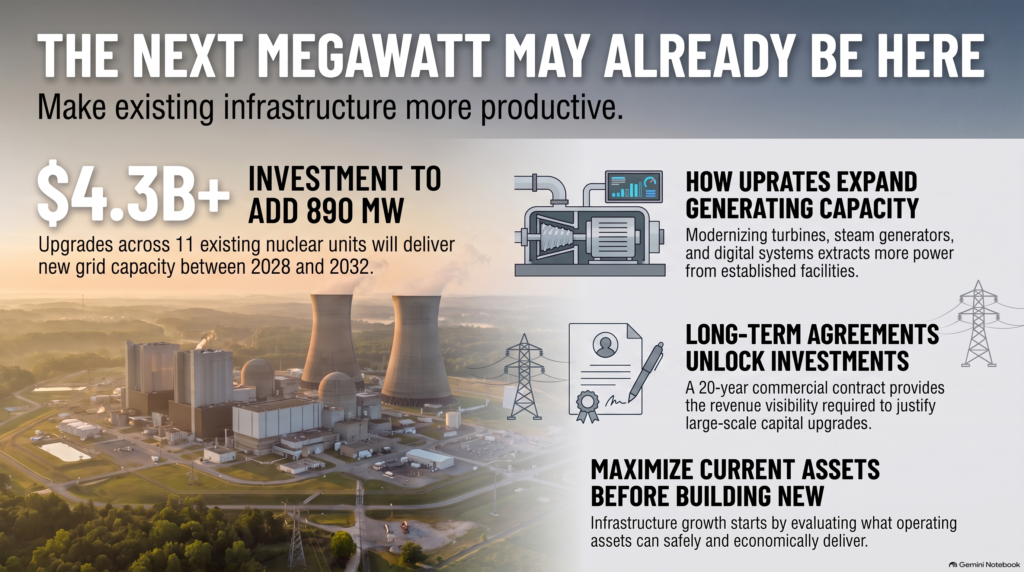
    Announced October 6, the companies’ 20-year power purchase agreement supports upgrades at 11 existing Constellation nuclear units across six sites in Illinois, Pennsylvania, and New Jersey. The upgrades are expected to add 890 megawatts of nuclear capacity to the PJM grid. Constellation says it plans to invest more than $4.3 billion in the work. The first uprate is expected in 2028, with the full 890 MW planned by the end of 2032. 

    This is not a new nuclear plant coming online today. It is a long-term investment plan to increase output from existing reactors.

    What an uprate changes

    A nuclear uprate increases a plant’s generating capacity by upgrading equipment and systems. The companies cite work involving turbines, steam generators, and digital control systems. The goal is to produce more electricity from an existing facility while maintaining the requirements that govern its safe and reliable operation. 

    That distinction matters. An operating plant already has a site, grid connections, and much of the supporting infrastructure. Upgrading it may offer a different development path from building a new facility. But it still requires substantial capital, specialized engineering, regulatory work, construction planning, and time.

    Why the commercial structure matters

    The 20-year agreement provides a long-term customer commitment associated with the planned upgrades. That kind of revenue visibility can help a generator justify capital investment in equipment and capacity improvements.

    The agreement also sits within a larger power arrangement. Google and Constellation signed a separate 15-year supply contract for another 2,700 MW from Constellation’s PJM generation fleet. That supply is not linked to a specific generating source, so it should not be counted as part of the 890 MW of new nuclear capacity. 

    The distinction between the two agreements is useful: one supports planned incremental nuclear capacity; the other provides long-term revenue certainty for existing generation assets.

    The capital-efficiency lesson

    Capital efficiency does not mean avoiding investment. In this case, the announced program includes more than $4.3 billion in planned investment. The efficiency question is whether targeted upgrades to existing assets can add useful capacity while making productive use of infrastructure already in place.

    That is a different question from simply asking how quickly a new plant can be built. It asks whether the current system contains assets with additional potential—and what investment, operational changes, and approvals are needed to realize it.

    The answer will vary by asset and location. An upgrade is not automatically faster, cheaper, or feasible everywhere. The 890 MW is a target for future delivery, with the first uprate expected in 2028 and the full capacity planned by the end of 2032. 

    A broader infrastructure principle

    For executives assessing electricity needs, the agreement offers a useful lens: examine both new supply and the productivity of existing assets. In power, that can mean evaluating uprates, reliability, grid connections, operating performance, and demand flexibility alongside new construction.

    The broader lesson applies across infrastructure. Growth does not always begin with acquiring or building another asset. Sometimes it begins by asking what the current asset base can safely and economically deliver—and what commitment will make the required investment possible.

    The next megawatt may come from a new plant. It may also come from making an existing one work harder.

    Source note: Constellation’s announcement says 890 MW will be added to the PJM grid through the planned nuclear upgrades; Google’s post provides the end-of-2032 target. The separate 2,700 MW agreement is not source-specific. 

  • FERC’s Pause on PJM’s Backstop Plan Shows Why Speed Needs Structure

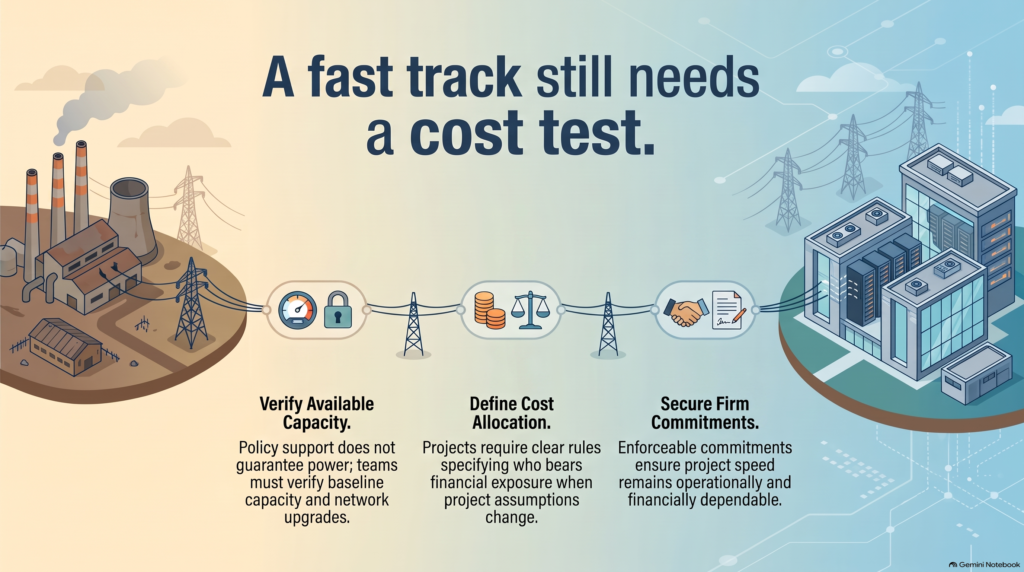
    A regulatory fast-track can shorten a process. It cannot make unresolved obligations disappear.

    On September 29, FERC acted on PJM Interconnection’s proposed Reliability Backstop Procurement, or RBP. PJM designed the one-time procurement to secure additional capacity after its 2028/2029 capacity auction fell approximately 6,800 MW short of the region’s reliability target. The plan was intended to help address a near-term supply gap amid rapid load growth, including demand from data centers. 

    FERC accepted parts of PJM’s proposal but suspended it for five months, with an effective date of February 28, 2027, while opening further proceedings on unresolved provisions. PJM confirmed that the procurement would not begin on September 30 as originally planned. The commission also asked PJM to improve its data-center demand forecasts. 

    The issues are practical, not procedural trivia. PJM identified concerns around cost allocation, transmission-owner exit rules, and collateral requirements for load-serving entities. Those rules shape who bears financial exposure if the procurement moves forward, and whether the obligations remain dependable over time. 

    That makes this a useful infrastructure-planning signal: a mechanism designed to move quickly can still be delayed if its allocation of costs and risks is not sufficiently defined. FERC did not say the region does not need new capacity. Its order accepted core elements while requiring more work on how the proposal would function.

    The distinction between this case and “fast-track interconnection” also matters. The RBP is a capacity procurement. PJM’s Expedited Interconnection Track is a separate process for qualifying new generation projects, and FERC approved that track separately. Calling the RBP pause the “death of shortcut interconnections” would merge two different mechanisms and draw a broader conclusion than the order supports. 

    For developers and large energy users, the practical takeaway is to treat policy support as one input to a project plan—not as proof of available power. Before relying on a site or procurement pathway, teams should verify the relevant capacity, interconnection status, needed network upgrades, enforceable commitments, and who carries the costs if assumptions change.

    PJM’s case illustrates a broader principle: speed can help a project move, but clear rules make that speed usable. The next advantage may belong to developers who can show not only that they have a path to power, but that the path is operationally and financially credible.

  • The Curtailment Question Data Centers Need to Ask About Air Permits

    Grid flexibility can shift the emissions question

    As electricity demand grows, grid operators are looking for ways to manage periods when supply is tight. Data centers may be asked to reduce demand, and some emergency reliability measures can direct large customers to use onsite backup generation as a last resort.

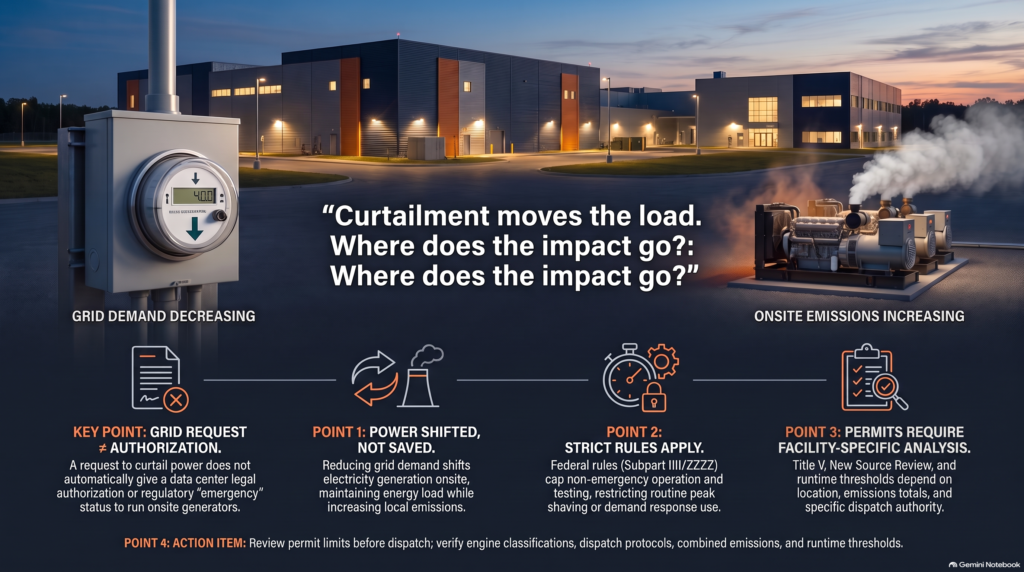
    That creates an important distinction. A facility can reduce the electricity it draws from the grid without reducing its total energy use. If onsite engines take over some or all of the load, the grid sees a reduction in demand—but the facility has shifted where its electricity is produced.

    That shift raises an air-permitting question alongside the electrical one: What operating rules and permit conditions apply to the generators during the event?

    “Emergency generator” is a regulatory status with conditions

    Stationary engines are subject to federal requirements that can include the New Source Performance Standards for compression-ignition engines under 40 CFR Part 60, Subpart IIII, and the RICE NESHAP under 40 CFR Part 63, Subpart ZZZZ.

    For engines regulated under Subpart IIII, the rules distinguish emergency operation from other use. They generally allow up to 100 hours per calendar year for maintenance and testing, with certain non-emergency use limited to as much as 50 hours within that total. The rules restrict using that allowance for ordinary peak shaving or non-emergency demand response, while providing a narrow exception for specified local reliability dispatches.

    The details of a particular grid event matter. EPA has also stated that operation under certain 2026 Department of Energy emergency orders is considered emergency operation for covered stationary engines. Those orders apply in defined circumstances; they do not establish that every curtailment request qualifies as an emergency.

    So “the grid asked us to curtail” is not, by itself, a complete answer. The operator needs to know who issued the dispatch, under what authority or protocol, and how the facility’s permit addresses the proposed operation.

    Permitting consequences require a facility-specific analysis

    A generator’s operating classification is only one part of the permitting picture. Title V and New Source Review requirements depend on factors such as the facility’s potential to emit, pollutant totals, source aggregation, location, and applicable state rules.

    A major-source determination does not automatically mean that every facility will need the same controls. PSD applicability and its requirements—including any BACT determination—depend on the source and the proposed construction or modification. SCR, diesel particulate filters, continuous emissions monitoring, or dispersion modeling may be relevant in particular cases, but they are not universal consequences of a generator being used during a grid event.

    The same care applies to temporary generation. A portable engine used or intended to remain at one location for 12 months or longer can cease to qualify as a nonroad engine under federal rules. That fact alone does not answer every permitting question: source status, emissions aggregation, permit obligations, and enforcement depend on the circumstances and applicable requirements.

    Treat the dispatch plan as an air-permitting input

    Before relying on onsite generation as part of a demand-response or emergency plan, engineering and environmental teams should review:

    • The facility’s permit conditions and engine classifications.
    • The dispatch authority, purpose, and applicable reliability protocol.
    • Runtime limits and how testing or other operation counts toward them.
    • Potential emissions from the engines operating together.
    • Whether planned changes require agency review or a permit revision.

    There may be other ways to manage a grid event, including reducing flexible workloads, shifting computing tasks, using stored energy, or combining approaches. The right mix depends on the facility’s design, reliability obligations, grid program, and permits.

    Curtailment can help manage grid reliability. But the effect depends on what the site actually does. If the response transfers load from the grid to onsite combustion, the plan should account for the emissions and permit implications as carefully as it accounts for electrical continuity.

    The practical question is not only whether the data center can stay online. It is what powers it during the event—and whether that operating plan fits the facility’s air permit.

    Regulatory references

  • AI Infrastructure Is Developing Its Own Social Contract

    The rapid expansion of artificial intelligence is often discussed as a technical race.

    Who has the most advanced chips? Who can build the largest models? Who can secure enough electricity? Who can bring new computing capacity online fastest?

    But another constraint is emerging—one that cannot be solved by ordering more GPUs or signing another power-purchase agreement.

    AI infrastructure is confronting the question of public legitimacy.

    Across the United States, communities, regulators, utilities, and lawmakers are renegotiating the conditions under which large data centers will be permitted to consume local resources and reshape regional infrastructure.

    The emerging message is not simply, “Do not build.”

    It is closer to this:

    You can build enormous AI infrastructure—but the right to build at that scale may increasingly come with obligations to pay attributable costs, disclose resource requirements, respond flexibly during grid stress, and prove that promised behavior occurred.

    That begins to resemble a social contract.

    The Debate Has Reached Spartanburg

    The issue is no longer theoretical in Spartanburg County, South Carolina.

    County officials approved a one-year moratorium affecting data-center applications that had not been finalized while the county evaluates appropriate locations and future development standards.

    At the same time, residents and environmental groups have challenged aspects of a separate computing-center project already being developed at the former Kohler manufacturing site. The concerns surrounding that project include its proposed expansion, onsite generation, air emissions, noise, and the transparency of the approval process.

    These are technically separate matters, but together they illustrate the same governance gap.

    Communities are being asked to make long-term infrastructure decisions while basic questions may still be contested:

    Who owns the project?

    How much electricity will it ultimately require?

    Will the power come from the public grid or onsite generation?

    How much water will be consumed?

    What emissions, noise, or land-use effects will accompany it?

    Which infrastructure costs will be paid by the developer, and which could eventually reach existing customers?

    What benefits will remain in the community after construction is complete?

    When those answers arrive late, change during development, or remain buried inside fragmented proceedings, distrust should not be surprising.

    The problem is not merely a communications failure. It is an evidence failure.

    From Economic Development to Cost Attribution

    For years, data centers were commonly presented through the language of investment, construction activity, tax revenue, and technological competitiveness.

    Those benefits still matter.

    But officials are now asking a second set of questions: What costs are being created, and who will pay them?

    In September 2026, the U.S. House passed the Ratepayer Protection Act with overwhelming bipartisan support. The legislation would require state utility regulators to consider whether large electricity users, including data centers, should bear the incremental infrastructure costs required to serve them.

    The measure may not settle the issue by itself, but its political significance is difficult to miss.

    The national conversation is moving from whether AI infrastructure is economically valuable to whether its costs are being allocated fairly.

    That is an important shift.

    If a private facility requires new substations, transmission capacity, generation resources, water-system upgrades, or other dedicated infrastructure, existing residents and small businesses will increasingly question why those costs should be socialized while the project’s financial returns remain private.

    “Who benefits?” is being joined by “Who pays?”

    Transparency Is Becoming a Condition of Operation

    Resource disclosure is also moving closer to the center of the regulatory bargain.

    California recently enacted a package of laws requiring greater reporting around data-center electricity and water use, while strengthening protections intended to prevent infrastructure costs from being shifted onto ordinary ratepayers.

    Virginia has proposed an accountability framework addressing project secrecy, environmental effects, and electricity costs, including restrictions on certain nondisclosure agreements.

    Different states will take different approaches, but the direction is becoming visible.

    Communities are losing patience with being asked to approve projects based primarily on economic projections while detailed resource requirements remain confidential, incomplete, or subject to later expansion.

    For major AI infrastructure, transparency can no longer be treated as a public-relations accessory.

    It is becoming part of the operating model.

    Flexibility Could Change the Bargain

    The industry is also developing a possible response to grid concerns: treating data centers as flexible loads rather than permanent, inflexible demand.

    A flexible data center could reduce its draw from the grid during constrained periods by shifting computing workloads, using batteries, drawing from approved onsite generation, or temporarily curtailing noncritical activity.

    That could make a facility more valuable to the grid and potentially reduce the need for some infrastructure expansion.

    The idea has enough momentum that Google, Nvidia, Emerald AI, utilities, power producers, and other organizations have formed the AI Energy Management Alliance to advocate for grid-enhancing data centers.

    But there is a major difference between claiming flexibility and delivering it.

    If a data center receives faster interconnection, preferential pricing, tax incentives, or regulatory accommodation because it promises to reduce demand during grid emergencies, that commitment cannot remain a sentence in an application.

    It must become an auditable operational obligation.

    A credible framework would need to record:

    • The grid condition or authorized curtailment event.

    • The time the response was requested.

    • The facility’s baseline demand.

    • The amount of load reduction promised.

    • The reduction actually delivered.

    • The duration of the response.

    • Any exception or failure to perform.

    • The process used to verify and report the result.

    This is the same distinction that appears throughout governance:

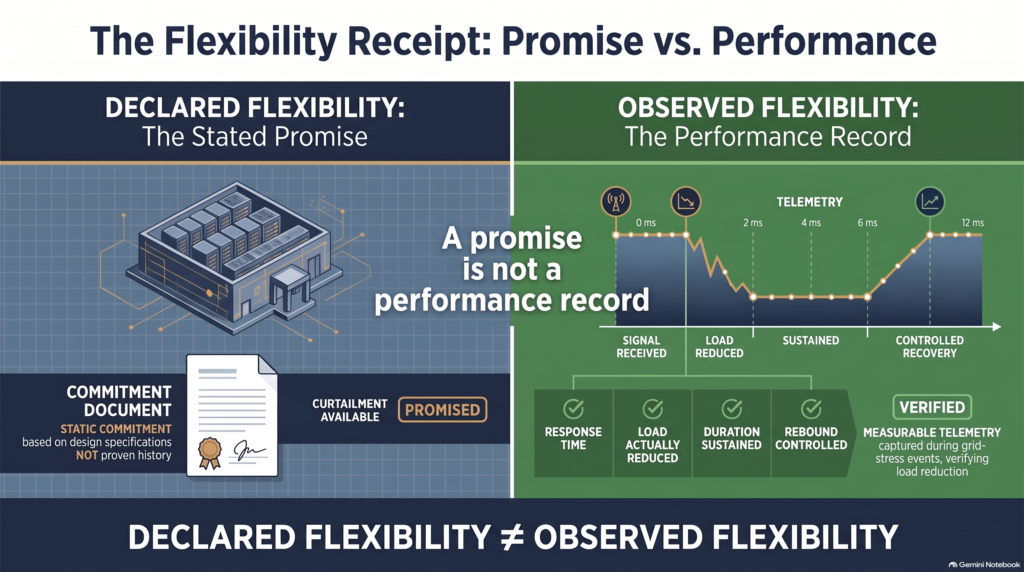
    Declared flexibility describes what the operator says the facility can do.

    Observed flexibility records what the facility actually did when the system was under stress.

    Only the second one can support a defensible decision.

    A Permit Is Not the Same as Legitimacy

    Companies sometimes treat permitting as the final boundary: if the project meets the formal requirements and receives approval, construction should proceed.

    Legally, that may be sufficient.

    Operationally and politically, it may not be.

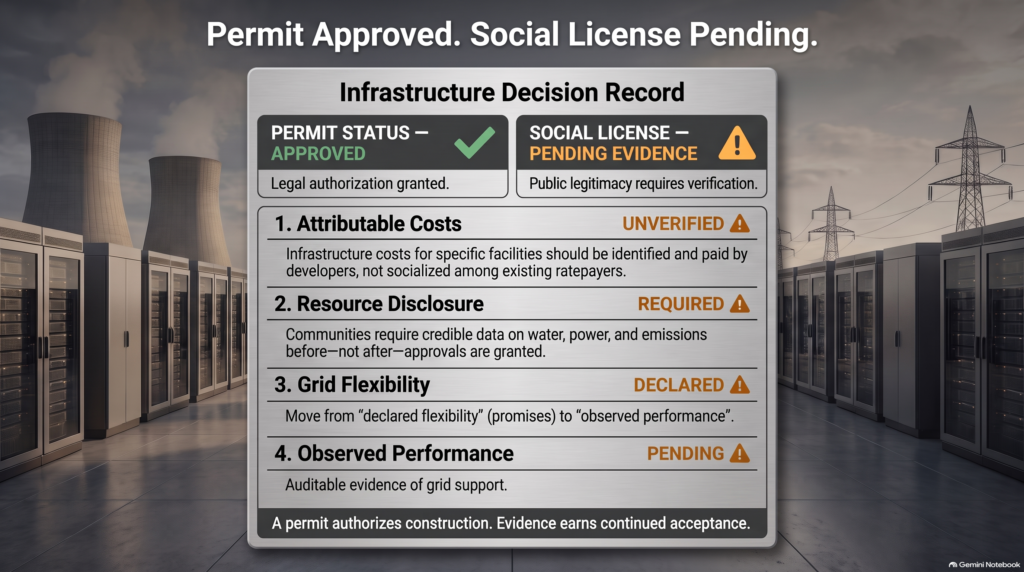
    A permit provides legal authorization. A social license reflects continuing public acceptance of the conditions under which the facility operates.

    That acceptance can weaken when project ownership is unclear, resource requirements expand, promised benefits fail to materialize, or community costs appear only after approval.

    The result is not limited to protests.

    It can produce moratoriums, litigation, delayed permits, stricter tariffs, lost incentives, and political pressure for broader regulation.

    For developers, transparency and verifiable performance are therefore not simply compliance expenses. They are forms of project-risk management.

    The Emerging Social Contract

    The developing bargain for AI infrastructure appears to contain four core obligations.

    1. Pay attributable costs

    The costs created specifically to connect and serve a major facility should be identified rather than quietly distributed across existing customers.

    2. Disclose resource requirements

    Communities need credible information about electricity, water, land, emissions, noise, ownership, incentives, and expected local benefits before—not after—the central decisions are made.

    3. Operate as a responsible grid participant

    Where technically possible, large facilities should be capable of shifting or reducing demand during constrained conditions instead of treating the grid as an unlimited resource.

    4. Prove performance

    Flexibility, efficiency, and community-benefit commitments should produce evidence that regulators, utilities, and the public can independently review.

    These expectations will not look identical in every jurisdiction. A facility in South Carolina will face different resources, grid conditions, and community priorities than one in California, Texas, or Virginia.

    But the governing principle is likely to remain consistent:

    The greater the infrastructure footprint, the greater the obligation to make its costs, behavior, and benefits visible.

    Infrastructure Governance Is Catching Up

    AI companies are not wrong to argue that data centers are strategically important. Compute capacity will influence economic competitiveness, scientific research, national security, and the development of new industries.

    Communities are also not wrong to ask what they are being required to contribute—and what safeguards accompany that contribution.

    Those positions do not have to be mutually exclusive.

    The mature path is neither unrestricted development nor reflexive prohibition.

    It is governed development: clear conditions, attributable costs, transparent resource claims, measurable operating commitments, and evidence that those commitments were fulfilled.

    The next generation of AI infrastructure will not be judged only by how much computing power it produces.

    It will be judged by whether it behaves like infrastructure worthy of public trust.

    That is the quiet thesis underneath the current disputes:

    AI infrastructure is developing its own social contract.

    And the companies that understand that early may find it much easier to earn both a grid connection and a durable place in the communities expected to host them.

  • Declared Flexibility vs. Observed Flexibility: The Next Credibility Test for AI Infrastructure

    The AI infrastructure conversation is beginning to mature.

    For much of the current buildout, attention has centered on announced investments, proposed data-center capacity, land acquisitions, power agreements, and projected electricity demand. But as projects move closer to construction and operation, the market is learning to distinguish what has been declared from what is actually available.

    Announced capacity is not the same as energized capacity.

    A similar distinction is now emerging around power flexibility.

    Data-center developers increasingly describe their facilities as flexible loads capable of shifting computing workloads, discharging batteries, using on-site generation, or reducing electricity consumption when the grid becomes constrained.

    Those capabilities could create significant value. They may allow utilities to connect large facilities faster, use existing grid infrastructure more efficiently, protect reliability during periods of stress, and defer some expensive system upgrades.

    But a stated ability to curtail power is still only a claim.

    The more important question is whether that flexibility can be observed, measured, and repeated during actual grid events.

    From Flexible Design to Verified Performance

    The AI Energy Management Alliance, launched by Emerald AI, Google, and NVIDIA, is advancing data centers that can dynamically manage their electricity use in response to grid conditions.

    Its approach is notable because it is described as technology-neutral and performance-based. The focus is not limited to which batteries, generators, workload-management platforms, or cooling systems a facility installs. The focus is on the measurable service the facility can deliver.

    That includes response speed, duration, predictability, and behavior during emergencies.

    This is an important shift.

    A data center may be technically capable of reducing its electricity demand under controlled conditions. That does not automatically prove it will deliver the promised reduction when the regional grid is under stress, temperatures are extreme, equipment availability has changed, and computing demand is high.

    Technical capability must eventually become operational evidence.

    What Observed Flexibility Should Show

    If a facility commits to curtailing 100 megawatts during a grid emergency, verification should extend beyond confirming that a control system received the request.

    Operators and regulators may need evidence showing:

    • The facility’s electricity demand before the event
    • The amount of load actually reduced
    • The time between the grid signal and the response
    • How long the reduction was maintained
    • Which energy resources or workloads produced the reduction
    • Whether essential computing services remained within agreed performance limits
    • Whether electricity demand rebounded sharply after the event
    • Whether the facility can reproduce the result across multiple events
    • Which exceptions, failures, or overrides occurred
    • Whether the supporting telemetry and records are complete and auditable

    The baseline also matters.

    A facility should not receive full credit for a reduction that would have occurred anyway because workloads had already declined. Without a credible baseline, flexibility measurements could become another version of inflated announced capacity: technically documented but operationally misleading.

    Benefits Should Follow Evidence

    The alliance argues that credible and verifiable flexibility commitments could support faster, risk-adjusted interconnection pathways.

    That proposition makes sense. A data center that can reliably reduce its load during a limited number of critical hours may impose a different risk on the power system than a facility requiring maximum electricity delivery around the clock.

    However, any preferential treatment should be connected to continuing performance.

    Faster interconnection should not be granted solely because a developer includes flexible-load language in an application. The commitment should be defined before connection, monitored during operation, and reassessed as equipment, workloads, software, ownership, and grid conditions change.

    Otherwise, flexibility becomes a one-time qualification rather than an ongoing operating obligation.

    A defensible model would connect the lifecycle:

    Declared capability → tested capability → observed grid-event performance → verified record → continued authorization

    If performance falls outside the agreed limits, the system should identify the variance and determine whether operating conditions, interconnection terms, or incentives need to change.

    Flexibility Is Becoming a Governance Question

    This issue extends beyond electrical engineering.

    Once data-center flexibility influences interconnection priority, infrastructure spending, electricity rates, or reliability planning, the underlying evidence becomes a governance concern.

    Someone must establish:

    • What was promised
    • How performance is measured
    • Who can verify the result
    • What exceptions are permitted
    • How failures are recorded
    • When a commitment must be retested
    • What happens when observed performance no longer matches the declaration

    That is the same pattern appearing across AI governance more broadly.

    A policy is not proof of enforcement.

    A control is not proof of execution.

    A resolved incident is not proof of correction.

    And a declared flexible load is not proof of grid-responsive performance.

    The Next Infrastructure Advantage

    Flexible AI data centers could become valuable grid participants rather than passive sources of rapidly growing demand. The technical potential is increasingly credible: research and demonstrations have shown that AI workloads can be shifted or curtailed while protecting priority services. (arxiv.org)

    But the long-term value will depend on whether flexibility survives contact with real operating conditions.

    The data centers that gain an advantage may not be those making the largest flexibility promises. They may be those capable of producing a consistent, independently reviewable record showing what happened when the grid actually needed them.

    The market is moving from declarations toward evidence.

    Announced capacity must become energized capacity.

    Flexible design must become verified response.

    And declared flexibility must become observed flexibility.