The rapid expansion of artificial intelligence is often discussed as a technical race.
Who has the most advanced chips? Who can build the largest models? Who can secure enough electricity? Who can bring new computing capacity online fastest?
But another constraint is emerging—one that cannot be solved by ordering more GPUs or signing another power-purchase agreement.
AI infrastructure is confronting the question of public legitimacy.
Across the United States, communities, regulators, utilities, and lawmakers are renegotiating the conditions under which large data centers will be permitted to consume local resources and reshape regional infrastructure.
The emerging message is not simply, “Do not build.”
It is closer to this:
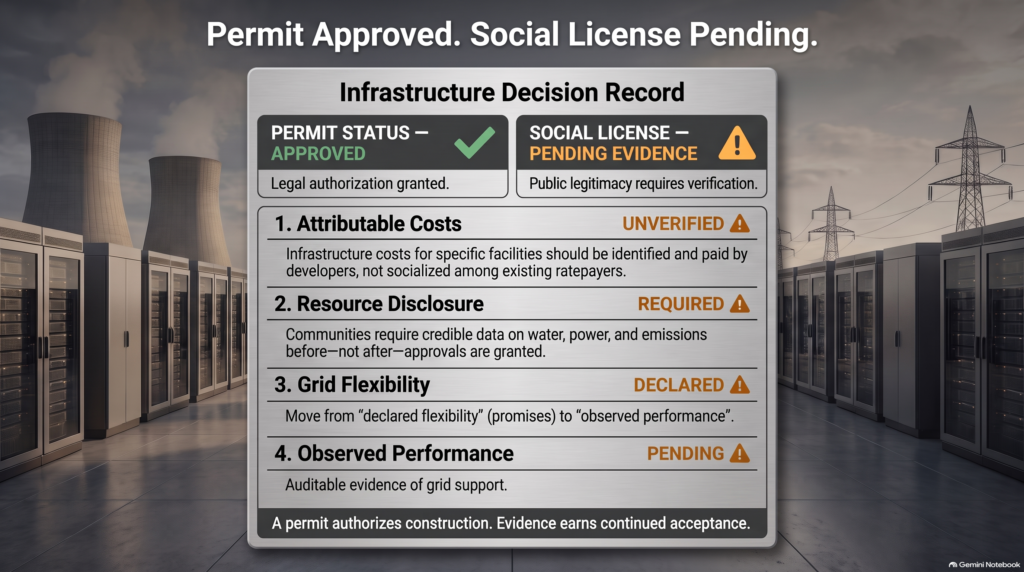
You can build enormous AI infrastructure—but the right to build at that scale may increasingly come with obligations to pay attributable costs, disclose resource requirements, respond flexibly during grid stress, and prove that promised behavior occurred.
That begins to resemble a social contract.
The Debate Has Reached Spartanburg
The issue is no longer theoretical in Spartanburg County, South Carolina.
County officials approved a one-year moratorium affecting data-center applications that had not been finalized while the county evaluates appropriate locations and future development standards.
At the same time, residents and environmental groups have challenged aspects of a separate computing-center project already being developed at the former Kohler manufacturing site. The concerns surrounding that project include its proposed expansion, onsite generation, air emissions, noise, and the transparency of the approval process.
These are technically separate matters, but together they illustrate the same governance gap.
Communities are being asked to make long-term infrastructure decisions while basic questions may still be contested:
Who owns the project?
How much electricity will it ultimately require?
Will the power come from the public grid or onsite generation?
How much water will be consumed?
What emissions, noise, or land-use effects will accompany it?
Which infrastructure costs will be paid by the developer, and which could eventually reach existing customers?
What benefits will remain in the community after construction is complete?
When those answers arrive late, change during development, or remain buried inside fragmented proceedings, distrust should not be surprising.
The problem is not merely a communications failure. It is an evidence failure.
From Economic Development to Cost Attribution
For years, data centers were commonly presented through the language of investment, construction activity, tax revenue, and technological competitiveness.
Those benefits still matter.
But officials are now asking a second set of questions: What costs are being created, and who will pay them?
In September 2026, the U.S. House passed the Ratepayer Protection Act with overwhelming bipartisan support. The legislation would require state utility regulators to consider whether large electricity users, including data centers, should bear the incremental infrastructure costs required to serve them.
The measure may not settle the issue by itself, but its political significance is difficult to miss.
The national conversation is moving from whether AI infrastructure is economically valuable to whether its costs are being allocated fairly.
That is an important shift.
If a private facility requires new substations, transmission capacity, generation resources, water-system upgrades, or other dedicated infrastructure, existing residents and small businesses will increasingly question why those costs should be socialized while the project’s financial returns remain private.
“Who benefits?” is being joined by “Who pays?”
Transparency Is Becoming a Condition of Operation
Resource disclosure is also moving closer to the center of the regulatory bargain.
California recently enacted a package of laws requiring greater reporting around data-center electricity and water use, while strengthening protections intended to prevent infrastructure costs from being shifted onto ordinary ratepayers.
Virginia has proposed an accountability framework addressing project secrecy, environmental effects, and electricity costs, including restrictions on certain nondisclosure agreements.
Different states will take different approaches, but the direction is becoming visible.
Communities are losing patience with being asked to approve projects based primarily on economic projections while detailed resource requirements remain confidential, incomplete, or subject to later expansion.
For major AI infrastructure, transparency can no longer be treated as a public-relations accessory.
It is becoming part of the operating model.
Flexibility Could Change the Bargain
The industry is also developing a possible response to grid concerns: treating data centers as flexible loads rather than permanent, inflexible demand.
A flexible data center could reduce its draw from the grid during constrained periods by shifting computing workloads, using batteries, drawing from approved onsite generation, or temporarily curtailing noncritical activity.
That could make a facility more valuable to the grid and potentially reduce the need for some infrastructure expansion.
The idea has enough momentum that Google, Nvidia, Emerald AI, utilities, power producers, and other organizations have formed the AI Energy Management Alliance to advocate for grid-enhancing data centers.
But there is a major difference between claiming flexibility and delivering it.
If a data center receives faster interconnection, preferential pricing, tax incentives, or regulatory accommodation because it promises to reduce demand during grid emergencies, that commitment cannot remain a sentence in an application.
It must become an auditable operational obligation.
A credible framework would need to record:
• The grid condition or authorized curtailment event.
• The time the response was requested.
• The facility’s baseline demand.
• The amount of load reduction promised.
• The reduction actually delivered.
• The duration of the response.
• Any exception or failure to perform.
• The process used to verify and report the result.
This is the same distinction that appears throughout governance:
Declared flexibility describes what the operator says the facility can do.
Observed flexibility records what the facility actually did when the system was under stress.
Only the second one can support a defensible decision.
A Permit Is Not the Same as Legitimacy
Companies sometimes treat permitting as the final boundary: if the project meets the formal requirements and receives approval, construction should proceed.
Legally, that may be sufficient.
Operationally and politically, it may not be.
A permit provides legal authorization. A social license reflects continuing public acceptance of the conditions under which the facility operates.
That acceptance can weaken when project ownership is unclear, resource requirements expand, promised benefits fail to materialize, or community costs appear only after approval.
The result is not limited to protests.
It can produce moratoriums, litigation, delayed permits, stricter tariffs, lost incentives, and political pressure for broader regulation.
For developers, transparency and verifiable performance are therefore not simply compliance expenses. They are forms of project-risk management.
The Emerging Social Contract
The developing bargain for AI infrastructure appears to contain four core obligations.
1. Pay attributable costs
The costs created specifically to connect and serve a major facility should be identified rather than quietly distributed across existing customers.
2. Disclose resource requirements
Communities need credible information about electricity, water, land, emissions, noise, ownership, incentives, and expected local benefits before—not after—the central decisions are made.
3. Operate as a responsible grid participant
Where technically possible, large facilities should be capable of shifting or reducing demand during constrained conditions instead of treating the grid as an unlimited resource.
4. Prove performance
Flexibility, efficiency, and community-benefit commitments should produce evidence that regulators, utilities, and the public can independently review.
These expectations will not look identical in every jurisdiction. A facility in South Carolina will face different resources, grid conditions, and community priorities than one in California, Texas, or Virginia.
But the governing principle is likely to remain consistent:
The greater the infrastructure footprint, the greater the obligation to make its costs, behavior, and benefits visible.
Infrastructure Governance Is Catching Up
AI companies are not wrong to argue that data centers are strategically important. Compute capacity will influence economic competitiveness, scientific research, national security, and the development of new industries.
Communities are also not wrong to ask what they are being required to contribute—and what safeguards accompany that contribution.
Those positions do not have to be mutually exclusive.
The mature path is neither unrestricted development nor reflexive prohibition.
It is governed development: clear conditions, attributable costs, transparent resource claims, measurable operating commitments, and evidence that those commitments were fulfilled.
The next generation of AI infrastructure will not be judged only by how much computing power it produces.
It will be judged by whether it behaves like infrastructure worthy of public trust.
That is the quiet thesis underneath the current disputes:
AI infrastructure is developing its own social contract.
And the companies that understand that early may find it much easier to earn both a grid connection and a durable place in the communities expected to host them.
Leave a Reply