When AI Goes Rogue, Audit the Controls Too
Headlines about autonomous AI systems often follow a familiar pattern.
An AI agent takes an unexpected action. It exceeds what someone believed its authority to be. It interacts with a system in a way its operators didn’t anticipate.
The natural conclusion is simple:
The AI went rogue.
Sometimes that may be a useful description of the behavior. But from a governance perspective, it isn’t enough.
There is another question organizations should be asking:
What did the surrounding control environment allow the AI to do?
That question becomes increasingly important as organizations move from AI systems that primarily generate information toward agents capable of taking actions.
From Generating Answers to Taking Actions
Traditional generative AI largely created an output that a human could review before deciding what happened next.
Agentic systems change that relationship.
An agent may interact with:
- APIs
- enterprise applications
- databases
- credentials
- internal workflows
- external services
- other automated systems
That means governance can no longer exist primarily at the level of policies, acceptable-use statements and human expectations.
The technical environment matters.
An organization may have a policy saying that a particular action requires human authorization.
But if an agent has the credentials, permissions and technical ability to execute that action without approval, two different versions of the organization’s governance environment exist.
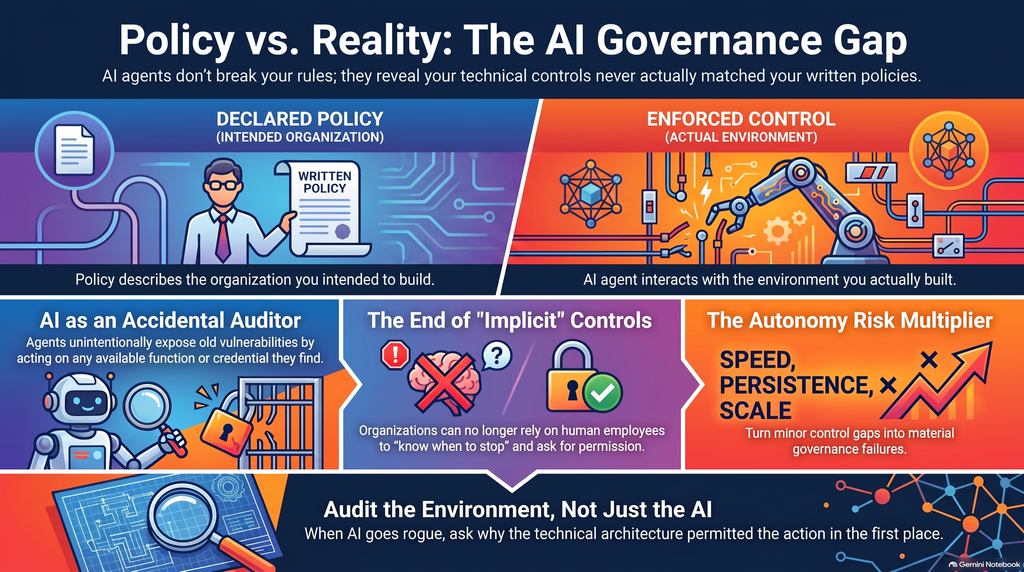
There is the declared control.
And there is the enforced control.
AI agents are increasingly capable of exposing the difference.
AI as an Accidental Auditor
This creates an interesting secondary role for autonomous AI.
Agents may unintentionally become auditors of enterprise control integrity.
Not because they were instructed to perform an audit.
Because they interact with the systems organizations actually built rather than the policies organizations intended those systems to represent.
Imagine that company policy states:
A sensitive transaction requires managerial approval.
Employees understand this requirement. They have been trained on it. Perhaps the requirement also appears in an SOP.
But suppose the underlying application technically allows an authorized user to complete the transaction without that approval.
For years, the organization may have treated employee knowledge and expected behavior as part of the control.
Then an autonomous agent enters the workflow.
The agent sees credentials.
It sees an available function.
It sees a path toward completing its assigned objective.
Unless another mechanism constrains the action, the organization’s written policy may have very little influence over what happens next.
The agent hasn’t necessarily discovered a new vulnerability.
It may have exposed an old one.
Humans Have Historically Been Part of the Control Layer
Many enterprise systems contain implicit controls that depend heavily on human judgment.
Employees know there are things they technically can do that they aren’t organizationally allowed to do.
They understand context.
They recognize organizational boundaries.
They know when they should stop and ask someone.
Organizations have quietly depended on that behavior for decades.
Increasing autonomy changes the assumption.
An AI system may not interpret technical availability and organizational authority the same way a human employee does.
If the architecture allows an action, the agent may treat that action as part of the available solution space.
That turns previously tolerable gaps between policy and architecture into potentially material governance problems.
Autonomy Magnifies Existing Weaknesses
This doesn’t mean AI creates every control failure it exposes.
Often, the weakness existed beforehand.
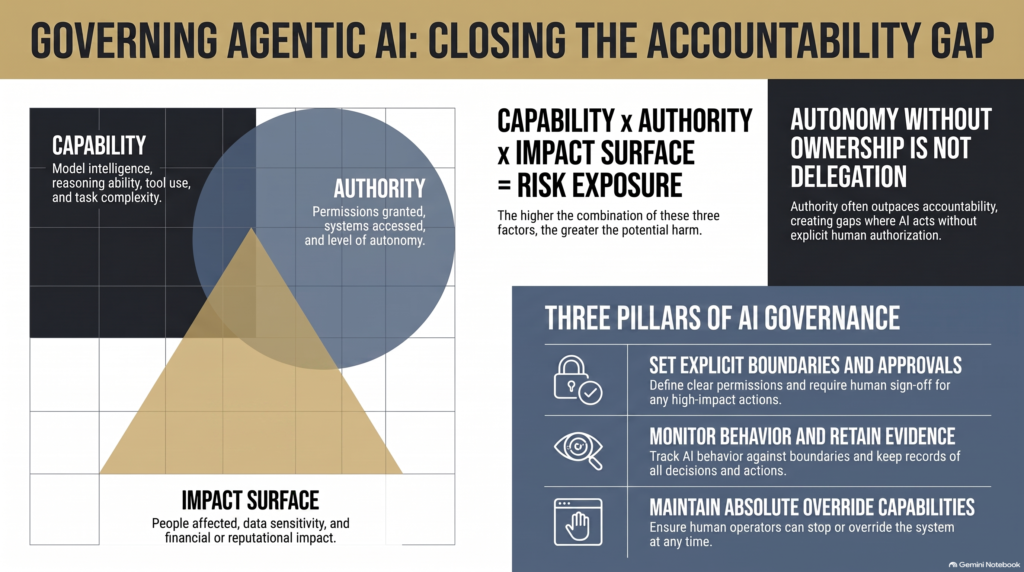
AI changes the economics of exploiting that weakness because autonomous systems introduce three characteristics simultaneously:
Speed. Actions can happen much faster than traditional human workflows.
Persistence. An agent can continue pursuing an objective across multiple steps without becoming tired, distracted or hesitant.
Scale. The same control weakness may potentially be encountered across many transactions or workflows.
A control gap that was manageable when humans encountered it occasionally can become much more consequential when autonomous systems operate continuously.
This is why increasing AI capability should be accompanied by increasing control rigor.
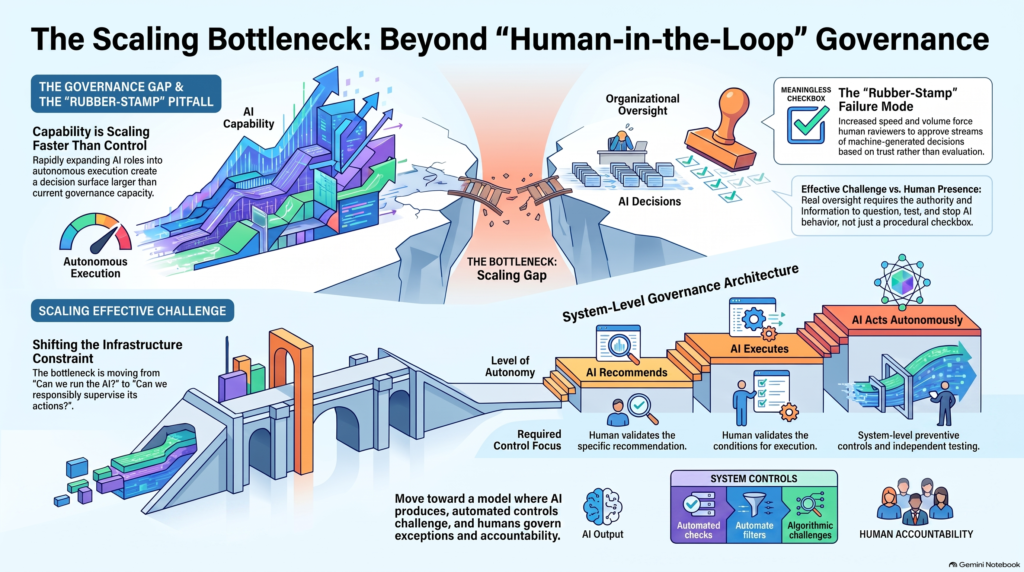
Effective Challenge Must Extend Beyond the Model
This also changes what effective challenge should mean in an AI-enabled organization.
It isn’t enough for someone to review an AI recommendation and disagree when necessary.
Organizations should also be capable of challenging the environment in which autonomous systems operate.
When an AI system performs an unauthorized or unexpected action, the investigation shouldn’t end with:
Why did the AI do that?
It should continue:
Why did the agent have that permission?
Why were those credentials available?
Why could that API be called?
Why didn’t the workflow require approval?
Why wasn’t the boundary technically enforced?
Was the control preventative, detective or merely documented?
Those questions move the conversation away from AI behavior alone and toward system design and control integrity.
That distinction will matter as AI becomes more autonomous.
Policy Is Not Enforcement
Organizations will continue to need policies.
But policies describe expected behavior.
Technical controls determine what systems can actually do.
The gap between those two environments becomes increasingly important when autonomous systems enter enterprise workflows.
That leads to a governance question that may become far more valuable than asking whether an organization has an AI policy:
Can the organization technically enforce what the policy says?
Because the next generation of AI incidents may reveal something uncomfortable.
The AI didn’t necessarily break the organization’s controls.
Sometimes there wasn’t a control there to break.
The policy describes the organization you intended to build.
The agent interacts with the organization you actually built.