The conversation around artificial intelligence is increasingly focused on capability.
How much can an AI agent accomplish?
How cheaply can organizations deploy it?
How much infrastructure will be required?
How quickly can AI generate and review code?
Those are important questions.
But they may be overshadowing a more consequential one:
Can organizations effectively challenge the systems they are increasingly trusting with decisions and actions?
That may become one of AI governance’s defining problems.
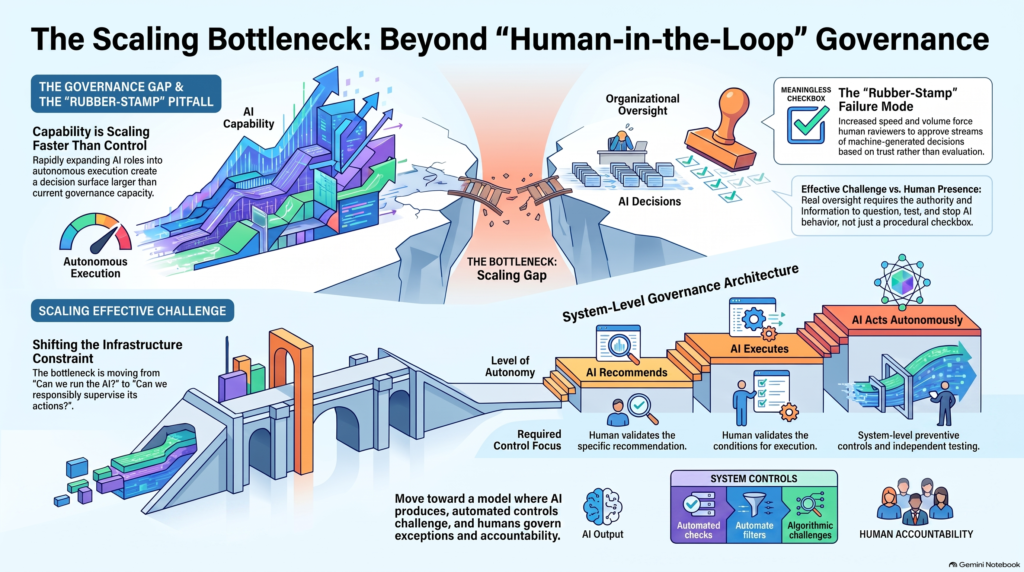
Capability Is Scaling Faster Than Challenge
Organizations are rapidly expanding the role AI plays inside their operations.
AI systems are moving beyond simple content generation and search into coding, analysis, workflow automation, decision support, and increasingly autonomous execution.
At the same time, the cost of deploying increasingly capable agents continues to fall.
That creates a predictable organizational response:
If the technology can do more, let it do more.
But capability does not automatically create control.
In fact, greater capability can expose weaknesses in the control environment that were previously hidden.
A system that only generates a recommendation presents one level of risk.
A system that can independently execute a workflow presents another.
A system that can modify code, interact with external systems, make decisions, or trigger downstream actions presents an even larger decision surface.
The technology may have become more capable.
The organization therefore needs to become more capable at challenging it.
Human Oversight Is Not Automatically a Control
One of the most common assumptions in AI governance is that putting a human somewhere in the workflow creates meaningful oversight.
It doesn’t.
Consider a simple process:
AI produces an output → employee reviews it → employee approves it.
On paper, there is a human in the loop.
But what happens if the employee:
- doesn’t understand how the AI reached its conclusion?
- lacks the information necessary to independently validate it?
- assumes the AI is probably correct?
- is measured primarily on speed?
- reviews hundreds of AI-generated decisions per day?
- has no defined criteria for challenging the output?
The human may technically be “in the loop.”
But the control may be functionally meaningless.
This is the difference between human presence and effective challenge.
Effective challenge requires the ability—and organizational authority—to question assumptions, test outputs, identify inconsistencies, request evidence, and stop or escalate activity when something doesn’t make sense.
That is a much higher standard.
The Rubber-Stamp Problem
There is a dangerous failure mode hiding inside many AI implementations:
Automation increases faster than independent verification.
The AI gets faster.
The workflow gets faster.
The employee gets more outputs to review.
Eventually, the reviewer isn’t really evaluating each decision.
They’re approving a stream of machine-generated decisions based on trust, familiarity, or workload.
At that point, “human oversight” can become little more than a procedural checkbox.
And checkboxes don’t create effective controls.
They create evidence that someone checked a box.
Those are very different things.
Greater Autonomy Should Require Greater Challenge
This is where the governance model needs to evolve.
AI autonomy should not be treated as a reason to reduce oversight.
It should be treated as a reason to increase the quality and independence of challenge.
Think about the progression:
AI recommends
Human validates the recommendation.
↓
AI executes
Human validates the conditions under which execution occurs.
↓
AI acts autonomously
The organization needs stronger preventive controls, monitoring, exception handling, evidence capture, and independent testing.
The more decision-making authority the system receives, the more important it becomes to understand:
What assumptions is the system making?
What evidence supports its output?
What happens when the system is wrong?
Who can override it?
What prevents unauthorized behavior?
Can the organization reconstruct what happened afterward?
That’s not an argument against autonomy.
It’s an argument for building a control environment that is capable of supporting it.
Challenge Must Become Part of the System
There is also a larger opportunity here.
Effective challenge doesn’t necessarily have to come exclusively from another human.
Organizations can increasingly build systems that challenge AI systems through independent validation, rule-based controls, anomaly detection, evidence requirements, policy checks, logging, and secondary models.
That creates a more interesting architecture:
AI produces.
Controls challenge.
Humans govern exceptions and accountability.
The objective isn’t to put a person in front of every AI decision.
That would defeat much of the value of automation.
The objective is to build an environment where consequential AI behavior is subject to meaningful challenge.
That distinction matters.
The Infrastructure Investment May Not Be Enough
Organizations are already thinking seriously about the infrastructure required to support AI.
Compute.
Data.
Networking.
Storage.
Energy.
Specialized hardware.
But there is another infrastructure layer that receives considerably less attention:
Governance infrastructure.
An organization may have enough compute to run thousands of agents.
That doesn’t mean it has enough governance capacity to understand what those agents are doing.
The constraint may eventually shift from:
“Can we run the AI?”
to:
“Can we responsibly supervise everything we’ve allowed the AI to do?”
That is a very different problem.
The New AI Governance Question
For years, organizations have asked whether they have a human in the loop.
That question is becoming insufficient.
A better question is:
Can the organization independently challenge the AI when the AI is wrong, uncertain, unexpected, or operating outside its intended boundaries?
That question changes the conversation.
It moves governance away from demonstrating that a policy exists and toward demonstrating that the control environment can actually function.
Because the real risk isn’t simply that AI makes mistakes.
Organizations already know AI can make mistakes.
The bigger risk is creating an operating environment where those mistakes become difficult to detect, difficult to challenge, and increasingly expensive to reverse.
AI capability is scaling.
The next competitive advantage may belong to organizations that can scale something alongside it:
the ability to challenge the machine.
And as AI becomes more autonomous, effective challenge may become less of a governance preference and more of an operational necessity.
Leave a Reply