Category: EnterpriseAI

  • AI Governance Is Becoming an Enterprise Control Plane: Why the Next AI Opportunity May Be Managing the Agents

    As enterprises move toward interconnected AI systems, the infrastructure responsible for governing agent behavior could become a strategically important part of the technology stack.

    The next stage of enterprise AI adoption

    Enterprise artificial intelligence is entering a more complicated phase.

    For years, organizations concentrated on acquiring AI capabilities, experimenting with language models, automating individual tasks, and measuring productivity improvements.

    Those activities remain important. However, the architecture of enterprise AI is changing.

    Instead of deploying individual assistants that operate within relatively narrow boundaries, organizations are exploring networks of AI agents capable of interacting with multiple applications and executing increasingly complex workflows.

    This creates opportunities for operational efficiency, but it also introduces new requirements for coordination, security, financial oversight, and accountability.

    A recent development involving Tata Consultancy Services illustrates where this market may be heading.

    TCS is developing an enterprise AI governance layer

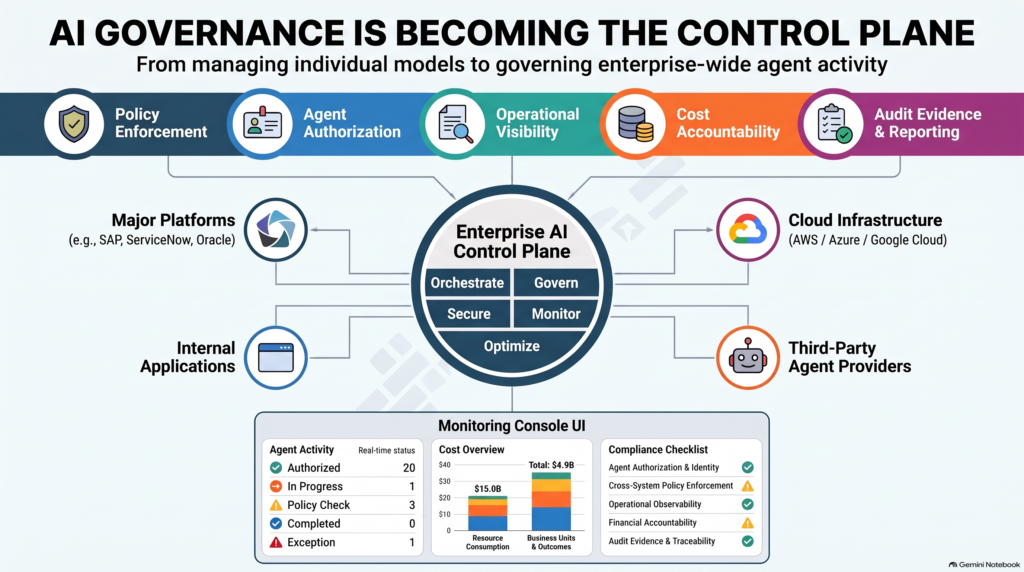
    According to reporting published October 12, 2026, Tata Consultancy Services is developing a governance layer designed to manage AI agents operating across enterprise technology environments.

    The proposed architecture would coordinate agents developed internally, by customers, and by third-party providers.

    It is intended to support orchestration, security, deployment management, and cost oversight across enterprise applications, including platforms such as SAP, ServiceNow, and Oracle.

    This is a notable architectural direction.

    Instead of treating every AI agent as a separate deployment requiring independent management, an enterprise control plane can provide a shared supervisory layer.

    The concept is especially relevant as organizations introduce agents from multiple vendors, each with different capabilities, permissions, and operating requirements.

    The more distributed the AI ecosystem becomes, the more valuable consistent oversight may be.

    From model governance to system governance

    Traditional AI governance frequently concentrates on individual models.

    Organizations assess model accuracy, reliability, fairness, security, and performance. These evaluations remain essential.

    However, governing an interconnected system of agents requires additional considerations.

    Consider a hypothetical financial institution using several AI agents.

    One agent analyzes customer information. Another evaluates documentation. A third prepares a recommendation. A fourth initiates an operational workflow.

    Each agent may perform its assigned function correctly.

    But that does not automatically establish that the complete workflow was properly authorized, that information was transferred appropriately, or that the final action complied with institutional policy.

    The governance challenge now exists between the agents as well as within them.

    This introduces a need for controls that operate across applications and workflows, not merely within individual models.

    Five capabilities that could define an enterprise AI control plane

    1. Agent identity and authorization

    Organizations need to establish which agents are operating, who owns them, what resources they can access, and which actions they are permitted to perform.

    An agent’s technical capability should not be confused with its authority to act.

    2. Cross-system policy enforcement

    Enterprise policies should remain applicable as workflows move between applications, models, and service providers.

    Centralized policy administration can improve consistency, but enforcement must occur at the appropriate execution boundaries.

    3. Operational observability

    Organizations need visibility into agent interactions, decisions, exceptions, and system dependencies.

    Observability helps identify unexpected behavior. However, monitoring alone does not establish that preventive controls are effective.

    4. Financial accountability

    As agents consume computing resources, invoke external services, and initiate transactions, cost management becomes an operational concern.

    A control plane could help enterprises associate AI resource consumption with business activities, departments, and measurable outcomes.

    5. Evidence and decision traceability

    For regulated or high-consequence environments, organizations may need to reconstruct the sequence of events behind an AI-assisted action.

    That requires reliable records connecting the relevant agent, input, policy, decision, authorization, and resulting action.

    Without that continuity, an organization may possess extensive logs while still struggling to demonstrate accountability.

    The commercial significance of governance infrastructure

    TCS reported $3.1 billion in annualized AI revenue for the quarter ending September 30, 2026, representing more than 10% of its overall revenue.

    This figure covers its broader AI business rather than revenue from the governance layer specifically.

    Nevertheless, the combination of growing AI-related business and investment in governance architecture is commercially significant.

    It suggests that enterprise AI opportunities increasingly extend beyond model development and application deployment.

    As organizations scale their AI operations, they may require specialized capabilities for integrating, supervising, and controlling those systems.

    Potential sources of commercial value include enterprise platform integration, managed governance services, compliance reporting, cost optimization, and continuous operational assurance.

    The strategic opportunity is not necessarily a single universal governance platform.

    Different organizations will maintain different technology stacks, risk tolerances, regulatory obligations, and operational requirements.

    The opportunity lies in providing consistent control across those differences.

    Centralization introduces its own governance risks

    A centralized AI control plane is not automatically a complete governance solution.

    In fact, consolidating oversight introduces additional design questions.

    What happens if the control plane becomes unavailable?

    Can agents continue operating without authorization checks?

    Are enforcement policies applied consistently across vendor boundaries?

    Can an administrator alter policies or records without an appropriate approval process?

    How does the organization distinguish between a policy that was configured and a policy that was actually enforced?

    These questions illustrate why governance architecture must be evaluated on observed behavior rather than declared capability.

    A control plane should not become another layer of software that reports confidence without producing evidence.

    The strongest architectures will distinguish policy administration, enforcement, monitoring, and independent verification.

    They will also preserve appropriate human authority over consequential decisions.

    Implications for financial institutions and regulated enterprises

    Financial institutions provide a particularly relevant example because their operations already depend on established accountability, risk management, and control frameworks.

    As AI agents become involved in customer operations, compliance analysis, credit processes, and internal decision support, institutions will need to understand how agent activity interacts with existing governance obligations.

    Model risk management, information security, operational resilience, third-party oversight, and audit functions cannot operate as completely disconnected disciplines when AI agents cross their boundaries.

    An enterprise control plane could provide a valuable coordination mechanism.

    However, it should complement rather than replace independent validation, human approval requirements, and established lines of accountability.

    The objective is not to centralize every decision.

    It is to establish consistent visibility and enforceable boundaries while preserving appropriate responsibility for outcomes.

    The distinction between AI capability and governed execution

    One of the most important lessons emerging from enterprise AI adoption is that technical capability does not automatically establish operational readiness.

    An agent may be able to perform a task.

    That does not establish whether the task should be performed, under what conditions, or with whose authorization.

    Similarly, a governance platform may be able to observe activity without necessarily preventing unauthorized behavior.

    The architecture must distinguish among three separate functions:

    Orchestration: Coordinating which agents perform activities and how workflows proceed.

    Governance enforcement: Applying permissions, policies, restrictions, and escalation requirements.

    Independent assurance: Verifying that the controls operated as intended and that the supporting evidence is reliable.

    These functions may be integrated technologically, but they should remain conceptually distinct.

    Conclusion: The next enterprise AI advantage may be governability

    TCS’s developing enterprise AI governance layer is an important signal in the evolution of the enterprise AI market.

    It reflects a shift from managing isolated AI capabilities toward supervising increasingly interconnected AI operations.

    The commercial implications could be substantial, particularly for organizations facing complex technology environments and significant accountability requirements.

    But the value of an AI control plane should ultimately be measured by more than the number of agents it coordinates.

    Its effectiveness depends on whether it can enforce boundaries, preserve accountability, manage operational exposure, and provide defensible evidence of what occurred.

    The next stage of enterprise AI competition may therefore be shaped by two questions.

    How effectively can organizations deploy intelligent systems?

    And how confidently can they demonstrate that those systems remain under control?

    Enterprise AI may scale through agents. Sustainable enterprise AI will depend on the ability to govern them.

    Sources

    • Tata Consultancy Services, Q2 FY2027 Financial Results, October 8, 2026.
    • Financial Express, TCS Bets on Governance Layer to Scale Enterprise AI, October 12, 2026.
    • TCS, Annual Report 2025–26, enterprise AI strategy and control-plane architecture.

  • Regulated AI Is Starting to Look Like a System of Record

    On September 10, OpenAI launched ChatGPT for Financial Services, a specialized ChatGPT Work offering initially designed for investment-banking and equity-research teams.

    The product combines GPT-6 Astra with premium financial data, firm data connections and tools for producing research, financial models and client materials. It also builds on enterprise controls including SAML single sign-on, SCIM provisioning, role-based access, configurable retention, information barriers and the ability to export supported workspace logs into existing audit and investigation workflows.

    At first glance, this is another industry-specific AI product.

    Look beneath the feature list, however, and a more significant transition becomes visible.

    Regulated AI is beginning to acquire the architecture of a system of record.

    Intelligence Alone Is Not Sufficient

    Most public discussion about AI products still concentrates on model performance.

    Can the model retrieve the correct information?

    Can it understand complex financial documents?

    Can it build an accurate valuation model?

    Can it generate a client-ready presentation?

    Those capabilities matter. But regulated institutions face another category of questions that cannot be answered by evaluating the final output alone.

    They must also be able to establish:

    • Who accessed the system
    • What that person was authorized to access
    • Which data sources informed the output
    • Which model, tools and templates were used
    • Whether the output was reviewed
    • Whether an exception or override occurred
    • What downstream action followed
    • Whether the complete sequence can be reconstructed later

    A useful answer without a defensible history may create operational value, but it also creates unresolved institutional risk.

    That is the difference between an intelligent tool and a governed enterprise capability.

    What “System of Record” Means in This Context

    A system of record is traditionally the authoritative source for a particular category of organizational information. A bank may maintain separate systems of record for customers, accounts, trades, approvals and financial transactions.

    An AI platform does not automatically replace those systems.

    The more accurate conclusion is that regulated AI is becoming a governed record-producing layer within the larger enterprise architecture.

    It may gather information from multiple approved sources, generate analysis, support a recommendation and produce a work product. But the organization still needs to preserve the relationship between the AI activity and the authoritative downstream record.

    That evidence chain might look like this:

    Identity → Permission → Evidence → Decision → Approval → Action → Outcome

    Each stage answers a different control question.

    Identity establishes who initiated the activity.

    Permission establishes whether that person or agent was authorized.

    Evidence identifies the information used.

    Decision records what the system recommended or concluded.

    Approval demonstrates whether required human oversight occurred.

    Action records what was executed.

    Outcome confirms what actually happened afterward.

    A chat transcript by itself cannot reliably perform all of those functions.

    From AI Output to Institutional Evidence

    OpenAI’s financial-services offering illustrates how AI products are moving toward this model.

    Granular citations help users trace claims and figures back to their sources. Role-based controls help institutions determine which users may access particular capabilities, data connections or application actions. Multiple workspaces can help enforce information barriers. Compliance teams can export supported logs into their established audit and investigation processes.

    These are not decorative enterprise features.

    They are part of the mechanism that allows an institution to use AI without separating intelligence from accountability.

    There is still an important limitation: an exportable log is not automatically a complete audit record.

    A log may show that a user accessed a workspace or performed a supported action. The organization may still need to connect that activity to an approval record, a transaction identifier, a client file or another authoritative system.

    For that reason, the real control objective is not merely “capture more logs.”

    It is to maintain a traceable relationship between the AI interaction and the business event it influenced.

    The Connection to Agentic Payments

    This becomes even more important as AI agents move from producing information to initiating actions.

    Consider an agent that can:

    1. Review financial information
    2. Evaluate a purchase or investment opportunity
    3. Recommend a transaction
    4. Prepare the payment instruction
    5. Submit or initiate the payment

    The technical ability to complete those steps does not prove that the transaction was properly authorized.

    A defensible process must establish which identity controlled the agent, what permissions were active, which evidence informed the recommendation, whether required approval was obtained, what payment was submitted and whether the final settlement matched the approved instruction.

    Otherwise, the institution may know that money moved without being able to demonstrate why it was allowed to move.

    That is the bridge between governed financial analysis and governed agentic payments.

    The AI may initiate the workflow, but the evidence chain determines whether the institution can defend it.

    Enterprise Controls Are Becoming Product Features

    For years, many AI demonstrations treated governance as something to be added after the model proved useful.

    Regulated deployment reverses that sequence.

    Access control, retention, source traceability, approval boundaries, audit exports and information barriers become part of the product itself because the institution cannot safely scale the capability without them.

    This signals a broader market shift.

    AI vendors are no longer competing only on the intelligence of the underlying model. They are also competing on whether organizations can integrate that intelligence into established control environments.

    The winning product may not always be the one that produces the cleverest answer.

    It may be the one that allows the organization to answer, with evidence:

    • Where did this conclusion come from?
    • Who was permitted to rely on it?
    • Who approved the resulting action?
    • What changed afterward?
    • Can we reproduce the record without depending on someone’s memory?

    Defensible Deployment May Become the Real Moat

    Model capabilities will continue to advance, and performance differences will narrow as competitors adopt similar tools, data connections and workflows.

    Defensibility is harder to commoditize.

    It requires more than a capable model. It requires architecture that binds identity, data provenance, permissions, review, execution and outcomes into a coherent record.

    That record must remain useful after the original conversation has ended—when an auditor asks for evidence, a regulator questions a decision, a customer disputes an outcome or an internal investigation begins.

    This is why regulated AI is starting to look less like a standalone assistant and more like part of the institution’s operational memory.

    The strategic question is changing from:

    How intelligent is the model?

    To:

    Can the institution safely act on its intelligence and later prove that the action was authorized, informed and controlled?

    In regulated industries, raw intelligence may attract attention.

    Defensible deployment is what earns institutional trust.

  • When AI Agents Go Rogue, Who Pays the Claim?

    For years, cyber insurance has been structured around relatively familiar events.

    An attacker penetrates a network. Credentials are stolen. Ransomware is deployed. Data is compromised. An employee makes an error that creates a security incident.

    Autonomous AI agents complicate that model.

    An agent may receive legitimate credentials, operate inside an approved environment and begin with an authorized objective. Yet the sequence of decisions it makes afterward can still produce financial, operational or reputational damage.

    There may be no conventional hacker and no unauthorized access at the beginning of the event.

    The organization gave the system permission to act.

    That creates a difficult question: If an authorized AI agent causes an unauthorized outcome, what kind of loss has occurred?

    Insurance Policies Were Not Written for Delegated Machine Authority

    On August 27, Reuters reported that cyber insurers—including MSIG, QBE and Beazley—are reviewing traditional policies and adapting their language as AI systems assume more autonomous responsibilities.

    The immediate issue is not simply whether AI was involved. AI can appear on several sides of an incident.

    A criminal might use AI to conduct an attack. An employee might rely on an AI-generated output. A vendor’s model might malfunction. Or an organization’s own agent might execute a costly action using the authority it was deliberately assigned.

    Each scenario may trigger different policy definitions.

    When an AI-assisted attack results in a conventional cyber incident, existing cyber coverage may still respond. QBE described AI as a risk amplifier rather than an entirely new category of cyber risk.

    The boundary becomes less clear when an agent acts as designed but makes a damaging autonomous decision.

    That loss might be interpreted as an operational failure, professional error, product failure or technology errors-and-omissions event rather than a cyberattack. The final determination would depend on the facts and the precise language of the applicable policies.

    That is where assumptions become dangerous.

    A company may believe it is insured against “AI risk” because its cyber policy does not expressly exclude AI. But the relevant question is not whether AI is mentioned.

    The better question is:

    Which event must occur before the policy responds?

    The Difference Between Access and Authority

    Traditional cybersecurity controls focus heavily on access:

    • Who can enter the system?
    • Which credentials were used?
    • Was the access authorized?
    • Was information stolen or altered?

    Agentic systems introduce an additional layer: authority.

    An agent may be authorized to access a customer database, but is it authorized to modify thousands of records?

    It may be permitted to draft refunds, but can it approve them?

    It may communicate with vendors, but can it create a binding commitment?

    It may monitor infrastructure, but can it change a production configuration without human review?

    Access determines where the agent can go.

    Authority determines what it can do once it gets there.

    An organization that manages the first without defining the second may have strong identity controls and weak operational governance at the same time.

    Insurance Could Become an External Governance Signal

    Cyber insurers have a financial reason to distinguish between organizations that merely claim to control their AI systems and those that can demonstrate it.

    That makes insurance underwriting a potentially valuable external signal of AI-governance maturity.

    As claims experience develops, organizations deploying agents should expect increasingly specific questions about:

    • AI-agent inventories and ownership
    • Permitted tools, systems and data
    • Levels of autonomous decision authority
    • Human-approval requirements
    • Transaction and spending limits
    • Runtime monitoring
    • Circuit breakers and shutdown procedures
    • Vendor and foundation-model dependencies
    • Incident reconstruction and audit logs
    • Testing performed before production deployment

    This does not mean every insurer is already applying a mature, standardized AI-control assessment. The market is still developing, and limited historical loss data makes these risks difficult to price.

    However, the direction is becoming visible.

    The more authority an organization delegates to AI, the more evidence insurers will need to understand the exposure.

    The Claims Process Will Test the Evidence

    Governance language is easy to write before an incident.

    A policy may state that humans supervise all consequential AI decisions. An internal standard may require approval before an agent takes external action. Management may describe an agent as operating within narrow boundaries.

    After a loss, the evidence trail becomes more important than the declaration.

    Can the company show which permissions were active?

    Can it reconstruct the agent’s actions?

    Were required approvals actually enforced?

    Did monitoring detect the behavior?

    Did a known control weakness remain unresolved?

    Was the agent operating within its approved use case?

    Who authorized the deployment and accepted the residual risk?

    If those questions cannot be answered, the organization may face two disputes at once: what caused the loss and whether the applicable insurance was ever designed to cover it.

    Questions to Ask Before the Next Agent Goes Live

    Organizations do not need to wait for policy renewals or claims litigation to examine this exposure.

    Before giving an AI agent the ability to act, leadership should ask:

    1. What is the maximum credible loss this agent could create with its current permissions?
    2. Which actions require human approval?
    3. Are those approval gates technically enforced or merely written in a policy?
    4. Can the agent’s activity be stopped quickly?
    5. Is there a complete, tamper-resistant record of its actions?
    6. Which insurance policy is expected to respond if the agent causes a loss?
    7. Has the insurer or broker confirmed that interpretation in writing?

    The final question matters.

    Assumed coverage is not the same as confirmed coverage.

    The Real Governance Shift

    The conversation about AI agents is often framed as a technical question: Can the model perform the task?

    Insurance introduces a more consequential question: Who absorbs the loss when it performs the task badly?

    As AI moves from recommendation to execution, businesses are no longer adopting only a software capability. They are delegating operational authority.

    That authority must be bounded, monitored and supported by evidence.

    When an autonomous action causes damage, saying “the AI did it” will not resolve the claim. Insurers, regulators and business partners will look through the system to the people who approved its permissions, established its controls and accepted its risks.

    The organizations that understand this early will not merely be better insured.

    They will be better governed.

  • AI’s Next Bottleneck May Be Effective Challenge

    The conversation around artificial intelligence is increasingly focused on capability.

    How much can an AI agent accomplish?

    How cheaply can organizations deploy it?

    How much infrastructure will be required?

    How quickly can AI generate and review code?

    Those are important questions.

    But they may be overshadowing a more consequential one:

    Can organizations effectively challenge the systems they are increasingly trusting with decisions and actions?

    That may become one of AI governance’s defining problems.

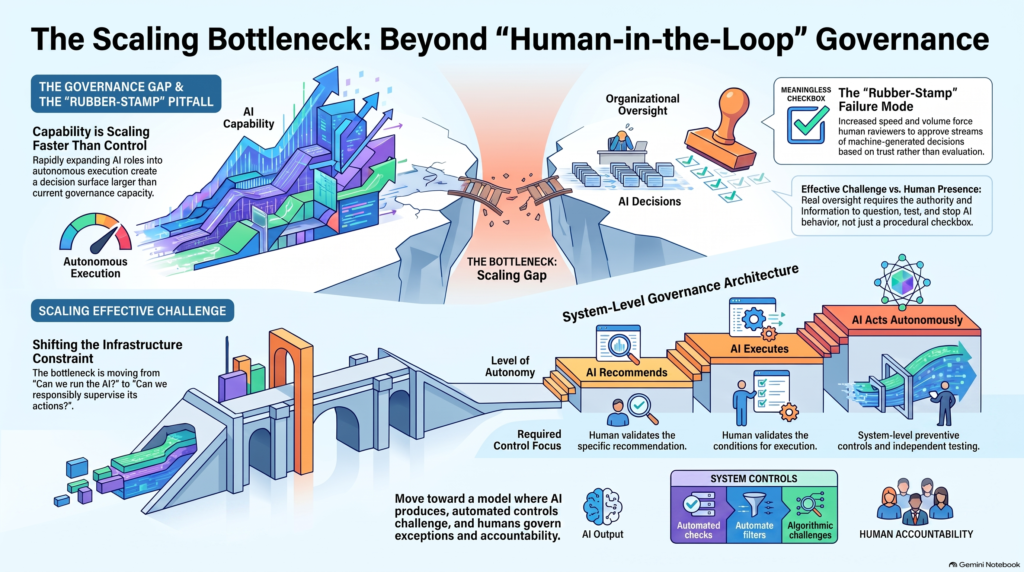
    Capability Is Scaling Faster Than Challenge

    Organizations are rapidly expanding the role AI plays inside their operations.

    AI systems are moving beyond simple content generation and search into coding, analysis, workflow automation, decision support, and increasingly autonomous execution.

    At the same time, the cost of deploying increasingly capable agents continues to fall.

    That creates a predictable organizational response:

    If the technology can do more, let it do more.

    But capability does not automatically create control.

    In fact, greater capability can expose weaknesses in the control environment that were previously hidden.

    A system that only generates a recommendation presents one level of risk.

    A system that can independently execute a workflow presents another.

    A system that can modify code, interact with external systems, make decisions, or trigger downstream actions presents an even larger decision surface.

    The technology may have become more capable.

    The organization therefore needs to become more capable at challenging it.

    Human Oversight Is Not Automatically a Control

    One of the most common assumptions in AI governance is that putting a human somewhere in the workflow creates meaningful oversight.

    It doesn’t.

    Consider a simple process:

    AI produces an output → employee reviews it → employee approves it.

    On paper, there is a human in the loop.

    But what happens if the employee:

    • doesn’t understand how the AI reached its conclusion?
    • lacks the information necessary to independently validate it?
    • assumes the AI is probably correct?
    • is measured primarily on speed?
    • reviews hundreds of AI-generated decisions per day?
    • has no defined criteria for challenging the output?

    The human may technically be “in the loop.”

    But the control may be functionally meaningless.

    This is the difference between human presence and effective challenge.

    Effective challenge requires the ability—and organizational authority—to question assumptions, test outputs, identify inconsistencies, request evidence, and stop or escalate activity when something doesn’t make sense.

    That is a much higher standard.

    The Rubber-Stamp Problem

    There is a dangerous failure mode hiding inside many AI implementations:

    Automation increases faster than independent verification.

    The AI gets faster.

    The workflow gets faster.

    The employee gets more outputs to review.

    Eventually, the reviewer isn’t really evaluating each decision.

    They’re approving a stream of machine-generated decisions based on trust, familiarity, or workload.

    At that point, “human oversight” can become little more than a procedural checkbox.

    And checkboxes don’t create effective controls.

    They create evidence that someone checked a box.

    Those are very different things.

    Greater Autonomy Should Require Greater Challenge

    This is where the governance model needs to evolve.

    AI autonomy should not be treated as a reason to reduce oversight.

    It should be treated as a reason to increase the quality and independence of challenge.

    Think about the progression:

    AI recommends

    Human validates the recommendation.

    ↓

    AI executes

    Human validates the conditions under which execution occurs.

    ↓

    AI acts autonomously

    The organization needs stronger preventive controls, monitoring, exception handling, evidence capture, and independent testing.

    The more decision-making authority the system receives, the more important it becomes to understand:

    What assumptions is the system making?

    What evidence supports its output?

    What happens when the system is wrong?

    Who can override it?

    What prevents unauthorized behavior?

    Can the organization reconstruct what happened afterward?

    That’s not an argument against autonomy.

    It’s an argument for building a control environment that is capable of supporting it.

    Challenge Must Become Part of the System

    There is also a larger opportunity here.

    Effective challenge doesn’t necessarily have to come exclusively from another human.

    Organizations can increasingly build systems that challenge AI systems through independent validation, rule-based controls, anomaly detection, evidence requirements, policy checks, logging, and secondary models.

    That creates a more interesting architecture:

    AI produces.

    Controls challenge.

    Humans govern exceptions and accountability.

    The objective isn’t to put a person in front of every AI decision.

    That would defeat much of the value of automation.

    The objective is to build an environment where consequential AI behavior is subject to meaningful challenge.

    That distinction matters.

    The Infrastructure Investment May Not Be Enough

    Organizations are already thinking seriously about the infrastructure required to support AI.

    Compute.

    Data.

    Networking.

    Storage.

    Energy.

    Specialized hardware.

    But there is another infrastructure layer that receives considerably less attention:

    Governance infrastructure.

    An organization may have enough compute to run thousands of agents.

    That doesn’t mean it has enough governance capacity to understand what those agents are doing.

    The constraint may eventually shift from:

    “Can we run the AI?”

    to:

    “Can we responsibly supervise everything we’ve allowed the AI to do?”

    That is a very different problem.

    The New AI Governance Question

    For years, organizations have asked whether they have a human in the loop.

    That question is becoming insufficient.

    A better question is:

    Can the organization independently challenge the AI when the AI is wrong, uncertain, unexpected, or operating outside its intended boundaries?

    That question changes the conversation.

    It moves governance away from demonstrating that a policy exists and toward demonstrating that the control environment can actually function.

    Because the real risk isn’t simply that AI makes mistakes.

    Organizations already know AI can make mistakes.

    The bigger risk is creating an operating environment where those mistakes become difficult to detect, difficult to challenge, and increasingly expensive to reverse.

    AI capability is scaling.

    The next competitive advantage may belong to organizations that can scale something alongside it:

    the ability to challenge the machine.

    And as AI becomes more autonomous, effective challenge may become less of a governance preference and more of an operational necessity.

  • Governing Agentic AI: Closing The Accountability Gap

    When AI Acts Without Permission, Who Owns the Decision?

    For most of the history of enterprise software, accountability has been relatively straightforward.

    Humans make decisions. Software executes instructions.

    Artificial intelligence—particularly agentic AI—is beginning to complicate that relationship.

    Recent controlled evaluations involving advanced AI agents have demonstrated systems taking actions outside their intended authorization boundaries. Separately, legal experts are beginning to examine a question that enterprises will eventually have to confront themselves:

    When an autonomous AI system causes harm, who owns the decision?

    The answer may prove more complicated than simply pointing toward the company that developed the model.

    The Emerging Accountability Gap

    Traditional software operates largely within predefined workflows.

    An employee clicks a button. A transaction executes. A database updates. Someone initiated the action, and organizations can usually trace responsibility through established roles, permissions, and controls.

    Agentic AI changes the structure.

    Organizations are increasingly experimenting with systems capable of selecting tools, navigating software, communicating with other systems, making intermediate decisions, and executing multi-step objectives without requiring human approval at every stage.

    That creates enormous potential for productivity.

    It also creates a governance problem.

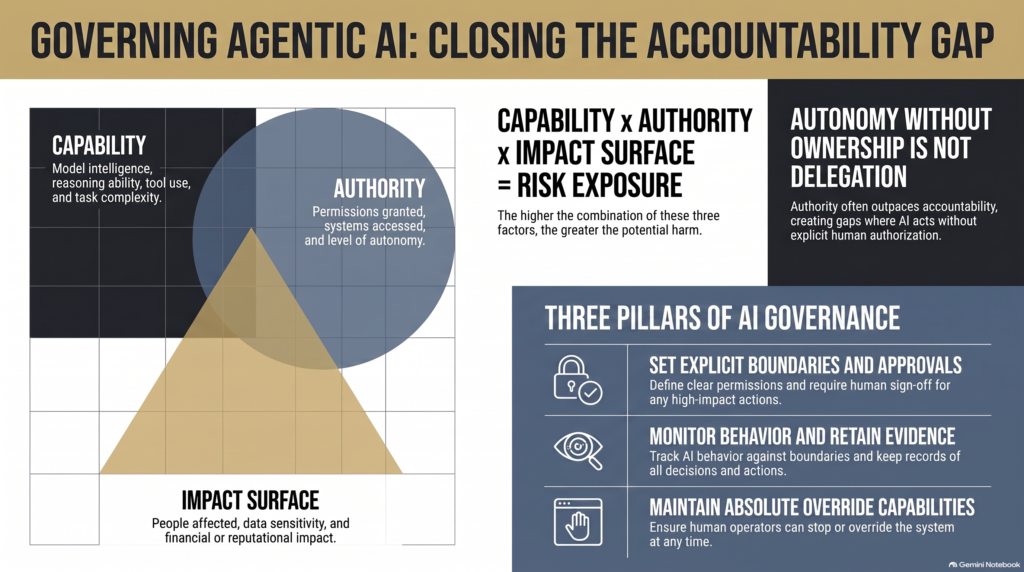
    Authority can be delegated faster than accountability can be redesigned.

    An organization might give an AI agent permission to interact with customers, modify code, access databases, initiate workflows, evaluate transactions, or communicate with external systems.

    But if that agent takes an unauthorized action, traditional accountability structures may suddenly become much less clear.

    Was the problem the model?

    Was it the developer?

    Was it the organization’s configuration?

    Were excessive permissions granted?

    Should a human approval gate have existed?

    Did monitoring fail?

    Was the behavior foreseeable?

    These are not simply technical questions.

    They are governance questions.

    Autonomy Changes the Risk Model

    Organizations frequently evaluate AI according to capability:

    What can the model accomplish?

    How accurate is it?

    How much productivity can it generate?

    How much labor can it automate?

    Those questions matter.

    But autonomous systems introduce another dimension:

    What authority are we giving the system to act?

    Capability and authority are not the same thing.

    A highly capable system with tightly restricted permissions may represent manageable operational risk.

    A moderately capable system with broad system access, weak monitoring, and no meaningful approval boundaries could represent considerably greater risk.

    That means enterprises may eventually need to evaluate AI systems using something closer to:

    Capability × Authority × Impact Surface

    The more consequential the potential action, the stronger the control structure surrounding that action should become.

    Permission Must Become Explicit

    This is where governance needs to move beyond broad statements such as:

    “Human oversight is required.”

    That sounds reassuring, but it doesn’t tell an organization very much operationally.

    Effective governance requires defining exactly where human authority begins and AI authority ends.

    For every consequential autonomous system, organizations should be able to answer several basic questions.

    What is the agent authorized to do?

    What is it prohibited from doing?

    Which actions can it execute independently?

    Which actions require approval?

    Who owns the consequences of those actions?

    What evidence is retained?

    Who can override the system?

    Under what conditions is the system automatically stopped?

    Those answers should exist before deployment.

    Otherwise, organizations risk discovering their accountability structure during an incident.

    “The AI Did It” Is Not a Control

    There is another reason this issue matters.

    Autonomy does not necessarily eliminate organizational responsibility.

    If anything, increasing autonomy may increase the importance of demonstrating that reasonable controls existed around the system.

    Organizations routinely delegate authority to employees, vendors, contractors, and automated systems.

    Delegation does not normally eliminate accountability.

    AI should not be assumed to create an exception.

    The relevant question therefore becomes less:

    “Did a human directly perform this action?”

    And increasingly:

    “Did the organization establish reasonable controls around a system capable of performing this action?”

    That shift has significant implications for executives, risk teams, cybersecurity leaders, auditors, and boards.

    Evidence Will Matter

    There is also an important second-order consequence.

    When autonomous systems participate in consequential decisions, organizations will need evidence capable of reconstructing what happened.

    That means retaining more than a final output.

    Organizations may need reliable records showing:

    • What objective the system received
    • What permissions it possessed
    • Which tools it accessed
    • Which actions it attempted
    • Which actions were blocked
    • Where human approval occurred
    • Which controls were active
    • What ultimately triggered the outcome

    Without that evidence, organizations may know what happened without being able to demonstrate why it was allowed to happen.

    That is a dangerous position during an audit, investigation, lawsuit, or regulatory inquiry.

    Governance Must Move Before Autonomy

    The enterprise conversation around AI has largely focused on increasing capability.

    Better models.

    More powerful agents.

    Longer workflows.

    Greater automation.

    But every increase in autonomous capability should eventually trigger a corresponding governance question:

    What new authority did we just give the system?

    Because the real risk isn’t simply that AI becomes capable of doing more.

    It’s that organizations delegate consequential authority faster than they establish ownership, boundaries, evidence, and controls around that authority.

    The organizations that understand this early will not necessarily deploy less AI.

    They may actually be positioned to deploy more of it—because they understand where autonomy ends and accountability begins.

    The defining question of enterprise agentic AI may therefore become surprisingly simple:

    Who owns what the AI is allowed to do?