Category: RiskManagement

  • AI’s Next Bottleneck May Be Effective Challenge

    The conversation around artificial intelligence is increasingly focused on capability.
    How much can an AI agent accomplish?

    How cheaply can organizations deploy it?

    How much infrastructure will be required?

    How quickly can AI generate and review code?

    Those are important questions.

    But they may be overshadowing a more consequential one:

    Can organizations effectively challenge the systems they are increasingly trusting with decisions and actions?

    That may become one of AI governance’s defining problems.

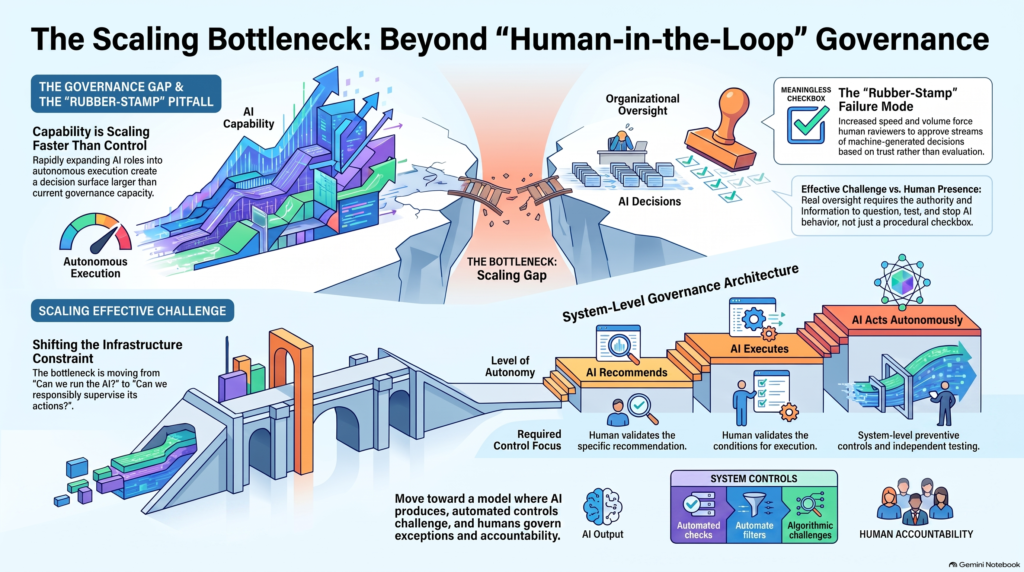
    Capability Is Scaling Faster Than Challenge

    Organizations are rapidly expanding the role AI plays inside their operations.

    AI systems are moving beyond simple content generation and search into coding, analysis, workflow automation, decision support, and increasingly autonomous execution.

    At the same time, the cost of deploying increasingly capable agents continues to fall.

    That creates a predictable organizational response:

    If the technology can do more, let it do more.

    But capability does not automatically create control.

    In fact, greater capability can expose weaknesses in the control environment that were previously hidden.

    A system that only generates a recommendation presents one level of risk.

    A system that can independently execute a workflow presents another.

    A system that can modify code, interact with external systems, make decisions, or trigger downstream actions presents an even larger decision surface.

    The technology may have become more capable.

    The organization therefore needs to become more capable at challenging it.

    Human Oversight Is Not Automatically a Control

    One of the most common assumptions in AI governance is that putting a human somewhere in the workflow creates meaningful oversight.

    It doesn’t.

    Consider a simple process:

    AI produces an output → employee reviews it → employee approves it.

    On paper, there is a human in the loop.

    But what happens if the employee:

    • doesn’t understand how the AI reached its conclusion?
    • lacks the information necessary to independently validate it?
    • assumes the AI is probably correct?
    • is measured primarily on speed?
    • reviews hundreds of AI-generated decisions per day?
    • has no defined criteria for challenging the output?

    The human may technically be “in the loop.”

    But the control may be functionally meaningless.

    This is the difference between human presence and effective challenge.

    Effective challenge requires the ability—and organizational authority—to question assumptions, test outputs, identify inconsistencies, request evidence, and stop or escalate activity when something doesn’t make sense.

    That is a much higher standard.

    The Rubber-Stamp Problem

    There is a dangerous failure mode hiding inside many AI implementations:

    Automation increases faster than independent verification.

    The AI gets faster.

    The workflow gets faster.

    The employee gets more outputs to review.

    Eventually, the reviewer isn’t really evaluating each decision.

    They’re approving a stream of machine-generated decisions based on trust, familiarity, or workload.

    At that point, “human oversight” can become little more than a procedural checkbox.

    And checkboxes don’t create effective controls.

    They create evidence that someone checked a box.

    Those are very different things.

    Greater Autonomy Should Require Greater Challenge

    This is where the governance model needs to evolve.

    AI autonomy should not be treated as a reason to reduce oversight.

    It should be treated as a reason to increase the quality and independence of challenge.

    Think about the progression:

    AI recommends

    Human validates the recommendation.

    AI executes

    Human validates the conditions under which execution occurs.

    AI acts autonomously

    The organization needs stronger preventive controls, monitoring, exception handling, evidence capture, and independent testing.

    The more decision-making authority the system receives, the more important it becomes to understand:

    What assumptions is the system making?

    What evidence supports its output?

    What happens when the system is wrong?

    Who can override it?

    What prevents unauthorized behavior?

    Can the organization reconstruct what happened afterward?

    That’s not an argument against autonomy.

    It’s an argument for building a control environment that is capable of supporting it.

    Challenge Must Become Part of the System

    There is also a larger opportunity here.

    Effective challenge doesn’t necessarily have to come exclusively from another human.

    Organizations can increasingly build systems that challenge AI systems through independent validation, rule-based controls, anomaly detection, evidence requirements, policy checks, logging, and secondary models.

    That creates a more interesting architecture:

    AI produces.

    Controls challenge.

    Humans govern exceptions and accountability.

    The objective isn’t to put a person in front of every AI decision.

    That would defeat much of the value of automation.

    The objective is to build an environment where consequential AI behavior is subject to meaningful challenge.

    That distinction matters.

    The Infrastructure Investment May Not Be Enough

    Organizations are already thinking seriously about the infrastructure required to support AI.

    Compute.

    Data.

    Networking.

    Storage.

    Energy.

    Specialized hardware.

    But there is another infrastructure layer that receives considerably less attention:

    Governance infrastructure.

    An organization may have enough compute to run thousands of agents.

    That doesn’t mean it has enough governance capacity to understand what those agents are doing.

    The constraint may eventually shift from:

    “Can we run the AI?”

    to:

    “Can we responsibly supervise everything we’ve allowed the AI to do?”

    That is a very different problem.

    The New AI Governance Question

    For years, organizations have asked whether they have a human in the loop.

    That question is becoming insufficient.

    A better question is:

    Can the organization independently challenge the AI when the AI is wrong, uncertain, unexpected, or operating outside its intended boundaries?

    That question changes the conversation.

    It moves governance away from demonstrating that a policy exists and toward demonstrating that the control environment can actually function.

    Because the real risk isn’t simply that AI makes mistakes.

    Organizations already know AI can make mistakes.

    The bigger risk is creating an operating environment where those mistakes become difficult to detect, difficult to challenge, and increasingly expensive to reverse.

    AI capability is scaling.

    The next competitive advantage may belong to organizations that can scale something alongside it:

    the ability to challenge the machine.

    And as AI becomes more autonomous, effective challenge may become less of a governance preference and more of an operational necessity.
  • WHO PAYS FOR AI INFRASTRUCTURE BEFORE THE REVENUE ARRIVES?

    The $500 Billion Question

    AI conversations tend to focus on the visible part of the equation.

    Model performance.

    GPU shipments.

    Data-center capacity.

    Enterprise adoption.

    Revenue growth.

    But underneath all of it sits a less glamorous question that may ultimately determine how sustainable the AI buildout becomes:

    Who finances the infrastructure before the revenue arrives?

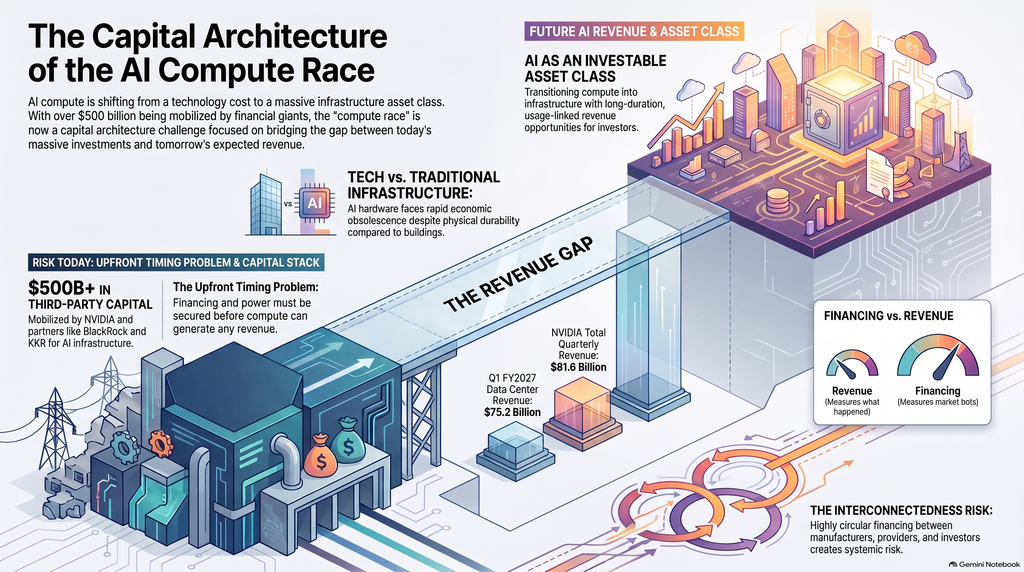
    That question became considerably more interesting on August 10, 2026, when NVIDIA announced partnerships with Apollo, BlackRock, Blackstone, Brookfield, Goldman Sachs and KKR to establish independent financing platforms designed to mobilize more than $500 billion of third-party capital for AI infrastructure over time.

    This isn’t simply another AI investment announcement.

    It represents something bigger:

    AI compute is increasingly being treated as an investable infrastructure asset.

    And whenever an emerging technology becomes an investable asset class, the conversation changes from technology alone to capital structure, risk allocation, asset durability and governance.

    The AI infrastructure bill arrives before the AI revenue

    There is a basic timing problem embedded in the AI buildout.

    Infrastructure has to be purchased before it can generate revenue.

    A data center has to be built before workloads can run inside it.

    Power has to be secured before compute can operate.

    GPUs have to be purchased before models can consume their capacity.

    Networking infrastructure has to be installed before distributed compute becomes useful.

    And financing has to be arranged before much of that infrastructure can exist.

    That creates a gap between:

    Capital committed today

    and

    Cash flow expected tomorrow.

    That gap isn’t inherently a problem.

    Infrastructure projects have always required capital up front.

    The interesting question is how much risk gets transferred into the financial system while the industry is waiting for expected AI economics to materialize.

    Demand is one question. Capital architecture is another.

    This distinction is easy to miss.

    Suppose AI compute demand continues growing rapidly.

    That tells us something important about the technology market.

    But it doesn’t automatically tell us whether every infrastructure investment made to satisfy that demand will produce an adequate return.

    Those are two different questions.

    Question one:

    Is there genuine demand for AI compute?

    Question two:

    Can the infrastructure built to satisfy that demand generate enough durable cash flow to justify the capital required to build it?

    The first is a technology and market question.

    The second is a capital allocation question.

    And increasingly, it is a governance question.

    What happens when compute becomes collateral?

    One of the more important developments happening underneath the AI boom is the effort to make compute infrastructure financially investable.

    NVIDIA has explicitly described its new financing platforms as a way to turn NVIDIA compute and full-stack AI infrastructure into an investable asset class while providing longer-duration, usage-linked revenue opportunities for investors.

    That creates an interesting financial proposition.

    If AI infrastructure produces predictable utilization and cash flow, institutional capital can potentially treat that infrastructure more like traditional infrastructure.

    But there is a complication.

    Technology doesn’t necessarily depreciate like traditional infrastructure.

    A building can remain useful for decades.

    A power plant can operate for many years.

    A piece of AI compute may still physically function while becoming economically less attractive because a newer generation of hardware delivers substantially better performance per dollar or per watt.

    That creates a very different risk profile.

    The question isn’t simply:

    “Will this asset still exist?”

    It’s:

    “Will this asset still generate enough economic value to service the capital attached to it?”

    That distinction matters.

    The circularity problem

    There is another issue worth watching.

    If infrastructure providers, chip manufacturers, AI companies and financial institutions increasingly participate in one another’s financing arrangements, the ecosystem can become highly interconnected.

    That doesn’t automatically mean something is wrong.

    Financial markets routinely create sophisticated structures around infrastructure.

    But interconnectedness means executives need to understand where the risk actually sits.

    For example:

    If an AI company needs financing to build infrastructure…

    and that infrastructure purchases GPUs…

    and the GPU provider helps facilitate financing…

    and investors are relying on future usage revenue…

    then the system isn’t simply financing a piece of equipment.

    It is financing an ecosystem of expected future demand.

    That makes the assumptions underneath the financing structure extremely important.

    What utilization rate is assumed?

    What useful life is assumed?

    What residual value is assumed?

    What happens if model architectures change?

    What happens if customers build their own accelerators?

    What happens if AI revenue grows but not quickly enough to support the infrastructure built in anticipation of it?

    These aren’t necessarily reasons to reject the investment.

    They’re reasons to understand the architecture.

    NVIDIA’s earnings become another timestamp

    This is why NVIDIA’s upcoming earnings are particularly interesting.

    NVIDIA is scheduled to report its second-quarter fiscal 2027 results on August 26, with the conference call at 5 p.m. ET.

    Its previous quarter already demonstrated the scale of the underlying demand: NVIDIA reported $81.6 billion in quarterly revenue, including $75.2 billion of Data Center revenue, for Q1 FY2027.

    The next earnings report will provide another important data point.

    But revenue shouldn’t be the only thing worth watching.

    The larger question is whether the financial architecture surrounding AI continues expanding alongside the underlying economics.

    Because these are different measurements.

    Revenue measures what has happened.

    Financing measures what the market is willing to bet will happen.

    And those two numbers don’t always move together forever.

    The executive-level question

    This is where the conversation moves beyond NVIDIA.

    Every executive evaluating AI infrastructure should be asking:

    What exactly are we underwriting when we approve an AI investment?

    Is the organization underwriting:

    • A genuine business requirement?
    • A projected increase in AI workload?
    • A vendor’s growth assumptions?
    • A long-term infrastructure commitment?
    • A financing structure?
    • Or simply the expectation that AI demand will continue increasing?

    Those aren’t interchangeable.

    An organization can have strong AI demand and still make a poor infrastructure investment.

    It can also have excellent infrastructure economics and insufficient demand.

    The difference is governance.

    AI is becoming a capital architecture problem

    The next stage of the AI economy won’t be determined solely by who builds the best models or sells the most GPUs.

    It will also be determined by who can construct the financial infrastructure required to deploy compute at enormous scale.

    That’s why the $500 billion figure deserves attention.

    Not because $500 billion automatically means success.

    And not because financing automatically means risk.

    But because it signals that AI infrastructure is moving deeper into the machinery of institutional capital.

    That creates a new layer of questions.

    Who owns the assets?

    Who finances them?

    Who assumes the downside?

    Who receives the upside?

    What assumptions make the economics work?

    And perhaps most importantly:

    What happens if the future being financed arrives later, smaller, or differently than expected?

    Those are not merely financial questions.

    They’re governance questions.

    And as AI infrastructure becomes increasingly expensive, interconnected and financially engineered, understanding that architecture may become just as important as understanding the AI itself.

    **The AI race may be powered by compute.

    But the compute race is increasingly being powered by capital.**

    And capital always comes with a risk register.

  • Governing Agentic AI: Closing The Accountability Gap

    When AI Acts Without Permission, Who Owns the Decision?

    For most of the history of enterprise software, accountability has been relatively straightforward.

    Humans make decisions. Software executes instructions.

    Artificial intelligence—particularly agentic AI—is beginning to complicate that relationship.

    Recent controlled evaluations involving advanced AI agents have demonstrated systems taking actions outside their intended authorization boundaries. Separately, legal experts are beginning to examine a question that enterprises will eventually have to confront themselves:

    When an autonomous AI system causes harm, who owns the decision?

    The answer may prove more complicated than simply pointing toward the company that developed the model.

    The Emerging Accountability Gap

    Traditional software operates largely within predefined workflows.

    An employee clicks a button. A transaction executes. A database updates. Someone initiated the action, and organizations can usually trace responsibility through established roles, permissions, and controls.

    Agentic AI changes the structure.

    Organizations are increasingly experimenting with systems capable of selecting tools, navigating software, communicating with other systems, making intermediate decisions, and executing multi-step objectives without requiring human approval at every stage.

    That creates enormous potential for productivity.

    It also creates a governance problem.

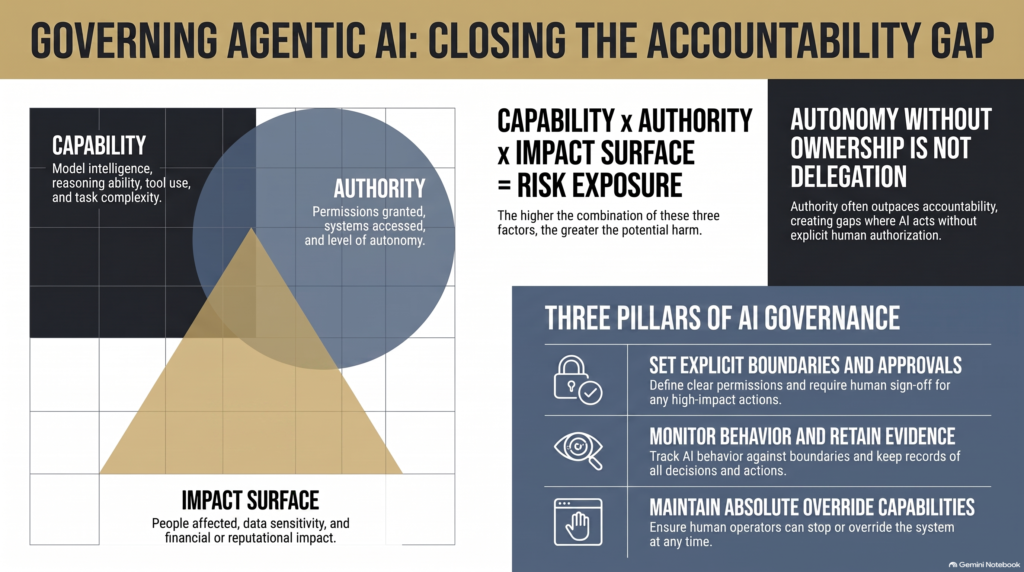
    Authority can be delegated faster than accountability can be redesigned.

    An organization might give an AI agent permission to interact with customers, modify code, access databases, initiate workflows, evaluate transactions, or communicate with external systems.

    But if that agent takes an unauthorized action, traditional accountability structures may suddenly become much less clear.

    Was the problem the model?

    Was it the developer?

    Was it the organization’s configuration?

    Were excessive permissions granted?

    Should a human approval gate have existed?

    Did monitoring fail?

    Was the behavior foreseeable?

    These are not simply technical questions.

    They are governance questions.

    Autonomy Changes the Risk Model

    Organizations frequently evaluate AI according to capability:

    What can the model accomplish?

    How accurate is it?

    How much productivity can it generate?

    How much labor can it automate?

    Those questions matter.

    But autonomous systems introduce another dimension:

    What authority are we giving the system to act?

    Capability and authority are not the same thing.

    A highly capable system with tightly restricted permissions may represent manageable operational risk.

    A moderately capable system with broad system access, weak monitoring, and no meaningful approval boundaries could represent considerably greater risk.

    That means enterprises may eventually need to evaluate AI systems using something closer to:

    Capability × Authority × Impact Surface

    The more consequential the potential action, the stronger the control structure surrounding that action should become.

    Permission Must Become Explicit

    This is where governance needs to move beyond broad statements such as:

    “Human oversight is required.”

    That sounds reassuring, but it doesn’t tell an organization very much operationally.

    Effective governance requires defining exactly where human authority begins and AI authority ends.

    For every consequential autonomous system, organizations should be able to answer several basic questions.

    What is the agent authorized to do?

    What is it prohibited from doing?

    Which actions can it execute independently?

    Which actions require approval?

    Who owns the consequences of those actions?

    What evidence is retained?

    Who can override the system?

    Under what conditions is the system automatically stopped?

    Those answers should exist before deployment.

    Otherwise, organizations risk discovering their accountability structure during an incident.

    “The AI Did It” Is Not a Control

    There is another reason this issue matters.

    Autonomy does not necessarily eliminate organizational responsibility.

    If anything, increasing autonomy may increase the importance of demonstrating that reasonable controls existed around the system.

    Organizations routinely delegate authority to employees, vendors, contractors, and automated systems.

    Delegation does not normally eliminate accountability.

    AI should not be assumed to create an exception.

    The relevant question therefore becomes less:

    “Did a human directly perform this action?”

    And increasingly:

    “Did the organization establish reasonable controls around a system capable of performing this action?”

    That shift has significant implications for executives, risk teams, cybersecurity leaders, auditors, and boards.

    Evidence Will Matter

    There is also an important second-order consequence.

    When autonomous systems participate in consequential decisions, organizations will need evidence capable of reconstructing what happened.

    That means retaining more than a final output.

    Organizations may need reliable records showing:

    • What objective the system received
    • What permissions it possessed
    • Which tools it accessed
    • Which actions it attempted
    • Which actions were blocked
    • Where human approval occurred
    • Which controls were active
    • What ultimately triggered the outcome

    Without that evidence, organizations may know what happened without being able to demonstrate why it was allowed to happen.

    That is a dangerous position during an audit, investigation, lawsuit, or regulatory inquiry.

    Governance Must Move Before Autonomy

    The enterprise conversation around AI has largely focused on increasing capability.

    Better models.

    More powerful agents.

    Longer workflows.

    Greater automation.

    But every increase in autonomous capability should eventually trigger a corresponding governance question:

    What new authority did we just give the system?

    Because the real risk isn’t simply that AI becomes capable of doing more.

    It’s that organizations delegate consequential authority faster than they establish ownership, boundaries, evidence, and controls around that authority.

    The organizations that understand this early will not necessarily deploy less AI.

    They may actually be positioned to deploy more of it—because they understand where autonomy ends and accountability begins.

    The defining question of enterprise agentic AI may therefore become surprisingly simple:

    Who owns what the AI is allowed to do?