Category: EnergyGrid

  • AI Data Centers Are Becoming Large Enough to Require New Reliability Rules

    The growth of large computational loads is changing the operating relationship between data centers and the electric grid. NERC’s new standards point toward a more formal governance model—one that connects facility operations, engineering, and executive oversight to bulk-power-system reliability.

    A data center can be highly resilient inside its fence and still create risks at the grid interface.

    That distinction matters as AI facilities, data centers, and other computational loads grow in scale and connect to the bulk power system. Their electrical demand can change quickly, and their response during a disturbance can affect more than the facility itself. Grid operators need timely information about the load, credible models of its behavior, and clear communication with the people who operate it.

    NERC’s proposed computational-load reliability standards are an effort to establish that foundation.

    From stakeholder ballot to regulatory review

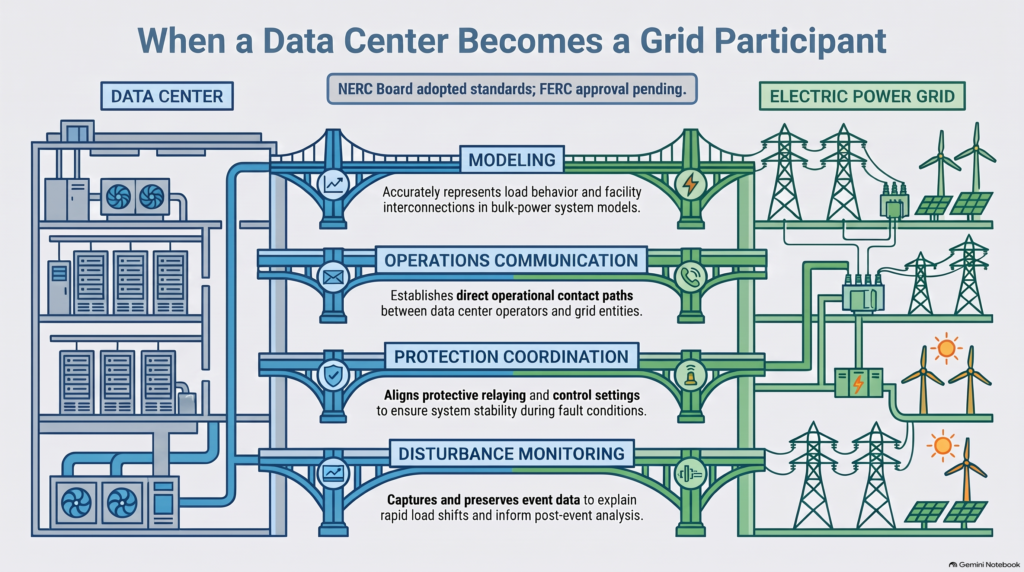
    On October 15, NERC announced that the standards and their implementation plans had passed their final stakeholder ballot. On October 26, NERC’s Board of Trustees adopted the standards. NERC has said it will submit them to the Federal Energy Regulatory Commission for approval in the United States. Until FERC approves them and the applicable implementation period arrives, they are not enforceable U.S. reliability standards. (nerc.com, nerc.com)

    The proposed registry criteria would apply to Computational Load Owners and Computational Load Operators at sites with total connected load of at least 50 MW, supplied through electrical equipment connected at 100 kV or higher. This is a proposed registration threshold—not a claim that every data center or large electricity customer is covered. The related registry criteria also have a separate approval path. (publicpower.org, nerc.com)

    What the standards address

    NERC’s first phase centers on basic capabilities needed to integrate large computational loads reliably. The proposed standards address how loads are interconnected and represented in system models; how facility operators communicate with relevant grid entities; and how protection coordination and disturbance monitoring support reliable operation. The project materials identify three foundational standards—CLO-001-1, CLO-002-1, and CLO-003-1—alongside related revisions to interconnection requirements and studies. (nerc.com)

    These requirements matter because grid reliability depends on a shared operational picture. If the load changes unexpectedly, operators need to understand what happened, how the facility responded, and whether similar behavior could recur. Reliable models, clear communications, coordinated protection, and usable disturbance records help make that possible.

    The governance question for executives

    The standards create a practical governance challenge: responsibility may be split among the entity that owns the site, the entity that operates it, the data-center tenant, the utility, and other grid participants. NERC’s registry revisions establish distinct Computational Load Owner and Computational Load Operator roles, underscoring the need to identify who is accountable for each operational duty. The proposed registry criteria remain subject to FERC approval. (nerc.com)

    Executives should begin with a clear map of ownership and accountability:

    • Assign a responsible executive. Give one leader authority to coordinate energy, engineering, operations, compliance, and external grid relationships.
    • Clarify owner and operator responsibilities. Document who maintains models and protection settings, who communicates with grid entities, who responds to disturbances, and who preserves records.
    • Assess operational readiness. Review procedures, contact paths, escalation authority, and after-hours coverage. A contact list that works only during business hours is not an operating plan.
    • Review data and model quality. Confirm that technical information shared with grid operators reflects current facility design and actual operating behavior.
    • Connect contracts to operating reality. Agreements with tenants, operators, utilities, and service providers should support timely information sharing and coordinated action.
    • Prepare evidence of control. Keep records that show how the facility manages communications, models, protection coordination, and disturbance response.

    This work is useful before a rule becomes enforceable. The goal is not to guess at final compliance obligations; it is to identify gaps early enough to resolve unclear responsibilities, missing data, and fragile operating procedures.

    A first phase, not the finish line

    NERC describes the adopted standards as the first phase of its broader large-load action plan. Additional standards work is underway around computational-load performance, planning and reliability studies, event reporting, and model quality. (nerc.com)

    That points to a wider shift in how data-center readiness will be judged. Power availability, backup generation, and facility uptime remain essential. But large computational facilities also need to show that their grid-facing behavior is understood, communicated, and governed.

    For boards and executive teams, the strategic question is straightforward: Can the organization explain who is responsible for the facility’s effects on the grid, how those responsibilities are carried out, and what evidence shows the controls work?

    As computational loads grow, reliability will depend on that answer being clear before the next disturbance—not reconstructed afterward.
  • The Next AI Infrastructure Bottleneck May Be Electrical Cable

    AI infrastructure is often discussed through its most visible assets: advanced chips, enormous data centers and new sources of power. But those assets only become a functioning system when the supporting electrical infrastructure is available and connected.

    Electrical cable is one of those less visible dependencies—and it may be harder to scale quickly than project announcements suggest.

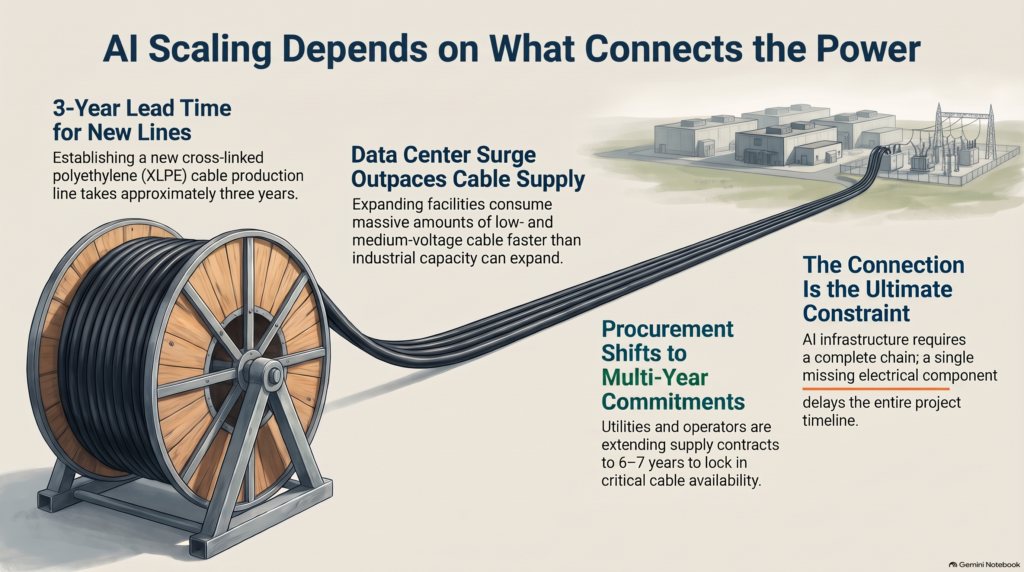
    On October 22, Reuters reported that Nexans CFO Vincent Piquet said cable production capacity is emerging as a bottleneck for AI-driven data-center construction. He described global capacity as tight and said that establishing a new cross-linked polyethylene (XLPE) cable production line, known in the industry as a CV line, takes around three years. 

    That estimate needs to be read precisely. It concerns the time required to establish a new production line. It does not mean that every cable order has a three-year delivery time, nor does it establish that all cable categories are constrained to the same degree.

    Why cable matters to data-center construction

    A data center is not simply a building filled with servers. It needs electrical systems that bring power into the site and distribute it through the facility. Reuters reported that data centers require large amounts of low- and medium-voltage cable for those connections, with larger facilities consuming proportionately more medium-voltage cable. 

    That creates a timing challenge. Demand for a project’s power infrastructure can rise faster than manufacturers can add capacity. Even when a developer has secured land, financing or computing equipment, the project still depends on the availability of components needed to connect and distribute electricity.

    The mismatch is between project urgency and industrial lead time. Data-center developers may want to move quickly, while manufacturing expansion requires investment, equipment, skilled labor and time to bring new lines into service.

    Procurement is already adapting

    The Reuters report also described a change in procurement behavior: French distribution network operator Enedis has moved from annual agreements to contracts lasting six or seven years to secure cable supply. That is one example of a buyer seeking more certainty through longer commitments; it should not be generalized to every market or customer. 

    Still, it points to a wider planning question. When essential components are scarce or slow to expand, procurement becomes part of infrastructure strategy. Buyers may need earlier demand forecasts, longer supplier relationships and clearer visibility into which projects will actually proceed.

    Where the opportunity may be

    The opportunity is broader than cable manufacturing alone. It may include:

    • Manufacturers able to expand the specific cable capacity the market needs.
    • Suppliers of specialized materials, production equipment and related components.
    • Procurement teams that secure supply early and coordinate across project schedules.
    • Developers and utilities that identify long-lead electrical components before construction is underway.

    These are possible areas of opportunity, not guarantees of demand or financial returns. The specific product, market, customer commitments and ability to deliver all matter.

    Nexans’ own October 22 financial release provides a concrete company response: it said it is investing to expand medium-voltage production capacity in Europe and the United States, with data centers among the markets it aims to serve. That confirms Nexans is adding capacity in that area; it does not show that the broader supply constraint has been resolved. 

    The bigger lesson for AI scaling

    The cable story fits a recurring pattern in infrastructure development: the component that limits progress may not be the one receiving the most attention.

    AI capacity depends on a sequence of linked systems—generation, grid connections, substations, electrical distribution, cooling, buildings and computing equipment. A delay in one essential layer can affect the schedule of the whole project.

    For executives, the practical question is not only how much capacity has been announced. It is whether the critical components can be manufactured, delivered and installed on the timeline the project assumes.

    A data center can be planned in megawatts. It still has to be built one connection at a time.

  • AI Infrastructure Debt Is Becoming an Executive Risk Indicator

    The market for AI infrastructure is sending a signal executives should watch: the cost of financing the buildout can change faster than the infrastructure can produce revenue.

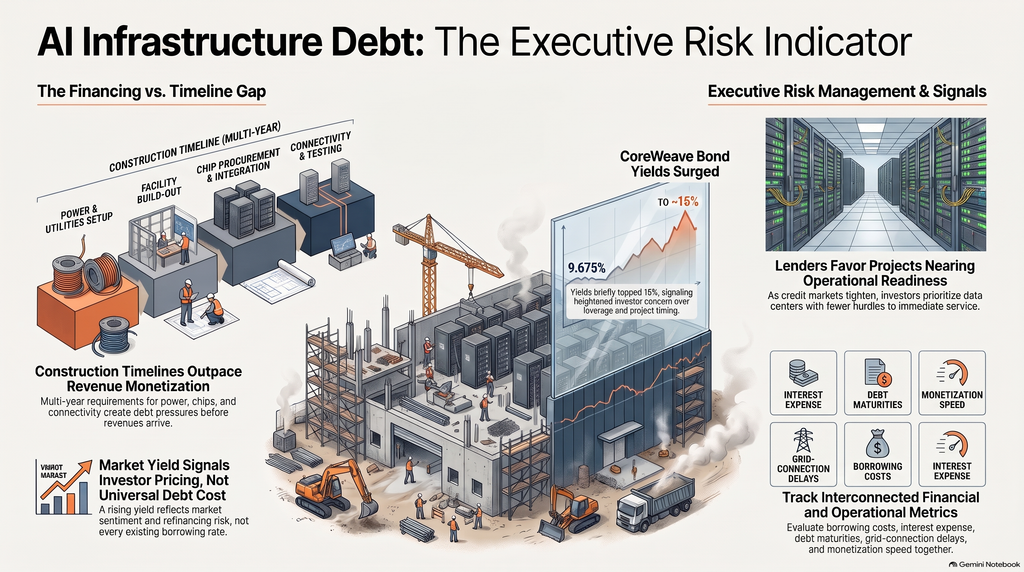
    On October 16, Reuters reported that CoreWeave bonds issued in June at a 9.675% yield had repriced to roughly 15%. The yield briefly moved above 16% during the week. That shift reflects investors demanding much more compensation to hold the company’s debt amid concerns about leverage, borrowing costs, execution risk, and the time required for large infrastructure investments to generate returns. reuters.com

    For executives, the point is not that one bond price predicts the future of AI. It is that financing conditions are becoming a useful indicator of which projects and business models the market considers more exposed. A data center can be strategically important and still face pressure if its debt costs rise before customer revenue catches up.

    That timing matters. AI infrastructure requires substantial investment in chips, power, cooling, buildings, and connectivity. Those assets may take years to plan, build, connect, and bring into productive use. During that period, a company still has to fund construction, service debt, and manage the possibility that equipment or market conditions change.

    A higher market yield does not automatically mean the company will pay that rate on all of its debt. But it can make future borrowing more expensive, complicate refinancing, and influence how investors assess new projects. As credit tightens, lenders may favor projects closer to completion, with clearer paths to service and revenue. Reuters reported that investors were showing preference for data center financings with fewer hurdles before entering operation. reuters.com

    This is a financing signal, not proof that AI demand is collapsing. Demand can remain strong while the economics of building capacity become harder to underwrite. The distinction matters: demand answers whether customers want compute; credit markets help answer whether the infrastructure can be financed at an acceptable cost and on a viable timeline.

    Executives tracking the market should watch several indicators together: borrowing costs, debt maturities, interest expense, construction and grid-connection timelines, customer commitments, and the pace at which new capacity becomes revenue-producing. A rising yield on one issuer is a data point. A pattern across financing costs, project delays, and customer economics would be a stronger signal.

    The executive question is not simply, “Is AI demand growing?” It is: Can this infrastructure be financed, delivered, and monetized before its costs or assumptions change?

    AI infrastructure debt is becoming an executive risk indicator because it makes the distance between planned capacity and productive capacity visible to the market.

  • The Next AI Power Plant May Not Look Like a Traditional Power Plant

    AI infrastructure is changing the conversation about electricity supply. Data centers need large, dependable amounts of power, while new generation and transmission can take years to plan and build. As a result, utilities and technology companies are considering a wider set of generation options.

    American Electric Power’s planned fuel-cell project near Cheyenne, Wyoming, is one example. Announced on October 14, the project is expected to provide 702 megawatts of generation for Google under a 20-year power purchase agreement. AEP estimates the investment at approximately $4 billion. Construction is planned to start in 2026, with the facility expected to be fully operational by the end of 2028. The project company, Cheyenne Fuel Cell LLC, is approximately 92% owned and controlled by AEP, with the remaining ownership held by funds advised by Basalt Infrastructure Partners. 

    Why fuel cells enter the AI power conversation

    Fuel cells generate electricity through an electrochemical process. Unlike a combustion-based generator, they do not burn fuel to produce electricity. Bloom Energy’s solid oxide systems can operate on natural gas, biogas, or hydrogen. This gives developers several possible fuel pathways, though the project’s actual fuel choice and supply arrangements matter to its cost and emissions. 

    The technology can therefore broaden the generation toolkit. A large customer may be able to contract for a dedicated source of on-demand electricity without relying solely on new conventional generation or waiting for grid upgrades to serve every increment of demand. That does not mean fuel cells replace the grid. It means they may become one part of a portfolio that includes grid supply, renewables, storage, conventional generation, and other emerging technologies.

    The scale of this project is also significant. At 702 MW, it is not a small backup installation. It is a large generation development with a substantial capital commitment and a long-term customer relationship. The structure links an energy supplier, a technology provider, an infrastructure investor, and a major electricity customer.

    The contract creates visibility, not certainty

    A 20-year power purchase agreement provides a long-term commercial framework. It signals that Google expects a sustained electricity need in the Cheyenne area and that AEP sees an opportunity to invest in dedicated generation for a large customer. Reuters also reported that Google has a separate arrangement with Black Hills Corp. for generation supporting its proposed data center in the area. 

    However, a long-term agreement does not by itself establish the final price of electricity, the project’s full risk allocation, or its performance over time. The economics will depend on details such as fuel procurement, financing, maintenance, operating costs, construction execution, and the terms that govern availability and performance. Those details are not all provided in the public announcement.

    Emissions claims need to be measured in operation

    AEP says the technology generates electricity without combustion of natural gas and that the project includes plans to integrate carbon-capture technology, with the goal of delivering near-zero-emissions power. Those statements describe the project’s design intent. They are not a published, measured operating emissions result. 

    Fuel-cell generation should not be described as inherently zero-carbon. Bloom notes that systems running on natural gas produce carbon emissions, while fuel choice affects the emissions outcome. The project’s eventual impact will depend on what fuel it uses, how that fuel is sourced, and whether carbon capture is installed and performs as expected. 

    For executives and policymakers, the useful questions are concrete:

    • What fuel will the facility use, and how secure is the supply?
    • What will the delivered power cost over the contract term?
    • What availability and reliability levels are guaranteed?
    • What emissions will be measured at the facility, including any upstream fuel impacts?
    • What carbon-capture system is planned, and how will its performance be verified?
    • What happens if construction, fuel delivery, or equipment performance falls behind plan?

    The broader signal: diversify generation, then verify performance

    The AEP–Google project illustrates a broader shift. AI-related electricity demand is encouraging new commercial arrangements and more varied generation technologies. The potential value of fuel cells is not that they solve every power constraint. It is that they add another possible source of dependable generation that can be evaluated alongside other options.

    The decision standard should remain consistent across technologies: compare delivered cost, dependable output, fuel risk, construction schedule, emissions, and operational performance. A promising configuration becomes useful infrastructure only when it can demonstrate those outcomes.

    The power plant of the AI era may look different from the traditional model. Its business case still has to pass familiar tests.

    How much dependable power will it deliver, at what cost, with what fuel and emissions profile—and can the project prove those results over time?

  • Why a Gigawatt of Electricity Doesn’t Mean a Gigawatt of AI Compute

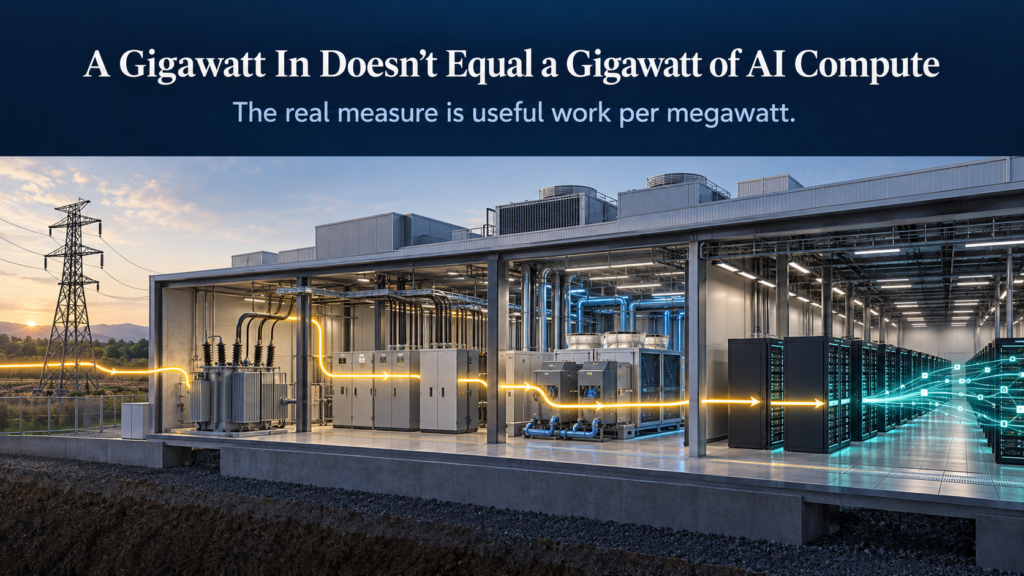
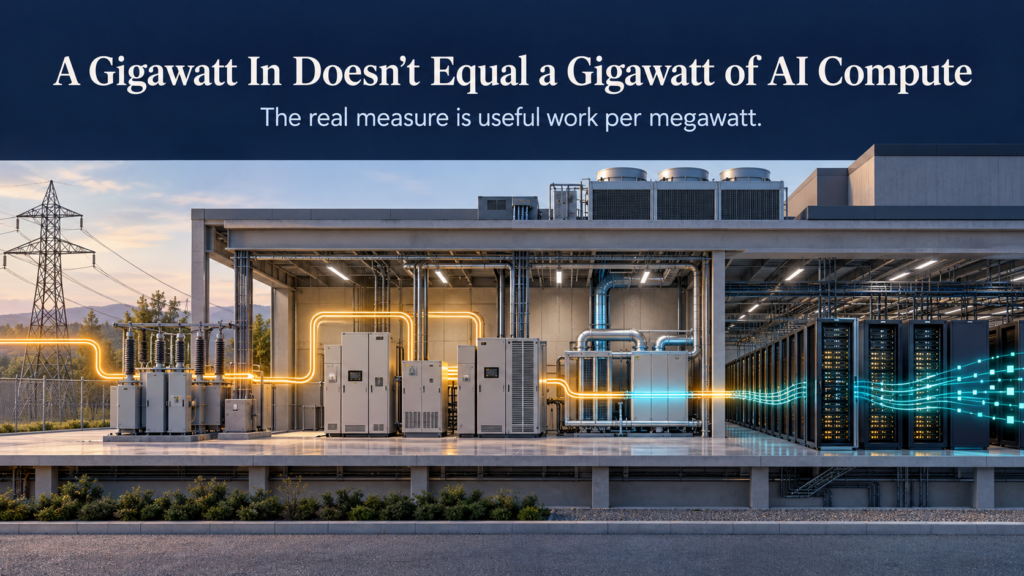
    A data center’s power capacity tells us how much electricity it can draw. It does not tell us how much useful AI work the facility will produce.

    That difference matters as companies compete for power, build larger campuses, and commit billions of dollars to AI infrastructure. A megawatt secured at the grid connection is only the beginning of the measurement.

    Power has to travel through the system

    Electricity entering a data center must be converted and distributed before it reaches computing equipment. The facility also needs cooling, monitoring, backup systems, and other infrastructure to operate reliably.

    Then there is the equipment itself. A GPU can be installed and powered without running at full utilization. A poorly configured rack, a failed component, or a system restart can reduce productive output even while the facility continues to draw power.

    The result is a gap between electricity consumed and useful computation delivered.

    What the reported 60–70% estimate tells us

    On October 14, TechRadar reported remarks from NVIDIA representatives at a Vertiv event suggesting that roughly 60–70% of electricity drawn by some AI data centers supports AI processing. The report described the remaining share as associated with cooling, power distribution and conversion, equipment configuration, failures, and restarts.

    That figure is an industry estimate reported from executive remarks. It is not an independently audited average for all data centers. Facility design, workload, equipment, climate, operating practices, and the way “AI processing” is measured can all affect the result.

    The estimate is still useful as a prompt: capacity figures alone do not reveal how efficiently a facility turns electricity into productive work.

    “Non-compute” power is not automatically waste

    Cooling and backup systems are necessary to keep high-density computing equipment within operating limits and protect service continuity. Power conversion and distribution are also part of delivering electricity safely to the IT load.

    The goal is not to eliminate every watt that does not go directly to a processor. The goal is to understand the full system, reduce avoidable losses, and make sure the infrastructure investment supports dependable output.

    A facility designed for peak demand and contingencies may also have capacity that is not used continuously. That may be appropriate for resilience, but it raises a management question: how much of the available infrastructure is producing useful work under typical operating conditions?

    Measure the output, not just the input

    “Gigawatt of AI compute” is shorthand. A gigawatt measures electrical power; compute output is measured through completed work and system performance.

    For executives, that means asking for more than a facility’s contracted power or nameplate capacity. Useful measures could include:

    • Electricity delivered to the facility and to IT equipment
    • AI workload throughput, such as completed jobs or tokens generated
    • Accelerator utilization and periods of idle or degraded operation
    • Cooling and power-system overhead
    • Availability, restart frequency, and time spent operating below target

    These measures need consistent definitions and a clear time period. A peak result, a design target, and an observed operating average are different kinds of evidence.

    The strategic implication

    When power is scarce, improving the amount of useful computation produced from existing electricity can be as important as securing more supply.

    That makes infrastructure efficiency an operating and capital-allocation issue. Better power delivery, cooling, equipment configuration, workload scheduling, and maintenance may help increase productive output without assuming that every problem can be solved by adding another megawatt.

    The reported 60–70% estimate should be treated as a signal to investigate, not a benchmark to apply blindly. Each operator needs facility-level evidence to understand where power goes and what work it enables.

    The executive question is therefore not only, “How much power can this data center draw?”

    It is: How much useful, reliable AI work does each megawatt deliver—and how do we know?

  • The Grid Can Track AI Demand. But Who Has Authority to Control It?

    FERC’s PJM decision separates load visibility from curtailment authority

    The growth of AI infrastructure is making electricity demand harder to forecast and plan around. Large data centers can require hundreds of megawatts, ramp up over time, and depend on power arrangements that affect regional reliability planning.

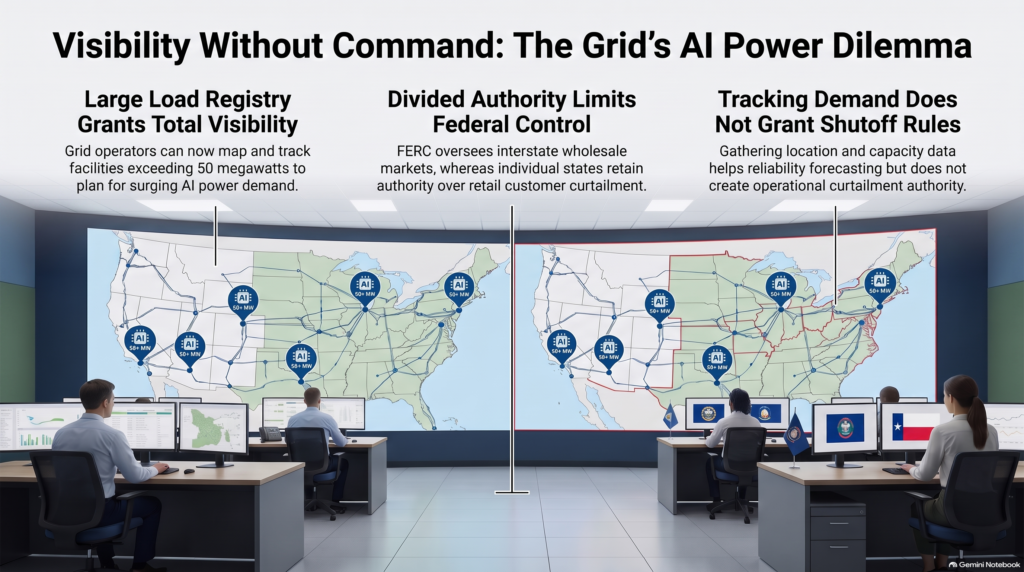
    On October 9, 2026, the Federal Energy Regulatory Commission (FERC) took a step toward improving visibility into that demand. It approved PJM Interconnection’s definition of a “Large Load” and its proposed Large Load Registry. At the same time, FERC rejected much of PJM’s broader proposal for providing interim service to new large loads, including provisions related to curtailment. (elibrary.ferc.gov, utilitydive.com)

    The decision highlights an important regulatory distinction: collecting information about large electricity users is different from deciding when their service can be interrupted.

    What the registry is meant to show

    PJM’s approved definition covers end-use customer load with a cumulative peak of at least 50 megawatts at a single electrical site. The registry is designed to collect information such as a facility’s location, ramp schedule and capacity supply. That information can help PJM understand how large loads may affect forecasts and reliability planning. (elibrary.ferc.gov, utilitydive.com)

    A registry improves visibility. It can help answer questions such as:

    • Where is major new demand expected to connect?
    • How quickly is that demand expected to ramp up?
    • What capacity supply is associated with the load?

    Those are important planning questions. But data collection does not itself create an operational curtailment rule or settle which regulator has authority over a retail customer’s service.

    Why FERC rejected the broader proposal

    PJM’s filing also proposed an Interim Resource Adequacy Service framework for certain new large loads. Under parts of that proposal, eligible loads that did not bring their own new capacity could face load-reduction requests as the system approached an emergency.

    FERC rejected that framework. The Commission said several provisions appeared to place obligations directly on large loads that are, for the most part, retail customers; to dictate which retail customers would be curtailed; and to establish a retail compensation rate. It also found that PJM had not adequately shown that the proposed treatment of those loads would avoid undue discrimination. (utilitydive.com)

    This is where jurisdiction matters. FERC oversees interstate transmission and wholesale market rules. States have a central role in regulating retail electricity service, including determining which retail customers may be curtailed when the system is stressed. FERC’s order treated the issue as a shared regulatory challenge, not as a simple question of whether grid operators can see or manage demand. (utilitydive.com)

    What the decision does—and does not—mean

    The order does not mean large data centers are exempt from every form of curtailment, or that emergency load reduction is off the table. It addresses the specific tariff framework PJM proposed in this filing. FERC also gave PJM direction on issues it would need to address if it revises and resubmits parts of the proposal. (utilitydive.com, headwaterswire.com)

    The distinction is between three separate layers:

    1. Visibility: identifying large loads and gathering information about them.
    2. Grid operations: maintaining system reliability as supply and demand change.
    3. Decision rights: determining which customers can be asked or required to reduce demand, under what rules, and with what protections.

    The registry advances the first layer. The order shows that the third requires careful coordination across federal and state authority, as well as rules that can be defended as fair.

    The governance question behind AI power demand

    For AI infrastructure, the practical issue is not only how much electricity a facility may use. It is also whether the grid and regulators have clear, workable rules for what happens when demand exceeds available supply.

    That requires a complete chain: reliable information about large loads, transparent criteria for reliability actions, clear responsibility for issuing those actions, and consistent treatment across customer classes. Without that chain, the grid may know where demand is growing while decision-makers remain uncertain about who can require it to change.

    The registry can help the grid see the load. It cannot, by itself, determine who has authority to control it.

    Source: FERC, Docket ER26-3515-000, order issued October 9, 2026.

  • The Next AI Megawatt May Come From a Power Plant We Already Built

    As demand for electricity grows, the conversation often turns to new generation: new plants, new transmission, and new infrastructure. Those investments matter. But a recent Google–Constellation agreement points to another part of the supply equation: increasing output from assets that are already operating.

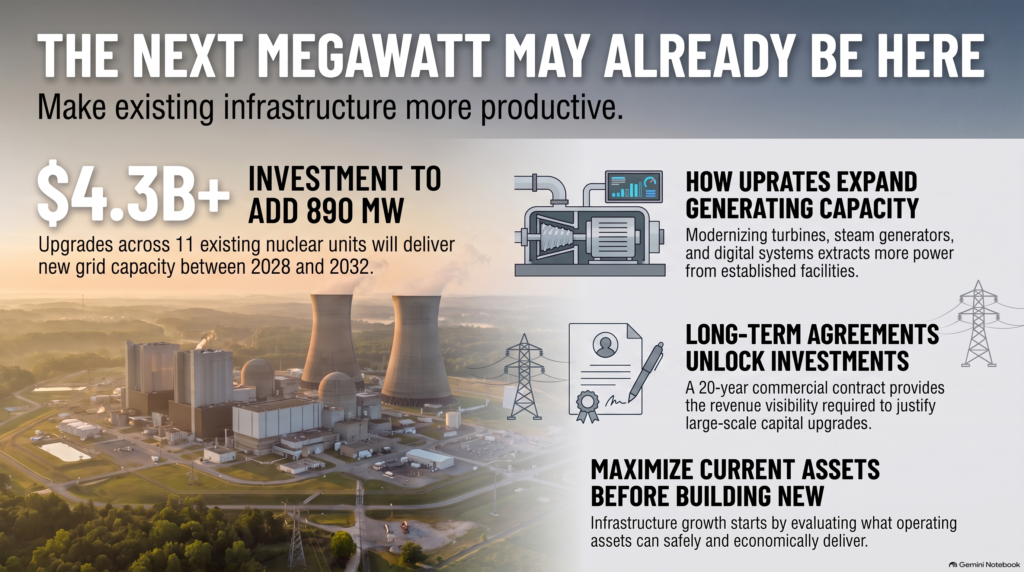
    Announced October 6, the companies’ 20-year power purchase agreement supports upgrades at 11 existing Constellation nuclear units across six sites in Illinois, Pennsylvania, and New Jersey. The upgrades are expected to add 890 megawatts of nuclear capacity to the PJM grid. Constellation says it plans to invest more than $4.3 billion in the work. The first uprate is expected in 2028, with the full 890 MW planned by the end of 2032. 

    This is not a new nuclear plant coming online today. It is a long-term investment plan to increase output from existing reactors.

    What an uprate changes

    A nuclear uprate increases a plant’s generating capacity by upgrading equipment and systems. The companies cite work involving turbines, steam generators, and digital control systems. The goal is to produce more electricity from an existing facility while maintaining the requirements that govern its safe and reliable operation. 

    That distinction matters. An operating plant already has a site, grid connections, and much of the supporting infrastructure. Upgrading it may offer a different development path from building a new facility. But it still requires substantial capital, specialized engineering, regulatory work, construction planning, and time.

    Why the commercial structure matters

    The 20-year agreement provides a long-term customer commitment associated with the planned upgrades. That kind of revenue visibility can help a generator justify capital investment in equipment and capacity improvements.

    The agreement also sits within a larger power arrangement. Google and Constellation signed a separate 15-year supply contract for another 2,700 MW from Constellation’s PJM generation fleet. That supply is not linked to a specific generating source, so it should not be counted as part of the 890 MW of new nuclear capacity. 

    The distinction between the two agreements is useful: one supports planned incremental nuclear capacity; the other provides long-term revenue certainty for existing generation assets.

    The capital-efficiency lesson

    Capital efficiency does not mean avoiding investment. In this case, the announced program includes more than $4.3 billion in planned investment. The efficiency question is whether targeted upgrades to existing assets can add useful capacity while making productive use of infrastructure already in place.

    That is a different question from simply asking how quickly a new plant can be built. It asks whether the current system contains assets with additional potential—and what investment, operational changes, and approvals are needed to realize it.

    The answer will vary by asset and location. An upgrade is not automatically faster, cheaper, or feasible everywhere. The 890 MW is a target for future delivery, with the first uprate expected in 2028 and the full capacity planned by the end of 2032. 

    A broader infrastructure principle

    For executives assessing electricity needs, the agreement offers a useful lens: examine both new supply and the productivity of existing assets. In power, that can mean evaluating uprates, reliability, grid connections, operating performance, and demand flexibility alongside new construction.

    The broader lesson applies across infrastructure. Growth does not always begin with acquiring or building another asset. Sometimes it begins by asking what the current asset base can safely and economically deliver—and what commitment will make the required investment possible.

    The next megawatt may come from a new plant. It may also come from making an existing one work harder.

    Source note: Constellation’s announcement says 890 MW will be added to the PJM grid through the planned nuclear upgrades; Google’s post provides the end-of-2032 target. The separate 2,700 MW agreement is not source-specific. 

  • AI Infrastructure Is Moving From Maximum Capacity to Maximum Certainty

    The AI infrastructure conversation has been dominated by scale: more data centers, more generation, more chips, more gigawatts.

    Scale is still essential. AI workloads need enormous amounts of compute and power. But a large capacity announcement does not, by itself, mean a project can be financed, built, connected, and operated on a dependable schedule.

    That gap is moving to the center of the conversation.

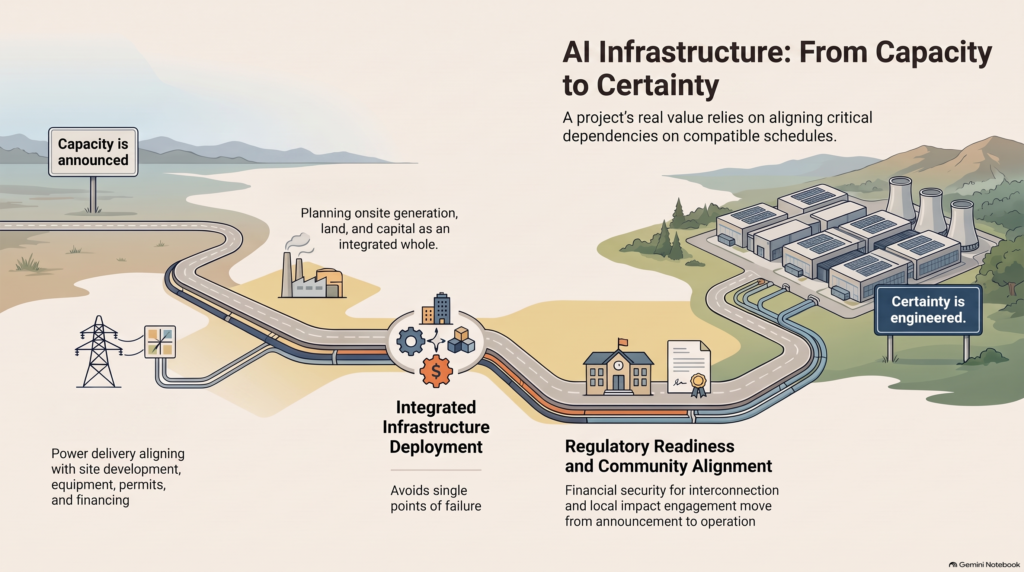
    A project’s real value depends on several linked conditions: a site that can be developed, power that can be delivered, equipment that can be procured, financing that can support the timeline, permits that can be secured, and a community willing to live with the project. If one critical dependency remains uncertain, the announced capacity may be far from usable compute.

    The signals are converging

    Recent developments point toward a more coordinated approach to AI infrastructure.

    In the United States, utility and regulatory processes are placing greater emphasis on whether large-load projects are financially ready and accountable for the infrastructure costs they create. Texas has adopted financial security requirements for large-load interconnection requests, while federal regulators have also focused on cost recovery and protections for existing customers.

    In Japan, a project involving JERA, Dell, and RHAELM brings together power capabilities, a site, data-center development, financing, and AI infrastructure. The project illustrates the appeal of planning these components as an integrated deployment rather than treating them as separate problems to solve one by one.

    Developers are also pursuing onsite generation. Recent reporting describes growing interest in smaller gas turbines and other behind-the-meter options, partly in response to equipment lead times and the challenge of securing grid connections. Onsite power may offer a different schedule path, but it does not erase the trade-offs: fuel supply, permitting, emissions, cost, and the eventual relationship with the grid still matter.

    Community relationships are becoming a more visible part of the infrastructure strategy as well. AWS recently announced a multiyear investment in programs for communities near its U.S. data centers. These commitments do not guarantee public support, but they show that local impact and engagement are now part of the deployment conversation.

    From announced capacity to predictable dependencies

    These examples are different, but they point in the same direction: the challenge is no longer just assembling enough capacity. It is coordinating the conditions that allow capacity to become operational.

    That means executives may need to ask a broader set of questions:

    • Is the power timeline credible, and what assumptions does it depend on?
    • Who pays for the upgrades needed to serve the load?
    • Are land, permits, equipment, and financing progressing on compatible schedules?
    • If grid power is delayed, what alternatives are available—and what new risks do they create?
    • How are local costs, benefits, and concerns being addressed?

    These questions do not replace the traditional focus on capacity. They make the capacity claim more useful by connecting it to execution.

    Certainty as a competitive advantage

    “Certainty” here does not mean that every project outcome is guaranteed. Large infrastructure projects will always involve uncertainty.

    It means that fewer critical dependencies are left unresolved, that assumptions are visible, and that decision-makers have a credible plan for what happens when conditions change.

    As AI infrastructure scales, the strongest projects may not be the ones with the largest headline number. They may be the ones that can show how power, capital, land, equipment, compute, and community considerations fit together—and how the project can move from announcement to operation.

    The optimization target is shifting from “How many gigawatts can we announce?” to “How many dependencies can we make predictable?”

    In AI infrastructure, certainty is becoming part of the product.

  • When a Data Center Load Disappears, the Grid Feels It

    A facility’s protection systems are designed to respond when power conditions move outside safe limits. But when a very large load disconnects or transfers to backup power at once, that protective response can become a grid-level event.

    That is the issue behind PJM’s proposed ride-through requirements for large computational loads, including data centers and cryptocurrency-mining facilities.

    In July 2026, about 3,800 MW of data-center load in northern Virginia transferred from the PJM grid to on-site backup generation after a transmission fault. PJM and Dominion reported voltage and frequency spikes. Operators took action to restore the balance between generation and demand, and PJM reported no significant reliability impacts from the event. 

    The mechanism is straightforward. If a large amount of demand suddenly leaves the grid while generation remains online, generation temporarily exceeds load. That imbalance can push frequency upward. Voltage can also rise, with the system response depending on the location, size, and timing of the load change.

    This does not mean every sudden load transfer will destabilize the grid or cause an outage. The July event was managed. The concern is that repeated or larger events can create operational challenges, especially when the grid has little time to adjust.

    PJM presented a proposal, not a final rule, on September 8. It would set performance expectations for how large computational loads respond within defined voltage and frequency disturbance ranges. It also addresses recovery: after voltage returns to an acceptable range, the proposal calls for load consumption to recover to more than 90% of its pre-disturbance level within two seconds, subject to the proposed conditions. 

    The regulatory status matters. FERC’s June 18 show-cause order asked PJM to address questions about its large-load processes, including whether tariff requirements are needed for ride-through, ramp rates, and load restoration. PJM says it plans to file proposed solutions with FERC in November. The specific ride-through requirements remain under review. 

    For facility owners and engineers, this shifts the design conversation. The question is not only whether the facility can ride through a disturbance internally. It is whether the combined facility response—its protection settings, power systems, backup transfer, and recovery behavior—will be predictable and compatible with grid needs.

    The distinction is important: a protective action can make sense for a single facility and still create a larger system challenge when many facilities react together. As large loads become a bigger part of grid planning, their disturbance response is becoming part of the infrastructure performance discussion.

    Source note: PJM proposal and FERC filing timeline; PJM’s account of the July 22 event. Citations above.

  • The Curtailment Question Data Centers Need to Ask About Air Permits

    Grid flexibility can shift the emissions question

    As electricity demand grows, grid operators are looking for ways to manage periods when supply is tight. Data centers may be asked to reduce demand, and some emergency reliability measures can direct large customers to use onsite backup generation as a last resort.

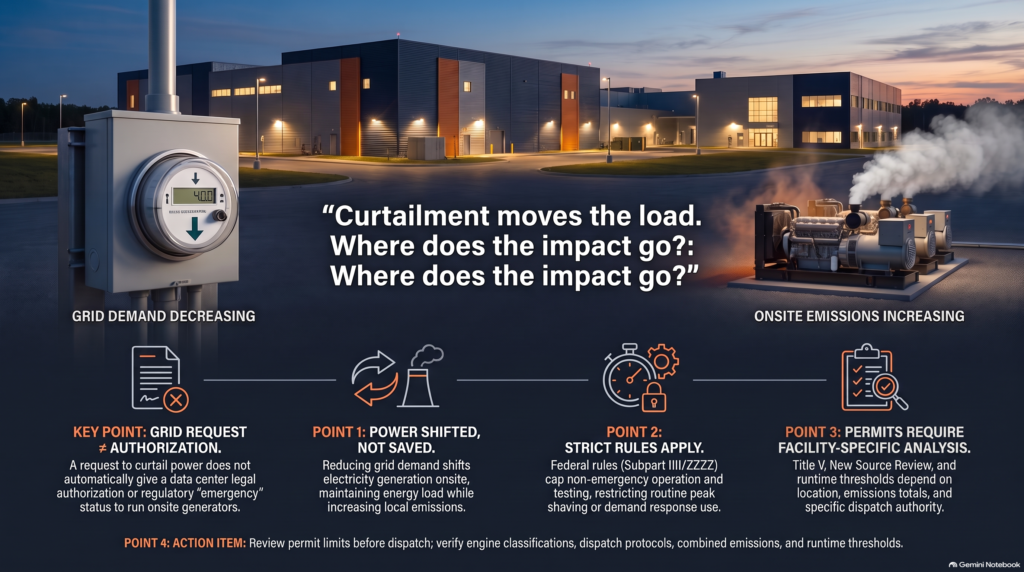
    That creates an important distinction. A facility can reduce the electricity it draws from the grid without reducing its total energy use. If onsite engines take over some or all of the load, the grid sees a reduction in demand—but the facility has shifted where its electricity is produced.

    That shift raises an air-permitting question alongside the electrical one: What operating rules and permit conditions apply to the generators during the event?

    “Emergency generator” is a regulatory status with conditions

    Stationary engines are subject to federal requirements that can include the New Source Performance Standards for compression-ignition engines under 40 CFR Part 60, Subpart IIII, and the RICE NESHAP under 40 CFR Part 63, Subpart ZZZZ.

    For engines regulated under Subpart IIII, the rules distinguish emergency operation from other use. They generally allow up to 100 hours per calendar year for maintenance and testing, with certain non-emergency use limited to as much as 50 hours within that total. The rules restrict using that allowance for ordinary peak shaving or non-emergency demand response, while providing a narrow exception for specified local reliability dispatches.

    The details of a particular grid event matter. EPA has also stated that operation under certain 2026 Department of Energy emergency orders is considered emergency operation for covered stationary engines. Those orders apply in defined circumstances; they do not establish that every curtailment request qualifies as an emergency.

    So “the grid asked us to curtail” is not, by itself, a complete answer. The operator needs to know who issued the dispatch, under what authority or protocol, and how the facility’s permit addresses the proposed operation.

    Permitting consequences require a facility-specific analysis

    A generator’s operating classification is only one part of the permitting picture. Title V and New Source Review requirements depend on factors such as the facility’s potential to emit, pollutant totals, source aggregation, location, and applicable state rules.

    A major-source determination does not automatically mean that every facility will need the same controls. PSD applicability and its requirements—including any BACT determination—depend on the source and the proposed construction or modification. SCR, diesel particulate filters, continuous emissions monitoring, or dispersion modeling may be relevant in particular cases, but they are not universal consequences of a generator being used during a grid event.

    The same care applies to temporary generation. A portable engine used or intended to remain at one location for 12 months or longer can cease to qualify as a nonroad engine under federal rules. That fact alone does not answer every permitting question: source status, emissions aggregation, permit obligations, and enforcement depend on the circumstances and applicable requirements.

    Treat the dispatch plan as an air-permitting input

    Before relying on onsite generation as part of a demand-response or emergency plan, engineering and environmental teams should review:

    • The facility’s permit conditions and engine classifications.
    • The dispatch authority, purpose, and applicable reliability protocol.
    • Runtime limits and how testing or other operation counts toward them.
    • Potential emissions from the engines operating together.
    • Whether planned changes require agency review or a permit revision.

    There may be other ways to manage a grid event, including reducing flexible workloads, shifting computing tasks, using stored energy, or combining approaches. The right mix depends on the facility’s design, reliability obligations, grid program, and permits.

    Curtailment can help manage grid reliability. But the effect depends on what the site actually does. If the response transfers load from the grid to onsite combustion, the plan should account for the emissions and permit implications as carefully as it accounts for electrical continuity.

    The practical question is not only whether the data center can stay online. It is what powers it during the event—and whether that operating plan fits the facility’s air permit.

    Regulatory references