AI infrastructure is often discussed through its most visible assets: advanced chips, enormous data centers and new sources of power. But those assets only become a functioning system when the supporting electrical infrastructure is available and connected.
Electrical cable is one of those less visible dependencies—and it may be harder to scale quickly than project announcements suggest.
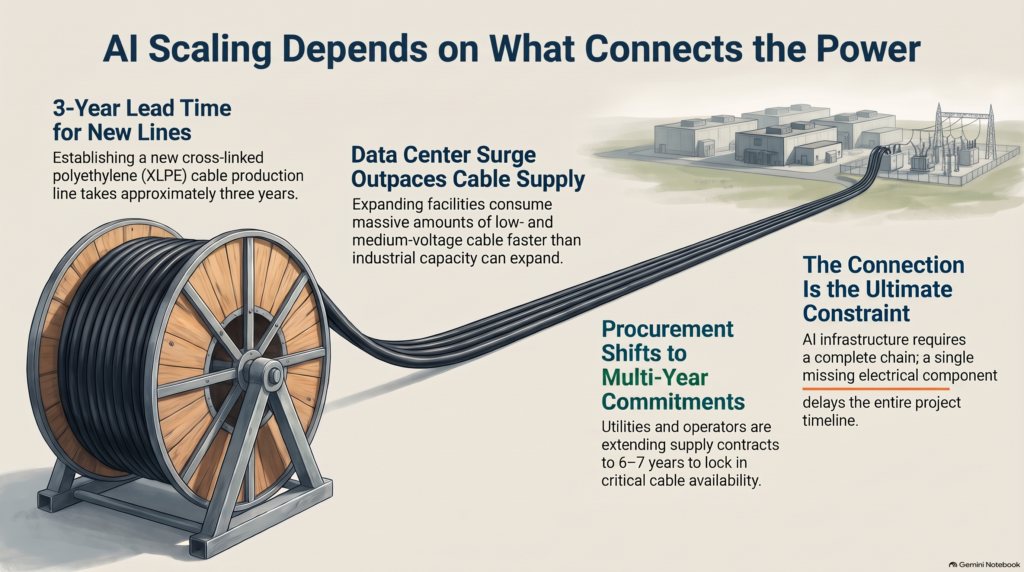
On October 22, Reuters reported that Nexans CFO Vincent Piquet said cable production capacity is emerging as a bottleneck for AI-driven data-center construction. He described global capacity as tight and said that establishing a new cross-linked polyethylene (XLPE) cable production line, known in the industry as a CV line, takes around three years.
That estimate needs to be read precisely. It concerns the time required to establish a new production line. It does not mean that every cable order has a three-year delivery time, nor does it establish that all cable categories are constrained to the same degree.
Why cable matters to data-center construction
A data center is not simply a building filled with servers. It needs electrical systems that bring power into the site and distribute it through the facility. Reuters reported that data centers require large amounts of low- and medium-voltage cable for those connections, with larger facilities consuming proportionately more medium-voltage cable.
That creates a timing challenge. Demand for a project’s power infrastructure can rise faster than manufacturers can add capacity. Even when a developer has secured land, financing or computing equipment, the project still depends on the availability of components needed to connect and distribute electricity.
The mismatch is between project urgency and industrial lead time. Data-center developers may want to move quickly, while manufacturing expansion requires investment, equipment, skilled labor and time to bring new lines into service.
Procurement is already adapting
The Reuters report also described a change in procurement behavior: French distribution network operator Enedis has moved from annual agreements to contracts lasting six or seven years to secure cable supply. That is one example of a buyer seeking more certainty through longer commitments; it should not be generalized to every market or customer.
Still, it points to a wider planning question. When essential components are scarce or slow to expand, procurement becomes part of infrastructure strategy. Buyers may need earlier demand forecasts, longer supplier relationships and clearer visibility into which projects will actually proceed.
Where the opportunity may be
The opportunity is broader than cable manufacturing alone. It may include:
- Manufacturers able to expand the specific cable capacity the market needs.
- Suppliers of specialized materials, production equipment and related components.
- Procurement teams that secure supply early and coordinate across project schedules.
- Developers and utilities that identify long-lead electrical components before construction is underway.
These are possible areas of opportunity, not guarantees of demand or financial returns. The specific product, market, customer commitments and ability to deliver all matter.
Nexans’ own October 22 financial release provides a concrete company response: it said it is investing to expand medium-voltage production capacity in Europe and the United States, with data centers among the markets it aims to serve. That confirms Nexans is adding capacity in that area; it does not show that the broader supply constraint has been resolved.
The bigger lesson for AI scaling
The cable story fits a recurring pattern in infrastructure development: the component that limits progress may not be the one receiving the most attention.
AI capacity depends on a sequence of linked systems—generation, grid connections, substations, electrical distribution, cooling, buildings and computing equipment. A delay in one essential layer can affect the schedule of the whole project.
For executives, the practical question is not only how much capacity has been announced. It is whether the critical components can be manufactured, delivered and installed on the timeline the project assumes.
A data center can be planned in megawatts. It still has to be built one connection at a time.
Leave a Reply