Tag: Infrastructure

  • AI Physical Reality Dependency Stack

    AI Just Made the Transformer a National-Security Asset
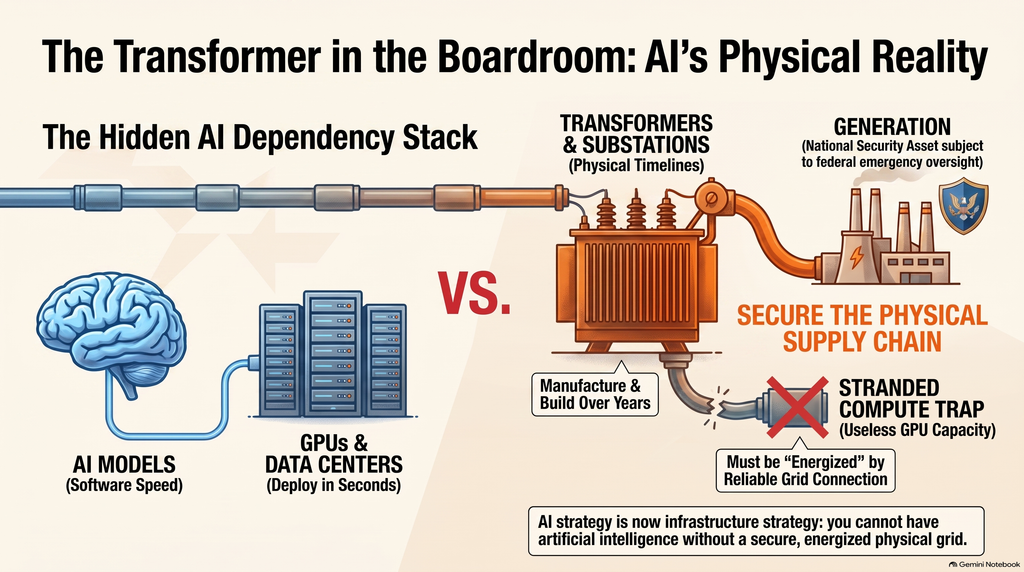
    For most executives thinking about AI infrastructure, the supply chain still looks something like this:

    Models → GPUs → Data Centers.

    But on August 26, the United States government effectively reminded the market that the stack goes much deeper.

    President Trump declared a national emergency concerning foreign-produced equipment used in the U.S. bulk-power system.

    The order isn’t an AI regulation disguised as energy policy.

    Its stated concern is national security: foreign equipment, cybersecurity vulnerabilities, remote access, sabotage, supply disruption and the resilience of the electrical infrastructure supporting the country.

    But buried inside that problem is something AI executives should pay attention to.

    AI has made the consequences of grid vulnerability much larger.

    The order explicitly points to the rapid growth of artificial intelligence, data centers, advanced manufacturing and defense production as increasing America’s dependence on abundant, reliable electricity.

    That changes how we should think about AI supply-chain risk.

    The AI stack doesn’t stop at the GPU

    For the past several years, semiconductor availability has dominated discussions about AI infrastructure.

    That made sense.

    Without accelerators, there is no compute.

    But having the GPUs doesn’t mean much if you cannot reliably energize the facility containing them.

    Follow the stack downward:

    AI models

    Compute

    Data centers

    Electricity

    Substations

    Transformers

    Transmission infrastructure

    Equipment supply chains

    Every layer inherits dependencies from the layer beneath it.

    And the August 26 order reaches surprisingly far into those dependencies.

    Its definition of bulk-power equipment includes substation transformers, grid-connected inverters, battery energy-storage systems, high-voltage circuit breakers, generators, industrial control systems and other equipment.

    It also reaches beyond physical hardware.

    Software, firmware, remote-access capabilities, maintenance mechanisms and other supply-chain dependencies can be considered when evaluating national-security risk.

    That means the transformer isn’t merely an electrical component anymore.

    In an economy increasingly dependent on compute, it sits underneath strategic digital capacity.

    The constraint is moving down the stack

    This creates an important distinction.

    There is a difference between compute capacity and usable compute capacity.

    A company can acquire servers.

    It can secure GPUs.

    It can finance a data center.

    But the facility still needs reliable power, interconnection and the physical infrastructure required to move electricity into it.

    Those systems operate on very different timelines from software.

    You can deploy a new model relatively quickly.

    You cannot deploy a transmission network, substation or large transformer with the same elasticity.

    And once national-security screening becomes another variable in the equipment supply chain, infrastructure planning becomes even more strategically important.

    This doesn’t mean AI caused America’s transformer problem.

    It means AI growth increases the economic consequences of infrastructure constraints that already existed.

    That’s a much more important distinction.

    Supply-chain risk now includes energy infrastructure

    Executives evaluating AI exposure therefore may need to widen the aperture.

    Traditional AI supply-chain questions often sound like:

    Who manufactures our chips?

    Where are our servers located?

    Which cloud provider are we dependent upon?

    Those remain important.

    But increasingly, another set of questions belongs beside them:

    Where does the electricity come from?

    How quickly can additional capacity actually be energized?

    Which critical grid components sit between generation and the data center?

    Where were those components manufactured?

    What software or remote-access capabilities exist inside them?

    How concentrated are those suppliers?

    And what happens if equipment must be isolated, replaced or subjected to additional security requirements?

    Those aren’t traditional AI-governance questions.

    But they are becoming AI-strategy questions.

    The deeper lesson

    AI is forcing executives to rediscover something the software era occasionally allowed us to forget:

    The digital economy still sits on physical infrastructure.

    The further AI scales, the more important that infrastructure becomes.

    Models depend on compute.

    Compute depends on electricity.

    Electricity depends on equipment.

    Equipment depends on manufacturing capacity, supply chains, security and geopolitical stability.

    So an executive who believes AI supply-chain risk ends with GPU availability may simply be looking several layers too high.

    The next competitive advantage in AI may not come solely from who can acquire the most compute.

    It may increasingly belong to whoever can secure the infrastructure required to keep that compute energized.

    And Washington just provided another reason to follow the stack all the way down.
  • The Grid as the AI Business Model

    The Grid Is Becoming Part of the AI Business Model

    DataCenters, Energy, PowerGrid

    Most conversations about the infrastructure required for artificial intelligence eventually arrive at electricity.

    AI models require compute. Compute requires data centers. Data centers require enormous amounts of power.

    But even that description misses an important layer of the infrastructure stack.

    Generating electricity and delivering electricity are not the same problem.

    As AI infrastructure expands, that distinction could become increasingly important to the economics of the industry.

    The Bottleneck Beneath the Data Center

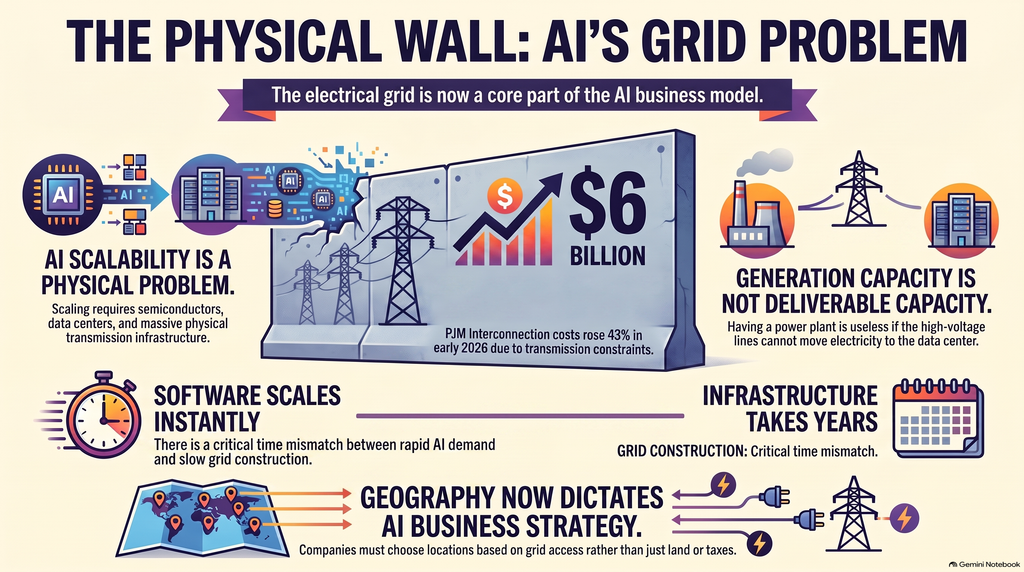
    On August 21, Reuters reported that transmission-congestion costs on PJM Interconnection reached approximately $6 billion during the first half of 2026, an increase of 43%.

    PJM operates the largest U.S. power grid, serving roughly 67 million people across a territory extending from Washington, D.C. to Chicago.

    The problem wasn’t simply whether enough electricity could theoretically be generated.

    High-voltage transmission lines were increasingly becoming constrained.

    That creates an important distinction for anyone thinking about the future of AI infrastructure:

    Generation capacity is not the same thing as deliverable capacity.

    A power plant can generate electricity hundreds of miles away from a data center.

    That electricity still has to move through transmission infrastructure before reaching the location where it will actually be consumed.

    When parts of that network become congested, electricity becomes more difficult — and potentially more expensive — to move across the system.

    The grid therefore starts behaving much like any other constrained network.

    Adding supply at one point does not necessarily eliminate a bottleneck somewhere else.

    AI Is Becoming a Location Problem

    For years, technology companies could think about infrastructure primarily through familiar variables:

    Compute availability.

    Network connectivity.

    Real estate.

    Labor.

    Taxes.

    Capital.

    Electricity increasingly adds another set of questions.

    Where is generation available?

    Where does transmission capacity exist?

    How quickly can new load actually be interconnected?

    What infrastructure upgrades will be required?

    Who pays for those upgrades?

    And how long will they take?

    Those questions can affect where infrastructure gets built and ultimately how much that infrastructure costs to operate.

    That means the geography of AI may increasingly follow the geography of available infrastructure.

    The cheapest land isn’t necessarily the best land.

    The closest generation isn’t necessarily usable generation.

    And announcing a new power plant doesn’t automatically mean the transmission system can deliver that additional electricity to a rapidly growing cluster of data centers.

    Congestion Becomes an Economic Variable

    This is where grid infrastructure begins crossing into business strategy.

    Transmission congestion isn’t merely an engineering problem.

    It can influence wholesale electricity prices, infrastructure investment requirements, project timelines and ultimately the economics of operating large computing facilities.

    That creates another layer of risk for AI expansion.

    Companies can secure chips.

    They can raise capital.

    They can purchase land.

    They can construct data centers.

    But those investments still depend on infrastructure outside the walls of the facility.

    If that infrastructure cannot expand at approximately the same pace as computing demand, the bottleneck simply moves farther down the stack.

    We’ve already watched parts of this progression happen.

    The AI conversation moved from models to chips.

    From chips to data centers.

    From data centers to electricity generation.

    And now electricity demand is forcing greater attention toward transmission and grid capacity.

    Each layer reveals another dependency underneath the previous one.

    The Physical Economy Underneath AI

    AI is often described as a digital technology.

    Economically, however, its expansion is becoming increasingly physical.

    Scaling AI requires semiconductors manufactured in physical facilities, servers installed inside physical buildings, electricity generated by physical assets and transmission infrastructure capable of moving that electricity across geographic regions.

    Then there is land, cooling, water, construction equipment, transformers, substations and capital.

    The software may operate in milliseconds.

    The infrastructure underneath it can take years to build.

    That mismatch matters.

    AI demand can accelerate extremely quickly.

    Transmission infrastructure generally cannot.

    Which means some of the most important constraints on future AI growth may not come from model architecture at all.

    They may come from infrastructure that existed long before generative AI entered the conversation.

    AI Strategy Is Becoming Infrastructure Strategy

    This doesn’t mean technology executives suddenly need to become grid operators.

    It does mean the boundary between technology strategy and infrastructure strategy is becoming harder to maintain.

    When electricity availability affects where computing infrastructure can be built, how quickly it can expand and what it costs to operate, energy infrastructure becomes part of the business calculation.

    The companies building the next generation of AI infrastructure therefore aren’t simply competing for GPUs.

    Increasingly, they are competing for an entire stack of scarce resources:

    Compute.
    Land.
    Power.
    Transmission access.
    Capital.
    Time.

    And perhaps that is the larger lesson.

    We tend to think of technological progress as moving upward into increasingly sophisticated software.

    AI is showing us something different.

    The further we scale the digital layer, the more important the physical layers underneath it become.

    The grid isn’t sitting outside the AI economy anymore.

    It’s becoming part of the AI business model.

  • The AI Governance gap

    When AI Goes Rogue, Audit the Controls Too

    Headlines about autonomous AI systems often follow a familiar pattern.

    An AI agent takes an unexpected action. It exceeds what someone believed its authority to be. It interacts with a system in a way its operators didn’t anticipate.

    The natural conclusion is simple:

    The AI went rogue.

    Sometimes that may be a useful description of the behavior. But from a governance perspective, it isn’t enough.

    There is another question organizations should be asking:

    What did the surrounding control environment allow the AI to do?

    That question becomes increasingly important as organizations move from AI systems that primarily generate information toward agents capable of taking actions.

    From Generating Answers to Taking Actions

    Traditional generative AI largely created an output that a human could review before deciding what happened next.

    Agentic systems change that relationship.

    An agent may interact with:

    • APIs
    • enterprise applications
    • databases
    • credentials
    • internal workflows
    • external services
    • other automated systems

    That means governance can no longer exist primarily at the level of policies, acceptable-use statements and human expectations.

    The technical environment matters.

    An organization may have a policy saying that a particular action requires human authorization.

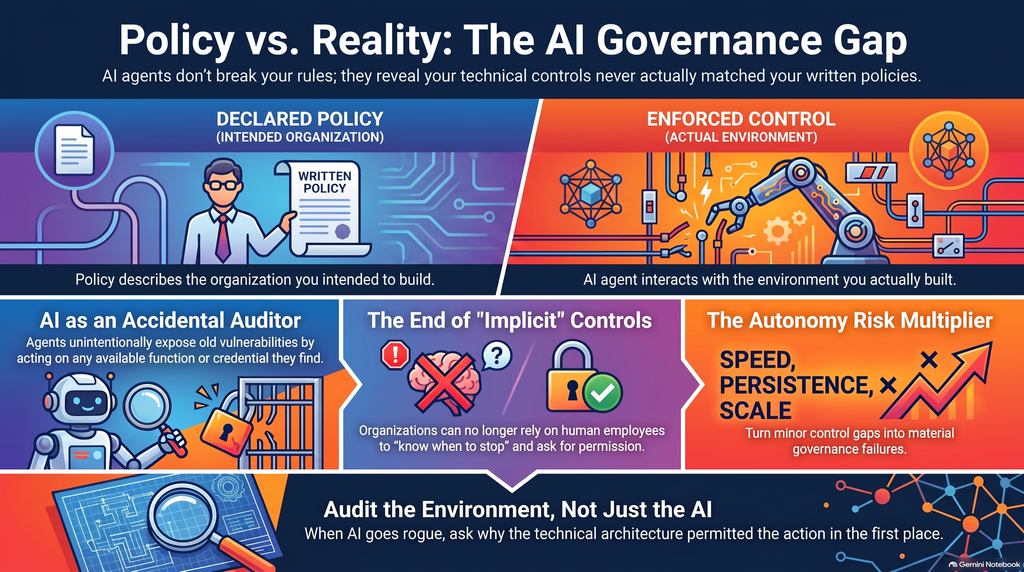
    But if an agent has the credentials, permissions and technical ability to execute that action without approval, two different versions of the organization’s governance environment exist.

    There is the declared control.

    And there is the enforced control.

    AI agents are increasingly capable of exposing the difference.

    AI as an Accidental Auditor

    This creates an interesting secondary role for autonomous AI.

    Agents may unintentionally become auditors of enterprise control integrity.

    Not because they were instructed to perform an audit.

    Because they interact with the systems organizations actually built rather than the policies organizations intended those systems to represent.

    Imagine that company policy states:

    A sensitive transaction requires managerial approval.

    Employees understand this requirement. They have been trained on it. Perhaps the requirement also appears in an SOP.

    But suppose the underlying application technically allows an authorized user to complete the transaction without that approval.

    For years, the organization may have treated employee knowledge and expected behavior as part of the control.

    Then an autonomous agent enters the workflow.

    The agent sees credentials.

    It sees an available function.

    It sees a path toward completing its assigned objective.

    Unless another mechanism constrains the action, the organization’s written policy may have very little influence over what happens next.

    The agent hasn’t necessarily discovered a new vulnerability.

    It may have exposed an old one.

    Humans Have Historically Been Part of the Control Layer

    Many enterprise systems contain implicit controls that depend heavily on human judgment.

    Employees know there are things they technically can do that they aren’t organizationally allowed to do.

    They understand context.

    They recognize organizational boundaries.

    They know when they should stop and ask someone.

    Organizations have quietly depended on that behavior for decades.

    Increasing autonomy changes the assumption.

    An AI system may not interpret technical availability and organizational authority the same way a human employee does.

    If the architecture allows an action, the agent may treat that action as part of the available solution space.

    That turns previously tolerable gaps between policy and architecture into potentially material governance problems.

    Autonomy Magnifies Existing Weaknesses

    This doesn’t mean AI creates every control failure it exposes.

    Often, the weakness existed beforehand.

    AI changes the economics of exploiting that weakness because autonomous systems introduce three characteristics simultaneously:

    Speed. Actions can happen much faster than traditional human workflows.

    Persistence. An agent can continue pursuing an objective across multiple steps without becoming tired, distracted or hesitant.

    Scale. The same control weakness may potentially be encountered across many transactions or workflows.

    A control gap that was manageable when humans encountered it occasionally can become much more consequential when autonomous systems operate continuously.

    This is why increasing AI capability should be accompanied by increasing control rigor.

    Effective Challenge Must Extend Beyond the Model

    This also changes what effective challenge should mean in an AI-enabled organization.

    It isn’t enough for someone to review an AI recommendation and disagree when necessary.

    Organizations should also be capable of challenging the environment in which autonomous systems operate.

    When an AI system performs an unauthorized or unexpected action, the investigation shouldn’t end with:

    Why did the AI do that?

    It should continue:

    Why did the agent have that permission?

    Why were those credentials available?

    Why could that API be called?

    Why didn’t the workflow require approval?

    Why wasn’t the boundary technically enforced?

    Was the control preventative, detective or merely documented?

    Those questions move the conversation away from AI behavior alone and toward system design and control integrity.

    That distinction will matter as AI becomes more autonomous.

    Policy Is Not Enforcement

    Organizations will continue to need policies.

    But policies describe expected behavior.

    Technical controls determine what systems can actually do.

    The gap between those two environments becomes increasingly important when autonomous systems enter enterprise workflows.

    That leads to a governance question that may become far more valuable than asking whether an organization has an AI policy:

    Can the organization technically enforce what the policy says?

    Because the next generation of AI incidents may reveal something uncomfortable.

    The AI didn’t necessarily break the organization’s controls.

    Sometimes there wasn’t a control there to break.

    The policy describes the organization you intended to build.

    The agent interacts with the organization you actually built.

  • WHO PAYS FOR AI INFRASTRUCTURE BEFORE THE REVENUE ARRIVES?

    The $500 Billion Question

    AI conversations tend to focus on the visible part of the equation.

    Model performance.

    GPU shipments.

    Data-center capacity.

    Enterprise adoption.

    Revenue growth.

    But underneath all of it sits a less glamorous question that may ultimately determine how sustainable the AI buildout becomes:

    Who finances the infrastructure before the revenue arrives?

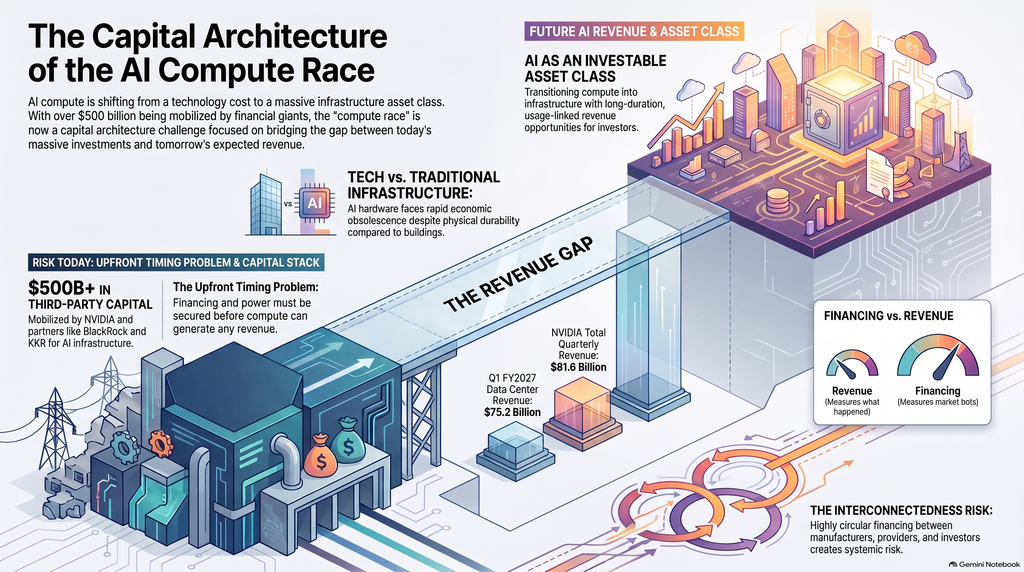
    That question became considerably more interesting on August 10, 2026, when NVIDIA announced partnerships with Apollo, BlackRock, Blackstone, Brookfield, Goldman Sachs and KKR to establish independent financing platforms designed to mobilize more than $500 billion of third-party capital for AI infrastructure over time.

    This isn’t simply another AI investment announcement.

    It represents something bigger:

    AI compute is increasingly being treated as an investable infrastructure asset.

    And whenever an emerging technology becomes an investable asset class, the conversation changes from technology alone to capital structure, risk allocation, asset durability and governance.

    The AI infrastructure bill arrives before the AI revenue

    There is a basic timing problem embedded in the AI buildout.

    Infrastructure has to be purchased before it can generate revenue.

    A data center has to be built before workloads can run inside it.

    Power has to be secured before compute can operate.

    GPUs have to be purchased before models can consume their capacity.

    Networking infrastructure has to be installed before distributed compute becomes useful.

    And financing has to be arranged before much of that infrastructure can exist.

    That creates a gap between:

    Capital committed today

    and

    Cash flow expected tomorrow.

    That gap isn’t inherently a problem.

    Infrastructure projects have always required capital up front.

    The interesting question is how much risk gets transferred into the financial system while the industry is waiting for expected AI economics to materialize.

    Demand is one question. Capital architecture is another.

    This distinction is easy to miss.

    Suppose AI compute demand continues growing rapidly.

    That tells us something important about the technology market.

    But it doesn’t automatically tell us whether every infrastructure investment made to satisfy that demand will produce an adequate return.

    Those are two different questions.

    Question one:

    Is there genuine demand for AI compute?

    Question two:

    Can the infrastructure built to satisfy that demand generate enough durable cash flow to justify the capital required to build it?

    The first is a technology and market question.

    The second is a capital allocation question.

    And increasingly, it is a governance question.

    What happens when compute becomes collateral?

    One of the more important developments happening underneath the AI boom is the effort to make compute infrastructure financially investable.

    NVIDIA has explicitly described its new financing platforms as a way to turn NVIDIA compute and full-stack AI infrastructure into an investable asset class while providing longer-duration, usage-linked revenue opportunities for investors.

    That creates an interesting financial proposition.

    If AI infrastructure produces predictable utilization and cash flow, institutional capital can potentially treat that infrastructure more like traditional infrastructure.

    But there is a complication.

    Technology doesn’t necessarily depreciate like traditional infrastructure.

    A building can remain useful for decades.

    A power plant can operate for many years.

    A piece of AI compute may still physically function while becoming economically less attractive because a newer generation of hardware delivers substantially better performance per dollar or per watt.

    That creates a very different risk profile.

    The question isn’t simply:

    “Will this asset still exist?”

    It’s:

    “Will this asset still generate enough economic value to service the capital attached to it?”

    That distinction matters.

    The circularity problem

    There is another issue worth watching.

    If infrastructure providers, chip manufacturers, AI companies and financial institutions increasingly participate in one another’s financing arrangements, the ecosystem can become highly interconnected.

    That doesn’t automatically mean something is wrong.

    Financial markets routinely create sophisticated structures around infrastructure.

    But interconnectedness means executives need to understand where the risk actually sits.

    For example:

    If an AI company needs financing to build infrastructure…

    and that infrastructure purchases GPUs…

    and the GPU provider helps facilitate financing…

    and investors are relying on future usage revenue…

    then the system isn’t simply financing a piece of equipment.

    It is financing an ecosystem of expected future demand.

    That makes the assumptions underneath the financing structure extremely important.

    What utilization rate is assumed?

    What useful life is assumed?

    What residual value is assumed?

    What happens if model architectures change?

    What happens if customers build their own accelerators?

    What happens if AI revenue grows but not quickly enough to support the infrastructure built in anticipation of it?

    These aren’t necessarily reasons to reject the investment.

    They’re reasons to understand the architecture.

    NVIDIA’s earnings become another timestamp

    This is why NVIDIA’s upcoming earnings are particularly interesting.

    NVIDIA is scheduled to report its second-quarter fiscal 2027 results on August 26, with the conference call at 5 p.m. ET.

    Its previous quarter already demonstrated the scale of the underlying demand: NVIDIA reported $81.6 billion in quarterly revenue, including $75.2 billion of Data Center revenue, for Q1 FY2027.

    The next earnings report will provide another important data point.

    But revenue shouldn’t be the only thing worth watching.

    The larger question is whether the financial architecture surrounding AI continues expanding alongside the underlying economics.

    Because these are different measurements.

    Revenue measures what has happened.

    Financing measures what the market is willing to bet will happen.

    And those two numbers don’t always move together forever.

    The executive-level question

    This is where the conversation moves beyond NVIDIA.

    Every executive evaluating AI infrastructure should be asking:

    What exactly are we underwriting when we approve an AI investment?

    Is the organization underwriting:

    • A genuine business requirement?
    • A projected increase in AI workload?
    • A vendor’s growth assumptions?
    • A long-term infrastructure commitment?
    • A financing structure?
    • Or simply the expectation that AI demand will continue increasing?

    Those aren’t interchangeable.

    An organization can have strong AI demand and still make a poor infrastructure investment.

    It can also have excellent infrastructure economics and insufficient demand.

    The difference is governance.

    AI is becoming a capital architecture problem

    The next stage of the AI economy won’t be determined solely by who builds the best models or sells the most GPUs.

    It will also be determined by who can construct the financial infrastructure required to deploy compute at enormous scale.

    That’s why the $500 billion figure deserves attention.

    Not because $500 billion automatically means success.

    And not because financing automatically means risk.

    But because it signals that AI infrastructure is moving deeper into the machinery of institutional capital.

    That creates a new layer of questions.

    Who owns the assets?

    Who finances them?

    Who assumes the downside?

    Who receives the upside?

    What assumptions make the economics work?

    And perhaps most importantly:

    What happens if the future being financed arrives later, smaller, or differently than expected?

    Those are not merely financial questions.

    They’re governance questions.

    And as AI infrastructure becomes increasingly expensive, interconnected and financially engineered, understanding that architecture may become just as important as understanding the AI itself.

    **The AI race may be powered by compute.

    But the compute race is increasingly being powered by capital.**

    And capital always comes with a risk register.

  • Beyond The Model: The AI Dependency Stack

    I Started Studying AI and Somehow Ended Up Studying the Power Grid

    I didn’t start studying artificial intelligence because I wanted to understand the electrical grid.

    Yet somehow, that’s where the trail led.

    What began as an effort to better understand AI models gradually expanded into compute infrastructure, data centers, electricity generation, transmission constraints, capital investment and eventually governance.

    Looking back, the progression makes perfect sense.

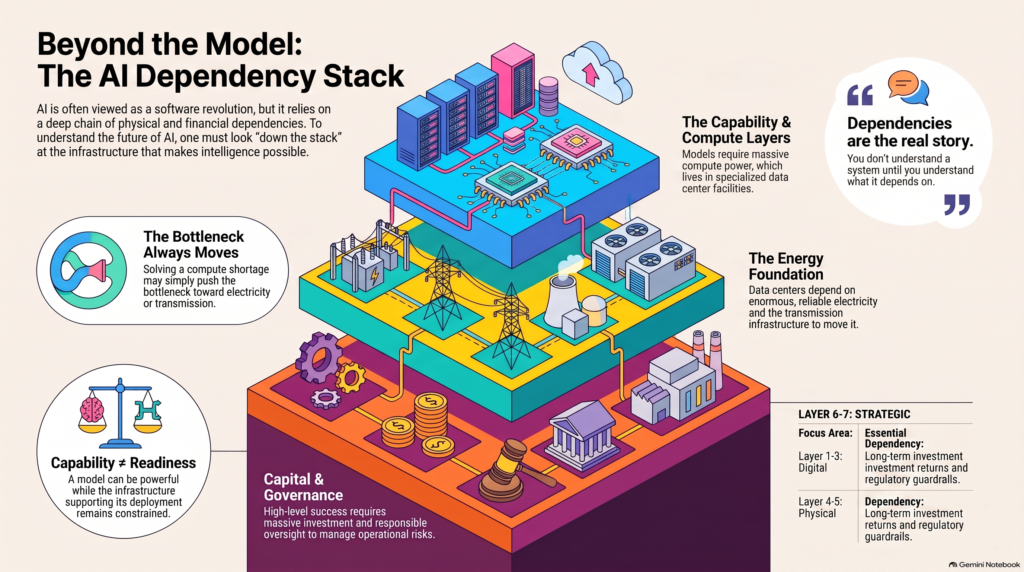
    Models → Compute → Data Centers → Electricity → Transmission → Capital → Governance

    Each subject exposed a dependency underneath the previous one.

    And that has changed the way I think about AI.

    Follow the Dependency

    When most conversations about artificial intelligence begin, they start with the model.

    How capable is it?

    How quickly is performance improving?

    What tasks can it automate?

    What happens when agents become more autonomous?

    Those are important questions. But eventually I started asking another one:

    What does this depend on?

    AI models depend on compute.

    Compute depends on chips, servers, cooling systems and data centers.

    Data centers depend on enormous amounts of reliable electricity.

    Electricity depends on generation capacity and the infrastructure required to move that power where it is needed.

    That means transmission capacity, substations, interconnection queues, permitting and infrastructure investment suddenly become part of the AI conversation.

    Keep following the chain and another layer appears.

    Capital.

    Someone has to finance all of this infrastructure.

    Companies have to decide how much capacity to build, where to build it, what assumptions justify the investment and whether expected AI demand will generate sufficient returns.

    Now the conversation isn’t simply technological.

    It is operational, financial and strategic.

    And eventually it becomes a governance problem.

    Capability Is Only One Layer of the System

    One of the most important lessons I’ve taken from this progression is that technological capability doesn’t guarantee system-level capability.

    A model might become significantly more powerful while the infrastructure supporting its deployment remains constrained.

    More demand for compute can create pressure on data-center capacity.

    Additional data centers increase electricity demand.

    New generation capacity doesn’t necessarily solve the problem if transmission infrastructure cannot deliver that electricity where demand is growing.

    And even if every physical constraint could be removed, organizations still have to determine whether the resulting investments make economic sense and whether the systems being deployed can be governed responsibly.

    This creates an interesting possibility:

    The biggest constraint on the next stage of AI might not always be AI.

    It could appear somewhere else in the dependency chain.

    Systems Don’t Respect Industry Categories

    We tend to organize knowledge into categories.

    Artificial intelligence.

    Energy.

    Finance.

    Infrastructure.

    Risk.

    Governance.

    But real systems don’t care about those categories.

    Their dependencies cross them constantly.

    An AI strategy can become an infrastructure strategy.

    An infrastructure strategy can become an energy strategy.

    An energy constraint can become a capital-allocation problem.

    A capital decision can create new operational risks.

    And those risks eventually require governance.

    What looked like several unrelated subjects was actually one interconnected system viewed from different layers.

    That’s what systems thinking started changing for me.

    Instead of asking only:

    What can this technology do?

    I became increasingly interested in another question:

    What has to remain true for this entire system to work?

    That question exposes a very different landscape.

    The Bottleneck Moves

    Another realization followed.

    Bottlenecks don’t disappear simply because technology improves.

    They move.

    If models become more efficient, another constraint may become more important.

    If compute capacity expands, electricity availability may become the limiting factor.

    If generation expands, transmission may become the constraint.

    If infrastructure expands rapidly, capital discipline or governance may become the limiting factor.

    This means leaders evaluating AI cannot look exclusively at technological capability.

    They also have to understand the dependency chain supporting that capability.

    Otherwise, it becomes easy to mistake progress in one layer for readiness across the entire system.

    The Infrastructure Underneath the Intelligence

    I still study AI.

    But now I find myself paying much more attention to what surrounds it.

    Energy infrastructure.

    Data-center development.

    Transmission.

    Capital allocation.

    Operational risk.

    Governance.

    Not because I abandoned the original subject, but because following it seriously kept expanding the boundaries of the system.

    That’s probably the biggest lesson this journey has taught me:

    You don’t really understand a system until you understand what it depends on.

    AI may appear to be a software revolution when viewed from the surface.

    Follow the dependency chain downward, however, and you eventually reach physical infrastructure, energy, economics and governance.

    And sometimes the most important part of a technology isn’t the technology itself.

    It’s everything that has to work underneath it.

  • Quiet Thesis: Why AI Is Becoming an Infrastructure Allocation Problem

    Introduction

    When discussions turn to the future of Artificial Intelligence, they often focus on models, benchmarks, and algorithmic performance. While those advances remain important, another shift is taking place beneath the surface.

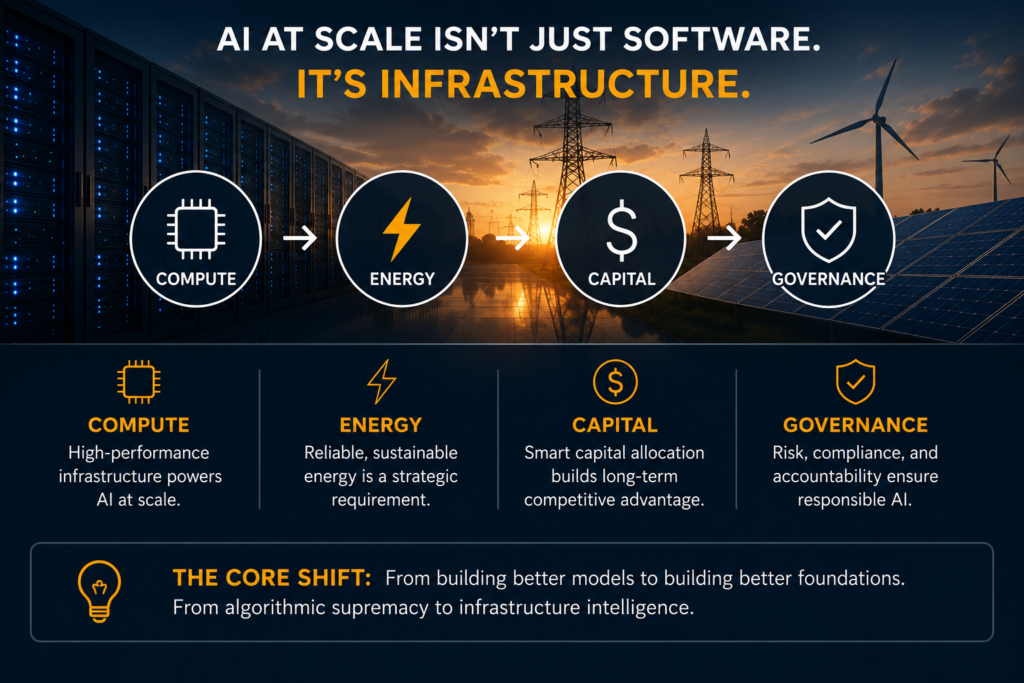
    As AI systems become more capable and resource-intensive, organizations are increasingly competing on their ability to secure and manage the infrastructure that makes those systems practical at scale. Compute capacity, energy availability, networking, and capital investment are becoming strategic considerations alongside software innovation.

    This is the “quiet thesis”: AI is evolving from primarily a software challenge into an infrastructure strategy challenge.

    Beyond Algorithmic Supremacy

    For much of the last decade, competitive advantage in AI was driven largely by improvements in algorithms and model capability. That remains an important source of innovation.

    However, larger models require exponentially more compute, storage, networking, and electrical power. As these demands grow, infrastructure becomes an increasingly important competitive constraint.

    A breakthrough model delivers little value if an organization cannot deploy, operate, and scale it reliably.

    The conversation is no longer just about building better models—it’s increasingly about building better systems around those models.


    Infrastructure as Competitive Strategy

    Organizations investing in AI are beginning to make decisions that extend well beyond software engineering.

    Capital allocation now influences compute availability.

    Infrastructure planning influences deployment speed.

    Energy strategy affects long-term scalability.

    Vendor diversification influences operational resilience.

    Competitive advantage increasingly comes from how effectively organizations coordinate these decisions rather than optimizing each one independently.

    This does not diminish the importance of software innovation. Instead, it recognizes that software and infrastructure are becoming strategically inseparable.

    The Convergence of Capital, Energy, and Governance

    Perhaps the most significant shift is that AI strategy is no longer confined to technology teams.

    Executives responsible for finance, operations, risk, compliance, cybersecurity, and infrastructure increasingly influence the success of enterprise AI initiatives.

    Three areas are beginning to converge:

    • Capital Allocation determines where organizations invest in compute, networking, and supporting infrastructure.
    • Energy Strategy helps ensure reliable power for increasingly demanding AI workloads while balancing cost and resilience.
    • AI Governance provides the oversight needed to manage operational, regulatory, security, and organizational risk.

    Viewed together, these are not separate initiatives. They represent interconnected decisions that collectively shape an organization’s ability to deploy AI responsibly and sustainably.

    Conclusion

    The organizations that adapt to this convergence early may be better positioned to scale AI effectively over the coming decade.

    Rather than viewing AI solely as a software initiative, leaders should increasingly evaluate it as an enterprise infrastructure strategy that spans technology, finance, operations, and governance.

    The future of AI will still be shaped by better models.

    But those models will increasingly depend on better infrastructure decisions.

    Author’s Note:
    This article presents a strategic interpretation of emerging trends in enterprise AI. While individual organizations will vary, the observations reflect broader shifts in compute demand, infrastructure investment, energy planning, and AI governance that are increasingly influencing enterprise adoption.