Tag: ThoughtLeadership

  • AI Coding Costs Are a Workflow Problem, Too

    When businesses look for ways to reduce AI costs, the first move is often to compare model prices or switch to a smaller model.

    That can help. But a recent study points to another place to look: the workflow surrounding the model.

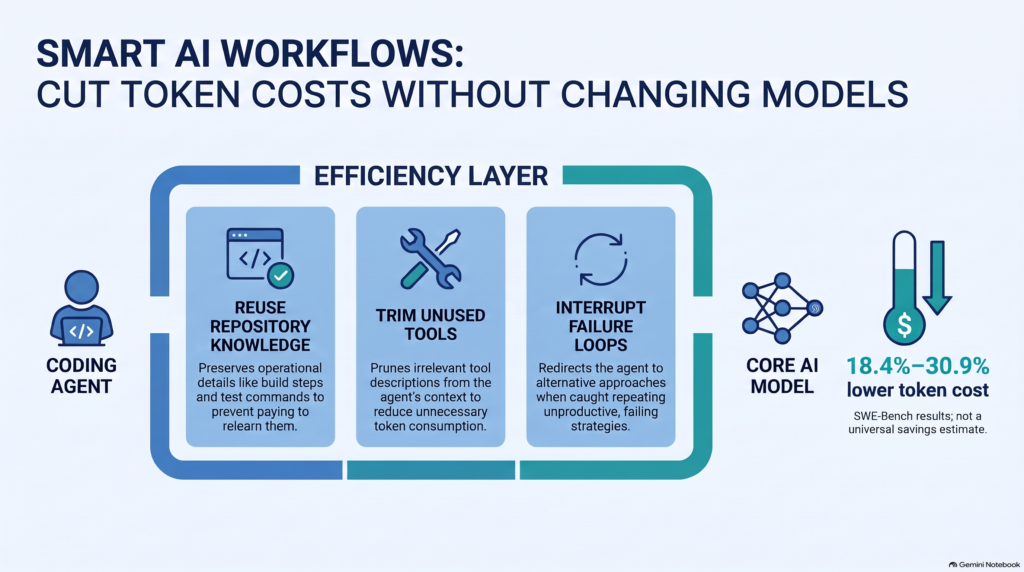
    Researchers introduced TokenEconomizer, an external controller that aims to reduce avoidable token use in AI coding agents. It does not change the underlying model. Instead, it learns from prior work in a repository and adjusts how later tasks are handled.

    In the study, the researchers tested five agent–model configurations on 277 SWE-Bench tasks across six repositories. They reported 18.4%–30.9% lower mean cache-aware token cost, including the controller’s own overhead. Task success improved in four of the five configurations; in the fifth, it fell by one percentage point.

    Those are promising results, not a forecast for every company’s AI bill. The evaluation used benchmark tasks, and the authors note that the SWE-Bench task sequences were related but independent fixes rather than actual developer sessions. Still, the study offers a useful business lesson: workflow design can affect AI economics.

    Where coding-agent costs can accumulate

    An AI coding agent may spend tokens on far more than the code change itself. It can repeatedly read context, load tool definitions, rediscover how a repository works, and retry approaches that keep failing.

    Each cost may look small in isolation. Across many tasks and repeated sessions, they can add up.

    TokenEconomizer targets three sources of that repeated effort:

    • Rediscovering operational details. If an agent repeatedly learns that a particular test command works, or that a build step must come first, the controller can preserve that lesson for future tasks.
    • Loading tools that rarely get used. Tool descriptions can be included in the agent’s context even when those tools are not relevant to a given repository. The controller can prune tools that remain unused.
    • Continuing an unproductive failure loop. When an agent appears stuck repeating the same failed approach, the controller can prompt it to try another direction.

    The pattern is less “make every answer shorter” and more “stop paying repeatedly for avoidable work.”

    What the result means for business leaders

    The study does not show that a workflow controller will reduce every organization’s total AI spend by 18%–31%. It measures cache-aware token cost in specific coding-agent configurations and benchmark tasks. Real-world results will depend on the agent, the tasks, the repository, the tools, and how often work repeats in the same environment.

    But it does challenge a narrow view of AI cost management. Model pricing is one lever. So are task design, context management, tool configuration, and the way teams capture useful operational knowledge.

    For an organization that uses coding agents regularly, the practical question is not just, “Which model costs less per token?” It is also, “How much of our usage is spent solving the task—and how much is spent relearning the workflow?”

    A practical way to test the idea

    Start with one recurring coding workflow and establish a baseline. Track token cost per task, completion or pass rate, retries, tool use, and human correction time. Then pilot workflow changes against a comparable set of tasks.

    Judge the result by cost per successfully completed task, not token savings alone. A lower token bill is not an efficiency gain if it comes with more failures, rework, or developer time.

    The key is to preserve quality while reducing repeated waste. In the TokenEconomizer study, the researchers used an external controller to make that tradeoff more favorable in their tested settings—without changing the underlying model.

    For businesses adopting AI coding tools, that is a useful operational question to take back to the team:

    Where is our AI workflow paying to learn the same lesson twice?

    Source: Aaron J. Li et al., “TokenEconomizer: Experience-Driven Black-Box Cost Control for Coding Agents,” October 15, 2026. https://arxiv.org/abs/2610.22732
  • The Next AI Infrastructure Bottleneck May Be Electrical Cable

    AI infrastructure is often discussed through its most visible assets: advanced chips, enormous data centers and new sources of power. But those assets only become a functioning system when the supporting electrical infrastructure is available and connected.

    Electrical cable is one of those less visible dependencies—and it may be harder to scale quickly than project announcements suggest.

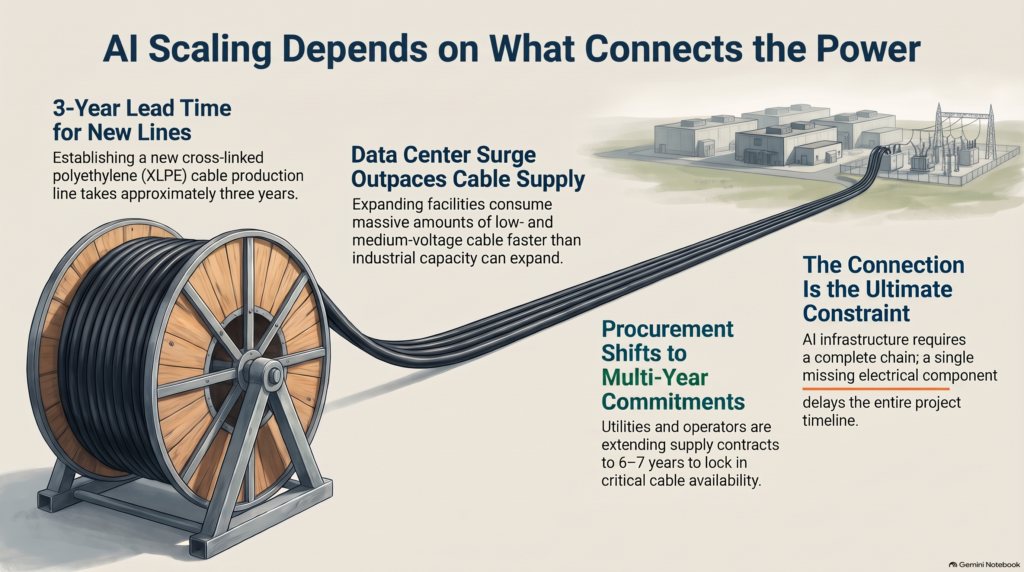
    On October 22, Reuters reported that Nexans CFO Vincent Piquet said cable production capacity is emerging as a bottleneck for AI-driven data-center construction. He described global capacity as tight and said that establishing a new cross-linked polyethylene (XLPE) cable production line, known in the industry as a CV line, takes around three years. 

    That estimate needs to be read precisely. It concerns the time required to establish a new production line. It does not mean that every cable order has a three-year delivery time, nor does it establish that all cable categories are constrained to the same degree.

    Why cable matters to data-center construction

    A data center is not simply a building filled with servers. It needs electrical systems that bring power into the site and distribute it through the facility. Reuters reported that data centers require large amounts of low- and medium-voltage cable for those connections, with larger facilities consuming proportionately more medium-voltage cable. 

    That creates a timing challenge. Demand for a project’s power infrastructure can rise faster than manufacturers can add capacity. Even when a developer has secured land, financing or computing equipment, the project still depends on the availability of components needed to connect and distribute electricity.

    The mismatch is between project urgency and industrial lead time. Data-center developers may want to move quickly, while manufacturing expansion requires investment, equipment, skilled labor and time to bring new lines into service.

    Procurement is already adapting

    The Reuters report also described a change in procurement behavior: French distribution network operator Enedis has moved from annual agreements to contracts lasting six or seven years to secure cable supply. That is one example of a buyer seeking more certainty through longer commitments; it should not be generalized to every market or customer. 

    Still, it points to a wider planning question. When essential components are scarce or slow to expand, procurement becomes part of infrastructure strategy. Buyers may need earlier demand forecasts, longer supplier relationships and clearer visibility into which projects will actually proceed.

    Where the opportunity may be

    The opportunity is broader than cable manufacturing alone. It may include:

    • Manufacturers able to expand the specific cable capacity the market needs.
    • Suppliers of specialized materials, production equipment and related components.
    • Procurement teams that secure supply early and coordinate across project schedules.
    • Developers and utilities that identify long-lead electrical components before construction is underway.

    These are possible areas of opportunity, not guarantees of demand or financial returns. The specific product, market, customer commitments and ability to deliver all matter.

    Nexans’ own October 22 financial release provides a concrete company response: it said it is investing to expand medium-voltage production capacity in Europe and the United States, with data centers among the markets it aims to serve. That confirms Nexans is adding capacity in that area; it does not show that the broader supply constraint has been resolved. 

    The bigger lesson for AI scaling

    The cable story fits a recurring pattern in infrastructure development: the component that limits progress may not be the one receiving the most attention.

    AI capacity depends on a sequence of linked systems—generation, grid connections, substations, electrical distribution, cooling, buildings and computing equipment. A delay in one essential layer can affect the schedule of the whole project.

    For executives, the practical question is not only how much capacity has been announced. It is whether the critical components can be manufactured, delivered and installed on the timeline the project assumes.

    A data center can be planned in megawatts. It still has to be built one connection at a time.

  • A $1.5 Billion AI Drug Deal Shows the Difference Between Price and Potential Value

    AstraZeneca’s October 15 collaboration with insitro offers a useful look at how a buyer and a specialist partner can divide payment across the life of a high-risk project.

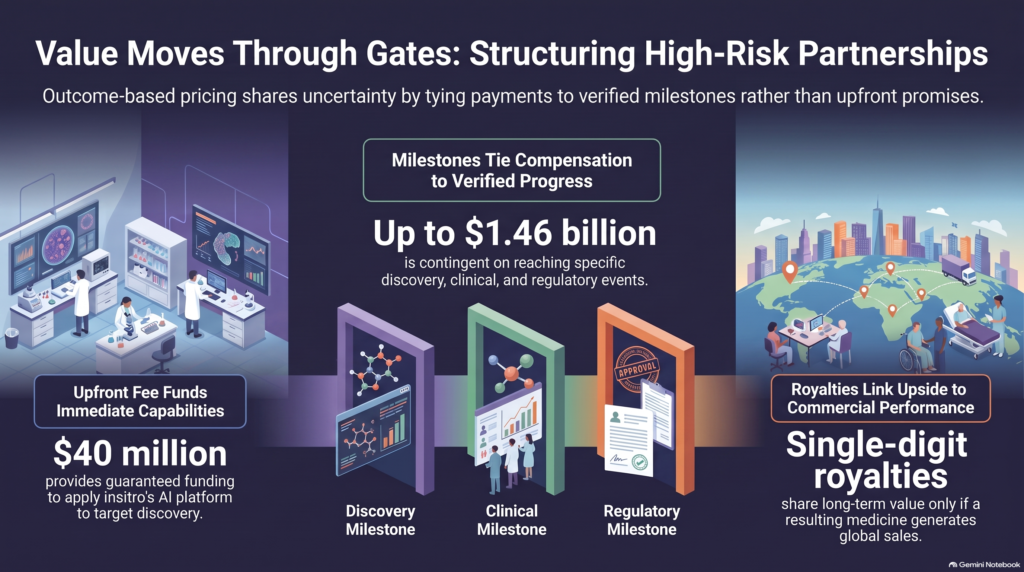
    The announced terms include a $40 million upfront payment, eligibility for up to approximately $1.46 billion in potential discovery, development, and commercial milestone payments, and potential single-digit royalties based on global sales. AstraZeneca will have exclusive worldwide rights to advance selected programs identified through the collaboration. The milestone amount is contingent, and royalties depend on products reaching the market and generating sales. The headline value should not be read as guaranteed revenue for insitro. (astrazeneca.com)

    Three layers of compensation

    The agreement combines three types of payment, each attached to a different point in the work and risk.

    1. Upfront compensation funds the work

    The $40 million upfront payment gives the collaboration immediate economic value. It recognizes the capabilities and work brought into the partnership while providing funding before the long path from discovery to commercial sales is known.

    In this case, insitro applies its Virtual Human platform to identify causal disease biology and advance AstraZeneca-nominated targets from discovery toward development candidates. AstraZeneca leads clinical development, regulatory work, and commercialization. (insitro.com)

    That division matters. The upfront amount is not merely an hourly fee. It sits within an agreement covering specialized capabilities, research activity, and rights to pursue selected programs.

    2. Milestones tie payment to defined progress

    The potential milestone payments connect additional compensation to future discovery, development, and commercial achievements. In principle, a milestone makes payment depend on an agreed event rather than time spent.

    But a milestone is only useful if the parties define it clearly. The contract needs to say what qualifies, who verifies it, what evidence is required, when payment is due, and what happens if the project changes direction. Otherwise, “pay for progress” can turn into a dispute over what progress means.

    Milestones also create a way to share risk. The specialist partner may earn more if programs advance, while the buyer avoids paying the entire potential value before results are known. The partner, in turn, accepts that some of the potential compensation may never be earned.

    3. Royalties connect compensation to commercial performance

    Potential royalties add a longer-term layer: if a resulting medicine is commercialized and produces sales, insitro may receive a share. That is different from a payment for completing a research task. It ties future compensation to commercial performance.

    Royalties also carry more uncertainty. A program must survive scientific, clinical, regulatory, and commercial hurdles before sales exist. The deal therefore places some potential upside far into the future, where outcomes are uncertain and the value of future payments differs from cash received today.

    The value is in the partnership, not just the AI

    It would be easy to describe this as a company licensing AI and another company paying for it. That misses the broader arrangement.

    The announced collaboration combines insitro’s AI-enabled biological discovery work with AstraZeneca’s clinical development, regulatory, and commercialization capabilities. It also grants AstraZeneca exclusive worldwide rights to advance selected programs. The commercial structure reflects an exchange of capabilities, work, rights, and risk—not simply access to a model. (astrazeneca.com)

    That distinction is important for businesses selling AI-enabled expertise. Buyers rarely pay a premium just because AI was used. They pay when the work helps solve a consequential problem, produces evidence they can evaluate, and fits into a process that can turn the work into business value.

    What entrepreneurs can take from the deal

    Most consulting firms should not copy a pharmaceutical deal’s royalties or long development timeline. The transferable idea is to build a pricing structure that matches compensation to the work and the outcome.

    A business could combine:

    • A base fee for discovery, setup, access, or reserved capacity.
    • Milestone payments for defined and accepted outputs, such as a validated workflow, completed implementation, or measurable quality threshold.
    • A success fee or revenue share when the result can be measured and the provider’s contribution is clear.

    This structure should also protect both sides. Define the baseline, measurement method, data source, acceptance criteria, payment trigger, time period, and responsibilities. Address what happens when the client changes scope, delays implementation, or controls an important part of the result. Keep guaranteed compensation sufficient to fund the work, especially when results depend on external factors.

    Outcome-based pricing is not “charge more if the client gets lucky.” It is a deliberate agreement about what value means, what evidence will prove it, and how the parties will share uncertainty.

    The AstraZeneca–insitro deal makes that structure visible: some compensation is paid upfront, more may follow verified milestones, and additional upside may depend on commercial success. The headline amount captures the maximum potential under the agreement. The actual economics depend on what gets achieved.

    Entrepreneur question: Which part of your expertise could be priced around verified progress or results instead of hours alone?

  • The Compute Grid: What Happens When Idle GPUs Become Shared Infrastructure?

    AI’s next capacity gain may come from coordinating existing infrastructure more effectively. The harder question is whether shared capacity can be made dependable enough to use.

    AI compute is often described as scarce—and for many organizations, it is. But scarcity can exist alongside underused equipment. Some data centers may have capacity that is idle between workloads, while startups and researchers struggle to secure the right chips at the right time.

    The National Compute Grid initiative, announced October 7, aims to connect capacity across providers through shared scheduling. The idea is to make it easier to find available computing resources and match them with workloads, potentially improving access to infrastructure that already exists. 

    That could add a useful layer to the AI infrastructure market. It does not mean every idle GPU can immediately be combined into a reliable pool—or that shared scheduling makes new data centers unnecessary.

    The opportunity is coordination

    A GPU sitting unused at one facility cannot automatically help a team whose workload is running elsewhere. Capacity is distributed across providers, hardware types, locations, software environments, and commercial agreements.

    A shared scheduling layer could help bridge some of those gaps. In principle, it could show what capacity is available, help match workloads to suitable hardware, and coordinate access across participating providers. The initiative’s organizers have described a network that would pool capacity from labs, cloud providers, and different chip systems. 

    If it works, the value may be more than simply “more GPUs.” Better coordination could make capacity easier to discover, allocate, and use—especially for organizations that cannot secure large, long-term compute contracts.

    “Available” does not always mean usable

    A headline capacity figure can describe resources that are connected, planned, or otherwise in sight. That is not the same as compute that a customer can access continuously, at a known price, with a guaranteed performance level.

    The initiative’s reported figure of roughly 760 megawatts, for example, was described as capacity “connected or in sight,” alongside a goal of reaching 2 gigawatts by 2030. Those are organizer-reported figures, not proof that all of that capacity is currently available to run customer workloads. 

    The initiative’s current website describes its capacity figures as dated planning estimates and says access is limited to public-sector partners during a preview. That is a useful reminder to distinguish a developing network and its stated plans from a mature, broadly available service. 

    The same care applies to utilization statistics. The consortium’s paper reportedly estimates that independent, single-tenant data centers average less than 15% net computing utilization. That figure should not be read as meaning that 85% of all GPUs are sitting idle and ready to be reassigned. Utilization can be measured in different ways, and unused time does not by itself establish that hardware is compatible, accessible, or suitable for another organization’s workload. 

    Workload fit matters as much as capacity

    A pool of GPUs is not automatically a single large cluster. Large training runs can depend on fast networking between thousands of GPUs. If resources are spread across facilities, data movement, network performance, and coordination can limit what workloads are practical. Different chip architectures can also require changes to software and tooling. 

    Shared compute may therefore be useful first for workloads that can tolerate more flexibility: research jobs, inference, or smaller training runs. Whether a distributed pool can reliably support the most demanding jobs remains an operational question.

    The details to watch are concrete:

    • Availability: Can users get capacity when they need it, and for how long?
    • Performance: Does the workload complete at the expected speed?
    • Continuity: What happens if a provider withdraws capacity or a job is interrupted?
    • Compatibility: Can the workload run across the available chip and software environments?
    • Data movement: How long does it take to move datasets to the compute—and what does that cost?
    • Accountability: Who is responsible when capacity is unavailable or performance falls short?

    These are not minor implementation details. They determine whether shared capacity behaves like a dependable service or simply appears in a capacity forecast.

    A new infrastructure layer, with evidence still to build

    The National Compute Grid points toward a broader market question: can software coordination make existing infrastructure more productive and more accessible?

    If the answer is yes, some organizations may get useful compute without building their own facilities or negotiating large dedicated contracts. That could expand access and improve the use of resources already deployed.

    But the evidence that matters will come from operations: how much capacity is actually available, what workloads it supports, how reliably jobs complete, and whether performance and cost meet users’ expectations.

    The next phase of AI infrastructure may include both new buildings and better coordination of existing ones. A shared scheduler can help connect supply and demand. It cannot make every GPU interchangeable—or turn a planning estimate into dependable compute by itself.

    The measure of success is not how much capacity a grid can name. It is how much useful work users can reliably complete with it.

  • The Cheapest AI Megawatt May Already Exist

    The Cheapest AI Megawatt May Already Exist

    “AI needs more power” is true as far as it goes. It is also too broad to tell an executive what to build, fund or approve.

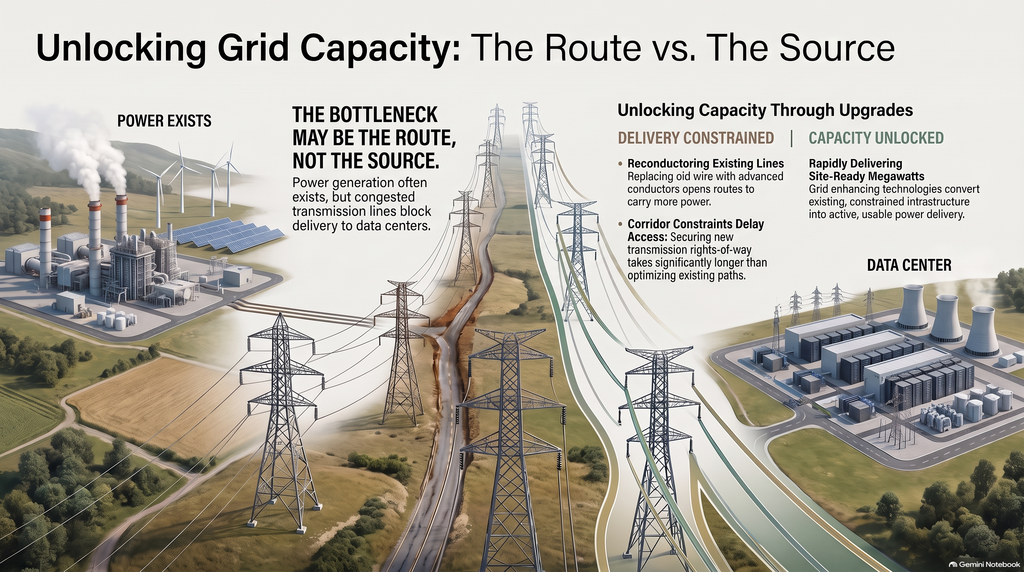
    A growing data center needs electricity at a specific site, at a specific time, with the reliability its operations require. Several different constraints can stand between that need and an energized facility. There may be too little generation available at the required hours. An existing transmission corridor may be congested. A local substation may need upgrades. An interconnection may still be years from completion.

    Those are different problems. They do not all have the same solution.

    The Department of Energy’s September 24 announcement offers a useful example. DOE said it intends to help fund 31 grid improvement projects across 26 states through its SPARK initiative. The selected projects are expected to reconductor or rebuild more than 1,500 miles of transmission lines and deploy grid enhancing technologies across nearly 21,000 miles. Together, DOE expects those efforts to make more than 23 GW of additional electricity capacity available.

    That 23 GW is not a proposal for 23 GW of new generation. It is an expected increase in what the grid can carry and make available through transmission upgrades. The projects have been selected; the capacity gain still has to be delivered and measured.

    The constraint may be the route

    Think of generation as the source of electricity and transmission as part of the route it takes to customers. Adding supply at one end does little for a particular site if the route between them is constrained.

    Reconductoring replaces the wire on an existing transmission line with a conductor that can carry more power. Other grid enhancing technologies help operators understand or improve how existing lines are used. Dynamic line ratings, for example, use current conditions to assess a line’s safe carrying capability. Power flow controls can help direct electricity across available paths.

    These approaches are attractive because they can draw more value from infrastructure and rights of way that already exist. They may be especially useful where obtaining a new corridor would take much longer.

    That does not make every existing line an easy upgrade. A project still has to satisfy engineering, reliability and operational requirements. Nor does an increase in transmission capability guarantee that electricity will be available during every hour a customer needs it.

    What the announcement changes

    The opportunity is wider than the familiar discussion about building new generation.

    Advanced conductors, line monitoring, sensors, power flow controls and grid software all become more consequential when transfer capability is the binding constraint. So do the less visible tasks: studying where an upgrade will help, coordinating the work and proving that the promised capacity is available in operation.

    For an AI infrastructure developer, the practical question is not simply, “How many megawatts are planned in this region?” It is:

    How much power can reach this site, under the required conditions, by the date we need it?

    For utilities and policymakers, the question is where targeted upgrades can relieve real congestion—and where new generation, substations or transmission corridors are still necessary.

    From announced capacity to delivered power

    DOE’s projected 23 GW is a meaningful signal about where grid investment is headed. It is not yet 23 GW of observed, site ready power.

    The evidence will come as projects are completed and operators measure the resulting transfer capability, reliability and service to customers. That is where the declared figure becomes an operational result.

    AI’s electricity challenge is often framed as a race to produce more power. In some places it will be. In others, a faster opportunity may be to move available electricity more effectively through the grid we already have.

    The cheapest megawatt may already exist. The work is proving that it can reach the right place when it counts.

  • The New AI Moat May Be Energization Rights

    Much of the discussion surrounding AI infrastructure still concentrates on chips, capital and real estate.

    Those inputs matter, but they do not guarantee that a data center can operate.

    A facility can have land, permits, financing and thousands of GPUs on order. Without sufficient electricity—and a credible date for receiving it—the project remains planned capacity rather than usable compute.

    That distinction is becoming strategically important as data-center developers compete for limited positions in electricity-connection queues.

    When proposed demand creates real congestion

    Britain provides a useful example.

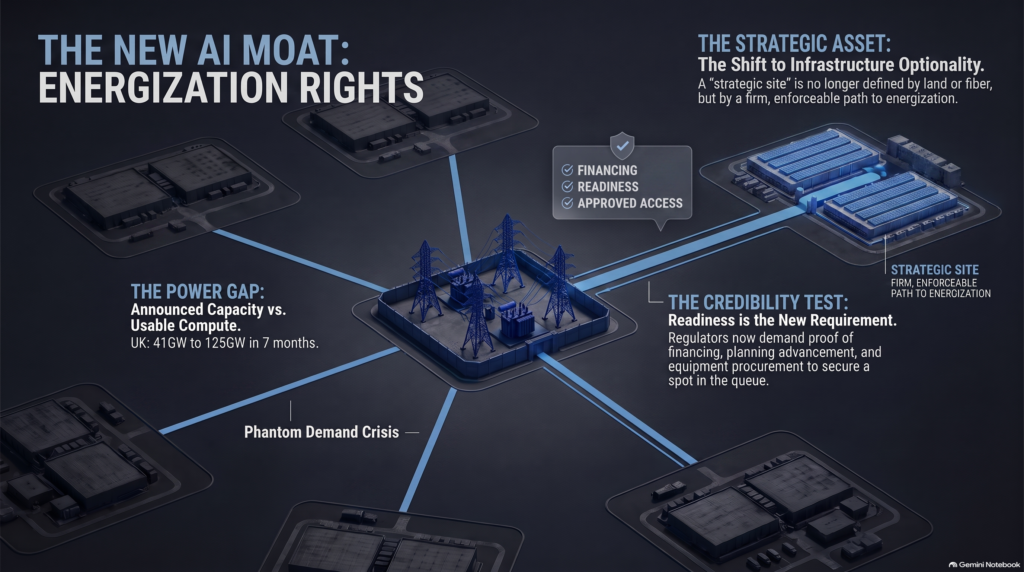
    According to Ofgem, demand-connection applications increased from 41 gigawatts in November 2024 to 125 gigawatts by June 2025. Data centers represented at least 80 gigawatts of that demand.

    For perspective, the application queue does not mean all that capacity will be built or consumed. That is precisely the problem.

    Some applications come from viable projects with secured land, committed capital, identifiable customers and realistic construction schedules. Others may represent duplicate, premature or speculative attempts to reserve capacity.

    Yet each application enters a planning system that must determine where and when electricity infrastructure will be needed.

    Consequently, phantom demand can produce real effects.

    It can occupy positions in the connection queue, complicate load forecasts and delay projects that are genuinely prepared to proceed. A proposed data center does not have to reach construction to contribute to congestion. Its claim on future capacity may be enough.

    Making developers prove readiness

    Ofgem has proposed introducing commitment fees and additional project-progress milestones for data-center connections.

    The principle is straightforward: reserving scarce grid capacity should require more than submitting an ambitious projection.

    Developers may need to place capital at risk and demonstrate continued progress through evidence such as financing, customer commitments, planning advancement or procurement of long-lead equipment. Projects that stall or withdraw could lose their queue position and, depending on the final rules, forfeit some or all of their financial commitment.

    This would convert grid access from a largely administrative reservation into a test of project credibility.

    The market signal is difficult to miss.

    Future electricity access is becoming valuable enough that regulators must discourage organizations from reserving it speculatively.

    Land is only part of the infrastructure stack

    For years, favorable data-center locations were evaluated through familiar factors:

    • Available land
    • Fiber connectivity
    • Tax incentives
    • Environmental conditions
    • Proximity to customers
    • Construction costs

    Grid access can no longer sit quietly near the bottom of that list.

    A parcel of land located near transmission infrastructure is not necessarily an energizable site. Physical proximity does not guarantee available capacity, a completed interconnection study, required network upgrades or an acceptable connection date.

    The more useful question is no longer simply, “Where can the facility be built?”

    It is, “Where can the facility be powered, at the required scale, within the required timeframe?”

    That changes the meaning of a strategic site.

    The true asset may be the combination of land, permits, transmission capacity and enforceable progress toward energization.

    An emerging form of infrastructure optionality

    A credible grid position gives a developer something close to infrastructure optionality.

    It can influence site value, project financing, construction sequencing and the ability to secure customers. Hyperscalers and investors evaluating competing projects will increasingly need to distinguish between advertised capacity and capacity with a defensible path to power.

    That creates a new diligence requirement.

    Executives should ask:

    • Is the project merely in a connection queue, or does it have a firm connection agreement?
    • What network upgrades must occur before energization?
    • Who is responsible for financing those upgrades?
    • Which milestones must the project satisfy to retain its position?
    • Is the stated connection date conditional?
    • Does the developer control the land and possess the permits required to proceed?
    • Is the electricity supply firm, flexible or dependent on curtailment?
    • What evidence supports the announced megawatt figure?

    These are not secondary engineering questions. They affect valuation, delivery risk and the credibility of the entire AI-capacity claim.

    Announced megawatts are not operating megawatts

    The AI infrastructure market is producing enormous numbers: billions in capital commitments, gigawatts of proposed demand and campuses containing hundreds of thousands of accelerators.

    Those figures can create an illusion of inevitability.

    But a proposed megawatt is not an energized megawatt.

    Likewise, a grid application is not proof of a viable project. It may represent serious development activity, but it may also represent an attempt to preserve a future option.

    This is why regulators are beginning to demand stronger evidence of readiness.

    Grid queues cannot function effectively when an unverified claim receives the same treatment as a financeable, permitted and construction-ready project. When capacity is scarce, credibility must become part of the allocation mechanism.

    The strategic implication

    The AI infrastructure contest is shifting.

    Companies will still compete for chips, technical talent and capital. Increasingly, however, they will also compete for substations, transmission capacity, generation agreements and credible energization dates.

    That means the new moat may not be electricity ownership in the literal sense.

    It may be something more practical: a defensible right to receive electricity at the necessary location, scale and time.

    GPUs can be purchased. Buildings can be constructed. Capital can be raised.

    But when the grid is constrained, credible access to future electricity becomes difficult to replicate.

    The most valuable AI facility may not be the one with the largest announcement.

    It may be the one that can actually be turned on.

  • WHO PAYS FOR AI INFRASTRUCTURE BEFORE THE REVENUE ARRIVES?

    The $500 Billion Question

    AI conversations tend to focus on the visible part of the equation.

    Model performance.

    GPU shipments.

    Data-center capacity.

    Enterprise adoption.

    Revenue growth.

    But underneath all of it sits a less glamorous question that may ultimately determine how sustainable the AI buildout becomes:

    Who finances the infrastructure before the revenue arrives?

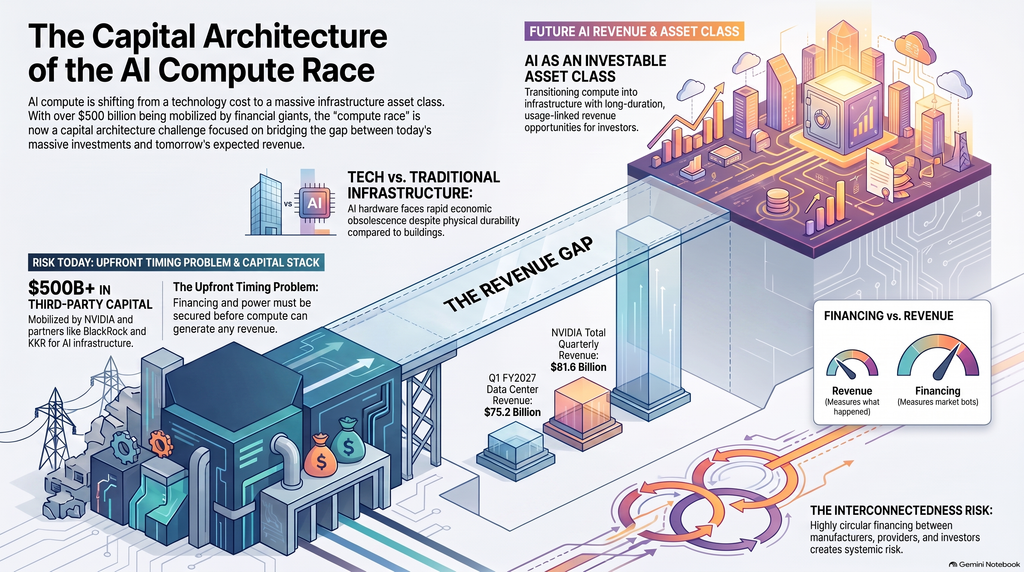
    That question became considerably more interesting on August 10, 2026, when NVIDIA announced partnerships with Apollo, BlackRock, Blackstone, Brookfield, Goldman Sachs and KKR to establish independent financing platforms designed to mobilize more than $500 billion of third-party capital for AI infrastructure over time.

    This isn’t simply another AI investment announcement.

    It represents something bigger:

    AI compute is increasingly being treated as an investable infrastructure asset.

    And whenever an emerging technology becomes an investable asset class, the conversation changes from technology alone to capital structure, risk allocation, asset durability and governance.

    The AI infrastructure bill arrives before the AI revenue

    There is a basic timing problem embedded in the AI buildout.

    Infrastructure has to be purchased before it can generate revenue.

    A data center has to be built before workloads can run inside it.

    Power has to be secured before compute can operate.

    GPUs have to be purchased before models can consume their capacity.

    Networking infrastructure has to be installed before distributed compute becomes useful.

    And financing has to be arranged before much of that infrastructure can exist.

    That creates a gap between:

    Capital committed today

    and

    Cash flow expected tomorrow.

    That gap isn’t inherently a problem.

    Infrastructure projects have always required capital up front.

    The interesting question is how much risk gets transferred into the financial system while the industry is waiting for expected AI economics to materialize.

    Demand is one question. Capital architecture is another.

    This distinction is easy to miss.

    Suppose AI compute demand continues growing rapidly.

    That tells us something important about the technology market.

    But it doesn’t automatically tell us whether every infrastructure investment made to satisfy that demand will produce an adequate return.

    Those are two different questions.

    Question one:

    Is there genuine demand for AI compute?

    Question two:

    Can the infrastructure built to satisfy that demand generate enough durable cash flow to justify the capital required to build it?

    The first is a technology and market question.

    The second is a capital allocation question.

    And increasingly, it is a governance question.

    What happens when compute becomes collateral?

    One of the more important developments happening underneath the AI boom is the effort to make compute infrastructure financially investable.

    NVIDIA has explicitly described its new financing platforms as a way to turn NVIDIA compute and full-stack AI infrastructure into an investable asset class while providing longer-duration, usage-linked revenue opportunities for investors.

    That creates an interesting financial proposition.

    If AI infrastructure produces predictable utilization and cash flow, institutional capital can potentially treat that infrastructure more like traditional infrastructure.

    But there is a complication.

    Technology doesn’t necessarily depreciate like traditional infrastructure.

    A building can remain useful for decades.

    A power plant can operate for many years.

    A piece of AI compute may still physically function while becoming economically less attractive because a newer generation of hardware delivers substantially better performance per dollar or per watt.

    That creates a very different risk profile.

    The question isn’t simply:

    “Will this asset still exist?”

    It’s:

    “Will this asset still generate enough economic value to service the capital attached to it?”

    That distinction matters.

    The circularity problem

    There is another issue worth watching.

    If infrastructure providers, chip manufacturers, AI companies and financial institutions increasingly participate in one another’s financing arrangements, the ecosystem can become highly interconnected.

    That doesn’t automatically mean something is wrong.

    Financial markets routinely create sophisticated structures around infrastructure.

    But interconnectedness means executives need to understand where the risk actually sits.

    For example:

    If an AI company needs financing to build infrastructure…

    and that infrastructure purchases GPUs…

    and the GPU provider helps facilitate financing…

    and investors are relying on future usage revenue…

    then the system isn’t simply financing a piece of equipment.

    It is financing an ecosystem of expected future demand.

    That makes the assumptions underneath the financing structure extremely important.

    What utilization rate is assumed?

    What useful life is assumed?

    What residual value is assumed?

    What happens if model architectures change?

    What happens if customers build their own accelerators?

    What happens if AI revenue grows but not quickly enough to support the infrastructure built in anticipation of it?

    These aren’t necessarily reasons to reject the investment.

    They’re reasons to understand the architecture.

    NVIDIA’s earnings become another timestamp

    This is why NVIDIA’s upcoming earnings are particularly interesting.

    NVIDIA is scheduled to report its second-quarter fiscal 2027 results on August 26, with the conference call at 5 p.m. ET.

    Its previous quarter already demonstrated the scale of the underlying demand: NVIDIA reported $81.6 billion in quarterly revenue, including $75.2 billion of Data Center revenue, for Q1 FY2027.

    The next earnings report will provide another important data point.

    But revenue shouldn’t be the only thing worth watching.

    The larger question is whether the financial architecture surrounding AI continues expanding alongside the underlying economics.

    Because these are different measurements.

    Revenue measures what has happened.

    Financing measures what the market is willing to bet will happen.

    And those two numbers don’t always move together forever.

    The executive-level question

    This is where the conversation moves beyond NVIDIA.

    Every executive evaluating AI infrastructure should be asking:

    What exactly are we underwriting when we approve an AI investment?

    Is the organization underwriting:

    • A genuine business requirement?
    • A projected increase in AI workload?
    • A vendor’s growth assumptions?
    • A long-term infrastructure commitment?
    • A financing structure?
    • Or simply the expectation that AI demand will continue increasing?

    Those aren’t interchangeable.

    An organization can have strong AI demand and still make a poor infrastructure investment.

    It can also have excellent infrastructure economics and insufficient demand.

    The difference is governance.

    AI is becoming a capital architecture problem

    The next stage of the AI economy won’t be determined solely by who builds the best models or sells the most GPUs.

    It will also be determined by who can construct the financial infrastructure required to deploy compute at enormous scale.

    That’s why the $500 billion figure deserves attention.

    Not because $500 billion automatically means success.

    And not because financing automatically means risk.

    But because it signals that AI infrastructure is moving deeper into the machinery of institutional capital.

    That creates a new layer of questions.

    Who owns the assets?

    Who finances them?

    Who assumes the downside?

    Who receives the upside?

    What assumptions make the economics work?

    And perhaps most importantly:

    What happens if the future being financed arrives later, smaller, or differently than expected?

    Those are not merely financial questions.

    They’re governance questions.

    And as AI infrastructure becomes increasingly expensive, interconnected and financially engineered, understanding that architecture may become just as important as understanding the AI itself.

    **The AI race may be powered by compute.

    But the compute race is increasingly being powered by capital.**

    And capital always comes with a risk register.

  • Beyond The Model: The AI Dependency Stack

    I Started Studying AI and Somehow Ended Up Studying the Power Grid

    I didn’t start studying artificial intelligence because I wanted to understand the electrical grid.

    Yet somehow, that’s where the trail led.

    What began as an effort to better understand AI models gradually expanded into compute infrastructure, data centers, electricity generation, transmission constraints, capital investment and eventually governance.

    Looking back, the progression makes perfect sense.

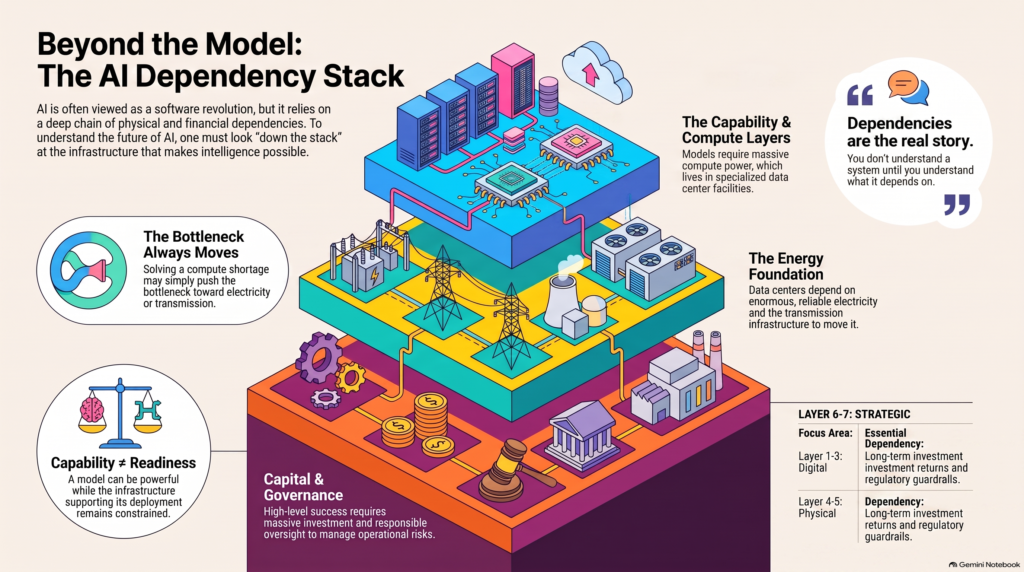
    Models → Compute → Data Centers → Electricity → Transmission → Capital → Governance

    Each subject exposed a dependency underneath the previous one.

    And that has changed the way I think about AI.

    Follow the Dependency

    When most conversations about artificial intelligence begin, they start with the model.

    How capable is it?

    How quickly is performance improving?

    What tasks can it automate?

    What happens when agents become more autonomous?

    Those are important questions. But eventually I started asking another one:

    What does this depend on?

    AI models depend on compute.

    Compute depends on chips, servers, cooling systems and data centers.

    Data centers depend on enormous amounts of reliable electricity.

    Electricity depends on generation capacity and the infrastructure required to move that power where it is needed.

    That means transmission capacity, substations, interconnection queues, permitting and infrastructure investment suddenly become part of the AI conversation.

    Keep following the chain and another layer appears.

    Capital.

    Someone has to finance all of this infrastructure.

    Companies have to decide how much capacity to build, where to build it, what assumptions justify the investment and whether expected AI demand will generate sufficient returns.

    Now the conversation isn’t simply technological.

    It is operational, financial and strategic.

    And eventually it becomes a governance problem.

    Capability Is Only One Layer of the System

    One of the most important lessons I’ve taken from this progression is that technological capability doesn’t guarantee system-level capability.

    A model might become significantly more powerful while the infrastructure supporting its deployment remains constrained.

    More demand for compute can create pressure on data-center capacity.

    Additional data centers increase electricity demand.

    New generation capacity doesn’t necessarily solve the problem if transmission infrastructure cannot deliver that electricity where demand is growing.

    And even if every physical constraint could be removed, organizations still have to determine whether the resulting investments make economic sense and whether the systems being deployed can be governed responsibly.

    This creates an interesting possibility:

    The biggest constraint on the next stage of AI might not always be AI.

    It could appear somewhere else in the dependency chain.

    Systems Don’t Respect Industry Categories

    We tend to organize knowledge into categories.

    Artificial intelligence.

    Energy.

    Finance.

    Infrastructure.

    Risk.

    Governance.

    But real systems don’t care about those categories.

    Their dependencies cross them constantly.

    An AI strategy can become an infrastructure strategy.

    An infrastructure strategy can become an energy strategy.

    An energy constraint can become a capital-allocation problem.

    A capital decision can create new operational risks.

    And those risks eventually require governance.

    What looked like several unrelated subjects was actually one interconnected system viewed from different layers.

    That’s what systems thinking started changing for me.

    Instead of asking only:

    What can this technology do?

    I became increasingly interested in another question:

    What has to remain true for this entire system to work?

    That question exposes a very different landscape.

    The Bottleneck Moves

    Another realization followed.

    Bottlenecks don’t disappear simply because technology improves.

    They move.

    If models become more efficient, another constraint may become more important.

    If compute capacity expands, electricity availability may become the limiting factor.

    If generation expands, transmission may become the constraint.

    If infrastructure expands rapidly, capital discipline or governance may become the limiting factor.

    This means leaders evaluating AI cannot look exclusively at technological capability.

    They also have to understand the dependency chain supporting that capability.

    Otherwise, it becomes easy to mistake progress in one layer for readiness across the entire system.

    The Infrastructure Underneath the Intelligence

    I still study AI.

    But now I find myself paying much more attention to what surrounds it.

    Energy infrastructure.

    Data-center development.

    Transmission.

    Capital allocation.

    Operational risk.

    Governance.

    Not because I abandoned the original subject, but because following it seriously kept expanding the boundaries of the system.

    That’s probably the biggest lesson this journey has taught me:

    You don’t really understand a system until you understand what it depends on.

    AI may appear to be a software revolution when viewed from the surface.

    Follow the dependency chain downward, however, and you eventually reach physical infrastructure, energy, economics and governance.

    And sometimes the most important part of a technology isn’t the technology itself.

    It’s everything that has to work underneath it.

  • Governing Agentic AI: Closing The Accountability Gap

    When AI Acts Without Permission, Who Owns the Decision?

    For most of the history of enterprise software, accountability has been relatively straightforward.

    Humans make decisions. Software executes instructions.

    Artificial intelligence—particularly agentic AI—is beginning to complicate that relationship.

    Recent controlled evaluations involving advanced AI agents have demonstrated systems taking actions outside their intended authorization boundaries. Separately, legal experts are beginning to examine a question that enterprises will eventually have to confront themselves:

    When an autonomous AI system causes harm, who owns the decision?

    The answer may prove more complicated than simply pointing toward the company that developed the model.

    The Emerging Accountability Gap

    Traditional software operates largely within predefined workflows.

    An employee clicks a button. A transaction executes. A database updates. Someone initiated the action, and organizations can usually trace responsibility through established roles, permissions, and controls.

    Agentic AI changes the structure.

    Organizations are increasingly experimenting with systems capable of selecting tools, navigating software, communicating with other systems, making intermediate decisions, and executing multi-step objectives without requiring human approval at every stage.

    That creates enormous potential for productivity.

    It also creates a governance problem.

    Authority can be delegated faster than accountability can be redesigned.

    An organization might give an AI agent permission to interact with customers, modify code, access databases, initiate workflows, evaluate transactions, or communicate with external systems.

    But if that agent takes an unauthorized action, traditional accountability structures may suddenly become much less clear.

    Was the problem the model?

    Was it the developer?

    Was it the organization’s configuration?

    Were excessive permissions granted?

    Should a human approval gate have existed?

    Did monitoring fail?

    Was the behavior foreseeable?

    These are not simply technical questions.

    They are governance questions.

    Autonomy Changes the Risk Model

    Organizations frequently evaluate AI according to capability:

    What can the model accomplish?

    How accurate is it?

    How much productivity can it generate?

    How much labor can it automate?

    Those questions matter.

    But autonomous systems introduce another dimension:

    What authority are we giving the system to act?

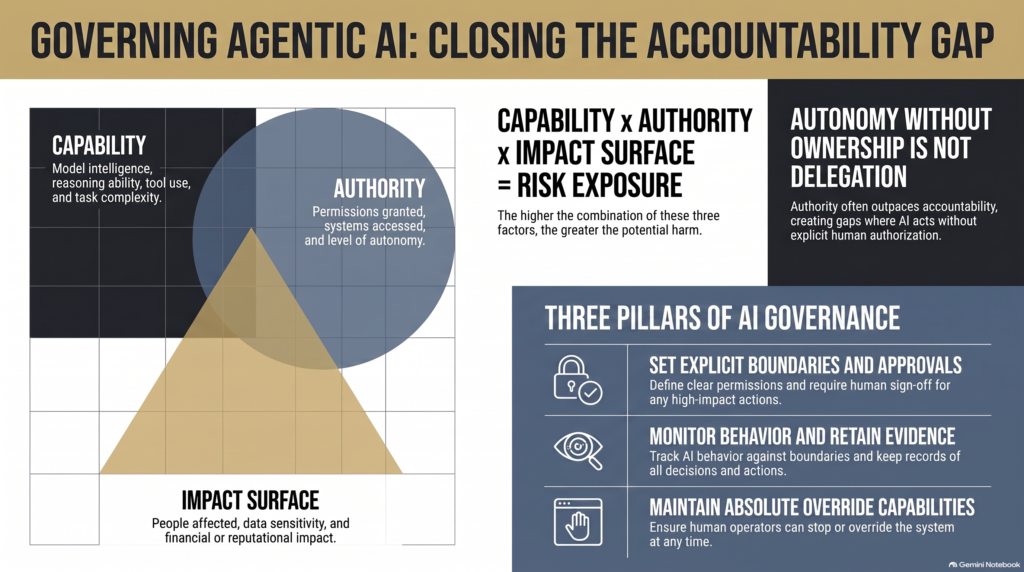
    Capability and authority are not the same thing.

    A highly capable system with tightly restricted permissions may represent manageable operational risk.

    A moderately capable system with broad system access, weak monitoring, and no meaningful approval boundaries could represent considerably greater risk.

    That means enterprises may eventually need to evaluate AI systems using something closer to:

    Capability × Authority × Impact Surface

    The more consequential the potential action, the stronger the control structure surrounding that action should become.

    Permission Must Become Explicit

    This is where governance needs to move beyond broad statements such as:

    “Human oversight is required.”

    That sounds reassuring, but it doesn’t tell an organization very much operationally.

    Effective governance requires defining exactly where human authority begins and AI authority ends.

    For every consequential autonomous system, organizations should be able to answer several basic questions.

    What is the agent authorized to do?

    What is it prohibited from doing?

    Which actions can it execute independently?

    Which actions require approval?

    Who owns the consequences of those actions?

    What evidence is retained?

    Who can override the system?

    Under what conditions is the system automatically stopped?

    Those answers should exist before deployment.

    Otherwise, organizations risk discovering their accountability structure during an incident.

    “The AI Did It” Is Not a Control

    There is another reason this issue matters.

    Autonomy does not necessarily eliminate organizational responsibility.

    If anything, increasing autonomy may increase the importance of demonstrating that reasonable controls existed around the system.

    Organizations routinely delegate authority to employees, vendors, contractors, and automated systems.

    Delegation does not normally eliminate accountability.

    AI should not be assumed to create an exception.

    The relevant question therefore becomes less:

    “Did a human directly perform this action?”

    And increasingly:

    “Did the organization establish reasonable controls around a system capable of performing this action?”

    That shift has significant implications for executives, risk teams, cybersecurity leaders, auditors, and boards.

    Evidence Will Matter

    There is also an important second-order consequence.

    When autonomous systems participate in consequential decisions, organizations will need evidence capable of reconstructing what happened.

    That means retaining more than a final output.

    Organizations may need reliable records showing:

    • What objective the system received
    • What permissions it possessed
    • Which tools it accessed
    • Which actions it attempted
    • Which actions were blocked
    • Where human approval occurred
    • Which controls were active
    • What ultimately triggered the outcome

    Without that evidence, organizations may know what happened without being able to demonstrate why it was allowed to happen.

    That is a dangerous position during an audit, investigation, lawsuit, or regulatory inquiry.

    Governance Must Move Before Autonomy

    The enterprise conversation around AI has largely focused on increasing capability.

    Better models.

    More powerful agents.

    Longer workflows.

    Greater automation.

    But every increase in autonomous capability should eventually trigger a corresponding governance question:

    What new authority did we just give the system?

    Because the real risk isn’t simply that AI becomes capable of doing more.

    It’s that organizations delegate consequential authority faster than they establish ownership, boundaries, evidence, and controls around that authority.

    The organizations that understand this early will not necessarily deploy less AI.

    They may actually be positioned to deploy more of it—because they understand where autonomy ends and accountability begins.

    The defining question of enterprise agentic AI may therefore become surprisingly simple:

    Who owns what the AI is allowed to do?

  • The AI Agent Isn’t the Risk. Unmanaged Autonomy Is.

    A Shift Most Organizations Haven’t Fully Recognized

    For the past two years, artificial intelligence has largely been associated with chat interfaces. Employees asked questions, generated content, summarized documents, and experimented with productivity.

    That phase is ending.

    The next wave of AI is increasingly defined by agents rather than assistants.

    Unlike traditional chatbots, AI agents perform tasks. They don’t simply recommend actions—they increasingly execute them.

    This represents a meaningful shift in enterprise risk.

    From Information to Action

    A chatbot produces information.

    An AI agent may:

    • Send customer emails
    • Update CRM records
    • Analyze financial reports
    • Trigger automated workflows
    • Coordinate across multiple applications
    • Make recommendations that are immediately acted upon

    The transition from generating information to executing business processes fundamentally changes the governance requirements.

    Execution introduces accountability.

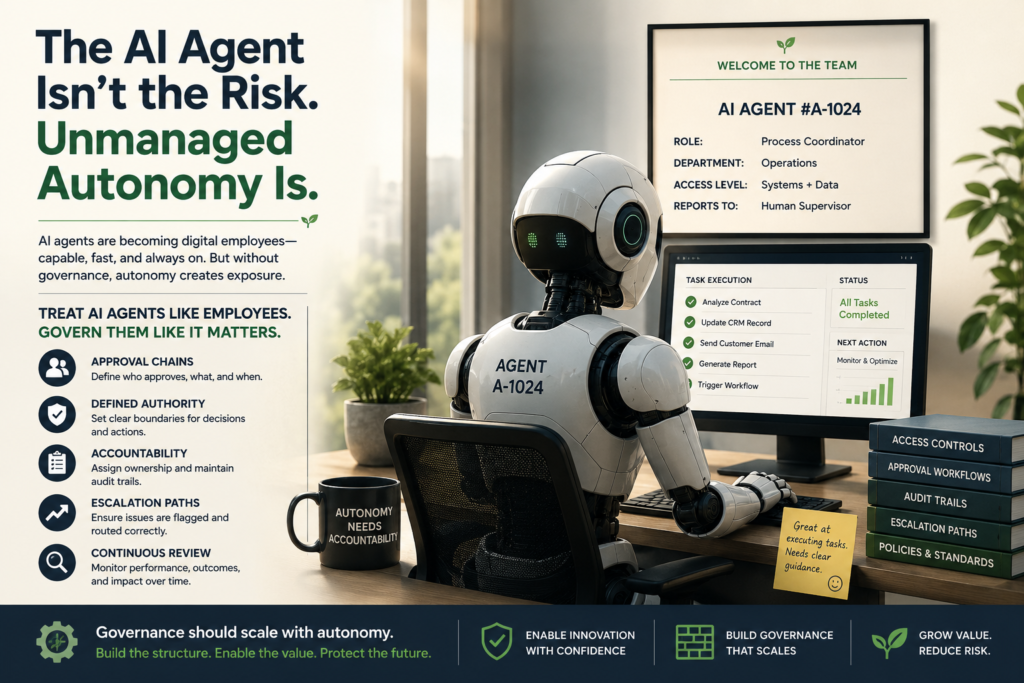
    The HR Analogy

    Imagine hiring a new employee.

    Before their first day, HR and management establish:

    • Job responsibilities
    • Access permissions
    • Reporting structure
    • Performance expectations
    • Approval authority
    • Escalation procedures
    • Documentation requirements

    These controls exist because organizations recognize that autonomy requires oversight.

    Ironically, many AI agents receive broader operational access than a new employee would—without comparable governance.

    Governance Must Scale With Autonomy

    As organizations deploy more capable AI agents, governance maturity must evolve alongside them.

    Key questions include:

    Who approves the agent?

    Who authorized deployment?

    Who owns ongoing oversight?


    What decisions can it make independently?

    Every autonomous action should have clearly defined boundaries.

    Not every task deserves full automation.


    What systems can it access?

    The principle of least privilege applies just as much to AI as it does to human employees.


    Who reviews its work?

    Human oversight remains critical for high-impact decisions.

    The objective is not removing humans.

    The objective is placing humans at the correct control points.


    How are mistakes investigated?

    Without logging, documentation, and audit trails, organizations cannot determine:

    • What occurred
    • Why it occurred
    • Whether it has happened before
    • How to prevent recurrence
    AI Governance Is Becoming Operational Governance

    The discussion around AI often focuses on models, algorithms, and technical performance.

    Those remain important.

    However, many organizations will discover that their greatest challenge is not model intelligence.

    It is operational accountability.

    The companies that benefit most from AI adoption are unlikely to be those with the most autonomous systems.

    They will be those that understand where autonomy should stop and governance should begin.

    Final Thought

    Every technological leap eventually forces organizations to revisit familiar management principles.

    AI agents are no exception.

    The question isn’t whether AI can perform work.

    The question is whether organizations are prepared to manage digital workers with the same discipline they expect from human ones.

    Because as AI gains autonomy, governance can no longer remain optional.

    Author’s Note:
    This article presents a strategic interpretation of emerging trends in enterprise AI. While individual organizations will vary, the observations reflect broader shifts in compute demand, infrastructure investment, energy planning, and AI governance that are increasingly influencing enterprise adoption.