The market for AI infrastructure is sending a signal executives should watch: the cost of financing the buildout can change faster than the infrastructure can produce revenue.
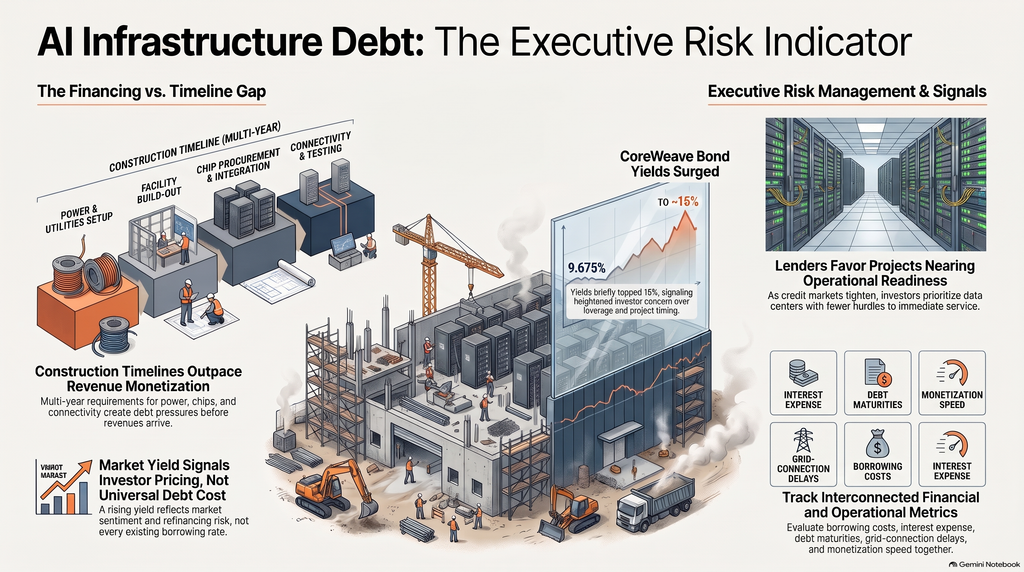
On October 16, Reuters reported that CoreWeave bonds issued in June at a 9.675% yield had repriced to roughly 15%. The yield briefly moved above 16% during the week. That shift reflects investors demanding much more compensation to hold the company’s debt amid concerns about leverage, borrowing costs, execution risk, and the time required for large infrastructure investments to generate returns. reuters.com
For executives, the point is not that one bond price predicts the future of AI. It is that financing conditions are becoming a useful indicator of which projects and business models the market considers more exposed. A data center can be strategically important and still face pressure if its debt costs rise before customer revenue catches up.
That timing matters. AI infrastructure requires substantial investment in chips, power, cooling, buildings, and connectivity. Those assets may take years to plan, build, connect, and bring into productive use. During that period, a company still has to fund construction, service debt, and manage the possibility that equipment or market conditions change.
A higher market yield does not automatically mean the company will pay that rate on all of its debt. But it can make future borrowing more expensive, complicate refinancing, and influence how investors assess new projects. As credit tightens, lenders may favor projects closer to completion, with clearer paths to service and revenue. Reuters reported that investors were showing preference for data center financings with fewer hurdles before entering operation. reuters.com
This is a financing signal, not proof that AI demand is collapsing. Demand can remain strong while the economics of building capacity become harder to underwrite. The distinction matters: demand answers whether customers want compute; credit markets help answer whether the infrastructure can be financed at an acceptable cost and on a viable timeline.
Executives tracking the market should watch several indicators together: borrowing costs, debt maturities, interest expense, construction and grid-connection timelines, customer commitments, and the pace at which new capacity becomes revenue-producing. A rising yield on one issuer is a data point. A pattern across financing costs, project delays, and customer economics would be a stronger signal.
The executive question is not simply, “Is AI demand growing?” It is: Can this infrastructure be financed, delivered, and monetized before its costs or assumptions change?
AI infrastructure debt is becoming an executive risk indicator because it makes the distance between planned capacity and productive capacity visible to the market.
Leave a Reply