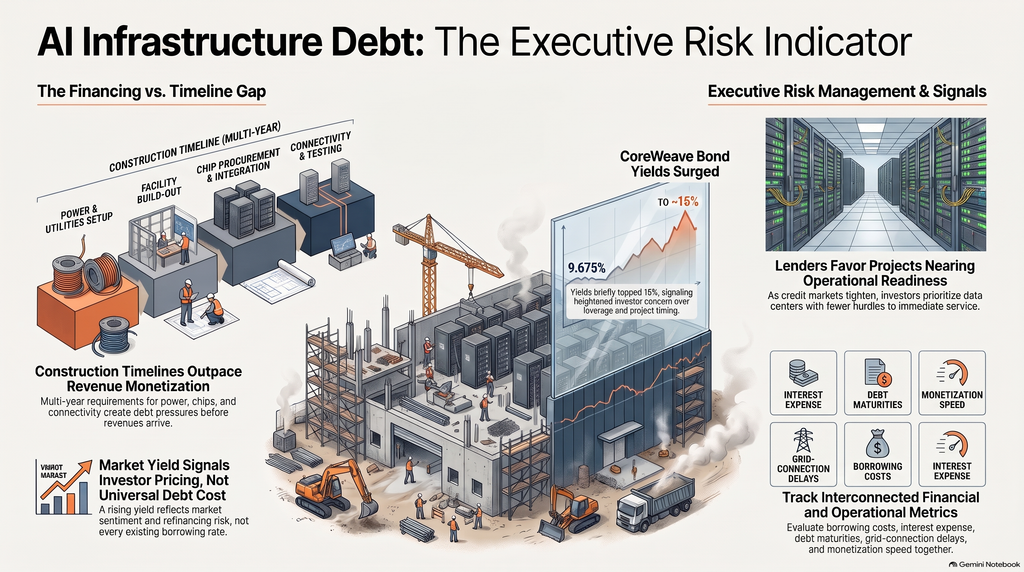
The market for AI infrastructure is sending a signal executives should watch: the cost of financing the buildout can change faster than the infrastructure can produce revenue.
On October 16, Reuters reported that CoreWeave bonds issued in June at a 9.675% yield had repriced to roughly 15%. The yield briefly moved above 16% during the week. That shift reflects investors demanding much more compensation to hold the company’s debt amid concerns about leverage, borrowing costs, execution risk, and the time required for large infrastructure investments to generate returns. reuters.com
For executives, the point is not that one bond price predicts the future of AI. It is that financing conditions are becoming a useful indicator of which projects and business models the market considers more exposed. A data center can be strategically important and still face pressure if its debt costs rise before customer revenue catches up.
That timing matters. AI infrastructure requires substantial investment in chips, power, cooling, buildings, and connectivity. Those assets may take years to plan, build, connect, and bring into productive use. During that period, a company still has to fund construction, service debt, and manage the possibility that equipment or market conditions change.
A higher market yield does not automatically mean the company will pay that rate on all of its debt. But it can make future borrowing more expensive, complicate refinancing, and influence how investors assess new projects. As credit tightens, lenders may favor projects closer to completion, with clearer paths to service and revenue. Reuters reported that investors were showing preference for data center financings with fewer hurdles before entering operation. reuters.com
This is a financing signal, not proof that AI demand is collapsing. Demand can remain strong while the economics of building capacity become harder to underwrite. The distinction matters: demand answers whether customers want compute; credit markets help answer whether the infrastructure can be financed at an acceptable cost and on a viable timeline.
Executives tracking the market should watch several indicators together: borrowing costs, debt maturities, interest expense, construction and grid-connection timelines, customer commitments, and the pace at which new capacity becomes revenue-producing. A rising yield on one issuer is a data point. A pattern across financing costs, project delays, and customer economics would be a stronger signal.
The executive question is not simply, “Is AI demand growing?” It is: Can this infrastructure be financed, delivered, and monetized before its costs or assumptions change?
AI infrastructure debt is becoming an executive risk indicator because it makes the distance between planned capacity and productive capacity visible to the market.
That statement may sound obvious, but the economics of artificial intelligence are beginning to demonstrate just how consequential it is.
Reuters reported on August 26 that Anthropic is expected to spend approximately $45 billion over six years to rent AI computing power from Nscale’s planned data center campus in West Virginia. According to the report, Nscale would deploy Nvidia’s Vera Rubin systems, and the agreement would represent approximately 460 megawatts of power capacity.
Anthropic declined to comment on the reported agreement, so the details should still be treated as reported rather than officially confirmed.
Nevertheless, the structure of the prospective deal offers an important signal about where AI competition is heading.
The headline number is $45 billion.
The more strategically revealing number may be 460 megawatts.
AI Compute Is Becoming a Long-Duration Infrastructure Commitment
Traditional cloud computing helped companies convert physical technology infrastructure into an operating expense. Businesses could purchase additional storage or computing resources without building their own data centers.
Frontier AI is beginning to complicate that model.
The scale of computing required to train and operate advanced models means that capacity cannot always be treated as an interchangeable service that will be available whenever demand appears. The necessary chips must be manufactured, installed, cooled, networked, powered, and maintained inside facilities capable of supporting unusually dense workloads.
That makes access to compute dependent on an entire physical system.
A six-year agreement of the reported size is therefore more than a technology purchase. It is a long-term commitment involving several interdependent assets:
Semiconductor capacity
Data-center construction
Electricity generation and delivery
Cooling infrastructure
Transformers and substations
Network connectivity
Land and permitting
Capital and financing
The AI company may be purchasing computing services, but the provider must assemble and operate the physical infrastructure behind those services.
AI procurement is starting to resemble infrastructure procurement.
Why the 460 Megawatts Matter
GPU counts remain important, but they do not tell the whole story.
A company can order advanced processors and still face delays if the intended facility cannot be energized. Electricity availability, grid interconnection, cooling capacity, equipment lead times, and construction schedules can all determine when those processors become commercially useful.
That is why megawatts are becoming strategically meaningful.
Power capacity represents the ability to operate computing equipment—not merely to own it. Securing access to hundreds of megawatts can therefore function as a competitive moat, particularly when other projects remain stuck in utility interconnection or permitting queues.
This changes the constraint.
The question is no longer simply:
“Can we obtain the newest chips?”
It is increasingly:
“Where can those chips be installed, when can the site be energized, and can the resulting capacity be operated reliably for years?”
GPU supply can improve as manufacturing expands. Energized infrastructure is often slower to reproduce.
Capital, Electricity, and Compute Are Converging
The reported Anthropic–Nscale agreement illustrates a larger structural shift: capital allocation, energy procurement, and computing strategy are becoming one decision.
A long-term compute contract implicitly contains assumptions about:
Future demand for AI services
Model-training and inference requirements
Electricity availability and cost
Hardware replacement cycles
Construction and commissioning timelines
The provider’s operational reliability
The customer’s ability to monetize the capacity
That creates both an advantage and an exposure.
Securing capacity early may protect a model developer from future scarcity and allow it to scale faster than competitors. However, a multiyear commitment may also create concentration risk, utilization risk, counterparty risk, and exposure to changes in hardware efficiency or market demand.
The infrastructure supporting AI can become a source of competitive advantage while simultaneously becoming one of the company’s largest obligations.
That is why these agreements require more than technical due diligence. They require financial, operational, energy, supply-chain, and governance scrutiny.
The AI Race Is Moving Down the Stack
The public conversation around artificial intelligence still focuses heavily on model benchmarks, new features, and GPU announcements.
But competition is moving farther down the infrastructure stack:
Models require compute. Compute requires data centers. Data centers require electricity. Electricity requires generation, transmission, equipment, permits, and capital.
Each layer introduces constraints that software alone cannot remove.
As companies pursue larger models and greater inference capacity, their strategies will become increasingly tied to utilities, infrastructure developers, equipment manufacturers, energy suppliers, and capital markets.
That means the people evaluating AI strategy may need to broaden their questions.
Executives should ask:
How much energized capacity is actually secured?
When will that capacity become operational?
Which utility, generation source, or onsite system will support it?
What dependencies could delay commissioning?
How concentrated is the company’s compute capacity among providers and locations?
What happens if utilization or energy costs differ from projections?
Who bears the risk if the infrastructure is delivered late?
These are not background engineering questions. They are business-model and enterprise-risk questions.
The Headline and the Strategy
The reported $45 billion figure captures attention because of its scale.
The 460-megawatt figure reveals what the money is intended to secure: the physical ability to operate AI systems at industrial scale.
That distinction matters.
The next stage of AI competition will not be decided exclusively by who develops the most capable model or obtains the newest GPU. It may also be decided by who can secure land, power, equipment, financing, and reliable infrastructure before those resources become harder to obtain.
AI strategy is becoming infrastructure strategy.
The $45 billion gets the headline.
The 460 megawatts reveal the constraint—and possibly the competitive advantage.