Category: Strategy

  • AI Physical Reality Dependency Stack

    AI Just Made the Transformer a National-Security Asset
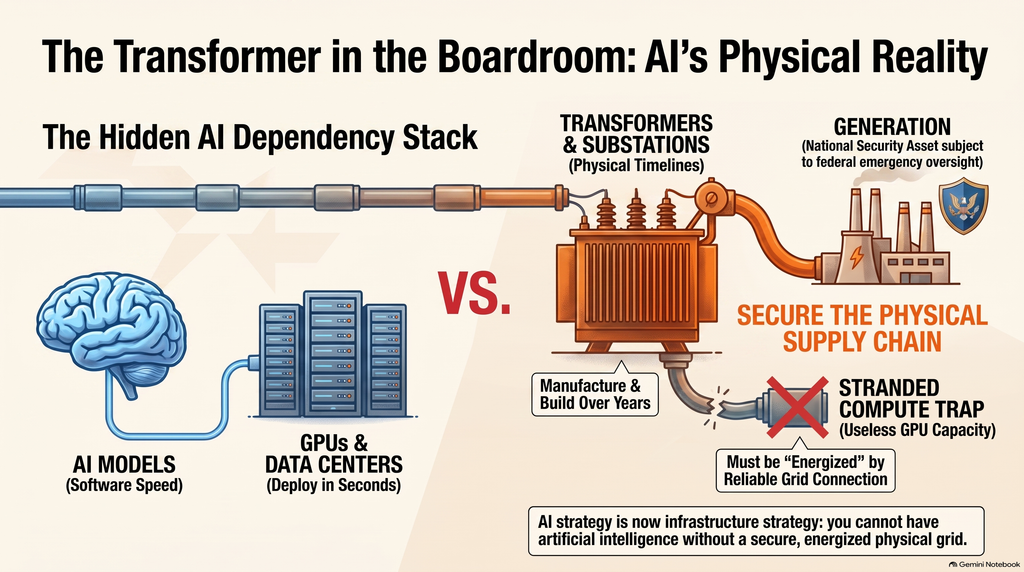
    For most executives thinking about AI infrastructure, the supply chain still looks something like this:

    Models → GPUs → Data Centers.

    But on August 26, the United States government effectively reminded the market that the stack goes much deeper.

    President Trump declared a national emergency concerning foreign-produced equipment used in the U.S. bulk-power system.

    The order isn’t an AI regulation disguised as energy policy.

    Its stated concern is national security: foreign equipment, cybersecurity vulnerabilities, remote access, sabotage, supply disruption and the resilience of the electrical infrastructure supporting the country.

    But buried inside that problem is something AI executives should pay attention to.

    AI has made the consequences of grid vulnerability much larger.

    The order explicitly points to the rapid growth of artificial intelligence, data centers, advanced manufacturing and defense production as increasing America’s dependence on abundant, reliable electricity.

    That changes how we should think about AI supply-chain risk.

    The AI stack doesn’t stop at the GPU

    For the past several years, semiconductor availability has dominated discussions about AI infrastructure.

    That made sense.

    Without accelerators, there is no compute.

    But having the GPUs doesn’t mean much if you cannot reliably energize the facility containing them.

    Follow the stack downward:

    AI models

    Compute

    Data centers

    Electricity

    Substations

    Transformers

    Transmission infrastructure

    Equipment supply chains

    Every layer inherits dependencies from the layer beneath it.

    And the August 26 order reaches surprisingly far into those dependencies.

    Its definition of bulk-power equipment includes substation transformers, grid-connected inverters, battery energy-storage systems, high-voltage circuit breakers, generators, industrial control systems and other equipment.

    It also reaches beyond physical hardware.

    Software, firmware, remote-access capabilities, maintenance mechanisms and other supply-chain dependencies can be considered when evaluating national-security risk.

    That means the transformer isn’t merely an electrical component anymore.

    In an economy increasingly dependent on compute, it sits underneath strategic digital capacity.

    The constraint is moving down the stack

    This creates an important distinction.

    There is a difference between compute capacity and usable compute capacity.

    A company can acquire servers.

    It can secure GPUs.

    It can finance a data center.

    But the facility still needs reliable power, interconnection and the physical infrastructure required to move electricity into it.

    Those systems operate on very different timelines from software.

    You can deploy a new model relatively quickly.

    You cannot deploy a transmission network, substation or large transformer with the same elasticity.

    And once national-security screening becomes another variable in the equipment supply chain, infrastructure planning becomes even more strategically important.

    This doesn’t mean AI caused America’s transformer problem.

    It means AI growth increases the economic consequences of infrastructure constraints that already existed.

    That’s a much more important distinction.

    Supply-chain risk now includes energy infrastructure

    Executives evaluating AI exposure therefore may need to widen the aperture.

    Traditional AI supply-chain questions often sound like:

    Who manufactures our chips?

    Where are our servers located?

    Which cloud provider are we dependent upon?

    Those remain important.

    But increasingly, another set of questions belongs beside them:

    Where does the electricity come from?

    How quickly can additional capacity actually be energized?

    Which critical grid components sit between generation and the data center?

    Where were those components manufactured?

    What software or remote-access capabilities exist inside them?

    How concentrated are those suppliers?

    And what happens if equipment must be isolated, replaced or subjected to additional security requirements?

    Those aren’t traditional AI-governance questions.

    But they are becoming AI-strategy questions.

    The deeper lesson

    AI is forcing executives to rediscover something the software era occasionally allowed us to forget:

    The digital economy still sits on physical infrastructure.

    The further AI scales, the more important that infrastructure becomes.

    Models depend on compute.

    Compute depends on electricity.

    Electricity depends on equipment.

    Equipment depends on manufacturing capacity, supply chains, security and geopolitical stability.

    So an executive who believes AI supply-chain risk ends with GPU availability may simply be looking several layers too high.

    The next competitive advantage in AI may not come solely from who can acquire the most compute.

    It may increasingly belong to whoever can secure the infrastructure required to keep that compute energized.

    And Washington just provided another reason to follow the stack all the way down.
  • The Grid as the AI Business Model

    The Grid Is Becoming Part of the AI Business Model

    DataCenters, Energy, PowerGrid

    Most conversations about the infrastructure required for artificial intelligence eventually arrive at electricity.

    AI models require compute. Compute requires data centers. Data centers require enormous amounts of power.

    But even that description misses an important layer of the infrastructure stack.

    Generating electricity and delivering electricity are not the same problem.

    As AI infrastructure expands, that distinction could become increasingly important to the economics of the industry.

    The Bottleneck Beneath the Data Center

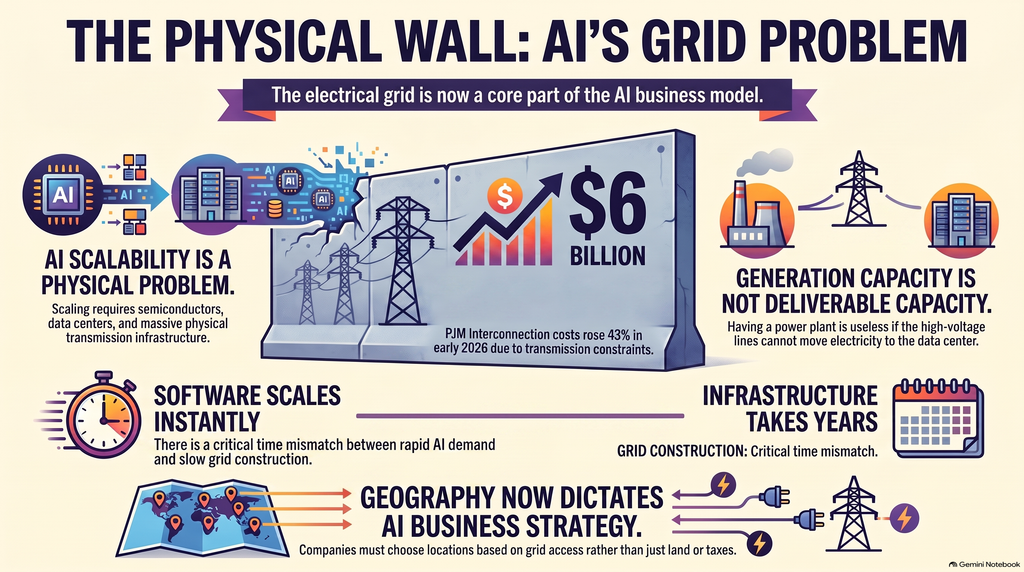
    On August 21, Reuters reported that transmission-congestion costs on PJM Interconnection reached approximately $6 billion during the first half of 2026, an increase of 43%.

    PJM operates the largest U.S. power grid, serving roughly 67 million people across a territory extending from Washington, D.C. to Chicago.

    The problem wasn’t simply whether enough electricity could theoretically be generated.

    High-voltage transmission lines were increasingly becoming constrained.

    That creates an important distinction for anyone thinking about the future of AI infrastructure:

    Generation capacity is not the same thing as deliverable capacity.

    A power plant can generate electricity hundreds of miles away from a data center.

    That electricity still has to move through transmission infrastructure before reaching the location where it will actually be consumed.

    When parts of that network become congested, electricity becomes more difficult — and potentially more expensive — to move across the system.

    The grid therefore starts behaving much like any other constrained network.

    Adding supply at one point does not necessarily eliminate a bottleneck somewhere else.

    AI Is Becoming a Location Problem

    For years, technology companies could think about infrastructure primarily through familiar variables:

    Compute availability.

    Network connectivity.

    Real estate.

    Labor.

    Taxes.

    Capital.

    Electricity increasingly adds another set of questions.

    Where is generation available?

    Where does transmission capacity exist?

    How quickly can new load actually be interconnected?

    What infrastructure upgrades will be required?

    Who pays for those upgrades?

    And how long will they take?

    Those questions can affect where infrastructure gets built and ultimately how much that infrastructure costs to operate.

    That means the geography of AI may increasingly follow the geography of available infrastructure.

    The cheapest land isn’t necessarily the best land.

    The closest generation isn’t necessarily usable generation.

    And announcing a new power plant doesn’t automatically mean the transmission system can deliver that additional electricity to a rapidly growing cluster of data centers.

    Congestion Becomes an Economic Variable

    This is where grid infrastructure begins crossing into business strategy.

    Transmission congestion isn’t merely an engineering problem.

    It can influence wholesale electricity prices, infrastructure investment requirements, project timelines and ultimately the economics of operating large computing facilities.

    That creates another layer of risk for AI expansion.

    Companies can secure chips.

    They can raise capital.

    They can purchase land.

    They can construct data centers.

    But those investments still depend on infrastructure outside the walls of the facility.

    If that infrastructure cannot expand at approximately the same pace as computing demand, the bottleneck simply moves farther down the stack.

    We’ve already watched parts of this progression happen.

    The AI conversation moved from models to chips.

    From chips to data centers.

    From data centers to electricity generation.

    And now electricity demand is forcing greater attention toward transmission and grid capacity.

    Each layer reveals another dependency underneath the previous one.

    The Physical Economy Underneath AI

    AI is often described as a digital technology.

    Economically, however, its expansion is becoming increasingly physical.

    Scaling AI requires semiconductors manufactured in physical facilities, servers installed inside physical buildings, electricity generated by physical assets and transmission infrastructure capable of moving that electricity across geographic regions.

    Then there is land, cooling, water, construction equipment, transformers, substations and capital.

    The software may operate in milliseconds.

    The infrastructure underneath it can take years to build.

    That mismatch matters.

    AI demand can accelerate extremely quickly.

    Transmission infrastructure generally cannot.

    Which means some of the most important constraints on future AI growth may not come from model architecture at all.

    They may come from infrastructure that existed long before generative AI entered the conversation.

    AI Strategy Is Becoming Infrastructure Strategy

    This doesn’t mean technology executives suddenly need to become grid operators.

    It does mean the boundary between technology strategy and infrastructure strategy is becoming harder to maintain.

    When electricity availability affects where computing infrastructure can be built, how quickly it can expand and what it costs to operate, energy infrastructure becomes part of the business calculation.

    The companies building the next generation of AI infrastructure therefore aren’t simply competing for GPUs.

    Increasingly, they are competing for an entire stack of scarce resources:

    Compute.
    Land.
    Power.
    Transmission access.
    Capital.
    Time.

    And perhaps that is the larger lesson.

    We tend to think of technological progress as moving upward into increasingly sophisticated software.

    AI is showing us something different.

    The further we scale the digital layer, the more important the physical layers underneath it become.

    The grid isn’t sitting outside the AI economy anymore.

    It’s becoming part of the AI business model.