Tag: Energy

  • AI Data Centers Are Becoming Large Enough to Require New Reliability Rules

    The growth of large computational loads is changing the operating relationship between data centers and the electric grid. NERC’s new standards point toward a more formal governance model—one that connects facility operations, engineering, and executive oversight to bulk-power-system reliability.

    A data center can be highly resilient inside its fence and still create risks at the grid interface.

    That distinction matters as AI facilities, data centers, and other computational loads grow in scale and connect to the bulk power system. Their electrical demand can change quickly, and their response during a disturbance can affect more than the facility itself. Grid operators need timely information about the load, credible models of its behavior, and clear communication with the people who operate it.

    NERC’s proposed computational-load reliability standards are an effort to establish that foundation.

    From stakeholder ballot to regulatory review

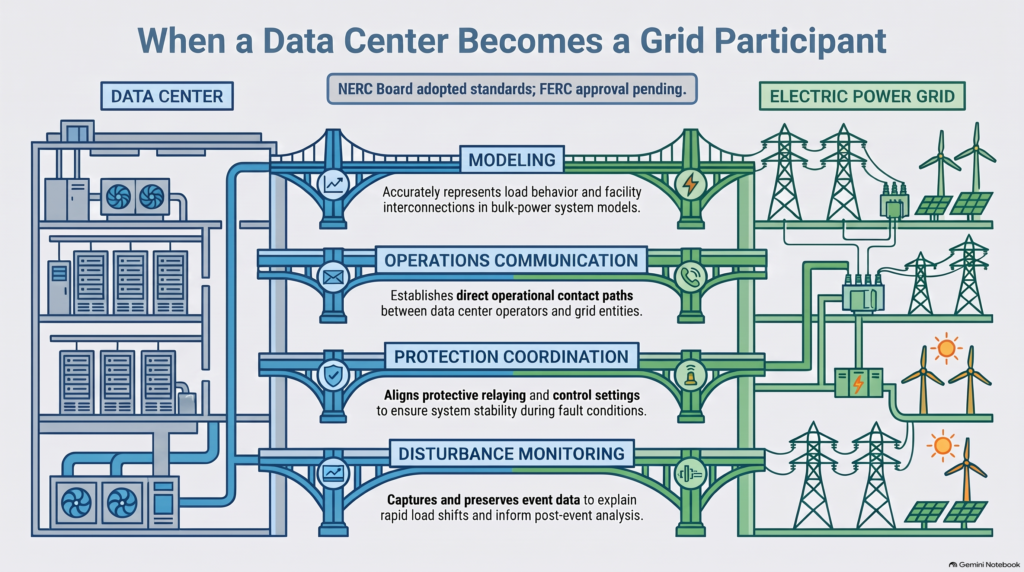
    On October 15, NERC announced that the standards and their implementation plans had passed their final stakeholder ballot. On October 26, NERC’s Board of Trustees adopted the standards. NERC has said it will submit them to the Federal Energy Regulatory Commission for approval in the United States. Until FERC approves them and the applicable implementation period arrives, they are not enforceable U.S. reliability standards. (nerc.com, nerc.com)

    The proposed registry criteria would apply to Computational Load Owners and Computational Load Operators at sites with total connected load of at least 50 MW, supplied through electrical equipment connected at 100 kV or higher. This is a proposed registration threshold—not a claim that every data center or large electricity customer is covered. The related registry criteria also have a separate approval path. (publicpower.org, nerc.com)

    What the standards address

    NERC’s first phase centers on basic capabilities needed to integrate large computational loads reliably. The proposed standards address how loads are interconnected and represented in system models; how facility operators communicate with relevant grid entities; and how protection coordination and disturbance monitoring support reliable operation. The project materials identify three foundational standards—CLO-001-1, CLO-002-1, and CLO-003-1—alongside related revisions to interconnection requirements and studies. (nerc.com)

    These requirements matter because grid reliability depends on a shared operational picture. If the load changes unexpectedly, operators need to understand what happened, how the facility responded, and whether similar behavior could recur. Reliable models, clear communications, coordinated protection, and usable disturbance records help make that possible.

    The governance question for executives

    The standards create a practical governance challenge: responsibility may be split among the entity that owns the site, the entity that operates it, the data-center tenant, the utility, and other grid participants. NERC’s registry revisions establish distinct Computational Load Owner and Computational Load Operator roles, underscoring the need to identify who is accountable for each operational duty. The proposed registry criteria remain subject to FERC approval. (nerc.com)

    Executives should begin with a clear map of ownership and accountability:

    • Assign a responsible executive. Give one leader authority to coordinate energy, engineering, operations, compliance, and external grid relationships.
    • Clarify owner and operator responsibilities. Document who maintains models and protection settings, who communicates with grid entities, who responds to disturbances, and who preserves records.
    • Assess operational readiness. Review procedures, contact paths, escalation authority, and after-hours coverage. A contact list that works only during business hours is not an operating plan.
    • Review data and model quality. Confirm that technical information shared with grid operators reflects current facility design and actual operating behavior.
    • Connect contracts to operating reality. Agreements with tenants, operators, utilities, and service providers should support timely information sharing and coordinated action.
    • Prepare evidence of control. Keep records that show how the facility manages communications, models, protection coordination, and disturbance response.

    This work is useful before a rule becomes enforceable. The goal is not to guess at final compliance obligations; it is to identify gaps early enough to resolve unclear responsibilities, missing data, and fragile operating procedures.

    A first phase, not the finish line

    NERC describes the adopted standards as the first phase of its broader large-load action plan. Additional standards work is underway around computational-load performance, planning and reliability studies, event reporting, and model quality. (nerc.com)

    That points to a wider shift in how data-center readiness will be judged. Power availability, backup generation, and facility uptime remain essential. But large computational facilities also need to show that their grid-facing behavior is understood, communicated, and governed.

    For boards and executive teams, the strategic question is straightforward: Can the organization explain who is responsible for the facility’s effects on the grid, how those responsibilities are carried out, and what evidence shows the controls work?

    As computational loads grow, reliability will depend on that answer being clear before the next disturbance—not reconstructed afterward.
  • Time to Power: Why Grid Delays Can Become Contract Risk for AI Infrastructure

    AI infrastructure projects are often described through large, attention-grabbing numbers: megawatts, GPUs, investment totals and planned opening dates. But those figures only tell part of the story. For a customer planning cloud or AI services, capacity matters when it is ready to use.

    The planned Nscale site in Loughton, Essex, offers a concrete example of how the schedule can break down.

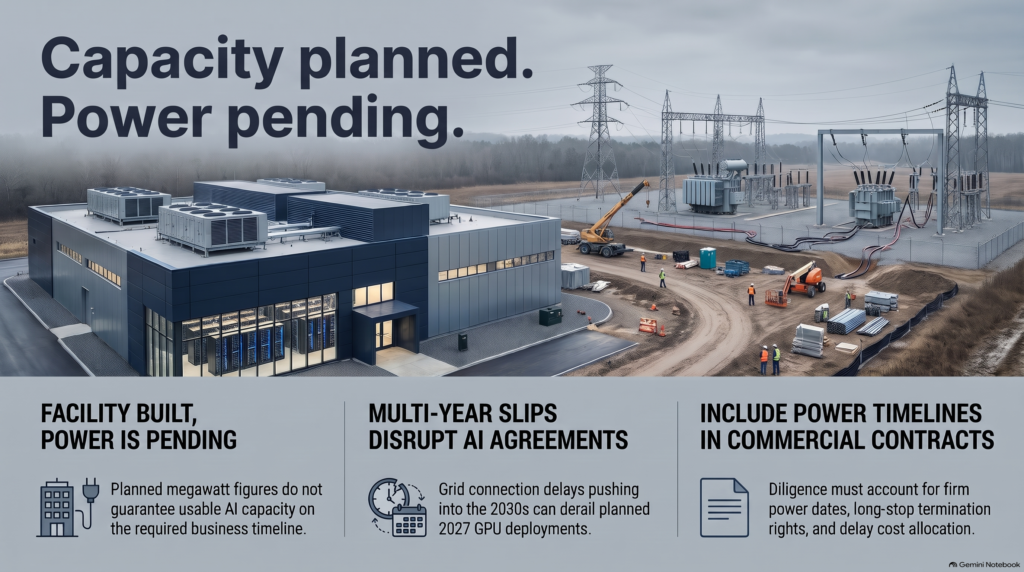
    Reuters reported that Microsoft withdrew from its agreement for capacity at the site after the expected grid connection slipped into the 2030s. Nscale had planned a facility with 50 MW of AI capacity, scalable to 90 MW, and approximately 23,040 Nvidia GB300 GPUs for Microsoft Azure. The original announcement anticipated GPU delivery beginning in early 2027. 

    Microsoft said its decision related to one site and reaffirmed its wider partnership with Nscale. Nscale said it remained committed to Loughton and was exploring alternative power sources and other UK expansion sites. The public reporting does not disclose the contract’s terms, the exact termination provision or the financial consequences for either party. 

    A project schedule depends on more than construction

    Data centre readiness depends on several linked pieces: the building, electrical equipment, cooling, network connectivity, hardware and sufficient power. If one critical dependency arrives years later than planned, the rest of the investment may not produce its expected value on schedule.

    That creates commercial consequences. A late power connection can postpone the point when a customer can use capacity, delay revenue, extend the time capital is tied up and create uncertainty about whether demand will still be there when the site is ready. These are general project risks; the publicly available details do not establish which of them applied to this specific agreement.

    Why this can become a contract issue

    Long-term infrastructure agreements have to allocate the risks of delay. Executives and project teams should understand how the contract treats power availability, delivery milestones, delay thresholds, customer remedies and termination rights.

    The questions are practical:

    • Is the power date confirmed, estimated or dependent on future grid work?
    • What happens if service begins later than the customer’s required date?
    • Is there a defined long-stop date after which a party can exit?
    • Can capacity be moved to another site or supplied from another source?
    • Who bears added costs while the project waits?

    These are questions to raise during commercial and legal review—not assumptions about the terms of Microsoft’s agreement.

    The executive takeaway

    A planned megawatt figure doesn’t guarantee usable capacity on the date a business needs it. Time to power affects whether a project can support customer commitments and whether its economics still work when the facility is ready.

    The better diligence question is not only, “How much AI capacity will this project deliver?” It is also, “When will power be available, how certain is that date, and what happens contractually if it moves?”

    In AI infrastructure, the power schedule belongs in the commercial plan from the start.

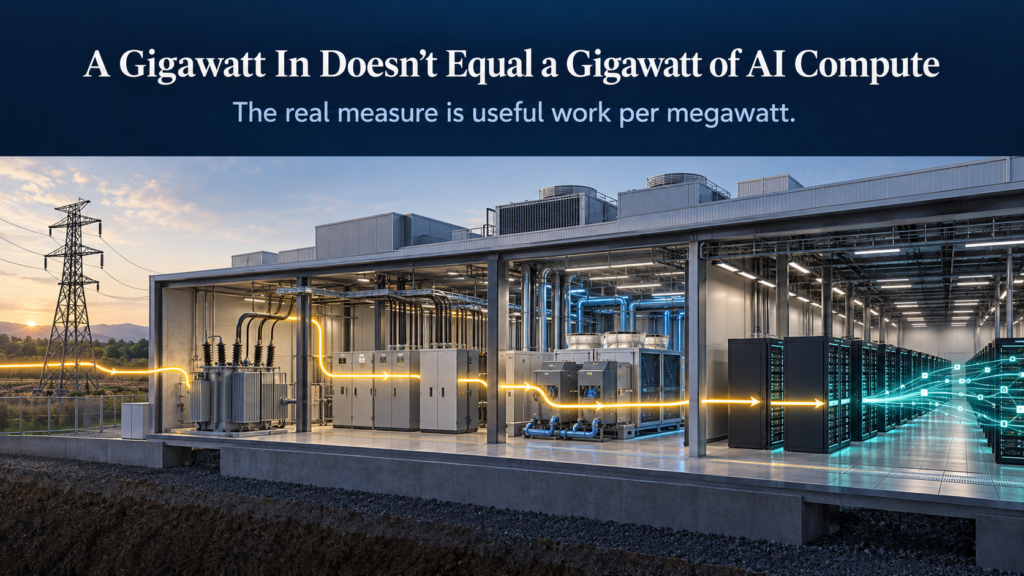
  • Why a Gigawatt of Electricity Doesn’t Mean a Gigawatt of AI Compute

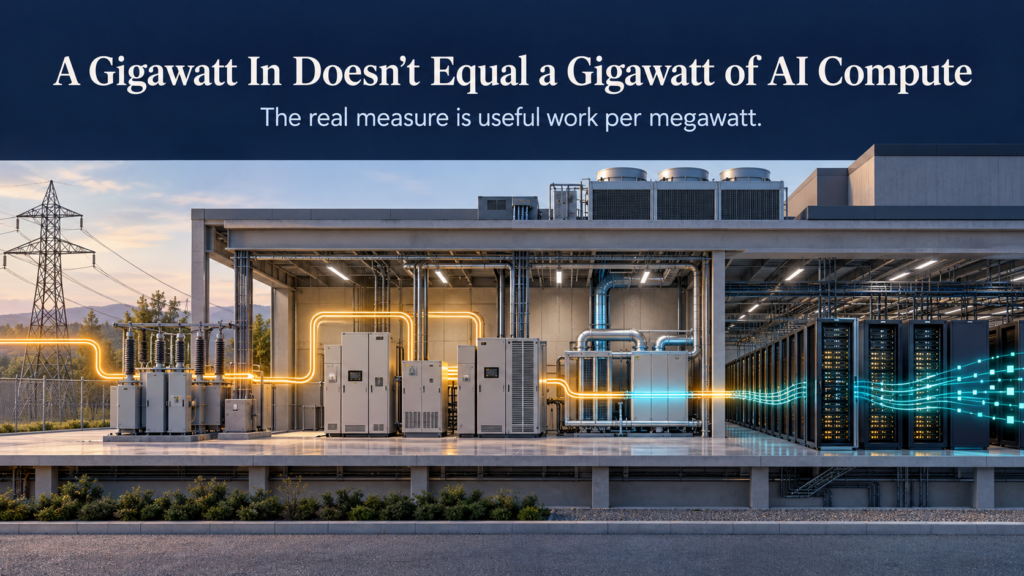
    A data center’s power capacity tells us how much electricity it can draw. It does not tell us how much useful AI work the facility will produce.

    That difference matters as companies compete for power, build larger campuses, and commit billions of dollars to AI infrastructure. A megawatt secured at the grid connection is only the beginning of the measurement.

    Power has to travel through the system

    Electricity entering a data center must be converted and distributed before it reaches computing equipment. The facility also needs cooling, monitoring, backup systems, and other infrastructure to operate reliably.

    Then there is the equipment itself. A GPU can be installed and powered without running at full utilization. A poorly configured rack, a failed component, or a system restart can reduce productive output even while the facility continues to draw power.

    The result is a gap between electricity consumed and useful computation delivered.

    What the reported 60–70% estimate tells us

    On October 14, TechRadar reported remarks from NVIDIA representatives at a Vertiv event suggesting that roughly 60–70% of electricity drawn by some AI data centers supports AI processing. The report described the remaining share as associated with cooling, power distribution and conversion, equipment configuration, failures, and restarts.

    That figure is an industry estimate reported from executive remarks. It is not an independently audited average for all data centers. Facility design, workload, equipment, climate, operating practices, and the way “AI processing” is measured can all affect the result.

    The estimate is still useful as a prompt: capacity figures alone do not reveal how efficiently a facility turns electricity into productive work.

    “Non-compute” power is not automatically waste

    Cooling and backup systems are necessary to keep high-density computing equipment within operating limits and protect service continuity. Power conversion and distribution are also part of delivering electricity safely to the IT load.

    The goal is not to eliminate every watt that does not go directly to a processor. The goal is to understand the full system, reduce avoidable losses, and make sure the infrastructure investment supports dependable output.

    A facility designed for peak demand and contingencies may also have capacity that is not used continuously. That may be appropriate for resilience, but it raises a management question: how much of the available infrastructure is producing useful work under typical operating conditions?

    Measure the output, not just the input

    “Gigawatt of AI compute” is shorthand. A gigawatt measures electrical power; compute output is measured through completed work and system performance.

    For executives, that means asking for more than a facility’s contracted power or nameplate capacity. Useful measures could include:

    • Electricity delivered to the facility and to IT equipment
    • AI workload throughput, such as completed jobs or tokens generated
    • Accelerator utilization and periods of idle or degraded operation
    • Cooling and power-system overhead
    • Availability, restart frequency, and time spent operating below target

    These measures need consistent definitions and a clear time period. A peak result, a design target, and an observed operating average are different kinds of evidence.

    The strategic implication

    When power is scarce, improving the amount of useful computation produced from existing electricity can be as important as securing more supply.

    That makes infrastructure efficiency an operating and capital-allocation issue. Better power delivery, cooling, equipment configuration, workload scheduling, and maintenance may help increase productive output without assuming that every problem can be solved by adding another megawatt.

    The reported 60–70% estimate should be treated as a signal to investigate, not a benchmark to apply blindly. Each operator needs facility-level evidence to understand where power goes and what work it enables.

    The executive question is therefore not only, “How much power can this data center draw?”

    It is: How much useful, reliable AI work does each megawatt deliver—and how do we know?

  • The Next AI Infrastructure Bottleneck May Be Chips Waiting on Other Chips

    AI infrastructure discussions often begin with the most visible asset: the accelerator. How many GPUs or other AI processors can a company buy, and when can they be installed?

    But installed capacity is only part of the equation. Those processors must also exchange data, coordinate work, and receive instructions from the software stack. If those connections cannot keep pace with the workload, adding more processors may not deliver a proportional increase in useful compute.

    That makes networking and integration a growing part of the economics of AI infrastructure.

    Compute depends on more than the processor

    An AI cluster is a system of connected components. Processors move data between memory, storage, and other processors while workloads are divided, coordinated, and recombined. The network affects how quickly those exchanges happen and how well the system handles congestion or failures.

    Two networking jobs matter here. Scale-up networking connects accelerators within a pod or rack. Scale-out networking connects systems across racks and throughout a data center. A workload can depend on both.

    When data movement or coordination becomes a constraint, some processors may wait for information or for other parts of the workload to finish. The hardware is present, but its potential output is not being fully realized. That can weaken the return on expensive infrastructure investments and complicate capacity planning.

    What Token Fabric is trying to do

    On October 8, Nvidia-backed Upscale AI introduced Token Fabric, a networking architecture intended to support AI processors from different suppliers. The company describes it as a combination of scale-up and scale-out networking, systems, and shared software for managing operations. Reuters reported that the platform is expected to roll out in stages, with the first component planned for the fourth quarter and the broader platform through 2027. Upscale says general availability is planned for early 2027. (reuters.com, upscale.com)

    The proposal addresses a practical challenge for operators: networking has often been assembled from separate components that customers must integrate and manage. A more unified approach could simplify parts of that work and make it easier to build clusters containing different types of accelerators.

    That is the opportunity. It is not yet proof that the architecture will deliver a specific utilization gain or make mixed-vendor systems simple to operate. Those results will depend on deployment conditions and independent performance evidence.

    Interoperability is useful, but it is not automatic

    The possibility of using multiple accelerator suppliers is attractive for organizations that want more choice in hardware procurement or want to match different processors to different workloads. It could also reduce reliance on a single hardware ecosystem.

    However, networking compatibility is only one part of interoperability. A system still needs suitable software frameworks, drivers, compilers, memory behavior, and workload orchestration. Operators must also understand how performance changes when different processors share a system.

    In other words, “connects different processors” does not necessarily mean every processor can be substituted freely, or that every workload will run equally well across all of them. The relevant test is whether the full system performs reliably and economically for the workloads a customer actually runs.

    The business metric is useful output

    For decision-makers, the central question is not simply how many processors are installed. It is how much useful work the organization gets from the complete system, at what cost, and with what operational burden.

    That means evaluating utilization alongside measures such as workload throughput, latency, energy use, network performance, software compatibility, and the cost of operating the environment. A network upgrade that improves one technical metric may not improve the business outcome if it adds complexity or fails to support the applications that matter.

    The same discipline applies to claims about future capacity. Product roadmaps and announced availability dates are signals about where vendors are investing. They are not substitutes for customer deployments, workload-level results, and independently reviewable performance data.

    The next bottleneck is system-level

    AI infrastructure is moving beyond a simple race to install more chips. The economics increasingly depend on how compute, networking, software, power, and operations work together.

    Token Fabric is one example of vendors trying to address that system-level problem and support more heterogeneous infrastructure. The broader industry question is whether these architectures can make processors easier to connect and keep productively occupied—without creating new integration and management burdens.

    The next generation of AI capacity may be shaped not only by how many chips organizations can obtain, but by how effectively those chips can work together.

  • AI Infrastructure Is Moving From Maximum Capacity to Maximum Certainty

    The AI infrastructure conversation has been dominated by scale: more data centers, more generation, more chips, more gigawatts.

    Scale is still essential. AI workloads need enormous amounts of compute and power. But a large capacity announcement does not, by itself, mean a project can be financed, built, connected, and operated on a dependable schedule.

    That gap is moving to the center of the conversation.

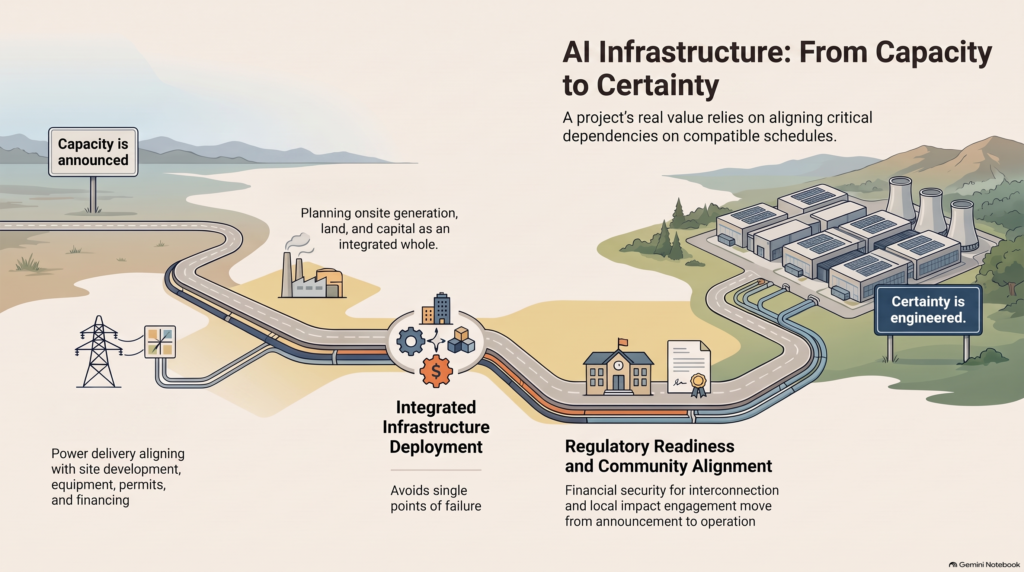
    A project’s real value depends on several linked conditions: a site that can be developed, power that can be delivered, equipment that can be procured, financing that can support the timeline, permits that can be secured, and a community willing to live with the project. If one critical dependency remains uncertain, the announced capacity may be far from usable compute.

    The signals are converging

    Recent developments point toward a more coordinated approach to AI infrastructure.

    In the United States, utility and regulatory processes are placing greater emphasis on whether large-load projects are financially ready and accountable for the infrastructure costs they create. Texas has adopted financial security requirements for large-load interconnection requests, while federal regulators have also focused on cost recovery and protections for existing customers.

    In Japan, a project involving JERA, Dell, and RHAELM brings together power capabilities, a site, data-center development, financing, and AI infrastructure. The project illustrates the appeal of planning these components as an integrated deployment rather than treating them as separate problems to solve one by one.

    Developers are also pursuing onsite generation. Recent reporting describes growing interest in smaller gas turbines and other behind-the-meter options, partly in response to equipment lead times and the challenge of securing grid connections. Onsite power may offer a different schedule path, but it does not erase the trade-offs: fuel supply, permitting, emissions, cost, and the eventual relationship with the grid still matter.

    Community relationships are becoming a more visible part of the infrastructure strategy as well. AWS recently announced a multiyear investment in programs for communities near its U.S. data centers. These commitments do not guarantee public support, but they show that local impact and engagement are now part of the deployment conversation.

    From announced capacity to predictable dependencies

    These examples are different, but they point in the same direction: the challenge is no longer just assembling enough capacity. It is coordinating the conditions that allow capacity to become operational.

    That means executives may need to ask a broader set of questions:

    • Is the power timeline credible, and what assumptions does it depend on?
    • Who pays for the upgrades needed to serve the load?
    • Are land, permits, equipment, and financing progressing on compatible schedules?
    • If grid power is delayed, what alternatives are available—and what new risks do they create?
    • How are local costs, benefits, and concerns being addressed?

    These questions do not replace the traditional focus on capacity. They make the capacity claim more useful by connecting it to execution.

    Certainty as a competitive advantage

    “Certainty” here does not mean that every project outcome is guaranteed. Large infrastructure projects will always involve uncertainty.

    It means that fewer critical dependencies are left unresolved, that assumptions are visible, and that decision-makers have a credible plan for what happens when conditions change.

    As AI infrastructure scales, the strongest projects may not be the ones with the largest headline number. They may be the ones that can show how power, capital, land, equipment, compute, and community considerations fit together—and how the project can move from announcement to operation.

    The optimization target is shifting from “How many gigawatts can we announce?” to “How many dependencies can we make predictable?”

    In AI infrastructure, certainty is becoming part of the product.

  • The Curtailment Question Data Centers Need to Ask About Air Permits

    Grid flexibility can shift the emissions question

    As electricity demand grows, grid operators are looking for ways to manage periods when supply is tight. Data centers may be asked to reduce demand, and some emergency reliability measures can direct large customers to use onsite backup generation as a last resort.

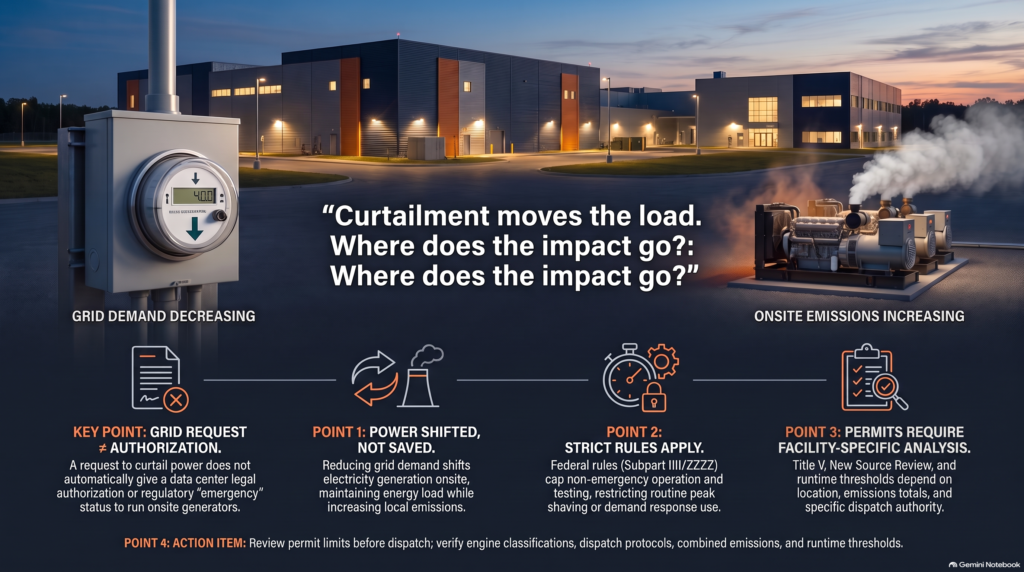
    That creates an important distinction. A facility can reduce the electricity it draws from the grid without reducing its total energy use. If onsite engines take over some or all of the load, the grid sees a reduction in demand—but the facility has shifted where its electricity is produced.

    That shift raises an air-permitting question alongside the electrical one: What operating rules and permit conditions apply to the generators during the event?

    “Emergency generator” is a regulatory status with conditions

    Stationary engines are subject to federal requirements that can include the New Source Performance Standards for compression-ignition engines under 40 CFR Part 60, Subpart IIII, and the RICE NESHAP under 40 CFR Part 63, Subpart ZZZZ.

    For engines regulated under Subpart IIII, the rules distinguish emergency operation from other use. They generally allow up to 100 hours per calendar year for maintenance and testing, with certain non-emergency use limited to as much as 50 hours within that total. The rules restrict using that allowance for ordinary peak shaving or non-emergency demand response, while providing a narrow exception for specified local reliability dispatches.

    The details of a particular grid event matter. EPA has also stated that operation under certain 2026 Department of Energy emergency orders is considered emergency operation for covered stationary engines. Those orders apply in defined circumstances; they do not establish that every curtailment request qualifies as an emergency.

    So “the grid asked us to curtail” is not, by itself, a complete answer. The operator needs to know who issued the dispatch, under what authority or protocol, and how the facility’s permit addresses the proposed operation.

    Permitting consequences require a facility-specific analysis

    A generator’s operating classification is only one part of the permitting picture. Title V and New Source Review requirements depend on factors such as the facility’s potential to emit, pollutant totals, source aggregation, location, and applicable state rules.

    A major-source determination does not automatically mean that every facility will need the same controls. PSD applicability and its requirements—including any BACT determination—depend on the source and the proposed construction or modification. SCR, diesel particulate filters, continuous emissions monitoring, or dispersion modeling may be relevant in particular cases, but they are not universal consequences of a generator being used during a grid event.

    The same care applies to temporary generation. A portable engine used or intended to remain at one location for 12 months or longer can cease to qualify as a nonroad engine under federal rules. That fact alone does not answer every permitting question: source status, emissions aggregation, permit obligations, and enforcement depend on the circumstances and applicable requirements.

    Treat the dispatch plan as an air-permitting input

    Before relying on onsite generation as part of a demand-response or emergency plan, engineering and environmental teams should review:

    • The facility’s permit conditions and engine classifications.
    • The dispatch authority, purpose, and applicable reliability protocol.
    • Runtime limits and how testing or other operation counts toward them.
    • Potential emissions from the engines operating together.
    • Whether planned changes require agency review or a permit revision.

    There may be other ways to manage a grid event, including reducing flexible workloads, shifting computing tasks, using stored energy, or combining approaches. The right mix depends on the facility’s design, reliability obligations, grid program, and permits.

    Curtailment can help manage grid reliability. But the effect depends on what the site actually does. If the response transfers load from the grid to onsite combustion, the plan should account for the emissions and permit implications as carefully as it accounts for electrical continuity.

    The practical question is not only whether the data center can stay online. It is what powers it during the event—and whether that operating plan fits the facility’s air permit.

    Regulatory references

  • AI May Make Grid Throughput More Valuable Than Grid Size

    For much of the recent discussion about artificial intelligence and electricity, the central question has been how much new power the country can produce.

    That question is essential. Data centers, manufacturing, transportation, and other forms of electrification are adding pressure to the power system. More generation can help meet that demand.

    But generation is only one part of the system. Electricity must also move from where it is produced to where it is needed, at the time it is needed, within the limits of the network.

    That brings a second question into focus:

    How efficiently can the existing grid move electricity to the places where demand is growing?

    Capacity is not the same as deliverability

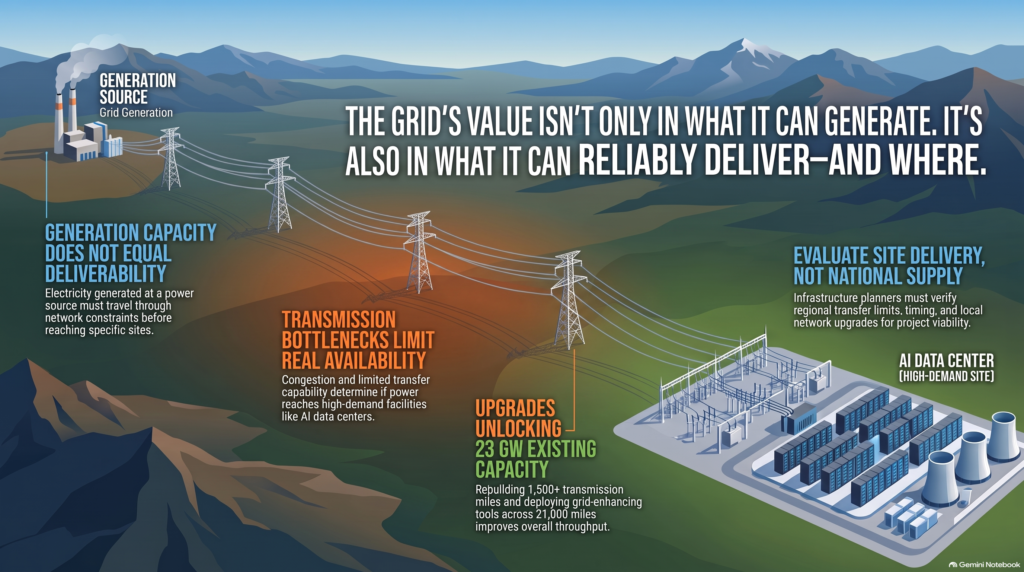
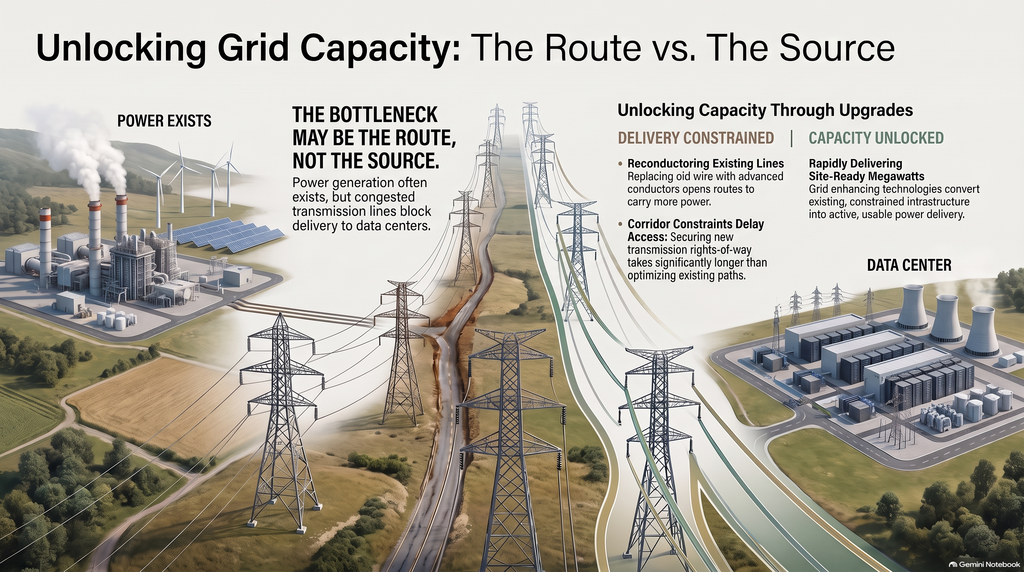
    A grid can have electricity available somewhere in the system and still face difficulty delivering it to a particular location. Transmission congestion, constraints on individual lines, and limited transfer capability can affect how much power can move between regions.

    In practical terms, this means that the amount of electricity a system can generate does not, by itself, tell us how much electricity a particular customer or facility can reliably receive. Location and delivery capability matter too.

    This distinction is especially relevant to AI infrastructure. Data centers need large amounts of electricity at specific sites, often on demanding timelines. A national supply figure alone cannot tell a project developer whether power can reach a particular location, or when the necessary network upgrades will be complete.

    DOE’s investments highlight the delivery side

    The U.S. Department of Energy recently announced investments across 26 states. DOE says project recipients are expected to reconductor or rebuild more than 1,500 miles of transmission lines and deploy grid-enhancing technologies across nearly 21,000 miles. Together, the projects are expected to make more than 23 GW of additional electricity capacity available. 

    These figures describe a mix of transmission upgrades and technologies intended to improve use of the existing grid. They do not mean that all grid constraints are solved, or that new generation and new transmission will no longer be needed. They do show that improving the performance of existing infrastructure is part of the response to rising demand.

    Some grid-enhancing technologies help operators understand or control the network more precisely. Dynamic line ratings, for example, use current conditions to estimate how much electricity a line can safely carry. Power-flow control devices can help redirect electricity toward lines with available capacity. 

    These measures can help unlock capacity in existing corridors. Their usefulness depends on the specific line, operating conditions, system needs, and the ability of grid operators to deploy and manage the technology.

    The value of throughput

    It may help to think of the grid as a network with both supply and movement constraints. Adding electricity is one way to increase what the system can serve. Improving the movement of electricity is another.

    For executives and infrastructure planners, that suggests a more complete set of questions:

    1. Is generation available?
    2. Can the grid transfer it to the relevant region?
    3. Can it be delivered to the specific site?
    4. Will it be available at the times the load needs it?
    5. What upgrades are needed to make that delivery reliable?

    These questions are connected, but they are not interchangeable. A project may have access to a potential energy supply while still depending on transmission work, interconnection steps, or local network upgrades before that power is deliverable.

    For large electricity users, this has implications for site selection, project schedules, utility coordination, and the cost of bringing infrastructure online. The grid’s ability to move power can influence whether a location is practical, how quickly a project can be served, and what additional investment may be required.

    A broader view of the AI power question

    The discussion should not become a contest between building new infrastructure and improving existing infrastructure. Growing demand may call for more generation, new transmission, upgrades to existing lines, and better tools for operating the system.

    The strategic point is that grid size and grid performance are different parts of the same challenge.

    As AI infrastructure expands, the value of the grid may increasingly be measured not only by how much electricity it can produce or connect, but by how effectively it can move that electricity to the right place at the right time.

    The supply question remains important. The delivery question is becoming just as important.

  • The AI Data Center Hit a Force-Majeure Clause Because the Power Wasn’t Ready

    AI infrastructure risk is moving from the grid connection into the contract

    A data center can be announced. It can attract financing, begin construction and have a major customer waiting for capacity. Yet those facts do not, by themselves, establish that the facility will have the power it needs when it is supposed to become operational.

    A recent report about Oracle’s Project Jupiter in New Mexico puts that gap into contractual terms.

    Reuters reported on September 24 that Oracle issued a force-majeure notice to a Blue Owl unit connected to the project, citing potential delays in securing power. Reuters also reported that securing power for the site is Oracle’s responsibility under the contract. Oracle said the project remained on its planned schedule, and Blue Owl said the notice did not change its financial commitments. (reuters.com)

    That combination deserves a measured reading. The notice does not prove that the project has failed, that power is unavailable, or that the 2028 target will be missed. It does show that uncertainty around power timing has reached the parties’ contractual relationship.

    That is the larger signal.

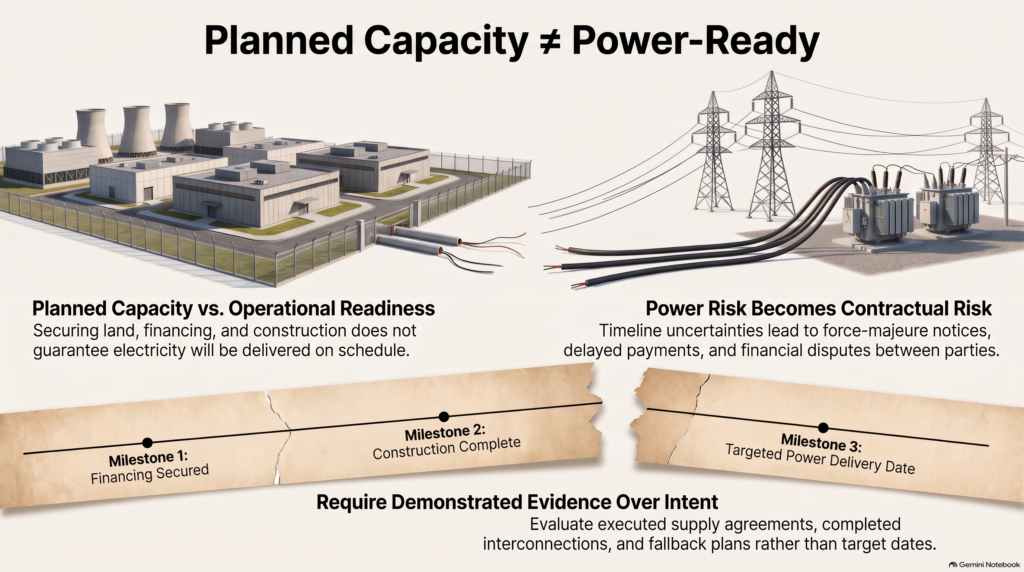
    Planned capacity and operational readiness are different claims

    Infrastructure announcements often combine several stages into one story: investment committed, land secured, construction underway, customer demand identified, power planned.

    Those are meaningful milestones. But they do not all answer the same question.

    “Planned” capacity is not necessarily capacity that has been secured. A power arrangement is not necessarily proof that electricity will be available at the required scale and date. And a building nearing completion does not automatically mean the facility is ready to deliver computing capacity.

    Each step needs its own evidence.

    For an AI data center, the sequence may involve site development, permits, fuel or grid supply, generation or transmission infrastructure, electrical equipment, commissioning, and the final handoff into operations. A delay in one part can affect the schedule for the whole project.

    When power timing reaches the contract

    Electricity is often discussed as an operating cost: a major expense that grows as computing demand increases. But power availability can matter before a facility begins operating.

    If the power timeline affects a project’s ability to meet an operational milestone, the consequences may include delayed revenue, changed payment timing, pressure on financing assumptions, or disputes about which party carries the cost of the delay.

    In the Project Jupiter case, Reuters reported that Oracle’s notice could allow it to delay payments if the data center were derailed and did not come online as planned. The report also said the notice did not amount to Oracle exiting as the main tenant. Blue Owl said its financial commitments were unchanged. (reuters.com)

    The precise effect depends on the contract and how the parties resolve the notice. The broader point does not: power risk can become delivery risk, and delivery risk can become contractual and financial risk.

    The readiness questions executives should ask

    The lesson is not that every data-center project is in trouble. It is that a headline capacity figure is only one piece of the readiness picture.

    Executives, investors and customers should ask:

    1. What does “power secured” mean in this project?
      Is there an executed supply agreement, a completed interconnection, fuel availability, installed generation, or some combination?
    2. Who is responsible for each power milestone?
      The answer may differ across utility service, transmission upgrades, fuel supply, on-site generation, permits and equipment.
    3. What evidence supports the schedule?
      A target date is a plan. Milestone records, approvals, construction status and commissioning evidence help show whether the plan is progressing.
    4. What happens if a milestone slips?
      Review who carries the cost, which payments may change, how notice requirements work, and whether customer commitments depend on the same schedule.
    5. What is the fallback plan?
      A backup source or phased energization may reduce exposure, but only if it is technically feasible, contractually available and supported by evidence.

    The declared-versus-observed distinction applies to infrastructure

    This is the same discipline that applies to other forms of risk: separate what has been stated from what has been demonstrated.

    A project may declare a capacity target. Operational readiness asks whether the required power is available, tested and usable on the relevant timeline.

    That distinction is especially important in AI infrastructure because the project’s value depends on more than a completed building. Compute capacity must be delivered in a form customers can use, when contracts say it will be available.

    The force-majeure notice around Project Jupiter is not a final verdict on the project. It is a visible sign that the power timeline has become material enough to enter the contractual conversation.

    The next phase of AI infrastructure will be judged not only by what gets announced or financed, but by what can be energized, delivered and supported by evidence.

  • The Cheapest AI Megawatt May Already Exist

    The Cheapest AI Megawatt May Already Exist

    “AI needs more power” is true as far as it goes. It is also too broad to tell an executive what to build, fund or approve.

    A growing data center needs electricity at a specific site, at a specific time, with the reliability its operations require. Several different constraints can stand between that need and an energized facility. There may be too little generation available at the required hours. An existing transmission corridor may be congested. A local substation may need upgrades. An interconnection may still be years from completion.

    Those are different problems. They do not all have the same solution.

    The Department of Energy’s September 24 announcement offers a useful example. DOE said it intends to help fund 31 grid improvement projects across 26 states through its SPARK initiative. The selected projects are expected to reconductor or rebuild more than 1,500 miles of transmission lines and deploy grid enhancing technologies across nearly 21,000 miles. Together, DOE expects those efforts to make more than 23 GW of additional electricity capacity available.

    That 23 GW is not a proposal for 23 GW of new generation. It is an expected increase in what the grid can carry and make available through transmission upgrades. The projects have been selected; the capacity gain still has to be delivered and measured.

    The constraint may be the route

    Think of generation as the source of electricity and transmission as part of the route it takes to customers. Adding supply at one end does little for a particular site if the route between them is constrained.

    Reconductoring replaces the wire on an existing transmission line with a conductor that can carry more power. Other grid enhancing technologies help operators understand or improve how existing lines are used. Dynamic line ratings, for example, use current conditions to assess a line’s safe carrying capability. Power flow controls can help direct electricity across available paths.

    These approaches are attractive because they can draw more value from infrastructure and rights of way that already exist. They may be especially useful where obtaining a new corridor would take much longer.

    That does not make every existing line an easy upgrade. A project still has to satisfy engineering, reliability and operational requirements. Nor does an increase in transmission capability guarantee that electricity will be available during every hour a customer needs it.

    What the announcement changes

    The opportunity is wider than the familiar discussion about building new generation.

    Advanced conductors, line monitoring, sensors, power flow controls and grid software all become more consequential when transfer capability is the binding constraint. So do the less visible tasks: studying where an upgrade will help, coordinating the work and proving that the promised capacity is available in operation.

    For an AI infrastructure developer, the practical question is not simply, “How many megawatts are planned in this region?” It is:

    How much power can reach this site, under the required conditions, by the date we need it?

    For utilities and policymakers, the question is where targeted upgrades can relieve real congestion—and where new generation, substations or transmission corridors are still necessary.

    From announced capacity to delivered power

    DOE’s projected 23 GW is a meaningful signal about where grid investment is headed. It is not yet 23 GW of observed, site ready power.

    The evidence will come as projects are completed and operators measure the resulting transfer capability, reliability and service to customers. That is where the declared figure becomes an operational result.

    AI’s electricity challenge is often framed as a race to produce more power. In some places it will be. In others, a faster opportunity may be to move available electricity more effectively through the grid we already have.

    The cheapest megawatt may already exist. The work is proving that it can reach the right place when it counts.

  • AI Infrastructure Is Moving From Declared Capacity to Observed Readiness

    The AI infrastructure race has largely been communicated through declarations of scale.

    Gigawatts of proposed data-center capacity. Billions of dollars in projected investment. Enormous forecasts for electricity demand. New campuses capable of housing hundreds of thousands of advanced processors.

    These numbers reveal the direction of travel—but they do not always reveal which projects can actually arrive.

    That distinction is becoming increasingly important.

    Microsoft reportedly has an internal target to expand its global data-center capacity from approximately 12 gigawatts today to more than 38 gigawatts by 2032. Meanwhile, electricity requests from large power users across portions of the United States have climbed above 700 gigawatts. Reuters⁠

    The scale is extraordinary.

    So is the uncertainty.

    The next phase of AI infrastructure may therefore be defined less by declared capacity and more by observed readiness: verifiable evidence that a proposed project possesses the physical, financial and institutional conditions necessary to become operational.

    Declared capacity is not delivered capacity

    Declared capacity describes intention.

    It may appear in a corporate target, utility interconnection request, investor presentation, electricity forecast or economic-development announcement.

    But a proposed gigawatt can exist on paper long before the organization has secured:

    • Land
    • Permits
    • Financing
    • Customers
    • Electricity
    • Grid interconnection
    • Transformers and turbines
    • Cooling infrastructure
    • Construction labor
    • Community acceptance

    Until those dependencies are resolved, the declared capacity remains conditional.

    This does not make the projection fraudulent or meaningless. Infrastructure planning requires forecasts. Organizations must reserve land, capital and power years before facilities become operational.

    The problem begins when every declaration is treated as equally probable.

    A project with a press release and an interconnection request should not carry the same planning weight as one with site control, permits, committed financing, signed tenants, equipment reservations and a defined energization date.

    Both may claim the same number of megawatts.

    They do not represent the same level of readiness.

    The market is beginning to demand proof

    Evidence of this transition is already appearing across the infrastructure stack.

    Utilities are introducing financial commitments and additional screening to separate credible large-load customers from speculative or duplicated applications. In Pennsylvania, Reuters found that only 20 of more than 100 proposed data centers had sought permits.

    Lenders are also becoming more selective. Investors are charging more for risk and demanding stronger protections against permitting delays, electricity queues and supply-chain bottlenecks. In one case, construction financing could not be accessed until permits were secured and leases signed.

    These are not merely administrative obstacles.

    They are attempts to convert projections into evidence.

    A permit demonstrates that a project has moved beyond general intention.

    A signed lease establishes customer commitment.

    An upfront payment gives the applicant something meaningful to lose.

    A power agreement identifies a plausible energy source.

    An equipment order connects the projected completion date to the physical supply chain.

    Each one increases confidence that the proposed capacity can actually materialize.

    Observed readiness is a chain, not a single document

    No single artifact proves that an AI infrastructure project will succeed.

    A signed lease is not useful if electricity cannot be delivered. A grid connection is insufficient if financing collapses. Available land does not create an operating data center without equipment, cooling, construction and customers.

    Observed readiness must therefore be evaluated as a connected chain of evidence:

    1. Commercial readiness: Are credible customers contractually committed?
    2. Financial readiness: Is capital available under conditions the project can satisfy?
    3. Regulatory readiness: Are permits, environmental requirements and local approvals progressing?
    4. Energy readiness: Is generation available, and can the electricity physically reach the site?
    5. Supply-chain readiness: Have critical transformers, turbines, switchgear, cooling equipment and chips been secured?
    6. Operational readiness: Can the facility withstand equipment failures, grid interruptions, cyber incidents and other disruptions?

    A weakness in any one of these areas can strand the rest.

    A warehouse full of GPUs without dependable electricity is stranded compute. A power reservation without financing may become ghost demand. A fully financed project without permits can remain trapped in development.

    Scale depends on the entire chain surviving.

    Readiness may become a competitive asset

    During the first phase of the AI infrastructure boom, scarcity made almost any plausible capacity valuable.

    The next phase will likely be more discriminating.

    Utilities cannot build generation and transmission around every speculative request. Lenders cannot treat every projected campus as equally financeable. Equipment manufacturers cannot reserve scarce production capacity indefinitely. Communities will increasingly question projects that consume land, water or grid capacity without producing credible benefits.

    As that scrutiny increases, organizations capable of producing verifiable readiness evidence may receive:

    • Better access to financing
    • Greater credibility with utilities
    • Stronger negotiating positions for equipment
    • Faster regulatory decisions
    • Higher confidence from customers
    • More defensible project valuations

    The advantage will not come from possessing the boldest forecast.

    It will come from reducing uncertainty for everyone whose resources are needed to make the forecast real.

    From projection to proof

    The AI infrastructure buildout is not slowing into irrelevance. It is moving into a more demanding stage.

    Announcements still matter. Forecasts still matter. Ambitious capacity targets still matter.

    But the gap between a declared gigawatt and an energized gigawatt is becoming impossible to ignore.

    The organizations that succeed may be those that can establish a traceable line from projected demand to committed capital, approved sites, contracted equipment, available generation and operational delivery.

    That is the transition from declared capacity to observed readiness.

    Gigawatts will remain the headline.

    Evidence will increasingly determine which ones get built.