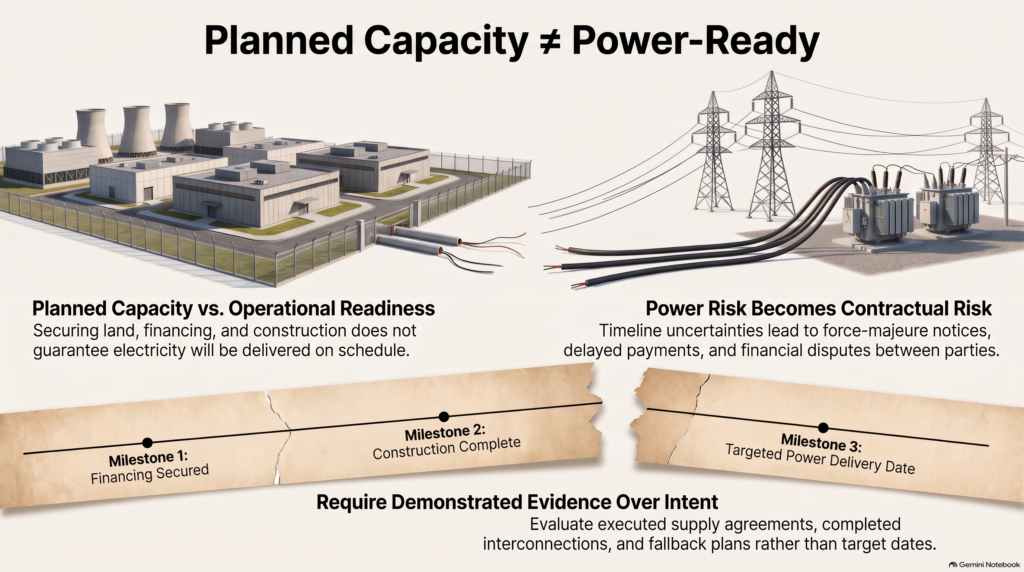
AI infrastructure risk is moving from the grid connection into the contract
A data center can be announced. It can attract financing, begin construction and have a major customer waiting for capacity. Yet those facts do not, by themselves, establish that the facility will have the power it needs when it is supposed to become operational.
A recent report about Oracle’s Project Jupiter in New Mexico puts that gap into contractual terms.
Reuters reported on September 24 that Oracle issued a force-majeure notice to a Blue Owl unit connected to the project, citing potential delays in securing power. Reuters also reported that securing power for the site is Oracle’s responsibility under the contract. Oracle said the project remained on its planned schedule, and Blue Owl said the notice did not change its financial commitments. (reuters.com)
That combination deserves a measured reading. The notice does not prove that the project has failed, that power is unavailable, or that the 2028 target will be missed. It does show that uncertainty around power timing has reached the parties’ contractual relationship.
That is the larger signal.
Planned capacity and operational readiness are different claims
Infrastructure announcements often combine several stages into one story: investment committed, land secured, construction underway, customer demand identified, power planned.
Those are meaningful milestones. But they do not all answer the same question.
“Planned” capacity is not necessarily capacity that has been secured. A power arrangement is not necessarily proof that electricity will be available at the required scale and date. And a building nearing completion does not automatically mean the facility is ready to deliver computing capacity.
Each step needs its own evidence.
For an AI data center, the sequence may involve site development, permits, fuel or grid supply, generation or transmission infrastructure, electrical equipment, commissioning, and the final handoff into operations. A delay in one part can affect the schedule for the whole project.
When power timing reaches the contract
Electricity is often discussed as an operating cost: a major expense that grows as computing demand increases. But power availability can matter before a facility begins operating.
If the power timeline affects a project’s ability to meet an operational milestone, the consequences may include delayed revenue, changed payment timing, pressure on financing assumptions, or disputes about which party carries the cost of the delay.
In the Project Jupiter case, Reuters reported that Oracle’s notice could allow it to delay payments if the data center were derailed and did not come online as planned. The report also said the notice did not amount to Oracle exiting as the main tenant. Blue Owl said its financial commitments were unchanged. (reuters.com)
The precise effect depends on the contract and how the parties resolve the notice. The broader point does not: power risk can become delivery risk, and delivery risk can become contractual and financial risk.
The readiness questions executives should ask
The lesson is not that every data-center project is in trouble. It is that a headline capacity figure is only one piece of the readiness picture.
Executives, investors and customers should ask:
- What does “power secured” mean in this project?
Is there an executed supply agreement, a completed interconnection, fuel availability, installed generation, or some combination? - Who is responsible for each power milestone?
The answer may differ across utility service, transmission upgrades, fuel supply, on-site generation, permits and equipment. - What evidence supports the schedule?
A target date is a plan. Milestone records, approvals, construction status and commissioning evidence help show whether the plan is progressing. - What happens if a milestone slips?
Review who carries the cost, which payments may change, how notice requirements work, and whether customer commitments depend on the same schedule. - What is the fallback plan?
A backup source or phased energization may reduce exposure, but only if it is technically feasible, contractually available and supported by evidence.
The declared-versus-observed distinction applies to infrastructure
This is the same discipline that applies to other forms of risk: separate what has been stated from what has been demonstrated.
A project may declare a capacity target. Operational readiness asks whether the required power is available, tested and usable on the relevant timeline.
That distinction is especially important in AI infrastructure because the project’s value depends on more than a completed building. Compute capacity must be delivered in a form customers can use, when contracts say it will be available.
The force-majeure notice around Project Jupiter is not a final verdict on the project. It is a visible sign that the power timeline has become material enough to enter the contractual conversation.
The next phase of AI infrastructure will be judged not only by what gets announced or financed, but by what can be energized, delivered and supported by evidence.
Leave a Reply