Tag: PowerGrid

  • Time to Power: Why Grid Delays Can Become Contract Risk for AI Infrastructure

    AI infrastructure projects are often described through large, attention-grabbing numbers: megawatts, GPUs, investment totals and planned opening dates. But those figures only tell part of the story. For a customer planning cloud or AI services, capacity matters when it is ready to use.

    The planned Nscale site in Loughton, Essex, offers a concrete example of how the schedule can break down.

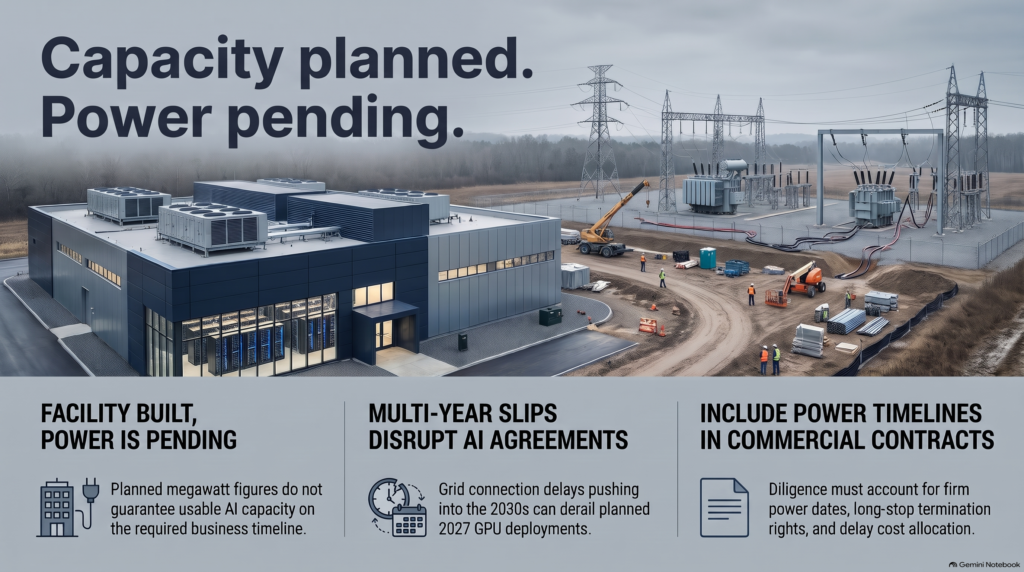
    Reuters reported that Microsoft withdrew from its agreement for capacity at the site after the expected grid connection slipped into the 2030s. Nscale had planned a facility with 50 MW of AI capacity, scalable to 90 MW, and approximately 23,040 Nvidia GB300 GPUs for Microsoft Azure. The original announcement anticipated GPU delivery beginning in early 2027. 

    Microsoft said its decision related to one site and reaffirmed its wider partnership with Nscale. Nscale said it remained committed to Loughton and was exploring alternative power sources and other UK expansion sites. The public reporting does not disclose the contract’s terms, the exact termination provision or the financial consequences for either party. 

    A project schedule depends on more than construction

    Data centre readiness depends on several linked pieces: the building, electrical equipment, cooling, network connectivity, hardware and sufficient power. If one critical dependency arrives years later than planned, the rest of the investment may not produce its expected value on schedule.

    That creates commercial consequences. A late power connection can postpone the point when a customer can use capacity, delay revenue, extend the time capital is tied up and create uncertainty about whether demand will still be there when the site is ready. These are general project risks; the publicly available details do not establish which of them applied to this specific agreement.

    Why this can become a contract issue

    Long-term infrastructure agreements have to allocate the risks of delay. Executives and project teams should understand how the contract treats power availability, delivery milestones, delay thresholds, customer remedies and termination rights.

    The questions are practical:

    • Is the power date confirmed, estimated or dependent on future grid work?
    • What happens if service begins later than the customer’s required date?
    • Is there a defined long-stop date after which a party can exit?
    • Can capacity be moved to another site or supplied from another source?
    • Who bears added costs while the project waits?

    These are questions to raise during commercial and legal review—not assumptions about the terms of Microsoft’s agreement.

    The executive takeaway

    A planned megawatt figure doesn’t guarantee usable capacity on the date a business needs it. Time to power affects whether a project can support customer commitments and whether its economics still work when the facility is ready.

    The better diligence question is not only, “How much AI capacity will this project deliver?” It is also, “When will power be available, how certain is that date, and what happens contractually if it moves?”

    In AI infrastructure, the power schedule belongs in the commercial plan from the start.
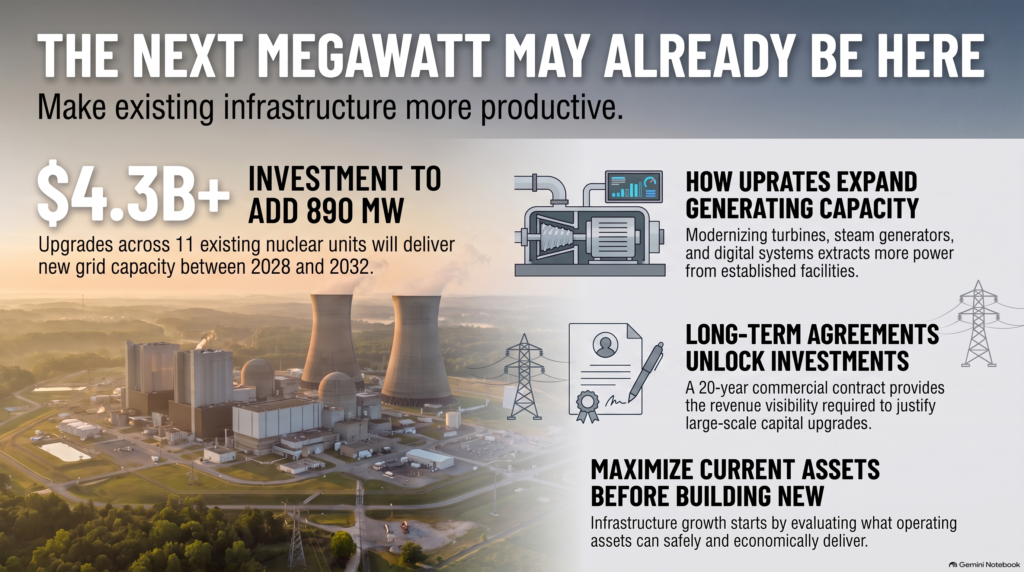
  • The Next AI Megawatt May Come From a Power Plant We Already Built

    As demand for electricity grows, the conversation often turns to new generation: new plants, new transmission, and new infrastructure. Those investments matter. But a recent Google–Constellation agreement points to another part of the supply equation: increasing output from assets that are already operating.

    Announced October 6, the companies’ 20-year power purchase agreement supports upgrades at 11 existing Constellation nuclear units across six sites in Illinois, Pennsylvania, and New Jersey. The upgrades are expected to add 890 megawatts of nuclear capacity to the PJM grid. Constellation says it plans to invest more than $4.3 billion in the work. The first uprate is expected in 2028, with the full 890 MW planned by the end of 2032. 

    This is not a new nuclear plant coming online today. It is a long-term investment plan to increase output from existing reactors.

    What an uprate changes

    A nuclear uprate increases a plant’s generating capacity by upgrading equipment and systems. The companies cite work involving turbines, steam generators, and digital control systems. The goal is to produce more electricity from an existing facility while maintaining the requirements that govern its safe and reliable operation. 

    That distinction matters. An operating plant already has a site, grid connections, and much of the supporting infrastructure. Upgrading it may offer a different development path from building a new facility. But it still requires substantial capital, specialized engineering, regulatory work, construction planning, and time.

    Why the commercial structure matters

    The 20-year agreement provides a long-term customer commitment associated with the planned upgrades. That kind of revenue visibility can help a generator justify capital investment in equipment and capacity improvements.

    The agreement also sits within a larger power arrangement. Google and Constellation signed a separate 15-year supply contract for another 2,700 MW from Constellation’s PJM generation fleet. That supply is not linked to a specific generating source, so it should not be counted as part of the 890 MW of new nuclear capacity. 

    The distinction between the two agreements is useful: one supports planned incremental nuclear capacity; the other provides long-term revenue certainty for existing generation assets.

    The capital-efficiency lesson

    Capital efficiency does not mean avoiding investment. In this case, the announced program includes more than $4.3 billion in planned investment. The efficiency question is whether targeted upgrades to existing assets can add useful capacity while making productive use of infrastructure already in place.

    That is a different question from simply asking how quickly a new plant can be built. It asks whether the current system contains assets with additional potential—and what investment, operational changes, and approvals are needed to realize it.

    The answer will vary by asset and location. An upgrade is not automatically faster, cheaper, or feasible everywhere. The 890 MW is a target for future delivery, with the first uprate expected in 2028 and the full capacity planned by the end of 2032. 

    A broader infrastructure principle

    For executives assessing electricity needs, the agreement offers a useful lens: examine both new supply and the productivity of existing assets. In power, that can mean evaluating uprates, reliability, grid connections, operating performance, and demand flexibility alongside new construction.

    The broader lesson applies across infrastructure. Growth does not always begin with acquiring or building another asset. Sometimes it begins by asking what the current asset base can safely and economically deliver—and what commitment will make the required investment possible.

    The next megawatt may come from a new plant. It may also come from making an existing one work harder.

    Source note: Constellation’s announcement says 890 MW will be added to the PJM grid through the planned nuclear upgrades; Google’s post provides the end-of-2032 target. The separate 2,700 MW agreement is not source-specific. 

  • When a Data Center Load Disappears, the Grid Feels It

    A facility’s protection systems are designed to respond when power conditions move outside safe limits. But when a very large load disconnects or transfers to backup power at once, that protective response can become a grid-level event.

    That is the issue behind PJM’s proposed ride-through requirements for large computational loads, including data centers and cryptocurrency-mining facilities.

    In July 2026, about 3,800 MW of data-center load in northern Virginia transferred from the PJM grid to on-site backup generation after a transmission fault. PJM and Dominion reported voltage and frequency spikes. Operators took action to restore the balance between generation and demand, and PJM reported no significant reliability impacts from the event. 

    The mechanism is straightforward. If a large amount of demand suddenly leaves the grid while generation remains online, generation temporarily exceeds load. That imbalance can push frequency upward. Voltage can also rise, with the system response depending on the location, size, and timing of the load change.

    This does not mean every sudden load transfer will destabilize the grid or cause an outage. The July event was managed. The concern is that repeated or larger events can create operational challenges, especially when the grid has little time to adjust.

    PJM presented a proposal, not a final rule, on September 8. It would set performance expectations for how large computational loads respond within defined voltage and frequency disturbance ranges. It also addresses recovery: after voltage returns to an acceptable range, the proposal calls for load consumption to recover to more than 90% of its pre-disturbance level within two seconds, subject to the proposed conditions. 

    The regulatory status matters. FERC’s June 18 show-cause order asked PJM to address questions about its large-load processes, including whether tariff requirements are needed for ride-through, ramp rates, and load restoration. PJM says it plans to file proposed solutions with FERC in November. The specific ride-through requirements remain under review. 

    For facility owners and engineers, this shifts the design conversation. The question is not only whether the facility can ride through a disturbance internally. It is whether the combined facility response—its protection settings, power systems, backup transfer, and recovery behavior—will be predictable and compatible with grid needs.

    The distinction is important: a protective action can make sense for a single facility and still create a larger system challenge when many facilities react together. As large loads become a bigger part of grid planning, their disturbance response is becoming part of the infrastructure performance discussion.

    Source note: PJM proposal and FERC filing timeline; PJM’s account of the July 22 event. Citations above.

  • The New AI Moat May Be Energization Rights

    Much of the discussion surrounding AI infrastructure still concentrates on chips, capital and real estate.

    Those inputs matter, but they do not guarantee that a data center can operate.

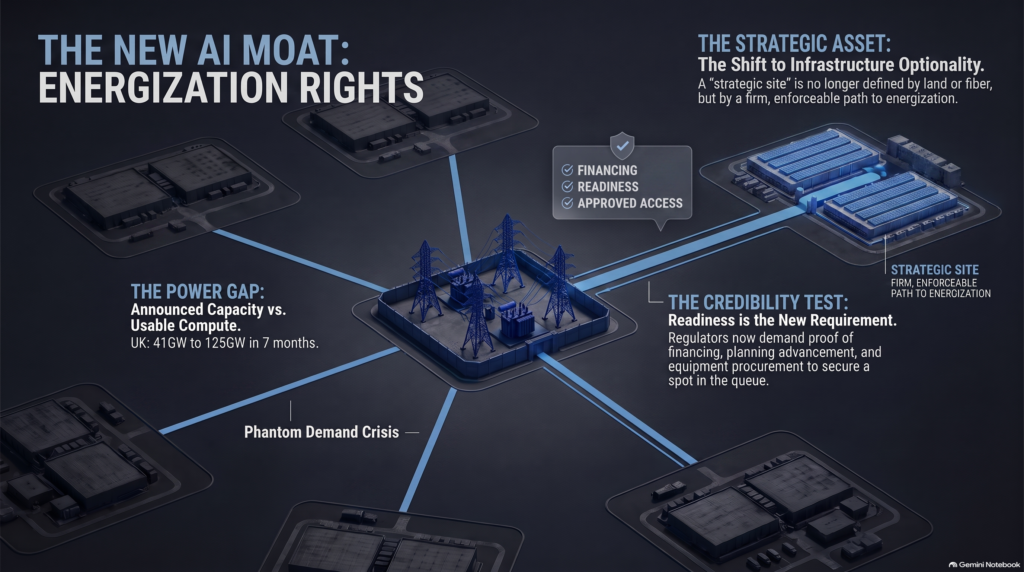
    A facility can have land, permits, financing and thousands of GPUs on order. Without sufficient electricity—and a credible date for receiving it—the project remains planned capacity rather than usable compute.

    That distinction is becoming strategically important as data-center developers compete for limited positions in electricity-connection queues.

    When proposed demand creates real congestion

    Britain provides a useful example.

    According to Ofgem, demand-connection applications increased from 41 gigawatts in November 2024 to 125 gigawatts by June 2025. Data centers represented at least 80 gigawatts of that demand.

    For perspective, the application queue does not mean all that capacity will be built or consumed. That is precisely the problem.

    Some applications come from viable projects with secured land, committed capital, identifiable customers and realistic construction schedules. Others may represent duplicate, premature or speculative attempts to reserve capacity.

    Yet each application enters a planning system that must determine where and when electricity infrastructure will be needed.

    Consequently, phantom demand can produce real effects.

    It can occupy positions in the connection queue, complicate load forecasts and delay projects that are genuinely prepared to proceed. A proposed data center does not have to reach construction to contribute to congestion. Its claim on future capacity may be enough.

    Making developers prove readiness

    Ofgem has proposed introducing commitment fees and additional project-progress milestones for data-center connections.

    The principle is straightforward: reserving scarce grid capacity should require more than submitting an ambitious projection.

    Developers may need to place capital at risk and demonstrate continued progress through evidence such as financing, customer commitments, planning advancement or procurement of long-lead equipment. Projects that stall or withdraw could lose their queue position and, depending on the final rules, forfeit some or all of their financial commitment.

    This would convert grid access from a largely administrative reservation into a test of project credibility.

    The market signal is difficult to miss.

    Future electricity access is becoming valuable enough that regulators must discourage organizations from reserving it speculatively.

    Land is only part of the infrastructure stack

    For years, favorable data-center locations were evaluated through familiar factors:

    • Available land
    • Fiber connectivity
    • Tax incentives
    • Environmental conditions
    • Proximity to customers
    • Construction costs

    Grid access can no longer sit quietly near the bottom of that list.

    A parcel of land located near transmission infrastructure is not necessarily an energizable site. Physical proximity does not guarantee available capacity, a completed interconnection study, required network upgrades or an acceptable connection date.

    The more useful question is no longer simply, “Where can the facility be built?”

    It is, “Where can the facility be powered, at the required scale, within the required timeframe?”

    That changes the meaning of a strategic site.

    The true asset may be the combination of land, permits, transmission capacity and enforceable progress toward energization.

    An emerging form of infrastructure optionality

    A credible grid position gives a developer something close to infrastructure optionality.

    It can influence site value, project financing, construction sequencing and the ability to secure customers. Hyperscalers and investors evaluating competing projects will increasingly need to distinguish between advertised capacity and capacity with a defensible path to power.

    That creates a new diligence requirement.

    Executives should ask:

    • Is the project merely in a connection queue, or does it have a firm connection agreement?
    • What network upgrades must occur before energization?
    • Who is responsible for financing those upgrades?
    • Which milestones must the project satisfy to retain its position?
    • Is the stated connection date conditional?
    • Does the developer control the land and possess the permits required to proceed?
    • Is the electricity supply firm, flexible or dependent on curtailment?
    • What evidence supports the announced megawatt figure?

    These are not secondary engineering questions. They affect valuation, delivery risk and the credibility of the entire AI-capacity claim.

    Announced megawatts are not operating megawatts

    The AI infrastructure market is producing enormous numbers: billions in capital commitments, gigawatts of proposed demand and campuses containing hundreds of thousands of accelerators.

    Those figures can create an illusion of inevitability.

    But a proposed megawatt is not an energized megawatt.

    Likewise, a grid application is not proof of a viable project. It may represent serious development activity, but it may also represent an attempt to preserve a future option.

    This is why regulators are beginning to demand stronger evidence of readiness.

    Grid queues cannot function effectively when an unverified claim receives the same treatment as a financeable, permitted and construction-ready project. When capacity is scarce, credibility must become part of the allocation mechanism.

    The strategic implication

    The AI infrastructure contest is shifting.

    Companies will still compete for chips, technical talent and capital. Increasingly, however, they will also compete for substations, transmission capacity, generation agreements and credible energization dates.

    That means the new moat may not be electricity ownership in the literal sense.

    It may be something more practical: a defensible right to receive electricity at the necessary location, scale and time.

    GPUs can be purchased. Buildings can be constructed. Capital can be raised.

    But when the grid is constrained, credible access to future electricity becomes difficult to replicate.

    The most valuable AI facility may not be the one with the largest announcement.

    It may be the one that can actually be turned on.

  • The Grid as the AI Business Model

    The Grid Is Becoming Part of the AI Business Model

    DataCenters, Energy, PowerGrid

    Most conversations about the infrastructure required for artificial intelligence eventually arrive at electricity.

    AI models require compute. Compute requires data centers. Data centers require enormous amounts of power.

    But even that description misses an important layer of the infrastructure stack.

    Generating electricity and delivering electricity are not the same problem.

    As AI infrastructure expands, that distinction could become increasingly important to the economics of the industry.

    The Bottleneck Beneath the Data Center

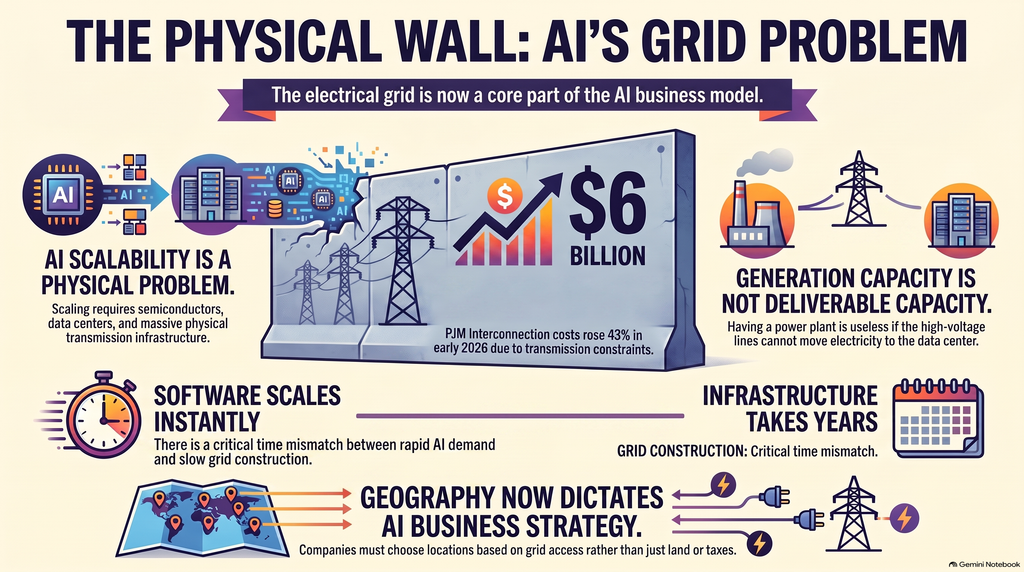
    On August 21, Reuters reported that transmission-congestion costs on PJM Interconnection reached approximately $6 billion during the first half of 2026, an increase of 43%.

    PJM operates the largest U.S. power grid, serving roughly 67 million people across a territory extending from Washington, D.C. to Chicago.

    The problem wasn’t simply whether enough electricity could theoretically be generated.

    High-voltage transmission lines were increasingly becoming constrained.

    That creates an important distinction for anyone thinking about the future of AI infrastructure:

    Generation capacity is not the same thing as deliverable capacity.

    A power plant can generate electricity hundreds of miles away from a data center.

    That electricity still has to move through transmission infrastructure before reaching the location where it will actually be consumed.

    When parts of that network become congested, electricity becomes more difficult — and potentially more expensive — to move across the system.

    The grid therefore starts behaving much like any other constrained network.

    Adding supply at one point does not necessarily eliminate a bottleneck somewhere else.

    AI Is Becoming a Location Problem

    For years, technology companies could think about infrastructure primarily through familiar variables:

    Compute availability.

    Network connectivity.

    Real estate.

    Labor.

    Taxes.

    Capital.

    Electricity increasingly adds another set of questions.

    Where is generation available?

    Where does transmission capacity exist?

    How quickly can new load actually be interconnected?

    What infrastructure upgrades will be required?

    Who pays for those upgrades?

    And how long will they take?

    Those questions can affect where infrastructure gets built and ultimately how much that infrastructure costs to operate.

    That means the geography of AI may increasingly follow the geography of available infrastructure.

    The cheapest land isn’t necessarily the best land.

    The closest generation isn’t necessarily usable generation.

    And announcing a new power plant doesn’t automatically mean the transmission system can deliver that additional electricity to a rapidly growing cluster of data centers.

    Congestion Becomes an Economic Variable

    This is where grid infrastructure begins crossing into business strategy.

    Transmission congestion isn’t merely an engineering problem.

    It can influence wholesale electricity prices, infrastructure investment requirements, project timelines and ultimately the economics of operating large computing facilities.

    That creates another layer of risk for AI expansion.

    Companies can secure chips.

    They can raise capital.

    They can purchase land.

    They can construct data centers.

    But those investments still depend on infrastructure outside the walls of the facility.

    If that infrastructure cannot expand at approximately the same pace as computing demand, the bottleneck simply moves farther down the stack.

    We’ve already watched parts of this progression happen.

    The AI conversation moved from models to chips.

    From chips to data centers.

    From data centers to electricity generation.

    And now electricity demand is forcing greater attention toward transmission and grid capacity.

    Each layer reveals another dependency underneath the previous one.

    The Physical Economy Underneath AI

    AI is often described as a digital technology.

    Economically, however, its expansion is becoming increasingly physical.

    Scaling AI requires semiconductors manufactured in physical facilities, servers installed inside physical buildings, electricity generated by physical assets and transmission infrastructure capable of moving that electricity across geographic regions.

    Then there is land, cooling, water, construction equipment, transformers, substations and capital.

    The software may operate in milliseconds.

    The infrastructure underneath it can take years to build.

    That mismatch matters.

    AI demand can accelerate extremely quickly.

    Transmission infrastructure generally cannot.

    Which means some of the most important constraints on future AI growth may not come from model architecture at all.

    They may come from infrastructure that existed long before generative AI entered the conversation.

    AI Strategy Is Becoming Infrastructure Strategy

    This doesn’t mean technology executives suddenly need to become grid operators.

    It does mean the boundary between technology strategy and infrastructure strategy is becoming harder to maintain.

    When electricity availability affects where computing infrastructure can be built, how quickly it can expand and what it costs to operate, energy infrastructure becomes part of the business calculation.

    The companies building the next generation of AI infrastructure therefore aren’t simply competing for GPUs.

    Increasingly, they are competing for an entire stack of scarce resources:

    Compute.
    Land.
    Power.
    Transmission access.
    Capital.
    Time.

    And perhaps that is the larger lesson.

    We tend to think of technological progress as moving upward into increasingly sophisticated software.

    AI is showing us something different.

    The further we scale the digital layer, the more important the physical layers underneath it become.

    The grid isn’t sitting outside the AI economy anymore.

    It’s becoming part of the AI business model.