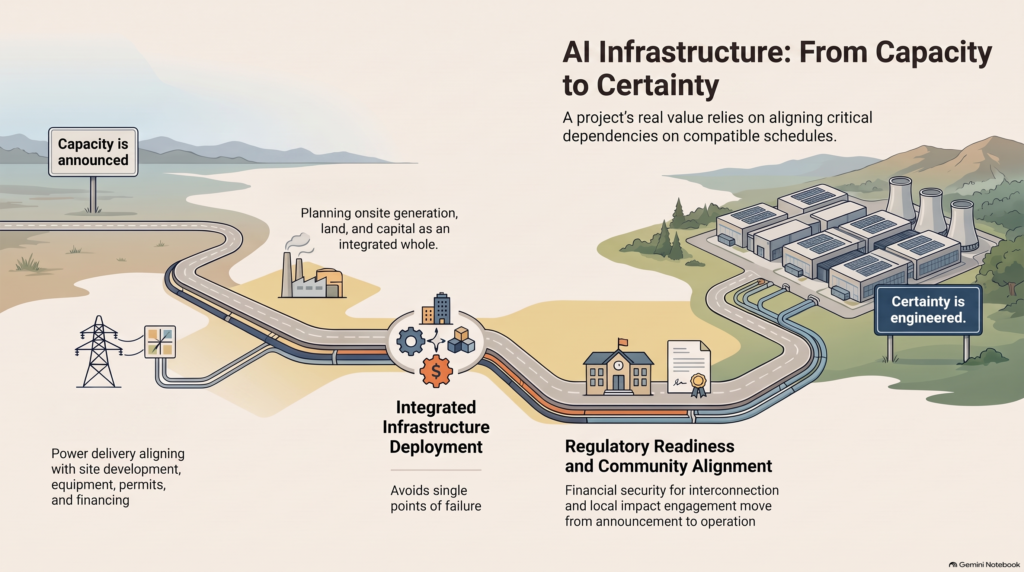
The AI infrastructure conversation has been dominated by scale: more data centers, more generation, more chips, more gigawatts.
Scale is still essential. AI workloads need enormous amounts of compute and power. But a large capacity announcement does not, by itself, mean a project can be financed, built, connected, and operated on a dependable schedule.
That gap is moving to the center of the conversation.
A project’s real value depends on several linked conditions: a site that can be developed, power that can be delivered, equipment that can be procured, financing that can support the timeline, permits that can be secured, and a community willing to live with the project. If one critical dependency remains uncertain, the announced capacity may be far from usable compute.
The signals are converging
Recent developments point toward a more coordinated approach to AI infrastructure.
In the United States, utility and regulatory processes are placing greater emphasis on whether large-load projects are financially ready and accountable for the infrastructure costs they create. Texas has adopted financial security requirements for large-load interconnection requests, while federal regulators have also focused on cost recovery and protections for existing customers.
In Japan, a project involving JERA, Dell, and RHAELM brings together power capabilities, a site, data-center development, financing, and AI infrastructure. The project illustrates the appeal of planning these components as an integrated deployment rather than treating them as separate problems to solve one by one.
Developers are also pursuing onsite generation. Recent reporting describes growing interest in smaller gas turbines and other behind-the-meter options, partly in response to equipment lead times and the challenge of securing grid connections. Onsite power may offer a different schedule path, but it does not erase the trade-offs: fuel supply, permitting, emissions, cost, and the eventual relationship with the grid still matter.
Community relationships are becoming a more visible part of the infrastructure strategy as well. AWS recently announced a multiyear investment in programs for communities near its U.S. data centers. These commitments do not guarantee public support, but they show that local impact and engagement are now part of the deployment conversation.
From announced capacity to predictable dependencies
These examples are different, but they point in the same direction: the challenge is no longer just assembling enough capacity. It is coordinating the conditions that allow capacity to become operational.
That means executives may need to ask a broader set of questions:
- Is the power timeline credible, and what assumptions does it depend on?
- Who pays for the upgrades needed to serve the load?
- Are land, permits, equipment, and financing progressing on compatible schedules?
- If grid power is delayed, what alternatives are available—and what new risks do they create?
- How are local costs, benefits, and concerns being addressed?
These questions do not replace the traditional focus on capacity. They make the capacity claim more useful by connecting it to execution.
Certainty as a competitive advantage
“Certainty” here does not mean that every project outcome is guaranteed. Large infrastructure projects will always involve uncertainty.
It means that fewer critical dependencies are left unresolved, that assumptions are visible, and that decision-makers have a credible plan for what happens when conditions change.
As AI infrastructure scales, the strongest projects may not be the ones with the largest headline number. They may be the ones that can show how power, capital, land, equipment, compute, and community considerations fit together—and how the project can move from announcement to operation.
The optimization target is shifting from “How many gigawatts can we announce?” to “How many dependencies can we make predictable?”
In AI infrastructure, certainty is becoming part of the product.
Leave a Reply