Fast growth in an AI category can coexist with modest company-wide growth. The difference between those two measures matters.
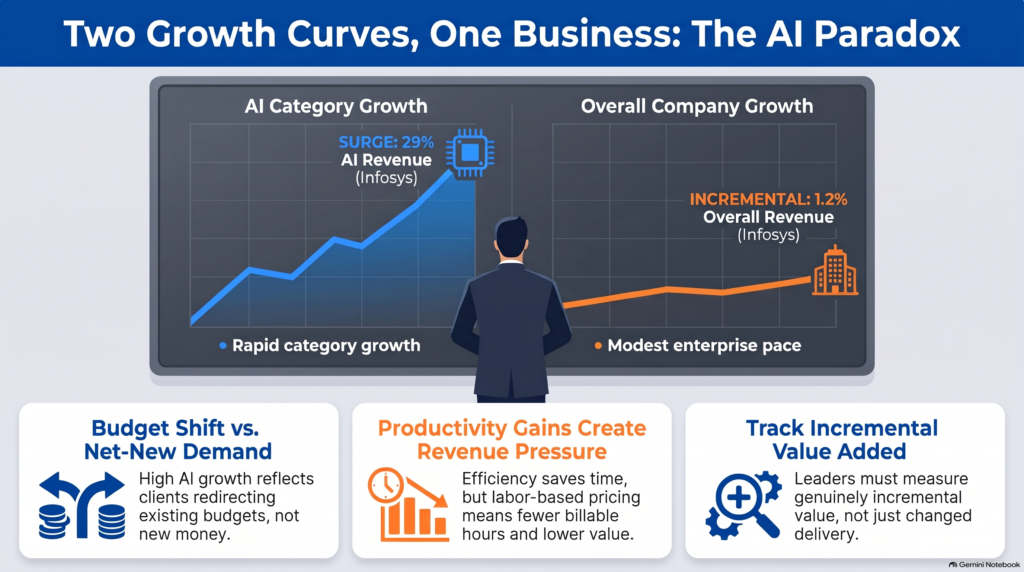
Infosys’s October 23 results offer a useful case study in how AI growth can appear inside a larger business. The company said AI revenue represented 10.5% of quarterly revenue and grew 29% quarter over quarter. Total revenue, measured in constant currency, grew 1.2% sequentially. Infosys also lowered its FY27 revenue growth guidance to 1%–2%, from 1.5%–3%.
Those figures do not show that AI caused the slower overall growth. They do show why executives need to look beyond growth within a new product or service category and ask whether it is adding to the company’s total economic value.
Category growth and company growth measure different things
A business can build a fast-growing AI practice while its overall revenue grows slowly. That can happen when the new activity is only part of the business, when other areas are flat or declining, or when AI work replaces some existing services.
The key distinction is whether AI revenue is incremental.
If a client hires a provider for a new AI project that would not otherwise have existed, that may represent new demand. If the client shifts budget from a traditional service to an AI service, the provider may be changing the mix of its revenue without increasing the total. If AI helps the provider deliver existing work with fewer hours, productivity may rise even as labor-based billings come under pressure.
These situations can look similar in an AI revenue headline. Their implications for growth and profitability are different.
Productivity gains can change who captures the value
Automation can help a services business complete work faster, reduce rework, or deliver more within the same timeframe. That may improve the provider’s cost structure. But if the contract is priced around hours or staffing levels, the client may also expect a lower price when fewer hours are needed.
Reuters reported that Infosys cited pricing pressure and client requests to pass along AI-related productivity gains among the factors reflected in its revised guidance. That is useful context for understanding the business-model challenge. It does not mean AI alone explains the company’s overall results.
When a provider saves time, the commercial question becomes: Who captures that productivity value?
The provider may retain more of the savings through improved margins. The client may capture part of it through lower prices. Or the parties may agree on outcome-based pricing, where payment is tied more closely to results than to labor hours.
Each approach changes the economics.
What executives should measure
AI revenue is worth tracking, but it should sit alongside measures that help explain its contribution to the whole business:
- How much AI work comes from new customer demand versus existing budgets being redirected?
- What revenue is won, retained, or replaced because of AI?
- Does delivery productivity improve margins, reduce prices, or produce a mix of both?
- Are customers buying additional outcomes, or receiving familiar outcomes through a new delivery method?
- How are contracts and pricing adapting as the labor required for delivery changes?
These questions help separate growth in an AI category from net-new growth for the enterprise.
The executive question
Infosys’s results are a reminder that a growing AI line item and modest company-wide growth can exist at the same time. That relationship deserves attention, but it is not proof of a single cause.
The more useful question is whether AI is creating genuinely incremental value—or changing how existing value is delivered, priced, and shared.
For an entrepreneur, that distinction is practical: Can AI make the business more productive while reducing revenue from the services that built it?
The answer depends on what customers are paying for, how the work is priced, and whether the business can turn its productivity gains into new demand or stronger economics.