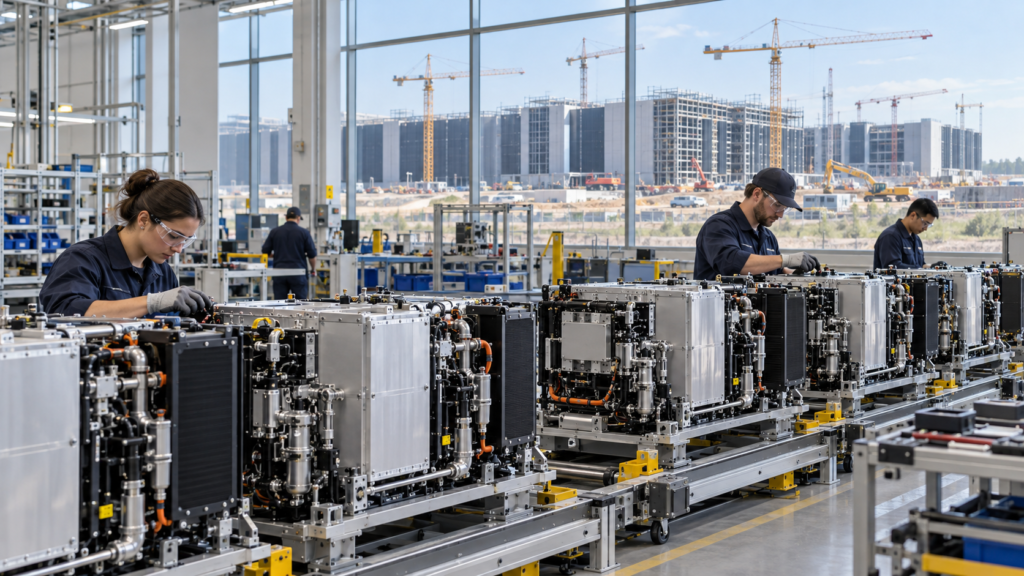
The expansion of AI data centers is putting pressure on electricity systems that were not designed to connect large new loads quickly. That is creating interest in on-site power, including fuel cells.
A Reuters report published October 23 cited Rystad Energy’s projection that investment in fuel cells for data centers could grow from approximately $2.8 billion in 2025 to $30 billion in 2030. Rystad also estimates that about 40% of projected U.S. data-center capacity in 2030 could pursue dedicated on-site power rather than rely entirely on the grid. These are forecasts, not guarantees of investment or deployment.
Why data-center developers are considering fuel cells
Data centers need dependable electricity for computing equipment and cooling. Reuters reports that large U.S. grid connections can take three to six years, according to Rystad estimates. That delay has developers looking at power options that could be installed at or near a facility while grid infrastructure catches up.
A fuel cell produces electricity through a chemical reaction involving fuel and oxygen. Natural gas is one current fuel option; some systems can also use hydrogen or hydrogen blends. Because fuel cells generate electricity without combustion inside the stack, they can have lower local emissions than conventional gas-fired generation. That does not make every fuel-cell installation carbon-free: the emissions picture depends on the fuel and its supply chain.
Fuel cells may support a data center’s power strategy, but they do not eliminate the need for grid access or other infrastructure. Depending on the project, developers still need fuel connections, permits, transformers, switchgear, and site work. Those requirements can become schedule constraints of their own.
Demand growth raises a manufacturing question
Rystad estimates annual fuel-cell manufacturing capacity at about 1.8 GW today, potentially increasing to 4 GW by 2030 as manufacturers expand. Rystad also projects 10.4 GW of cumulative fuel-cell demand from data centers between 2026 and 2030. These figures describe different measures—annual production capacity and cumulative demand—so they should not be treated as a direct one-to-one comparison. Together, they show why supply-chain execution deserves attention alongside market growth.
The order book also calls for careful reading. Rystad estimates it at roughly 9 GW, including agreements involving large companies. Reuters cautions that framework agreements do not necessarily represent firm orders for the full stated capacity. A headline number can signal interest without confirming exactly how much equipment will be purchased, manufactured, and installed.
Scaling production is more than adding factory floor space. It involves securing materials and components, expanding supplier capacity, controlling costs, and maintaining quality as output rises. Rystad has also identified potential material-supply exposure for some solid-oxide fuel-cell designs, another reminder that growth depends on the supply chain behind the finished system.
The opportunity depends on delivered power
For executives, manufacturers, and infrastructure investors, the useful question is not just how large the market forecast looks. It is whether the industry can turn demand into projects that are financed, supplied, permitted, connected to fuel, and ready to operate.
That creates opportunities across several layers: fuel-cell manufacturing, component supply, gas infrastructure, electrical equipment, project engineering, commissioning, and site development. It also creates risks if any one of those layers scales more slowly than demand.
The fuel-cell market may grow rapidly. The test will be whether manufacturing capacity and project readiness can grow with it—and whether the economics work at the level of the complete power system.
Executive takeaway: In the race to power AI, a faster-to-deploy generation technology still depends on factories, materials, fuel, electrical equipment, and a buildable site.
Entrepreneur question: Which part of the fuel-cell value chain looks most likely to become the next constraint?
Sources: Reuters, October 23, 2026 · Rystad Energy market analysis
Leave a Reply