The $500 Billion Question
AI conversations tend to focus on the visible part of the equation.
Model performance.
GPU shipments.
Data-center capacity.
Enterprise adoption.
Revenue growth.
But underneath all of it sits a less glamorous question that may ultimately determine how sustainable the AI buildout becomes:
Who finances the infrastructure before the revenue arrives?
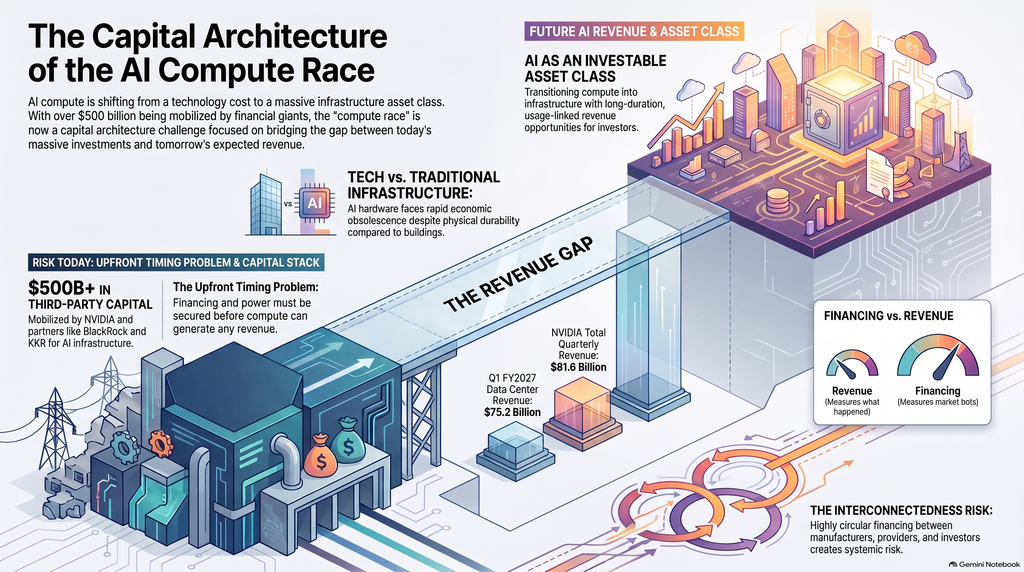
That question became considerably more interesting on August 10, 2026, when NVIDIA announced partnerships with Apollo, BlackRock, Blackstone, Brookfield, Goldman Sachs and KKR to establish independent financing platforms designed to mobilize more than $500 billion of third-party capital for AI infrastructure over time.
This isn’t simply another AI investment announcement.
It represents something bigger:
AI compute is increasingly being treated as an investable infrastructure asset.
And whenever an emerging technology becomes an investable asset class, the conversation changes from technology alone to capital structure, risk allocation, asset durability and governance.
The AI infrastructure bill arrives before the AI revenue
There is a basic timing problem embedded in the AI buildout.
Infrastructure has to be purchased before it can generate revenue.
A data center has to be built before workloads can run inside it.
Power has to be secured before compute can operate.
GPUs have to be purchased before models can consume their capacity.
Networking infrastructure has to be installed before distributed compute becomes useful.
And financing has to be arranged before much of that infrastructure can exist.
That creates a gap between:
Capital committed today
and
Cash flow expected tomorrow.
That gap isn’t inherently a problem.
Infrastructure projects have always required capital up front.
The interesting question is how much risk gets transferred into the financial system while the industry is waiting for expected AI economics to materialize.
Demand is one question. Capital architecture is another.
This distinction is easy to miss.
Suppose AI compute demand continues growing rapidly.
That tells us something important about the technology market.
But it doesn’t automatically tell us whether every infrastructure investment made to satisfy that demand will produce an adequate return.
Those are two different questions.
Question one:
Is there genuine demand for AI compute?
Question two:
Can the infrastructure built to satisfy that demand generate enough durable cash flow to justify the capital required to build it?
The first is a technology and market question.
The second is a capital allocation question.
And increasingly, it is a governance question.
What happens when compute becomes collateral?
One of the more important developments happening underneath the AI boom is the effort to make compute infrastructure financially investable.
NVIDIA has explicitly described its new financing platforms as a way to turn NVIDIA compute and full-stack AI infrastructure into an investable asset class while providing longer-duration, usage-linked revenue opportunities for investors.
That creates an interesting financial proposition.
If AI infrastructure produces predictable utilization and cash flow, institutional capital can potentially treat that infrastructure more like traditional infrastructure.
But there is a complication.
Technology doesn’t necessarily depreciate like traditional infrastructure.
A building can remain useful for decades.
A power plant can operate for many years.
A piece of AI compute may still physically function while becoming economically less attractive because a newer generation of hardware delivers substantially better performance per dollar or per watt.
That creates a very different risk profile.
The question isn’t simply:
“Will this asset still exist?”
It’s:
“Will this asset still generate enough economic value to service the capital attached to it?”
That distinction matters.
The circularity problem
There is another issue worth watching.
If infrastructure providers, chip manufacturers, AI companies and financial institutions increasingly participate in one another’s financing arrangements, the ecosystem can become highly interconnected.
That doesn’t automatically mean something is wrong.
Financial markets routinely create sophisticated structures around infrastructure.
But interconnectedness means executives need to understand where the risk actually sits.
For example:
If an AI company needs financing to build infrastructure…
and that infrastructure purchases GPUs…
and the GPU provider helps facilitate financing…
and investors are relying on future usage revenue…
then the system isn’t simply financing a piece of equipment.
It is financing an ecosystem of expected future demand.
That makes the assumptions underneath the financing structure extremely important.
What utilization rate is assumed?
What useful life is assumed?
What residual value is assumed?
What happens if model architectures change?
What happens if customers build their own accelerators?
What happens if AI revenue grows but not quickly enough to support the infrastructure built in anticipation of it?
These aren’t necessarily reasons to reject the investment.
They’re reasons to understand the architecture.
NVIDIA’s earnings become another timestamp
This is why NVIDIA’s upcoming earnings are particularly interesting.
NVIDIA is scheduled to report its second-quarter fiscal 2027 results on August 26, with the conference call at 5 p.m. ET.
Its previous quarter already demonstrated the scale of the underlying demand: NVIDIA reported $81.6 billion in quarterly revenue, including $75.2 billion of Data Center revenue, for Q1 FY2027.
The next earnings report will provide another important data point.
But revenue shouldn’t be the only thing worth watching.
The larger question is whether the financial architecture surrounding AI continues expanding alongside the underlying economics.
Because these are different measurements.
Revenue measures what has happened.
Financing measures what the market is willing to bet will happen.
And those two numbers don’t always move together forever.
The executive-level question
This is where the conversation moves beyond NVIDIA.
Every executive evaluating AI infrastructure should be asking:
What exactly are we underwriting when we approve an AI investment?
Is the organization underwriting:
- A genuine business requirement?
- A projected increase in AI workload?
- A vendor’s growth assumptions?
- A long-term infrastructure commitment?
- A financing structure?
- Or simply the expectation that AI demand will continue increasing?
Those aren’t interchangeable.
An organization can have strong AI demand and still make a poor infrastructure investment.
It can also have excellent infrastructure economics and insufficient demand.
The difference is governance.
AI is becoming a capital architecture problem
The next stage of the AI economy won’t be determined solely by who builds the best models or sells the most GPUs.
It will also be determined by who can construct the financial infrastructure required to deploy compute at enormous scale.
That’s why the $500 billion figure deserves attention.
Not because $500 billion automatically means success.
And not because financing automatically means risk.
But because it signals that AI infrastructure is moving deeper into the machinery of institutional capital.
That creates a new layer of questions.
Who owns the assets?
Who finances them?
Who assumes the downside?
Who receives the upside?
What assumptions make the economics work?
And perhaps most importantly:
What happens if the future being financed arrives later, smaller, or differently than expected?
Those are not merely financial questions.
They’re governance questions.
And as AI infrastructure becomes increasingly expensive, interconnected and financially engineered, understanding that architecture may become just as important as understanding the AI itself.
**The AI race may be powered by compute.
But the compute race is increasingly being powered by capital.**
And capital always comes with a risk register.
Leave a Reply