Category: Capital Allocation

  • A $1.5 Billion AI Drug Deal Shows the Difference Between Price and Potential Value

    AstraZeneca’s October 15 collaboration with insitro offers a useful look at how a buyer and a specialist partner can divide payment across the life of a high-risk project.

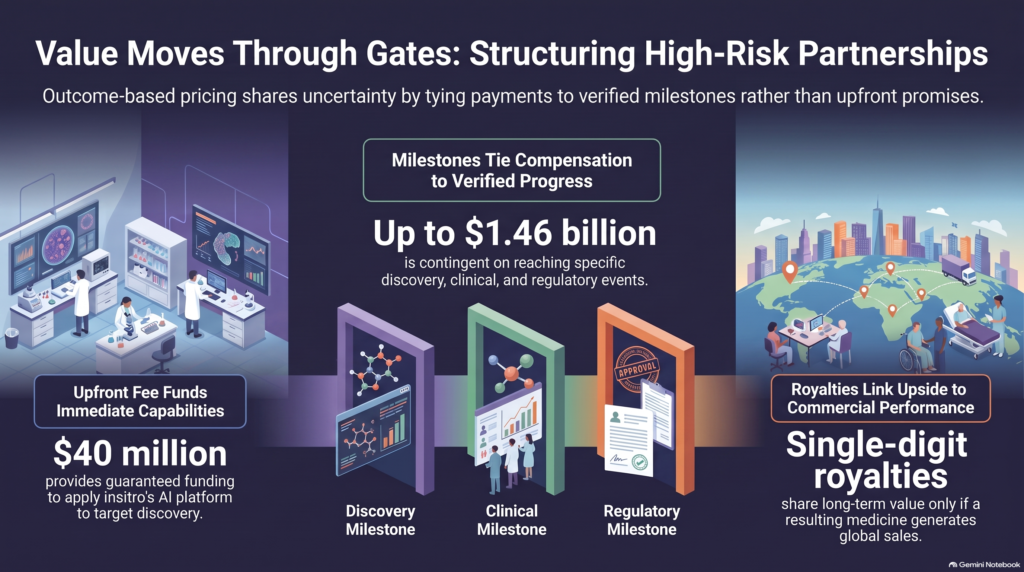
    The announced terms include a $40 million upfront payment, eligibility for up to approximately $1.46 billion in potential discovery, development, and commercial milestone payments, and potential single-digit royalties based on global sales. AstraZeneca will have exclusive worldwide rights to advance selected programs identified through the collaboration. The milestone amount is contingent, and royalties depend on products reaching the market and generating sales. The headline value should not be read as guaranteed revenue for insitro. (astrazeneca.com)

    Three layers of compensation

    The agreement combines three types of payment, each attached to a different point in the work and risk.

    1. Upfront compensation funds the work

    The $40 million upfront payment gives the collaboration immediate economic value. It recognizes the capabilities and work brought into the partnership while providing funding before the long path from discovery to commercial sales is known.

    In this case, insitro applies its Virtual Human platform to identify causal disease biology and advance AstraZeneca-nominated targets from discovery toward development candidates. AstraZeneca leads clinical development, regulatory work, and commercialization. (insitro.com)

    That division matters. The upfront amount is not merely an hourly fee. It sits within an agreement covering specialized capabilities, research activity, and rights to pursue selected programs.

    2. Milestones tie payment to defined progress

    The potential milestone payments connect additional compensation to future discovery, development, and commercial achievements. In principle, a milestone makes payment depend on an agreed event rather than time spent.

    But a milestone is only useful if the parties define it clearly. The contract needs to say what qualifies, who verifies it, what evidence is required, when payment is due, and what happens if the project changes direction. Otherwise, “pay for progress” can turn into a dispute over what progress means.

    Milestones also create a way to share risk. The specialist partner may earn more if programs advance, while the buyer avoids paying the entire potential value before results are known. The partner, in turn, accepts that some of the potential compensation may never be earned.

    3. Royalties connect compensation to commercial performance

    Potential royalties add a longer-term layer: if a resulting medicine is commercialized and produces sales, insitro may receive a share. That is different from a payment for completing a research task. It ties future compensation to commercial performance.

    Royalties also carry more uncertainty. A program must survive scientific, clinical, regulatory, and commercial hurdles before sales exist. The deal therefore places some potential upside far into the future, where outcomes are uncertain and the value of future payments differs from cash received today.

    The value is in the partnership, not just the AI

    It would be easy to describe this as a company licensing AI and another company paying for it. That misses the broader arrangement.

    The announced collaboration combines insitro’s AI-enabled biological discovery work with AstraZeneca’s clinical development, regulatory, and commercialization capabilities. It also grants AstraZeneca exclusive worldwide rights to advance selected programs. The commercial structure reflects an exchange of capabilities, work, rights, and risk—not simply access to a model. (astrazeneca.com)

    That distinction is important for businesses selling AI-enabled expertise. Buyers rarely pay a premium just because AI was used. They pay when the work helps solve a consequential problem, produces evidence they can evaluate, and fits into a process that can turn the work into business value.

    What entrepreneurs can take from the deal

    Most consulting firms should not copy a pharmaceutical deal’s royalties or long development timeline. The transferable idea is to build a pricing structure that matches compensation to the work and the outcome.

    A business could combine:

    • A base fee for discovery, setup, access, or reserved capacity.
    • Milestone payments for defined and accepted outputs, such as a validated workflow, completed implementation, or measurable quality threshold.
    • A success fee or revenue share when the result can be measured and the provider’s contribution is clear.

    This structure should also protect both sides. Define the baseline, measurement method, data source, acceptance criteria, payment trigger, time period, and responsibilities. Address what happens when the client changes scope, delays implementation, or controls an important part of the result. Keep guaranteed compensation sufficient to fund the work, especially when results depend on external factors.

    Outcome-based pricing is not “charge more if the client gets lucky.” It is a deliberate agreement about what value means, what evidence will prove it, and how the parties will share uncertainty.

    The AstraZeneca–insitro deal makes that structure visible: some compensation is paid upfront, more may follow verified milestones, and additional upside may depend on commercial success. The headline amount captures the maximum potential under the agreement. The actual economics depend on what gets achieved.

    Entrepreneur question: Which part of your expertise could be priced around verified progress or results instead of hours alone?
  • AI Infrastructure Is Entering Its Project-Finance Era

    AI Infrastructure Is Entering Its Project-Finance Era

    For much of the AI boom, attention has centered on company valuations, model capabilities and venture-capital investments.

    That view is becoming incomplete.

    The next phase of AI expansion requires physical infrastructure at enormous scale: processors, data centers, substations, transmission capacity, cooling systems and long-term access to electricity. Building that infrastructure requires more capital than even the largest technology companies may want to carry directly on their balance sheets.

    That is why one of the most important AI developments of the week came from the financing side of the market.

    On September 16, Reuters reported that a consortium of ten banks—including Goldman Sachs, Barclays, BNP Paribas, Sumitomo Mitsui Banking Corporation and Bank of Nova Scotia—was providing approximately $22 billion in financing for Crux AI, a cloud-computing venture backed by Blackstone and Alphabet.

    Blackstone had already committed an initial $5 billion in equity. Google is contributing its Tensor Processing Units, along with software and services. The debt is expected to be secured by the TPUs and customer contracts, while the venture is targeting its first 500 megawatts of computing capacity in 2027. The banks may eventually refinance portions of the loan through the bond market. (reuters.com, reuters.com)

    Those details deserve more attention than the headline dollar amount.

    The capital stack is becoming part of the AI story

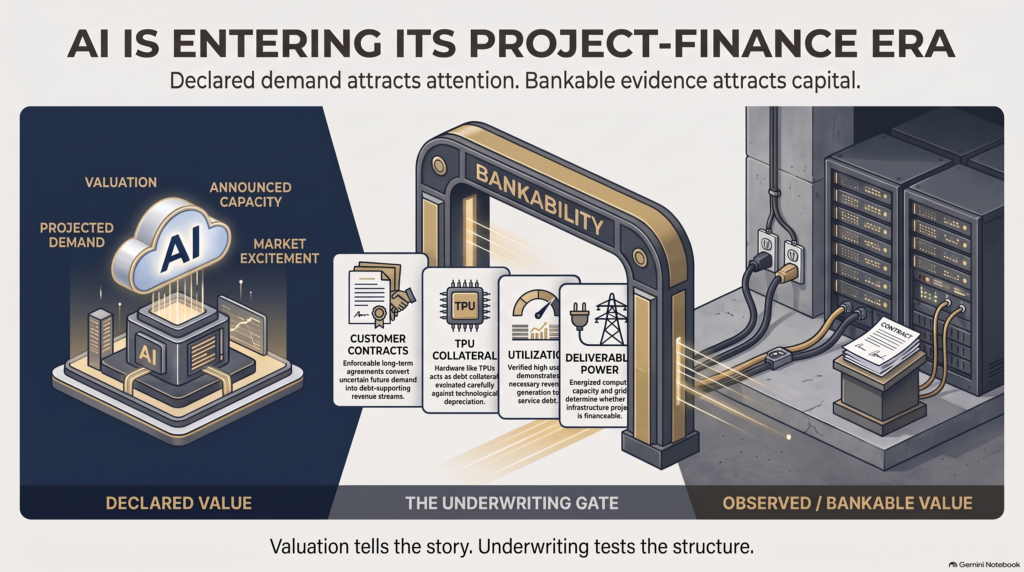
    This transaction suggests that AI infrastructure is beginning to acquire characteristics commonly associated with project finance.

    In traditional project finance, lenders do not rely solely on the reputation or market valuation of a corporate sponsor. They examine the project’s assets, contracts, construction milestones and expected cash flows.

    The fundamental question is straightforward:

    Can this specific group of assets produce enough reliable revenue to repay the financing used to build it?

    That question is now being applied to AI compute.

    The collateral is no longer merely an ownership stake in a promising technology company. It can include physical processors and contractual claims on future customer payments.

    That represents a significant evolution in how capital is moving through the AI sector.

    Money is moving beyond funding companies that develop AI. It is increasingly financing the industrial system required to operate AI at scale.

    Contracts are becoming infrastructure

    A processor has technical value, but a processor connected to power and committed to a creditworthy customer has financial value.

    That distinction explains why customer contracts matter so much to these financing structures.

    A long-term contract can transform uncertain future demand into a more predictable stream of revenue. That stream may then support debt financing, which allows the infrastructure provider to purchase more equipment and build additional capacity.

    The contract effectively becomes part of the infrastructure.

    But not all contracted demand is equally bankable. Lenders will examine the duration of the agreement, the customer’s ability to pay, cancellation provisions, minimum-use commitments and the consequences of delayed delivery.

    A large announced customer pipeline may attract attention.

    A durable contract with enforceable payment obligations can attract capital.

    Utilization is no longer merely an operating metric

    When infrastructure is financed with debt, utilization becomes directly connected to debt service.

    A data center can be completed. The processors can be installed. Power can be available. But if customers do not use the contracted capacity—or if the contracts allow them to walk away—the economic model can still fail.

    This creates an important separation between four different claims:

    1. Announced computing capacity
    2. Constructed computing capacity
    3. Energized computing capacity
    4. Revenue-producing computing capacity

    Those categories are not interchangeable.

    The AI sector has spent considerable time discussing how much capacity companies intend to build. Financing markets will increasingly ask how much of that capacity can be delivered, utilized and converted into dependable cash flow.

    This is another version of the declared-versus-observed problem.

    Declared demand may justify an announcement.

    Observed utilization must eventually justify the financing.

    AI chips are unusual collateral

    The inclusion of TPUs as collateral is particularly revealing.

    Processors are physical assets, but they do not behave like conventional infrastructure assets. A transmission line, pipeline or toll road may remain economically productive for decades. Advanced AI processors can face much faster technological and economic depreciation.

    A chip may continue functioning while becoming less competitive against a newer generation with better performance, lower energy consumption or a more attractive cost per unit of compute.

    That creates several underwriting questions:

    • How quickly will the equipment lose economic value?
    • Can the processors support multiple customers and workloads?
    • How dependent is the platform on one chip architecture?
    • What happens to the loan if utilization declines before the debt matures?
    • How much value could lenders recover from the hardware in a downside scenario?

    The equipment may be tangible, but its future value remains tied to technological relevance.

    Power readiness becomes a financial condition

    The planned 500 megawatts also connect this transaction to the broader infrastructure constraints surrounding AI.

    A processor cannot generate revenue while waiting for electricity.

    That means lenders financing AI infrastructure must look beyond chips and customer contracts. They also need confidence in land control, interconnection agreements, permits, construction schedules, cooling capacity and the delivery of dependable power.

    An announced 500-megawatt project is not automatically a financeable 500-megawatt project.

    The difference lies in whether the capacity can be built, energized and made available when customers expect it.

    Grid readiness is therefore becoming more than an engineering concern. It is becoming a credit concern.

    Follow what the financing requires

    Entrepreneurs and executives trying to understand AI economics should pay attention to more than valuations and funding announcements.

    The more useful questions may now be:

    • What assets secure the financing?
    • Which contracts support the projected revenue?
    • How concentrated is the customer base?
    • What utilization level is required to service the debt?
    • Who carries the risk of construction delays?
    • Who absorbs the loss if the equipment depreciates faster than expected?
    • Is the power capacity announced, contracted or actually deliverable?
    • Will the debt remain with the banks or be distributed through the bond market?

    These questions reveal what sophisticated capital providers believe can withstand scrutiny—and where they still require protection.

    That does not mean every heavily financed AI project will succeed. It means the AI boom is entering a stage where enthusiasm must increasingly be translated into assets, contracts, milestones and cash flows.

    Valuations show what the market hopes an AI company might become.

    Financing structures show what lenders are willing to treat as bankable.

    As AI infrastructure grows more capital-intensive, that may become one of the clearest ways to distinguish the sector’s declared promise from its observed economic foundation.

  • WHO PAYS FOR AI INFRASTRUCTURE BEFORE THE REVENUE ARRIVES?

    The $500 Billion Question

    AI conversations tend to focus on the visible part of the equation.

    Model performance.

    GPU shipments.

    Data-center capacity.

    Enterprise adoption.

    Revenue growth.

    But underneath all of it sits a less glamorous question that may ultimately determine how sustainable the AI buildout becomes:

    Who finances the infrastructure before the revenue arrives?

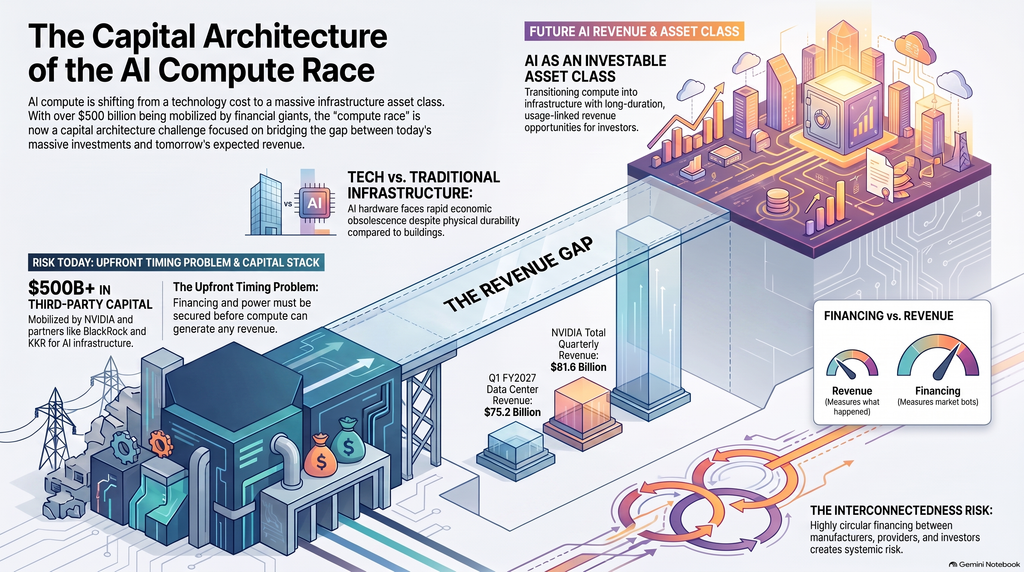
    That question became considerably more interesting on August 10, 2026, when NVIDIA announced partnerships with Apollo, BlackRock, Blackstone, Brookfield, Goldman Sachs and KKR to establish independent financing platforms designed to mobilize more than $500 billion of third-party capital for AI infrastructure over time.

    This isn’t simply another AI investment announcement.

    It represents something bigger:

    AI compute is increasingly being treated as an investable infrastructure asset.

    And whenever an emerging technology becomes an investable asset class, the conversation changes from technology alone to capital structure, risk allocation, asset durability and governance.

    The AI infrastructure bill arrives before the AI revenue

    There is a basic timing problem embedded in the AI buildout.

    Infrastructure has to be purchased before it can generate revenue.

    A data center has to be built before workloads can run inside it.

    Power has to be secured before compute can operate.

    GPUs have to be purchased before models can consume their capacity.

    Networking infrastructure has to be installed before distributed compute becomes useful.

    And financing has to be arranged before much of that infrastructure can exist.

    That creates a gap between:

    Capital committed today

    and

    Cash flow expected tomorrow.

    That gap isn’t inherently a problem.

    Infrastructure projects have always required capital up front.

    The interesting question is how much risk gets transferred into the financial system while the industry is waiting for expected AI economics to materialize.

    Demand is one question. Capital architecture is another.

    This distinction is easy to miss.

    Suppose AI compute demand continues growing rapidly.

    That tells us something important about the technology market.

    But it doesn’t automatically tell us whether every infrastructure investment made to satisfy that demand will produce an adequate return.

    Those are two different questions.

    Question one:

    Is there genuine demand for AI compute?

    Question two:

    Can the infrastructure built to satisfy that demand generate enough durable cash flow to justify the capital required to build it?

    The first is a technology and market question.

    The second is a capital allocation question.

    And increasingly, it is a governance question.

    What happens when compute becomes collateral?

    One of the more important developments happening underneath the AI boom is the effort to make compute infrastructure financially investable.

    NVIDIA has explicitly described its new financing platforms as a way to turn NVIDIA compute and full-stack AI infrastructure into an investable asset class while providing longer-duration, usage-linked revenue opportunities for investors.

    That creates an interesting financial proposition.

    If AI infrastructure produces predictable utilization and cash flow, institutional capital can potentially treat that infrastructure more like traditional infrastructure.

    But there is a complication.

    Technology doesn’t necessarily depreciate like traditional infrastructure.

    A building can remain useful for decades.

    A power plant can operate for many years.

    A piece of AI compute may still physically function while becoming economically less attractive because a newer generation of hardware delivers substantially better performance per dollar or per watt.

    That creates a very different risk profile.

    The question isn’t simply:

    “Will this asset still exist?”

    It’s:

    “Will this asset still generate enough economic value to service the capital attached to it?”

    That distinction matters.

    The circularity problem

    There is another issue worth watching.

    If infrastructure providers, chip manufacturers, AI companies and financial institutions increasingly participate in one another’s financing arrangements, the ecosystem can become highly interconnected.

    That doesn’t automatically mean something is wrong.

    Financial markets routinely create sophisticated structures around infrastructure.

    But interconnectedness means executives need to understand where the risk actually sits.

    For example:

    If an AI company needs financing to build infrastructure…

    and that infrastructure purchases GPUs…

    and the GPU provider helps facilitate financing…

    and investors are relying on future usage revenue…

    then the system isn’t simply financing a piece of equipment.

    It is financing an ecosystem of expected future demand.

    That makes the assumptions underneath the financing structure extremely important.

    What utilization rate is assumed?

    What useful life is assumed?

    What residual value is assumed?

    What happens if model architectures change?

    What happens if customers build their own accelerators?

    What happens if AI revenue grows but not quickly enough to support the infrastructure built in anticipation of it?

    These aren’t necessarily reasons to reject the investment.

    They’re reasons to understand the architecture.

    NVIDIA’s earnings become another timestamp

    This is why NVIDIA’s upcoming earnings are particularly interesting.

    NVIDIA is scheduled to report its second-quarter fiscal 2027 results on August 26, with the conference call at 5 p.m. ET.

    Its previous quarter already demonstrated the scale of the underlying demand: NVIDIA reported $81.6 billion in quarterly revenue, including $75.2 billion of Data Center revenue, for Q1 FY2027.

    The next earnings report will provide another important data point.

    But revenue shouldn’t be the only thing worth watching.

    The larger question is whether the financial architecture surrounding AI continues expanding alongside the underlying economics.

    Because these are different measurements.

    Revenue measures what has happened.

    Financing measures what the market is willing to bet will happen.

    And those two numbers don’t always move together forever.

    The executive-level question

    This is where the conversation moves beyond NVIDIA.

    Every executive evaluating AI infrastructure should be asking:

    What exactly are we underwriting when we approve an AI investment?

    Is the organization underwriting:

    • A genuine business requirement?
    • A projected increase in AI workload?
    • A vendor’s growth assumptions?
    • A long-term infrastructure commitment?
    • A financing structure?
    • Or simply the expectation that AI demand will continue increasing?

    Those aren’t interchangeable.

    An organization can have strong AI demand and still make a poor infrastructure investment.

    It can also have excellent infrastructure economics and insufficient demand.

    The difference is governance.

    AI is becoming a capital architecture problem

    The next stage of the AI economy won’t be determined solely by who builds the best models or sells the most GPUs.

    It will also be determined by who can construct the financial infrastructure required to deploy compute at enormous scale.

    That’s why the $500 billion figure deserves attention.

    Not because $500 billion automatically means success.

    And not because financing automatically means risk.

    But because it signals that AI infrastructure is moving deeper into the machinery of institutional capital.

    That creates a new layer of questions.

    Who owns the assets?

    Who finances them?

    Who assumes the downside?

    Who receives the upside?

    What assumptions make the economics work?

    And perhaps most importantly:

    What happens if the future being financed arrives later, smaller, or differently than expected?

    Those are not merely financial questions.

    They’re governance questions.

    And as AI infrastructure becomes increasingly expensive, interconnected and financially engineered, understanding that architecture may become just as important as understanding the AI itself.

    **The AI race may be powered by compute.

    But the compute race is increasingly being powered by capital.**

    And capital always comes with a risk register.

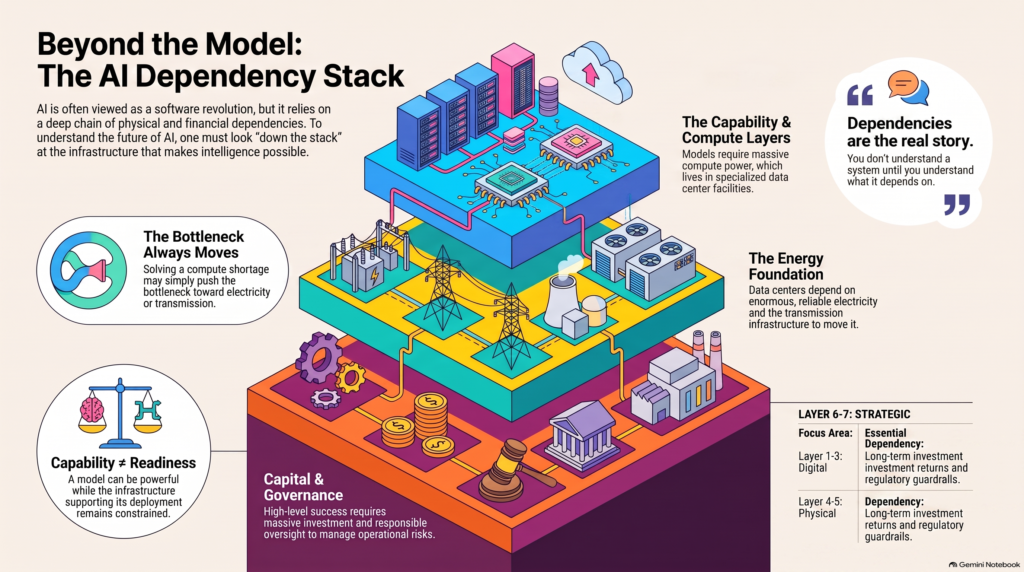
  • Beyond The Model: The AI Dependency Stack

    I Started Studying AI and Somehow Ended Up Studying the Power Grid

    I didn’t start studying artificial intelligence because I wanted to understand the electrical grid.

    Yet somehow, that’s where the trail led.

    What began as an effort to better understand AI models gradually expanded into compute infrastructure, data centers, electricity generation, transmission constraints, capital investment and eventually governance.

    Looking back, the progression makes perfect sense.

    Models → Compute → Data Centers → Electricity → Transmission → Capital → Governance

    Each subject exposed a dependency underneath the previous one.

    And that has changed the way I think about AI.

    Follow the Dependency

    When most conversations about artificial intelligence begin, they start with the model.

    How capable is it?

    How quickly is performance improving?

    What tasks can it automate?

    What happens when agents become more autonomous?

    Those are important questions. But eventually I started asking another one:

    What does this depend on?

    AI models depend on compute.

    Compute depends on chips, servers, cooling systems and data centers.

    Data centers depend on enormous amounts of reliable electricity.

    Electricity depends on generation capacity and the infrastructure required to move that power where it is needed.

    That means transmission capacity, substations, interconnection queues, permitting and infrastructure investment suddenly become part of the AI conversation.

    Keep following the chain and another layer appears.

    Capital.

    Someone has to finance all of this infrastructure.

    Companies have to decide how much capacity to build, where to build it, what assumptions justify the investment and whether expected AI demand will generate sufficient returns.

    Now the conversation isn’t simply technological.

    It is operational, financial and strategic.

    And eventually it becomes a governance problem.

    Capability Is Only One Layer of the System

    One of the most important lessons I’ve taken from this progression is that technological capability doesn’t guarantee system-level capability.

    A model might become significantly more powerful while the infrastructure supporting its deployment remains constrained.

    More demand for compute can create pressure on data-center capacity.

    Additional data centers increase electricity demand.

    New generation capacity doesn’t necessarily solve the problem if transmission infrastructure cannot deliver that electricity where demand is growing.

    And even if every physical constraint could be removed, organizations still have to determine whether the resulting investments make economic sense and whether the systems being deployed can be governed responsibly.

    This creates an interesting possibility:

    The biggest constraint on the next stage of AI might not always be AI.

    It could appear somewhere else in the dependency chain.

    Systems Don’t Respect Industry Categories

    We tend to organize knowledge into categories.

    Artificial intelligence.

    Energy.

    Finance.

    Infrastructure.

    Risk.

    Governance.

    But real systems don’t care about those categories.

    Their dependencies cross them constantly.

    An AI strategy can become an infrastructure strategy.

    An infrastructure strategy can become an energy strategy.

    An energy constraint can become a capital-allocation problem.

    A capital decision can create new operational risks.

    And those risks eventually require governance.

    What looked like several unrelated subjects was actually one interconnected system viewed from different layers.

    That’s what systems thinking started changing for me.

    Instead of asking only:

    What can this technology do?

    I became increasingly interested in another question:

    What has to remain true for this entire system to work?

    That question exposes a very different landscape.

    The Bottleneck Moves

    Another realization followed.

    Bottlenecks don’t disappear simply because technology improves.

    They move.

    If models become more efficient, another constraint may become more important.

    If compute capacity expands, electricity availability may become the limiting factor.

    If generation expands, transmission may become the constraint.

    If infrastructure expands rapidly, capital discipline or governance may become the limiting factor.

    This means leaders evaluating AI cannot look exclusively at technological capability.

    They also have to understand the dependency chain supporting that capability.

    Otherwise, it becomes easy to mistake progress in one layer for readiness across the entire system.

    The Infrastructure Underneath the Intelligence

    I still study AI.

    But now I find myself paying much more attention to what surrounds it.

    Energy infrastructure.

    Data-center development.

    Transmission.

    Capital allocation.

    Operational risk.

    Governance.

    Not because I abandoned the original subject, but because following it seriously kept expanding the boundaries of the system.

    That’s probably the biggest lesson this journey has taught me:

    You don’t really understand a system until you understand what it depends on.

    AI may appear to be a software revolution when viewed from the surface.

    Follow the dependency chain downward, however, and you eventually reach physical infrastructure, energy, economics and governance.

    And sometimes the most important part of a technology isn’t the technology itself.

    It’s everything that has to work underneath it.

  • Quiet Thesis: Why AI Is Becoming an Infrastructure Allocation Problem

    Introduction

    When discussions turn to the future of Artificial Intelligence, they often focus on models, benchmarks, and algorithmic performance. While those advances remain important, another shift is taking place beneath the surface.

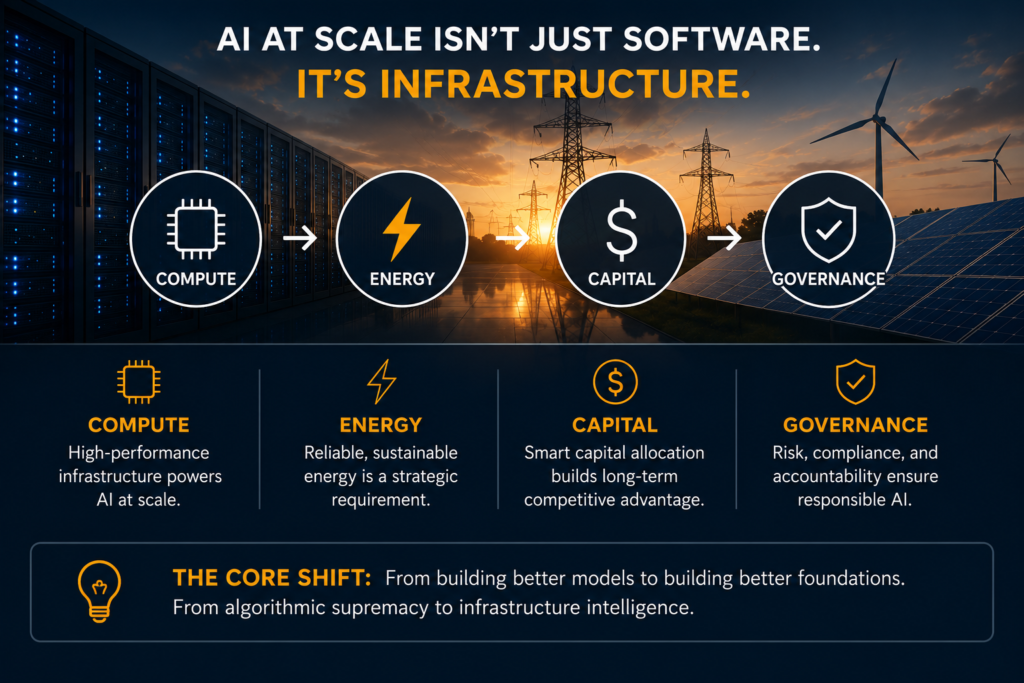
    As AI systems become more capable and resource-intensive, organizations are increasingly competing on their ability to secure and manage the infrastructure that makes those systems practical at scale. Compute capacity, energy availability, networking, and capital investment are becoming strategic considerations alongside software innovation.

    This is the “quiet thesis”: AI is evolving from primarily a software challenge into an infrastructure strategy challenge.

    Beyond Algorithmic Supremacy

    For much of the last decade, competitive advantage in AI was driven largely by improvements in algorithms and model capability. That remains an important source of innovation.

    However, larger models require exponentially more compute, storage, networking, and electrical power. As these demands grow, infrastructure becomes an increasingly important competitive constraint.

    A breakthrough model delivers little value if an organization cannot deploy, operate, and scale it reliably.

    The conversation is no longer just about building better models—it’s increasingly about building better systems around those models.


    Infrastructure as Competitive Strategy

    Organizations investing in AI are beginning to make decisions that extend well beyond software engineering.

    Capital allocation now influences compute availability.

    Infrastructure planning influences deployment speed.

    Energy strategy affects long-term scalability.

    Vendor diversification influences operational resilience.

    Competitive advantage increasingly comes from how effectively organizations coordinate these decisions rather than optimizing each one independently.

    This does not diminish the importance of software innovation. Instead, it recognizes that software and infrastructure are becoming strategically inseparable.

    The Convergence of Capital, Energy, and Governance

    Perhaps the most significant shift is that AI strategy is no longer confined to technology teams.

    Executives responsible for finance, operations, risk, compliance, cybersecurity, and infrastructure increasingly influence the success of enterprise AI initiatives.

    Three areas are beginning to converge:

    • Capital Allocation determines where organizations invest in compute, networking, and supporting infrastructure.
    • Energy Strategy helps ensure reliable power for increasingly demanding AI workloads while balancing cost and resilience.
    • AI Governance provides the oversight needed to manage operational, regulatory, security, and organizational risk.

    Viewed together, these are not separate initiatives. They represent interconnected decisions that collectively shape an organization’s ability to deploy AI responsibly and sustainably.

    Conclusion

    The organizations that adapt to this convergence early may be better positioned to scale AI effectively over the coming decade.

    Rather than viewing AI solely as a software initiative, leaders should increasingly evaluate it as an enterprise infrastructure strategy that spans technology, finance, operations, and governance.

    The future of AI will still be shaped by better models.

    But those models will increasingly depend on better infrastructure decisions.

    Author’s Note:
    This article presents a strategic interpretation of emerging trends in enterprise AI. While individual organizations will vary, the observations reflect broader shifts in compute demand, infrastructure investment, energy planning, and AI governance that are increasingly influencing enterprise adoption.