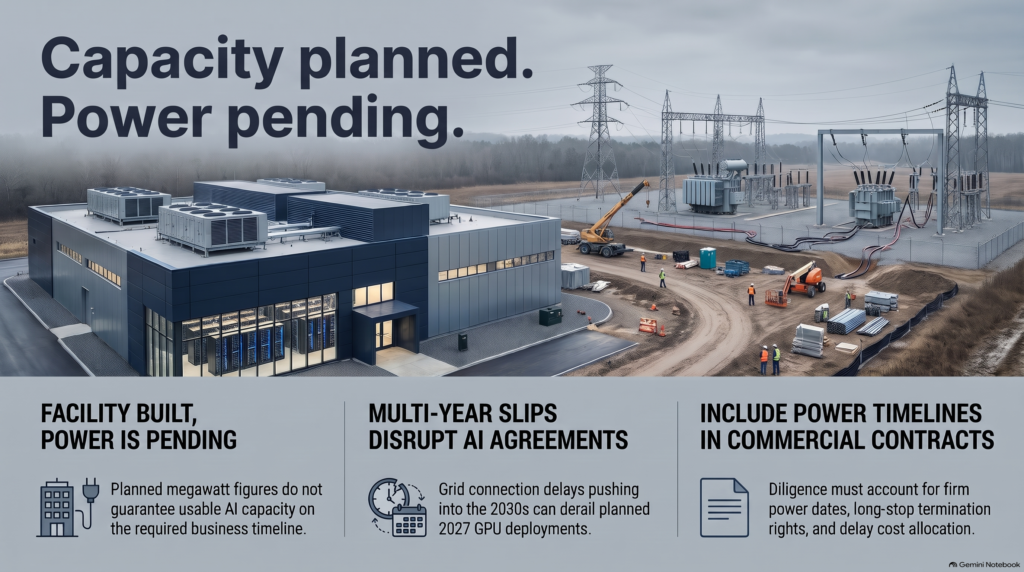
AI infrastructure projects are often described through large, attention-grabbing numbers: megawatts, GPUs, investment totals and planned opening dates. But those figures only tell part of the story. For a customer planning cloud or AI services, capacity matters when it is ready to use.
The planned Nscale site in Loughton, Essex, offers a concrete example of how the schedule can break down.
Reuters reported that Microsoft withdrew from its agreement for capacity at the site after the expected grid connection slipped into the 2030s. Nscale had planned a facility with 50 MW of AI capacity, scalable to 90 MW, and approximately 23,040 Nvidia GB300 GPUs for Microsoft Azure. The original announcement anticipated GPU delivery beginning in early 2027.
Microsoft said its decision related to one site and reaffirmed its wider partnership with Nscale. Nscale said it remained committed to Loughton and was exploring alternative power sources and other UK expansion sites. The public reporting does not disclose the contract’s terms, the exact termination provision or the financial consequences for either party.
A project schedule depends on more than construction
Data centre readiness depends on several linked pieces: the building, electrical equipment, cooling, network connectivity, hardware and sufficient power. If one critical dependency arrives years later than planned, the rest of the investment may not produce its expected value on schedule.
That creates commercial consequences. A late power connection can postpone the point when a customer can use capacity, delay revenue, extend the time capital is tied up and create uncertainty about whether demand will still be there when the site is ready. These are general project risks; the publicly available details do not establish which of them applied to this specific agreement.
Why this can become a contract issue
Long-term infrastructure agreements have to allocate the risks of delay. Executives and project teams should understand how the contract treats power availability, delivery milestones, delay thresholds, customer remedies and termination rights.
The questions are practical:
- Is the power date confirmed, estimated or dependent on future grid work?
- What happens if service begins later than the customer’s required date?
- Is there a defined long-stop date after which a party can exit?
- Can capacity be moved to another site or supplied from another source?
- Who bears added costs while the project waits?
These are questions to raise during commercial and legal review—not assumptions about the terms of Microsoft’s agreement.
The executive takeaway
A planned megawatt figure doesn’t guarantee usable capacity on the date a business needs it. Time to power affects whether a project can support customer commitments and whether its economics still work when the facility is ready.
The better diligence question is not only, “How much AI capacity will this project deliver?” It is also, “When will power be available, how certain is that date, and what happens contractually if it moves?”
In AI infrastructure, the power schedule belongs in the commercial plan from the start.
Leave a Reply