For much of the recent discussion about artificial intelligence and electricity, the central question has been how much new power the country can produce.
That question is essential. Data centers, manufacturing, transportation, and other forms of electrification are adding pressure to the power system. More generation can help meet that demand.
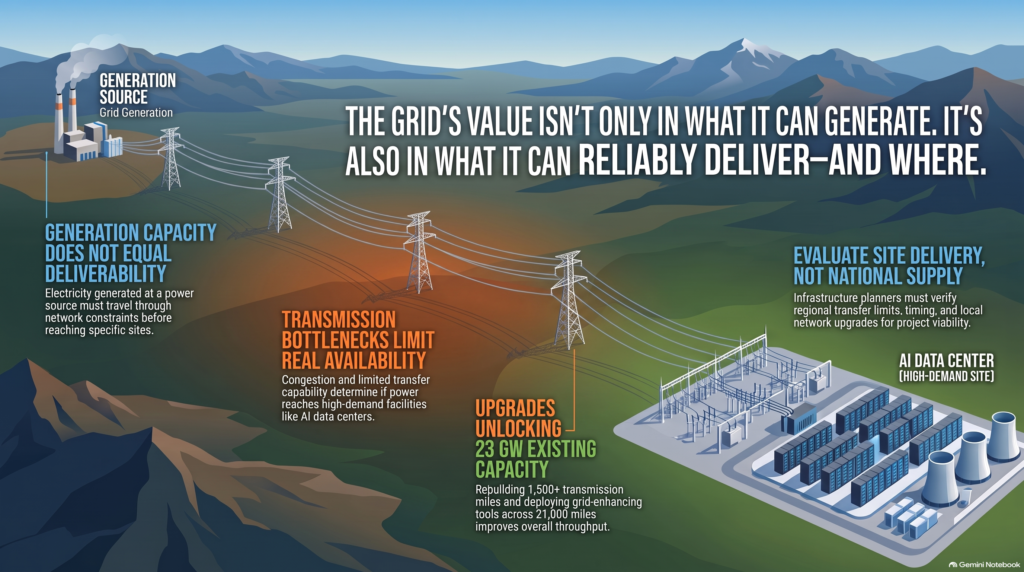
But generation is only one part of the system. Electricity must also move from where it is produced to where it is needed, at the time it is needed, within the limits of the network.
That brings a second question into focus:
How efficiently can the existing grid move electricity to the places where demand is growing?
Capacity is not the same as deliverability
A grid can have electricity available somewhere in the system and still face difficulty delivering it to a particular location. Transmission congestion, constraints on individual lines, and limited transfer capability can affect how much power can move between regions.
In practical terms, this means that the amount of electricity a system can generate does not, by itself, tell us how much electricity a particular customer or facility can reliably receive. Location and delivery capability matter too.
This distinction is especially relevant to AI infrastructure. Data centers need large amounts of electricity at specific sites, often on demanding timelines. A national supply figure alone cannot tell a project developer whether power can reach a particular location, or when the necessary network upgrades will be complete.
DOE’s investments highlight the delivery side
The U.S. Department of Energy recently announced investments across 26 states. DOE says project recipients are expected to reconductor or rebuild more than 1,500 miles of transmission lines and deploy grid-enhancing technologies across nearly 21,000 miles. Together, the projects are expected to make more than 23 GW of additional electricity capacity available.
These figures describe a mix of transmission upgrades and technologies intended to improve use of the existing grid. They do not mean that all grid constraints are solved, or that new generation and new transmission will no longer be needed. They do show that improving the performance of existing infrastructure is part of the response to rising demand.
Some grid-enhancing technologies help operators understand or control the network more precisely. Dynamic line ratings, for example, use current conditions to estimate how much electricity a line can safely carry. Power-flow control devices can help redirect electricity toward lines with available capacity.
These measures can help unlock capacity in existing corridors. Their usefulness depends on the specific line, operating conditions, system needs, and the ability of grid operators to deploy and manage the technology.
The value of throughput
It may help to think of the grid as a network with both supply and movement constraints. Adding electricity is one way to increase what the system can serve. Improving the movement of electricity is another.
For executives and infrastructure planners, that suggests a more complete set of questions:
- Is generation available?
- Can the grid transfer it to the relevant region?
- Can it be delivered to the specific site?
- Will it be available at the times the load needs it?
- What upgrades are needed to make that delivery reliable?
These questions are connected, but they are not interchangeable. A project may have access to a potential energy supply while still depending on transmission work, interconnection steps, or local network upgrades before that power is deliverable.
For large electricity users, this has implications for site selection, project schedules, utility coordination, and the cost of bringing infrastructure online. The grid’s ability to move power can influence whether a location is practical, how quickly a project can be served, and what additional investment may be required.
A broader view of the AI power question
The discussion should not become a contest between building new infrastructure and improving existing infrastructure. Growing demand may call for more generation, new transmission, upgrades to existing lines, and better tools for operating the system.
The strategic point is that grid size and grid performance are different parts of the same challenge.
As AI infrastructure expands, the value of the grid may increasingly be measured not only by how much electricity it can produce or connect, but by how effectively it can move that electricity to the right place at the right time.
The supply question remains important. The delivery question is becoming just as important.
Leave a Reply