The Cheapest AI Megawatt May Already Exist
“AI needs more power” is true as far as it goes. It is also too broad to tell an executive what to build, fund or approve.
A growing data center needs electricity at a specific site, at a specific time, with the reliability its operations require. Several different constraints can stand between that need and an energized facility. There may be too little generation available at the required hours. An existing transmission corridor may be congested. A local substation may need upgrades. An interconnection may still be years from completion.
Those are different problems. They do not all have the same solution.
The Department of Energy’s September 24 announcement offers a useful example. DOE said it intends to help fund 31 grid improvement projects across 26 states through its SPARK initiative. The selected projects are expected to reconductor or rebuild more than 1,500 miles of transmission lines and deploy grid enhancing technologies across nearly 21,000 miles. Together, DOE expects those efforts to make more than 23 GW of additional electricity capacity available.
That 23 GW is not a proposal for 23 GW of new generation. It is an expected increase in what the grid can carry and make available through transmission upgrades. The projects have been selected; the capacity gain still has to be delivered and measured.
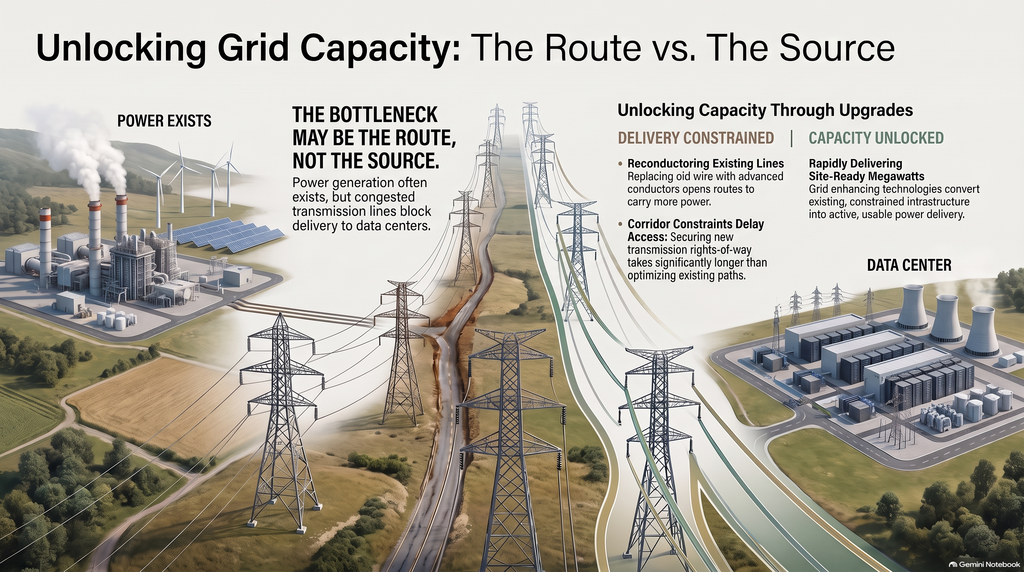
The constraint may be the route
Think of generation as the source of electricity and transmission as part of the route it takes to customers. Adding supply at one end does little for a particular site if the route between them is constrained.
Reconductoring replaces the wire on an existing transmission line with a conductor that can carry more power. Other grid enhancing technologies help operators understand or improve how existing lines are used. Dynamic line ratings, for example, use current conditions to assess a line’s safe carrying capability. Power flow controls can help direct electricity across available paths.
These approaches are attractive because they can draw more value from infrastructure and rights of way that already exist. They may be especially useful where obtaining a new corridor would take much longer.
That does not make every existing line an easy upgrade. A project still has to satisfy engineering, reliability and operational requirements. Nor does an increase in transmission capability guarantee that electricity will be available during every hour a customer needs it.
What the announcement changes
The opportunity is wider than the familiar discussion about building new generation.
Advanced conductors, line monitoring, sensors, power flow controls and grid software all become more consequential when transfer capability is the binding constraint. So do the less visible tasks: studying where an upgrade will help, coordinating the work and proving that the promised capacity is available in operation.
For an AI infrastructure developer, the practical question is not simply, “How many megawatts are planned in this region?” It is:
How much power can reach this site, under the required conditions, by the date we need it?
For utilities and policymakers, the question is where targeted upgrades can relieve real congestion—and where new generation, substations or transmission corridors are still necessary.
From announced capacity to delivered power
DOE’s projected 23 GW is a meaningful signal about where grid investment is headed. It is not yet 23 GW of observed, site ready power.
The evidence will come as projects are completed and operators measure the resulting transfer capability, reliability and service to customers. That is where the declared figure becomes an operational result.
AI’s electricity challenge is often framed as a race to produce more power. In some places it will be. In others, a faster opportunity may be to move available electricity more effectively through the grid we already have.
The cheapest megawatt may already exist. The work is proving that it can reach the right place when it counts.
Leave a Reply