The race to build artificial-intelligence infrastructure is usually described in terms of capital, chips and computing capacity.
Yet every AI data center ultimately depends on a more physical constraint: electricity.
That dependence has triggered a wave of large-load requests across the United States. Developers are reserving potential sites, exploring multiple utility territories and attempting to secure access to power years before facilities become operational.
The resulting interconnection queues appear to show extraordinary demand.
But they also create a difficult planning question:
How much of that demand is credible enough to build around?
Texas has brought that question into the open.
Why Texas paused the process
On August 3, 2026, Texas Governor Greg Abbott directed the Public Utility Commission of Texas and the Electric Reliability Council of Texas to conduct a comprehensive audit of data centers advancing through ERCOT’s interconnection process.
Projects must complete the audit before advancing, and noncompliant projects may be denied connection.
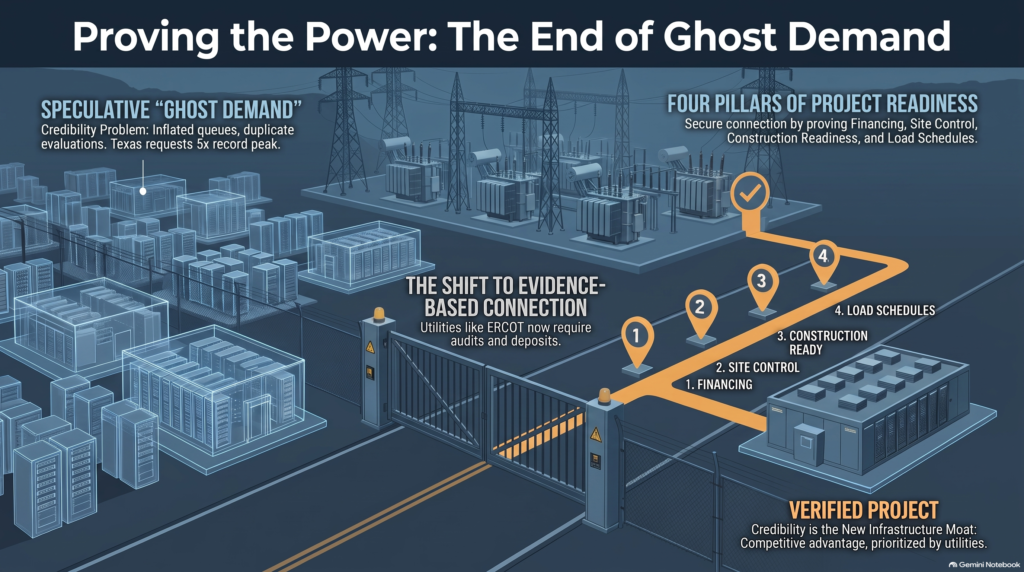
At the time of the directive, ERCOT was considering more than 474 gigawatts of electricity requests—more than five times the grid’s record peak demand. Approximately 90% of those new requests were tied to data centers. The audit seeks information about project ownership, projected power consumption, on-site generation, financial assistance, water demand and community impact. The official directive is available here.
Those figures do not mean Texas will actually add 474 gigawatts of new load.
They mean ERCOT received requests representing that amount.
The distinction is critical.
One project can appear as several electricity requests
A company planning a data center may evaluate multiple potential locations before making a final investment decision. Each proposed location can enter a utility’s planning process even if the company ultimately intends to develop only one.
Other applicants may be attempting to reserve a valuable grid position before securing financing, land, permits, customers or a complete construction plan.
These requests are not necessarily fraudulent. Some are part of reasonable site-selection and development activity.
However, when utilities aggregate them as though every project will be built, exploratory demand begins to resemble committed demand.
That makes the queue unreliable as a forecast.
A Reuters review found that large electricity requests across parts of the Midwest, Mid-Atlantic and South exceeded 700 gigawatts—more than ten times estimated current U.S. data-center electricity use. The reporting also found no common standard for how utilities count and disclose proposed demand. Some include only projects with signed agreements, while others count preliminary inquiries without firm commitments. Reuters described the resulting uncertainty as “ghost demand.”
The AI power queue therefore has both a capacity problem and a data-quality problem.
Utilities are being asked to make irreversible decisions using uncertain demand
Electric infrastructure cannot be scaled like cloud software.
Transmission lines, substations and generation facilities can require years of permitting, construction and capital deployment. Utilities must begin planning well before the associated demand appears.
If planners discount too much of the queue, legitimate projects may arrive before sufficient capacity is available. Reliability can deteriorate, interconnection delays can lengthen and regions may lose economically viable development.
If planners treat every request as certain, they may build expensive infrastructure for facilities that never materialize. Those stranded costs can eventually affect households and existing businesses.
The choice is not simply whether to build more power infrastructure.
It is whether the evidence supporting each projected load is strong enough to justify when, where and how much infrastructure should be built.
The queue is becoming a verification system
Historically, obtaining a position in an interconnection queue could be treated primarily as a procedural step.
That model becomes unstable when speculative applications overwhelm the planning signal.
A more defensible system would separate early interest from commercially executable demand. Projects seeking priority access to scarce grid capacity may therefore need to produce stronger evidence, including:
Financial readiness
A credible project should be able to demonstrate committed capital, credit support or enforceable financing milestones.
Deposits and study fees create financial consequences for occupying limited planning capacity without progressing. The Texas Batch Zero process reportedly required many projects to post security of $50,000 per megawatt, meaning some applicants committed tens of millions of dollars merely to enter the process. Reuters reported that proposed rule changes could make a larger portion of these deposits nonrefundable.
Money alone does not prove a facility will be completed, but it makes casual queue speculation more expensive.
Site control
Developers may need to demonstrate ownership, a binding lease, purchase options or another enforceable right to develop the proposed property.
Without site control, a large load request may represent little more than an attractive possibility.
Construction readiness
Permits, engineering plans, equipment orders and contractor commitments provide evidence that a project has progressed beyond an announcement.
Utilities may also evaluate whether the proposed commercial-operation date is consistent with the actual construction schedule.
Credible load schedules
A data center rarely reaches its full electricity demand on the first day of operation.
Developers should be able to present staged, time-bound load projections tied to buildings, equipment installations and customer commitments. A defensible schedule might specify when the first 100 megawatts will become operational, what triggers the next expansion and how demand changes if construction is delayed.
A single maximum-load figure is far less useful than an evidence-supported ramp.
Ownership and customer transparency
Regulators and utilities need to know who controls a project and whether the proposed facility has an identifiable end user.
Complex affiliate structures can obscure whether several applications represent separate developments or multiple versions of the same underlying project.
Operational flexibility
Projects that can provide on-site generation, storage or controlled load reduction may impose less risk on the grid than facilities requiring uninterrupted firm service at maximum capacity.
Flexibility will not eliminate the need for infrastructure, but it may affect how projects are evaluated and prioritized.
Credibility may become the next AI infrastructure moat
The immediate assumption might be that stricter screening will slow every project equally.
It probably will not.
Screening is more likely to separate credible projects from immature ones.
Developers with verified capital, controlled sites, transparent ownership and realistic construction schedules may gain an advantage because utilities can incorporate their demand into planning with greater confidence.
This creates a new form of infrastructure competition.
The scarce asset is not merely electricity. It is credible access to future electricity.
A queue position supported by verifiable evidence may become more valuable than a larger request backed only by projections.
Executives planning AI infrastructure should therefore ask:
- Is the stated load associated with an approved and financed project?
- Does the organization control the proposed site?
- Are construction dates tied to documented milestones?
- Does the load forecast distinguish initial demand from later expansion?
- Can ownership, customers and counterparties be verified?
- Has the organization accounted for deposits, transmission upgrades and delay risk?
- Can the facility reduce its grid dependence during constrained periods?
These are no longer administrative details. They affect whether an infrastructure plan can survive regulatory, financial and operational scrutiny.
The lesson extends beyond Texas
Texas is the clearest current example, but the underlying problem is national.
Utilities throughout the country are trying to determine whether enormous AI-related electricity requests represent an approaching physical load or a collection of overlapping development scenarios.
Financial requirements are already changing the answer. Reuters reported that Exelon reduced its estimate of high-probability data-center demand by about 40% after introducing stricter collateral requirements. AEP Ohio’s pipeline fell by more than half after new rules introduced study fees and other requirements.
That does not prove the remaining demand is easy to serve. Even after weak or duplicated requests are removed, credible AI demand can still exceed available generation and transmission capacity.
Filtering the queue does not manufacture electricity.
It produces a more trustworthy basis for deciding where infrastructure should be built.
From declared demand to observed readiness
The broader lesson is familiar across AI governance:
A declaration is not evidence.
Organizations routinely declare that controls exist, projects are ready or demand is imminent. Effective governance tests those claims against observable conditions.
The same principle is now reaching the power grid.
A developer may declare a need for one gigawatt. Grid planners increasingly need evidence showing the financing, site, customers, construction milestones and operating schedule behind that request.
Texas’s pause is therefore more than a reaction to data-center growth.
It signals a shift from accepting projected demand at face value to verifying whether that demand is executable.
The next phase of the AI infrastructure race will not be won by whoever submits the largest power request.
It will be won by organizations able to prove that their projects are real, ready and financially capable of reaching energization.
Before the grid can allocate capacity, it must be able to trust the queue.
Leave a Reply