Category: AIinBusiness

  • A $1.5 Billion AI Drug Deal Shows the Difference Between Price and Potential Value

    AstraZeneca’s October 15 collaboration with insitro offers a useful look at how a buyer and a specialist partner can divide payment across the life of a high-risk project.

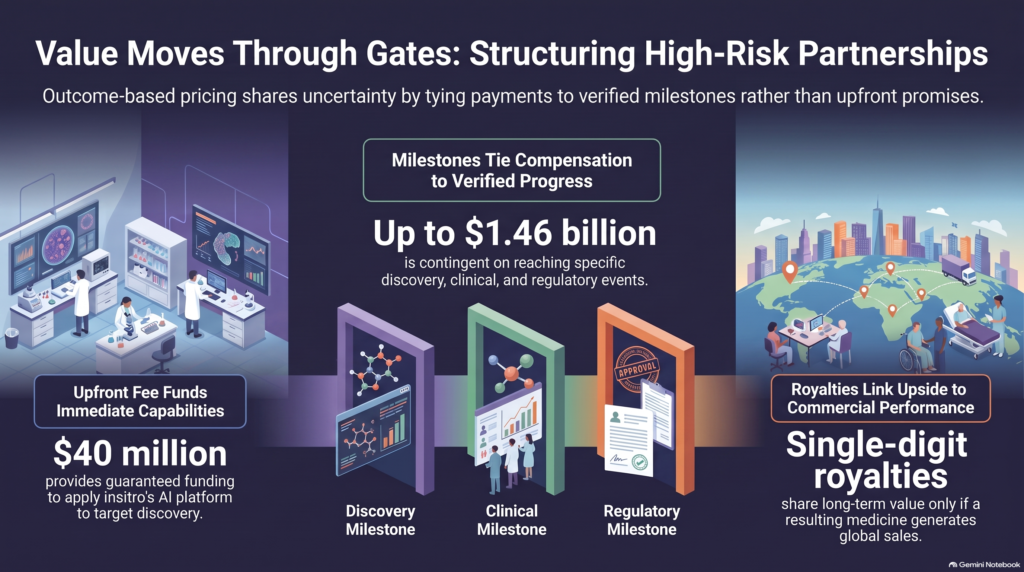
    The announced terms include a $40 million upfront payment, eligibility for up to approximately $1.46 billion in potential discovery, development, and commercial milestone payments, and potential single-digit royalties based on global sales. AstraZeneca will have exclusive worldwide rights to advance selected programs identified through the collaboration. The milestone amount is contingent, and royalties depend on products reaching the market and generating sales. The headline value should not be read as guaranteed revenue for insitro. (astrazeneca.com)

    Three layers of compensation

    The agreement combines three types of payment, each attached to a different point in the work and risk.

    1. Upfront compensation funds the work

    The $40 million upfront payment gives the collaboration immediate economic value. It recognizes the capabilities and work brought into the partnership while providing funding before the long path from discovery to commercial sales is known.

    In this case, insitro applies its Virtual Human platform to identify causal disease biology and advance AstraZeneca-nominated targets from discovery toward development candidates. AstraZeneca leads clinical development, regulatory work, and commercialization. (insitro.com)

    That division matters. The upfront amount is not merely an hourly fee. It sits within an agreement covering specialized capabilities, research activity, and rights to pursue selected programs.

    2. Milestones tie payment to defined progress

    The potential milestone payments connect additional compensation to future discovery, development, and commercial achievements. In principle, a milestone makes payment depend on an agreed event rather than time spent.

    But a milestone is only useful if the parties define it clearly. The contract needs to say what qualifies, who verifies it, what evidence is required, when payment is due, and what happens if the project changes direction. Otherwise, “pay for progress” can turn into a dispute over what progress means.

    Milestones also create a way to share risk. The specialist partner may earn more if programs advance, while the buyer avoids paying the entire potential value before results are known. The partner, in turn, accepts that some of the potential compensation may never be earned.

    3. Royalties connect compensation to commercial performance

    Potential royalties add a longer-term layer: if a resulting medicine is commercialized and produces sales, insitro may receive a share. That is different from a payment for completing a research task. It ties future compensation to commercial performance.

    Royalties also carry more uncertainty. A program must survive scientific, clinical, regulatory, and commercial hurdles before sales exist. The deal therefore places some potential upside far into the future, where outcomes are uncertain and the value of future payments differs from cash received today.

    The value is in the partnership, not just the AI

    It would be easy to describe this as a company licensing AI and another company paying for it. That misses the broader arrangement.

    The announced collaboration combines insitro’s AI-enabled biological discovery work with AstraZeneca’s clinical development, regulatory, and commercialization capabilities. It also grants AstraZeneca exclusive worldwide rights to advance selected programs. The commercial structure reflects an exchange of capabilities, work, rights, and risk—not simply access to a model. (astrazeneca.com)

    That distinction is important for businesses selling AI-enabled expertise. Buyers rarely pay a premium just because AI was used. They pay when the work helps solve a consequential problem, produces evidence they can evaluate, and fits into a process that can turn the work into business value.

    What entrepreneurs can take from the deal

    Most consulting firms should not copy a pharmaceutical deal’s royalties or long development timeline. The transferable idea is to build a pricing structure that matches compensation to the work and the outcome.

    A business could combine:

    • A base fee for discovery, setup, access, or reserved capacity.
    • Milestone payments for defined and accepted outputs, such as a validated workflow, completed implementation, or measurable quality threshold.
    • A success fee or revenue share when the result can be measured and the provider’s contribution is clear.

    This structure should also protect both sides. Define the baseline, measurement method, data source, acceptance criteria, payment trigger, time period, and responsibilities. Address what happens when the client changes scope, delays implementation, or controls an important part of the result. Keep guaranteed compensation sufficient to fund the work, especially when results depend on external factors.

    Outcome-based pricing is not “charge more if the client gets lucky.” It is a deliberate agreement about what value means, what evidence will prove it, and how the parties will share uncertainty.

    The AstraZeneca–insitro deal makes that structure visible: some compensation is paid upfront, more may follow verified milestones, and additional upside may depend on commercial success. The headline amount captures the maximum potential under the agreement. The actual economics depend on what gets achieved.

    Entrepreneur question: Which part of your expertise could be priced around verified progress or results instead of hours alone?
  • AI Infrastructure Is Entering Its Project-Finance Era

    AI Infrastructure Is Entering Its Project-Finance Era

    For much of the AI boom, attention has centered on company valuations, model capabilities and venture-capital investments.

    That view is becoming incomplete.

    The next phase of AI expansion requires physical infrastructure at enormous scale: processors, data centers, substations, transmission capacity, cooling systems and long-term access to electricity. Building that infrastructure requires more capital than even the largest technology companies may want to carry directly on their balance sheets.

    That is why one of the most important AI developments of the week came from the financing side of the market.

    On September 16, Reuters reported that a consortium of ten banks—including Goldman Sachs, Barclays, BNP Paribas, Sumitomo Mitsui Banking Corporation and Bank of Nova Scotia—was providing approximately $22 billion in financing for Crux AI, a cloud-computing venture backed by Blackstone and Alphabet.

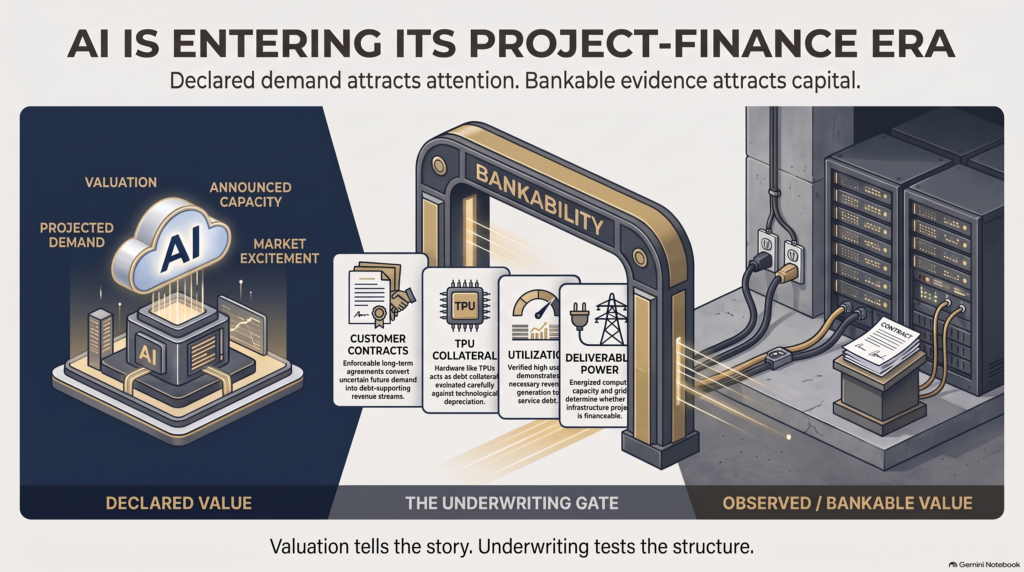
    Blackstone had already committed an initial $5 billion in equity. Google is contributing its Tensor Processing Units, along with software and services. The debt is expected to be secured by the TPUs and customer contracts, while the venture is targeting its first 500 megawatts of computing capacity in 2027. The banks may eventually refinance portions of the loan through the bond market. (reuters.com, reuters.com)

    Those details deserve more attention than the headline dollar amount.

    The capital stack is becoming part of the AI story

    This transaction suggests that AI infrastructure is beginning to acquire characteristics commonly associated with project finance.

    In traditional project finance, lenders do not rely solely on the reputation or market valuation of a corporate sponsor. They examine the project’s assets, contracts, construction milestones and expected cash flows.

    The fundamental question is straightforward:

    Can this specific group of assets produce enough reliable revenue to repay the financing used to build it?

    That question is now being applied to AI compute.

    The collateral is no longer merely an ownership stake in a promising technology company. It can include physical processors and contractual claims on future customer payments.

    That represents a significant evolution in how capital is moving through the AI sector.

    Money is moving beyond funding companies that develop AI. It is increasingly financing the industrial system required to operate AI at scale.

    Contracts are becoming infrastructure

    A processor has technical value, but a processor connected to power and committed to a creditworthy customer has financial value.

    That distinction explains why customer contracts matter so much to these financing structures.

    A long-term contract can transform uncertain future demand into a more predictable stream of revenue. That stream may then support debt financing, which allows the infrastructure provider to purchase more equipment and build additional capacity.

    The contract effectively becomes part of the infrastructure.

    But not all contracted demand is equally bankable. Lenders will examine the duration of the agreement, the customer’s ability to pay, cancellation provisions, minimum-use commitments and the consequences of delayed delivery.

    A large announced customer pipeline may attract attention.

    A durable contract with enforceable payment obligations can attract capital.

    Utilization is no longer merely an operating metric

    When infrastructure is financed with debt, utilization becomes directly connected to debt service.

    A data center can be completed. The processors can be installed. Power can be available. But if customers do not use the contracted capacity—or if the contracts allow them to walk away—the economic model can still fail.

    This creates an important separation between four different claims:

    1. Announced computing capacity
    2. Constructed computing capacity
    3. Energized computing capacity
    4. Revenue-producing computing capacity

    Those categories are not interchangeable.

    The AI sector has spent considerable time discussing how much capacity companies intend to build. Financing markets will increasingly ask how much of that capacity can be delivered, utilized and converted into dependable cash flow.

    This is another version of the declared-versus-observed problem.

    Declared demand may justify an announcement.

    Observed utilization must eventually justify the financing.

    AI chips are unusual collateral

    The inclusion of TPUs as collateral is particularly revealing.

    Processors are physical assets, but they do not behave like conventional infrastructure assets. A transmission line, pipeline or toll road may remain economically productive for decades. Advanced AI processors can face much faster technological and economic depreciation.

    A chip may continue functioning while becoming less competitive against a newer generation with better performance, lower energy consumption or a more attractive cost per unit of compute.

    That creates several underwriting questions:

    • How quickly will the equipment lose economic value?
    • Can the processors support multiple customers and workloads?
    • How dependent is the platform on one chip architecture?
    • What happens to the loan if utilization declines before the debt matures?
    • How much value could lenders recover from the hardware in a downside scenario?

    The equipment may be tangible, but its future value remains tied to technological relevance.

    Power readiness becomes a financial condition

    The planned 500 megawatts also connect this transaction to the broader infrastructure constraints surrounding AI.

    A processor cannot generate revenue while waiting for electricity.

    That means lenders financing AI infrastructure must look beyond chips and customer contracts. They also need confidence in land control, interconnection agreements, permits, construction schedules, cooling capacity and the delivery of dependable power.

    An announced 500-megawatt project is not automatically a financeable 500-megawatt project.

    The difference lies in whether the capacity can be built, energized and made available when customers expect it.

    Grid readiness is therefore becoming more than an engineering concern. It is becoming a credit concern.

    Follow what the financing requires

    Entrepreneurs and executives trying to understand AI economics should pay attention to more than valuations and funding announcements.

    The more useful questions may now be:

    • What assets secure the financing?
    • Which contracts support the projected revenue?
    • How concentrated is the customer base?
    • What utilization level is required to service the debt?
    • Who carries the risk of construction delays?
    • Who absorbs the loss if the equipment depreciates faster than expected?
    • Is the power capacity announced, contracted or actually deliverable?
    • Will the debt remain with the banks or be distributed through the bond market?

    These questions reveal what sophisticated capital providers believe can withstand scrutiny—and where they still require protection.

    That does not mean every heavily financed AI project will succeed. It means the AI boom is entering a stage where enthusiasm must increasingly be translated into assets, contracts, milestones and cash flows.

    Valuations show what the market hopes an AI company might become.

    Financing structures show what lenders are willing to treat as bankable.

    As AI infrastructure grows more capital-intensive, that may become one of the clearest ways to distinguish the sector’s declared promise from its observed economic foundation.

  • The AI Power Queue Has a Credibility Problem

    The race to build artificial-intelligence infrastructure is usually described in terms of capital, chips and computing capacity.

    Yet every AI data center ultimately depends on a more physical constraint: electricity.

    That dependence has triggered a wave of large-load requests across the United States. Developers are reserving potential sites, exploring multiple utility territories and attempting to secure access to power years before facilities become operational.

    The resulting interconnection queues appear to show extraordinary demand.

    But they also create a difficult planning question:

    How much of that demand is credible enough to build around?

    Texas has brought that question into the open.

    Why Texas paused the process

    On August 3, 2026, Texas Governor Greg Abbott directed the Public Utility Commission of Texas and the Electric Reliability Council of Texas to conduct a comprehensive audit of data centers advancing through ERCOT’s interconnection process.

    Projects must complete the audit before advancing, and noncompliant projects may be denied connection.

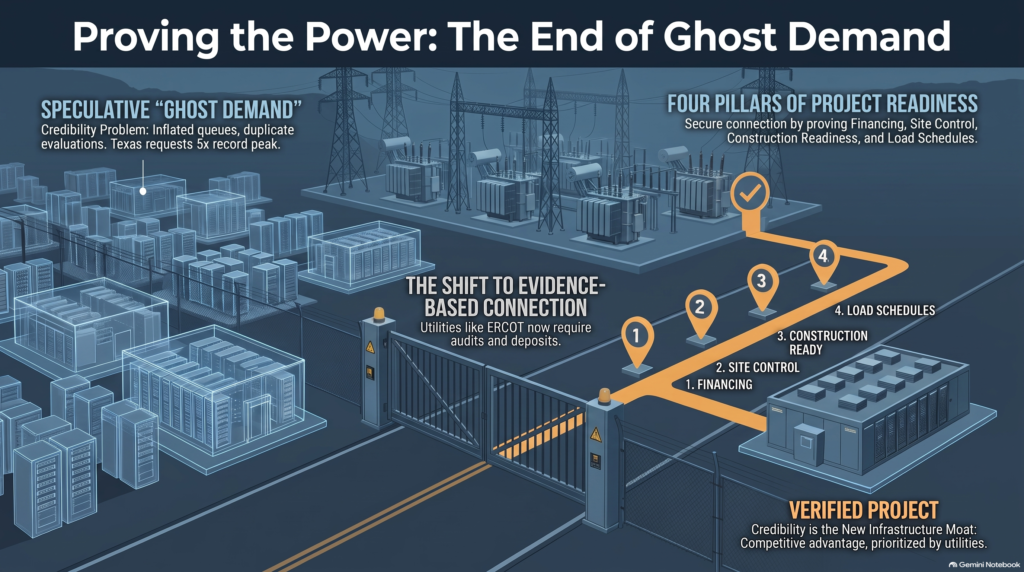
    At the time of the directive, ERCOT was considering more than 474 gigawatts of electricity requests—more than five times the grid’s record peak demand. Approximately 90% of those new requests were tied to data centers. The audit seeks information about project ownership, projected power consumption, on-site generation, financial assistance, water demand and community impact. The official directive is available here.

    Those figures do not mean Texas will actually add 474 gigawatts of new load.

    They mean ERCOT received requests representing that amount.

    The distinction is critical.

    One project can appear as several electricity requests

    A company planning a data center may evaluate multiple potential locations before making a final investment decision. Each proposed location can enter a utility’s planning process even if the company ultimately intends to develop only one.

    Other applicants may be attempting to reserve a valuable grid position before securing financing, land, permits, customers or a complete construction plan.

    These requests are not necessarily fraudulent. Some are part of reasonable site-selection and development activity.

    However, when utilities aggregate them as though every project will be built, exploratory demand begins to resemble committed demand.

    That makes the queue unreliable as a forecast.

    A Reuters review found that large electricity requests across parts of the Midwest, Mid-Atlantic and South exceeded 700 gigawatts—more than ten times estimated current U.S. data-center electricity use. The reporting also found no common standard for how utilities count and disclose proposed demand. Some include only projects with signed agreements, while others count preliminary inquiries without firm commitments. Reuters described the resulting uncertainty as “ghost demand.”

    The AI power queue therefore has both a capacity problem and a data-quality problem.

    Utilities are being asked to make irreversible decisions using uncertain demand

    Electric infrastructure cannot be scaled like cloud software.

    Transmission lines, substations and generation facilities can require years of permitting, construction and capital deployment. Utilities must begin planning well before the associated demand appears.

    If planners discount too much of the queue, legitimate projects may arrive before sufficient capacity is available. Reliability can deteriorate, interconnection delays can lengthen and regions may lose economically viable development.

    If planners treat every request as certain, they may build expensive infrastructure for facilities that never materialize. Those stranded costs can eventually affect households and existing businesses.

    The choice is not simply whether to build more power infrastructure.

    It is whether the evidence supporting each projected load is strong enough to justify when, where and how much infrastructure should be built.

    The queue is becoming a verification system

    Historically, obtaining a position in an interconnection queue could be treated primarily as a procedural step.

    That model becomes unstable when speculative applications overwhelm the planning signal.

    A more defensible system would separate early interest from commercially executable demand. Projects seeking priority access to scarce grid capacity may therefore need to produce stronger evidence, including:

    Financial readiness

    A credible project should be able to demonstrate committed capital, credit support or enforceable financing milestones.

    Deposits and study fees create financial consequences for occupying limited planning capacity without progressing. The Texas Batch Zero process reportedly required many projects to post security of $50,000 per megawatt, meaning some applicants committed tens of millions of dollars merely to enter the process. Reuters reported that proposed rule changes could make a larger portion of these deposits nonrefundable.

    Money alone does not prove a facility will be completed, but it makes casual queue speculation more expensive.

    Site control

    Developers may need to demonstrate ownership, a binding lease, purchase options or another enforceable right to develop the proposed property.

    Without site control, a large load request may represent little more than an attractive possibility.

    Construction readiness

    Permits, engineering plans, equipment orders and contractor commitments provide evidence that a project has progressed beyond an announcement.

    Utilities may also evaluate whether the proposed commercial-operation date is consistent with the actual construction schedule.

    Credible load schedules

    A data center rarely reaches its full electricity demand on the first day of operation.

    Developers should be able to present staged, time-bound load projections tied to buildings, equipment installations and customer commitments. A defensible schedule might specify when the first 100 megawatts will become operational, what triggers the next expansion and how demand changes if construction is delayed.

    A single maximum-load figure is far less useful than an evidence-supported ramp.

    Ownership and customer transparency

    Regulators and utilities need to know who controls a project and whether the proposed facility has an identifiable end user.

    Complex affiliate structures can obscure whether several applications represent separate developments or multiple versions of the same underlying project.

    Operational flexibility

    Projects that can provide on-site generation, storage or controlled load reduction may impose less risk on the grid than facilities requiring uninterrupted firm service at maximum capacity.

    Flexibility will not eliminate the need for infrastructure, but it may affect how projects are evaluated and prioritized.

    Credibility may become the next AI infrastructure moat

    The immediate assumption might be that stricter screening will slow every project equally.

    It probably will not.

    Screening is more likely to separate credible projects from immature ones.

    Developers with verified capital, controlled sites, transparent ownership and realistic construction schedules may gain an advantage because utilities can incorporate their demand into planning with greater confidence.

    This creates a new form of infrastructure competition.

    The scarce asset is not merely electricity. It is credible access to future electricity.

    A queue position supported by verifiable evidence may become more valuable than a larger request backed only by projections.

    Executives planning AI infrastructure should therefore ask:

    • Is the stated load associated with an approved and financed project?
    • Does the organization control the proposed site?
    • Are construction dates tied to documented milestones?
    • Does the load forecast distinguish initial demand from later expansion?
    • Can ownership, customers and counterparties be verified?
    • Has the organization accounted for deposits, transmission upgrades and delay risk?
    • Can the facility reduce its grid dependence during constrained periods?

    These are no longer administrative details. They affect whether an infrastructure plan can survive regulatory, financial and operational scrutiny.

    The lesson extends beyond Texas

    Texas is the clearest current example, but the underlying problem is national.

    Utilities throughout the country are trying to determine whether enormous AI-related electricity requests represent an approaching physical load or a collection of overlapping development scenarios.

    Financial requirements are already changing the answer. Reuters reported that Exelon reduced its estimate of high-probability data-center demand by about 40% after introducing stricter collateral requirements. AEP Ohio’s pipeline fell by more than half after new rules introduced study fees and other requirements.

    That does not prove the remaining demand is easy to serve. Even after weak or duplicated requests are removed, credible AI demand can still exceed available generation and transmission capacity.

    Filtering the queue does not manufacture electricity.

    It produces a more trustworthy basis for deciding where infrastructure should be built.

    From declared demand to observed readiness

    The broader lesson is familiar across AI governance:

    A declaration is not evidence.

    Organizations routinely declare that controls exist, projects are ready or demand is imminent. Effective governance tests those claims against observable conditions.

    The same principle is now reaching the power grid.

    A developer may declare a need for one gigawatt. Grid planners increasingly need evidence showing the financing, site, customers, construction milestones and operating schedule behind that request.

    Texas’s pause is therefore more than a reaction to data-center growth.

    It signals a shift from accepting projected demand at face value to verifying whether that demand is executable.

    The next phase of the AI infrastructure race will not be won by whoever submits the largest power request.

    It will be won by organizations able to prove that their projects are real, ready and financially capable of reaching energization.

    Before the grid can allocate capacity, it must be able to trust the queue.

  • The New AI Moat May Be Energization Rights

    Much of the discussion surrounding AI infrastructure still concentrates on chips, capital and real estate.

    Those inputs matter, but they do not guarantee that a data center can operate.

    A facility can have land, permits, financing and thousands of GPUs on order. Without sufficient electricity—and a credible date for receiving it—the project remains planned capacity rather than usable compute.

    That distinction is becoming strategically important as data-center developers compete for limited positions in electricity-connection queues.

    When proposed demand creates real congestion

    Britain provides a useful example.

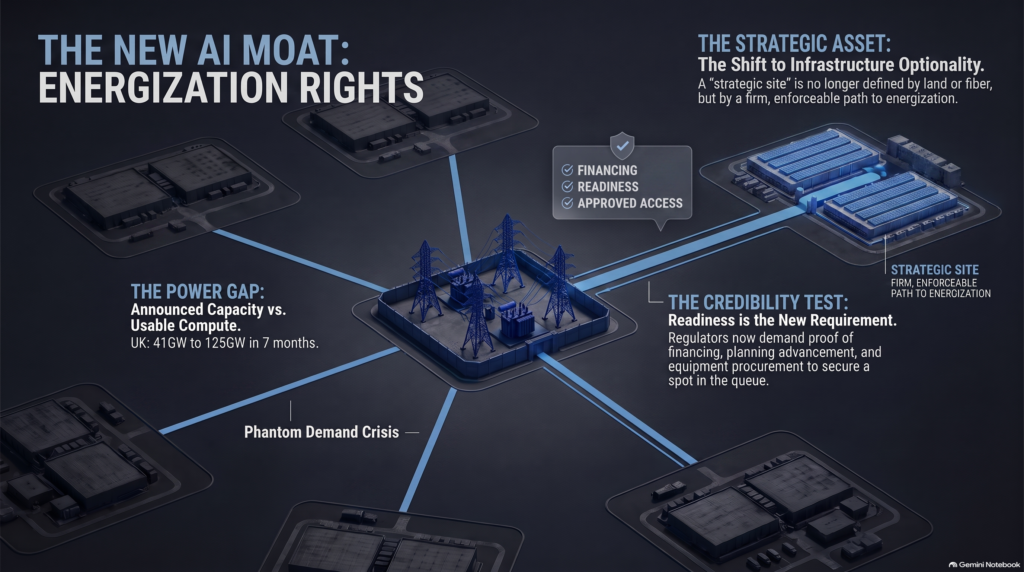
    According to Ofgem, demand-connection applications increased from 41 gigawatts in November 2024 to 125 gigawatts by June 2025. Data centers represented at least 80 gigawatts of that demand.

    For perspective, the application queue does not mean all that capacity will be built or consumed. That is precisely the problem.

    Some applications come from viable projects with secured land, committed capital, identifiable customers and realistic construction schedules. Others may represent duplicate, premature or speculative attempts to reserve capacity.

    Yet each application enters a planning system that must determine where and when electricity infrastructure will be needed.

    Consequently, phantom demand can produce real effects.

    It can occupy positions in the connection queue, complicate load forecasts and delay projects that are genuinely prepared to proceed. A proposed data center does not have to reach construction to contribute to congestion. Its claim on future capacity may be enough.

    Making developers prove readiness

    Ofgem has proposed introducing commitment fees and additional project-progress milestones for data-center connections.

    The principle is straightforward: reserving scarce grid capacity should require more than submitting an ambitious projection.

    Developers may need to place capital at risk and demonstrate continued progress through evidence such as financing, customer commitments, planning advancement or procurement of long-lead equipment. Projects that stall or withdraw could lose their queue position and, depending on the final rules, forfeit some or all of their financial commitment.

    This would convert grid access from a largely administrative reservation into a test of project credibility.

    The market signal is difficult to miss.

    Future electricity access is becoming valuable enough that regulators must discourage organizations from reserving it speculatively.

    Land is only part of the infrastructure stack

    For years, favorable data-center locations were evaluated through familiar factors:

    • Available land
    • Fiber connectivity
    • Tax incentives
    • Environmental conditions
    • Proximity to customers
    • Construction costs

    Grid access can no longer sit quietly near the bottom of that list.

    A parcel of land located near transmission infrastructure is not necessarily an energizable site. Physical proximity does not guarantee available capacity, a completed interconnection study, required network upgrades or an acceptable connection date.

    The more useful question is no longer simply, “Where can the facility be built?”

    It is, “Where can the facility be powered, at the required scale, within the required timeframe?”

    That changes the meaning of a strategic site.

    The true asset may be the combination of land, permits, transmission capacity and enforceable progress toward energization.

    An emerging form of infrastructure optionality

    A credible grid position gives a developer something close to infrastructure optionality.

    It can influence site value, project financing, construction sequencing and the ability to secure customers. Hyperscalers and investors evaluating competing projects will increasingly need to distinguish between advertised capacity and capacity with a defensible path to power.

    That creates a new diligence requirement.

    Executives should ask:

    • Is the project merely in a connection queue, or does it have a firm connection agreement?
    • What network upgrades must occur before energization?
    • Who is responsible for financing those upgrades?
    • Which milestones must the project satisfy to retain its position?
    • Is the stated connection date conditional?
    • Does the developer control the land and possess the permits required to proceed?
    • Is the electricity supply firm, flexible or dependent on curtailment?
    • What evidence supports the announced megawatt figure?

    These are not secondary engineering questions. They affect valuation, delivery risk and the credibility of the entire AI-capacity claim.

    Announced megawatts are not operating megawatts

    The AI infrastructure market is producing enormous numbers: billions in capital commitments, gigawatts of proposed demand and campuses containing hundreds of thousands of accelerators.

    Those figures can create an illusion of inevitability.

    But a proposed megawatt is not an energized megawatt.

    Likewise, a grid application is not proof of a viable project. It may represent serious development activity, but it may also represent an attempt to preserve a future option.

    This is why regulators are beginning to demand stronger evidence of readiness.

    Grid queues cannot function effectively when an unverified claim receives the same treatment as a financeable, permitted and construction-ready project. When capacity is scarce, credibility must become part of the allocation mechanism.

    The strategic implication

    The AI infrastructure contest is shifting.

    Companies will still compete for chips, technical talent and capital. Increasingly, however, they will also compete for substations, transmission capacity, generation agreements and credible energization dates.

    That means the new moat may not be electricity ownership in the literal sense.

    It may be something more practical: a defensible right to receive electricity at the necessary location, scale and time.

    GPUs can be purchased. Buildings can be constructed. Capital can be raised.

    But when the grid is constrained, credible access to future electricity becomes difficult to replicate.

    The most valuable AI facility may not be the one with the largest announcement.

    It may be the one that can actually be turned on.

  • AI Is Starting to Change How Professional Services Get Paid

    The Shift from Billable Hours to Outcome Economics

    For years, one of the simplest equations in professional services has been:

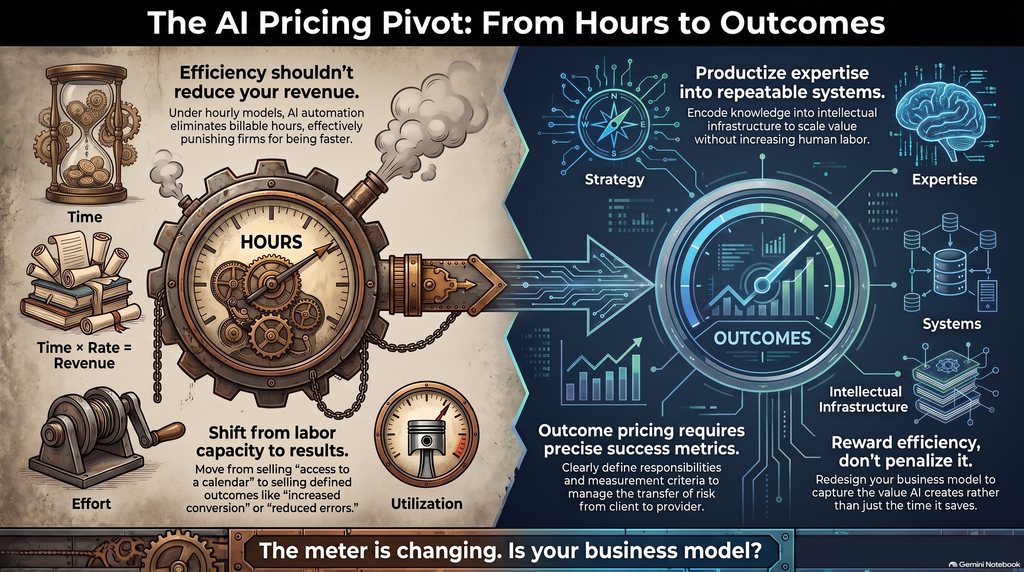
    Time × Rate = Revenue.

    Consultants bill hours. Agencies bill retainers based partly on labor requirements. Technology firms price projects around teams, utilization and delivery time.

    Artificial intelligence is beginning to challenge that equation.

    The reason is straightforward: AI can reduce the amount of human labor required to produce certain outcomes.

    That sounds like an obvious productivity win.

    Economically, however, it creates a much more interesting problem.

    What Happens When Efficiency Reduces Your Revenue?

    Imagine a professional-service firm that traditionally requires 20 hours to complete a particular engagement.

    Through automation, AI-assisted analysis and better internal systems, the same firm eventually produces an equivalent—or better—result in eight hours.

    Operationally, that’s a major improvement.

    Under a traditional hourly pricing model, however, the firm just eliminated 12 billable hours.

    The business became more productive while potentially making less money.

    That tension becomes increasingly difficult to ignore as AI capabilities improve.

    If professional-service firms continue selling primarily the amount of human effort required to produce something, AI may steadily compress the economic value of that effort.

    Clients will eventually ask an obvious question:

    If AI allows you to complete this faster, why am I still paying for the old amount of labor?

    We’re already beginning to see that conversation emerge.

    From Labor Arbitrage to Outcome Economics

    Recent changes within India’s enormous IT-services industry offer an early example.

    AI-assisted development and automation are allowing firms to accomplish more work with fewer traditional labor inputs. At the same time, clients are demanding greater productivity and increasingly structuring contracts around measurable business outcomes.

    That represents more than a pricing adjustment.

    It potentially changes the underlying unit of value.

    Under the traditional model, a provider could effectively sell access to labor capacity.

    Under an outcome-oriented model, the client is purchasing something closer to a defined result.

    Reduce operating costs.

    Improve processing speed.

    Deploy a functioning system.

    Reduce errors.

    Increase conversion.

    Achieve a specified operational improvement.

    The number of hours required to produce that result becomes less important.

    And suddenly efficiency stops being the enemy of the provider’s revenue model.

    AI Could Make Productized Expertise More Valuable

    This is where the opportunity becomes interesting for smaller professional-service firms and entrepreneurs.

    The more efficiently knowledge can be converted into repeatable processes, the more valuable it may become to package expertise into systems rather than continually reselling individual units of labor.

    A consultant with a repeatable diagnostic methodology isn’t simply selling time.

    An agency with a standardized acquisition system isn’t simply selling employee hours.

    A specialist with proprietary analysis, workflows and decision frameworks isn’t simply selling access to their calendar.

    They are increasingly selling intellectual infrastructure capable of producing an outcome.

    AI can potentially increase the leverage of that infrastructure.

    Instead of asking:

    How many additional clients can I personally serve?

    the better question becomes:

    How much of my expertise can be encoded into a repeatable system without degrading the quality of the outcome?

    That is a fundamentally different way to think about scaling professional expertise.

    But Outcome Pricing Transfers Risk

    There is an important caveat.

    Moving away from billable hours does not magically eliminate business risk.

    It changes who carries it.

    When firms price engagements around outcomes, they need to understand exactly which outcomes they can control.

    A consultant cannot guarantee revenue growth if the client fails to execute.

    A cybersecurity provider cannot guarantee that an organization will never experience an incident.

    An AI governance adviser cannot responsibly guarantee that a model will never fail.

    Good outcome-based pricing therefore requires something that professional-service firms sometimes avoid:

    precise definitions of responsibility, evidence and success.

    What outcome are we actually producing?

    How will it be measured?

    What assumptions must remain true?

    Which responsibilities belong to the provider?

    Which belong to the client?

    What happens when conditions change?

    Those aren’t merely contractual questions.

    They’re part of the operating model.

    The Bigger Question

    AI is frequently discussed as a technology that will reduce costs, automate jobs or increase productivity.

    But its effects may extend deeper into the economics of knowledge work.

    When expertise becomes increasingly augmented by software, selling the amount of labor required to produce an outcome may become less attractive than selling the outcome itself.

    That doesn’t mean billable hours disappear tomorrow.

    It means businesses built entirely around them may face increasing pressure to explain why greater efficiency shouldn’t result in lower fees.

    For entrepreneurs and professional-service firms, that creates a useful question to consider now:

    Does your pricing model reward you for becoming more efficient—or penalize you for it?

    Because if AI continues compressing the labor required to produce professional outcomes, the businesses that capture the greatest value may not simply be those using the best AI.

    They may be the ones that redesigned their business models around what AI makes possible.