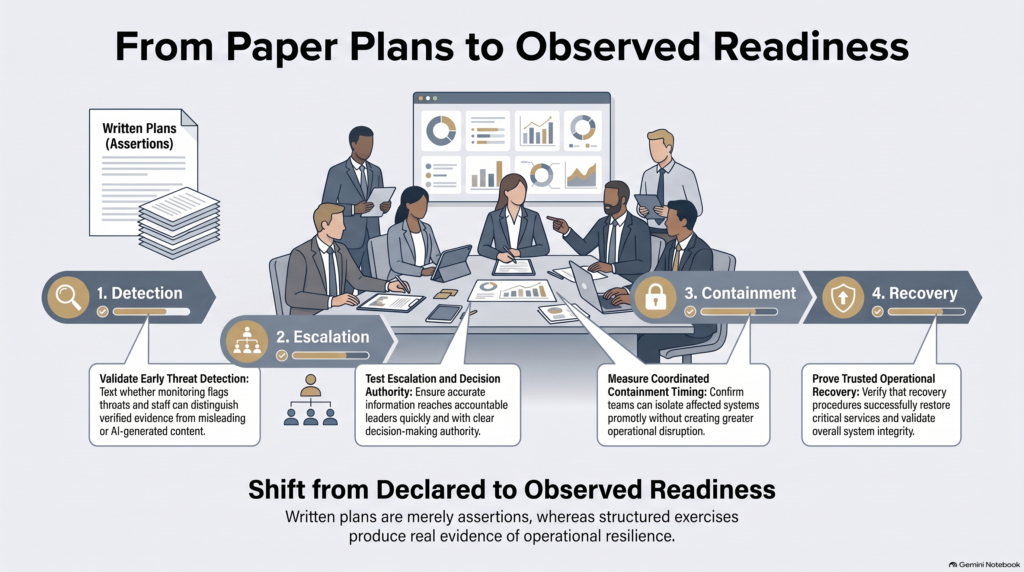
A response plan can look complete on paper and still fail under pressure.
That is why the G7’s agreement to conduct tabletop exercises simulating AI-enabled cyberattacks on the financial sector matters. Finance ministers and central bank governors have backed exercises designed to test existing response procedures. Depending on the scenarios, private financial institutions may also take part. The results are expected to help assess current protocols and identify improvements. (reuters.com)
The announcement does not mean the G7 has already tested those procedures. It does show that the conversation is moving toward operational readiness: asking whether people, processes, and systems can work together during a realistic incident.
A plan is not proof of readiness
A written incident-response plan can describe who should be notified, who has authority to act, and how systems should be restored. But those instructions are only useful if they work in practice.
During a fast-moving cyber incident, teams may need to determine whether an alert is credible, understand which services and third parties are affected, escalate to the right decision-makers, contain the threat, communicate accurately, and restore critical operations. Each step depends on clear ownership, timely information, and decisions that can be made under pressure.
An AI-enabled scenario adds questions that organizations should be prepared to answer. Did monitoring identify the activity? Could staff distinguish verified evidence from misleading or AI-generated content? Were decision-makers given reliable information quickly enough? Could the organization isolate affected systems without creating greater disruption? Did recovery procedures restore trusted operations?
The exercise is valuable because it can expose gaps between the documented process and the organization’s ability to carry it out.
What a useful exercise should reveal
A tabletop exercise should do more than confirm that participants attended and discussed a scenario. It should create evidence about how the response actually unfolded.
For example, an organization can record:
- When the incident was detected and when it was escalated.
- Who made key decisions, what information they had, and whether authority was clear.
- Whether containment actions were timely and coordinated across teams and providers.
- How the organization maintained or restored critical services.
- Which assumptions, dependencies, or communication paths failed.
- What corrective actions were assigned, to whom, and by when.
Those records help distinguish a rehearsed response from a demonstrated capability. They also give leadership a practical way to track whether identified weaknesses are fixed and retested.
The governance question is whether the controls connect
Detection, escalation, containment, and recovery are often described as separate capabilities. In a real incident, they form a chain. A strong detection tool has limited value if the alert reaches no accountable decision-maker. A clear escalation path cannot help if teams lack authority to contain the incident. Recovery plans are difficult to trust if the organization has not tested whether it can restore systems and validate their integrity.
That is where exercises can help leaders see whether controls work together across business units, technical teams, senior management, and external partners. They can also test how participants make decisions when facts are incomplete and the incident is still developing.
The G7 agreement is a meaningful step toward operational testing. The next measure of progress will be what the exercises uncover, what changes follow, and whether those changes are tested again.
For financial institutions, the broader lesson is straightforward: a procedure is an assertion about readiness. A well-designed exercise produces evidence about readiness.
Entrepreneur question: How can your organization show that its AI risk-management procedures work when the situation is uncertain, time-sensitive, and shared across teams?
Leave a Reply