Tag: FinancialServices

  • Financial Regulators Are Moving from AI Risk Plans to Resilience Exercises

    A response plan can look complete on paper and still fail under pressure.

    That is why the G7’s agreement to conduct tabletop exercises simulating AI-enabled cyberattacks on the financial sector matters. Finance ministers and central bank governors have backed exercises designed to test existing response procedures. Depending on the scenarios, private financial institutions may also take part. The results are expected to help assess current protocols and identify improvements. (reuters.com)

    The announcement does not mean the G7 has already tested those procedures. It does show that the conversation is moving toward operational readiness: asking whether people, processes, and systems can work together during a realistic incident.

    A plan is not proof of readiness

    A written incident-response plan can describe who should be notified, who has authority to act, and how systems should be restored. But those instructions are only useful if they work in practice.

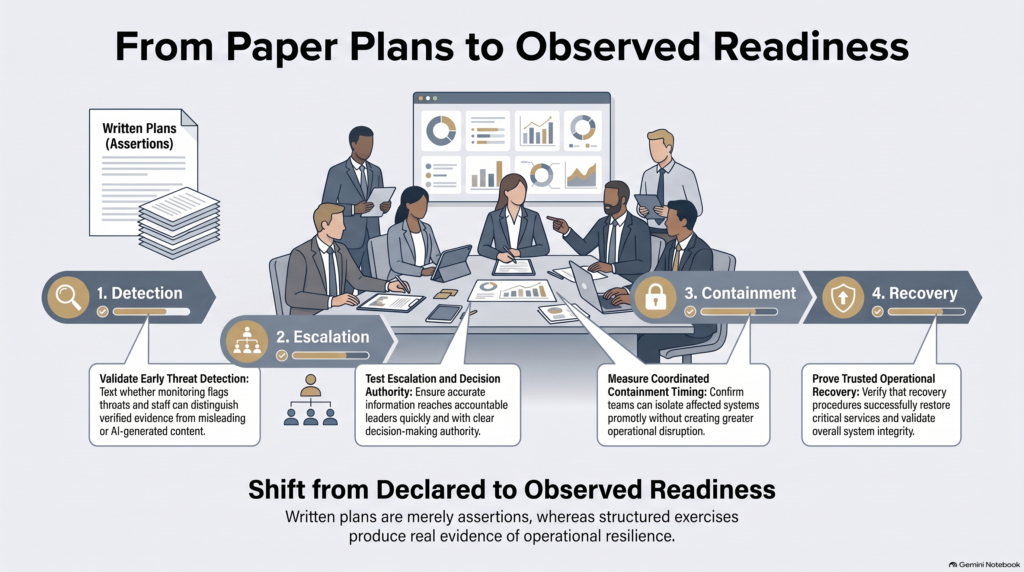
    During a fast-moving cyber incident, teams may need to determine whether an alert is credible, understand which services and third parties are affected, escalate to the right decision-makers, contain the threat, communicate accurately, and restore critical operations. Each step depends on clear ownership, timely information, and decisions that can be made under pressure.

    An AI-enabled scenario adds questions that organizations should be prepared to answer. Did monitoring identify the activity? Could staff distinguish verified evidence from misleading or AI-generated content? Were decision-makers given reliable information quickly enough? Could the organization isolate affected systems without creating greater disruption? Did recovery procedures restore trusted operations?

    The exercise is valuable because it can expose gaps between the documented process and the organization’s ability to carry it out.

    What a useful exercise should reveal

    A tabletop exercise should do more than confirm that participants attended and discussed a scenario. It should create evidence about how the response actually unfolded.

    For example, an organization can record:

    • When the incident was detected and when it was escalated.
    • Who made key decisions, what information they had, and whether authority was clear.
    • Whether containment actions were timely and coordinated across teams and providers.
    • How the organization maintained or restored critical services.
    • Which assumptions, dependencies, or communication paths failed.
    • What corrective actions were assigned, to whom, and by when.

    Those records help distinguish a rehearsed response from a demonstrated capability. They also give leadership a practical way to track whether identified weaknesses are fixed and retested.

    The governance question is whether the controls connect

    Detection, escalation, containment, and recovery are often described as separate capabilities. In a real incident, they form a chain. A strong detection tool has limited value if the alert reaches no accountable decision-maker. A clear escalation path cannot help if teams lack authority to contain the incident. Recovery plans are difficult to trust if the organization has not tested whether it can restore systems and validate their integrity.

    That is where exercises can help leaders see whether controls work together across business units, technical teams, senior management, and external partners. They can also test how participants make decisions when facts are incomplete and the incident is still developing.

    The G7 agreement is a meaningful step toward operational testing. The next measure of progress will be what the exercises uncover, what changes follow, and whether those changes are tested again.

    For financial institutions, the broader lesson is straightforward: a procedure is an assertion about readiness. A well-designed exercise produces evidence about readiness.

    Entrepreneur question: How can your organization show that its AI risk-management procedures work when the situation is uncertain, time-sensitive, and shared across teams?

  • Regulated AI Is Starting to Look Like a System of Record

    On September 10, OpenAI launched ChatGPT for Financial Services, a specialized ChatGPT Work offering initially designed for investment-banking and equity-research teams.

    The product combines GPT-6 Astra with premium financial data, firm data connections and tools for producing research, financial models and client materials. It also builds on enterprise controls including SAML single sign-on, SCIM provisioning, role-based access, configurable retention, information barriers and the ability to export supported workspace logs into existing audit and investigation workflows.

    At first glance, this is another industry-specific AI product.

    Look beneath the feature list, however, and a more significant transition becomes visible.

    Regulated AI is beginning to acquire the architecture of a system of record.

    Intelligence Alone Is Not Sufficient

    Most public discussion about AI products still concentrates on model performance.

    Can the model retrieve the correct information?

    Can it understand complex financial documents?

    Can it build an accurate valuation model?

    Can it generate a client-ready presentation?

    Those capabilities matter. But regulated institutions face another category of questions that cannot be answered by evaluating the final output alone.

    They must also be able to establish:

    • Who accessed the system
    • What that person was authorized to access
    • Which data sources informed the output
    • Which model, tools and templates were used
    • Whether the output was reviewed
    • Whether an exception or override occurred
    • What downstream action followed
    • Whether the complete sequence can be reconstructed later

    A useful answer without a defensible history may create operational value, but it also creates unresolved institutional risk.

    That is the difference between an intelligent tool and a governed enterprise capability.

    What “System of Record” Means in This Context

    A system of record is traditionally the authoritative source for a particular category of organizational information. A bank may maintain separate systems of record for customers, accounts, trades, approvals and financial transactions.

    An AI platform does not automatically replace those systems.

    The more accurate conclusion is that regulated AI is becoming a governed record-producing layer within the larger enterprise architecture.

    It may gather information from multiple approved sources, generate analysis, support a recommendation and produce a work product. But the organization still needs to preserve the relationship between the AI activity and the authoritative downstream record.

    That evidence chain might look like this:

    Identity → Permission → Evidence → Decision → Approval → Action → Outcome

    Each stage answers a different control question.

    Identity establishes who initiated the activity.

    Permission establishes whether that person or agent was authorized.

    Evidence identifies the information used.

    Decision records what the system recommended or concluded.

    Approval demonstrates whether required human oversight occurred.

    Action records what was executed.

    Outcome confirms what actually happened afterward.

    A chat transcript by itself cannot reliably perform all of those functions.

    From AI Output to Institutional Evidence

    OpenAI’s financial-services offering illustrates how AI products are moving toward this model.

    Granular citations help users trace claims and figures back to their sources. Role-based controls help institutions determine which users may access particular capabilities, data connections or application actions. Multiple workspaces can help enforce information barriers. Compliance teams can export supported logs into their established audit and investigation processes.

    These are not decorative enterprise features.

    They are part of the mechanism that allows an institution to use AI without separating intelligence from accountability.

    There is still an important limitation: an exportable log is not automatically a complete audit record.

    A log may show that a user accessed a workspace or performed a supported action. The organization may still need to connect that activity to an approval record, a transaction identifier, a client file or another authoritative system.

    For that reason, the real control objective is not merely “capture more logs.”

    It is to maintain a traceable relationship between the AI interaction and the business event it influenced.

    The Connection to Agentic Payments

    This becomes even more important as AI agents move from producing information to initiating actions.

    Consider an agent that can:

    1. Review financial information
    2. Evaluate a purchase or investment opportunity
    3. Recommend a transaction
    4. Prepare the payment instruction
    5. Submit or initiate the payment

    The technical ability to complete those steps does not prove that the transaction was properly authorized.

    A defensible process must establish which identity controlled the agent, what permissions were active, which evidence informed the recommendation, whether required approval was obtained, what payment was submitted and whether the final settlement matched the approved instruction.

    Otherwise, the institution may know that money moved without being able to demonstrate why it was allowed to move.

    That is the bridge between governed financial analysis and governed agentic payments.

    The AI may initiate the workflow, but the evidence chain determines whether the institution can defend it.

    Enterprise Controls Are Becoming Product Features

    For years, many AI demonstrations treated governance as something to be added after the model proved useful.

    Regulated deployment reverses that sequence.

    Access control, retention, source traceability, approval boundaries, audit exports and information barriers become part of the product itself because the institution cannot safely scale the capability without them.

    This signals a broader market shift.

    AI vendors are no longer competing only on the intelligence of the underlying model. They are also competing on whether organizations can integrate that intelligence into established control environments.

    The winning product may not always be the one that produces the cleverest answer.

    It may be the one that allows the organization to answer, with evidence:

    • Where did this conclusion come from?
    • Who was permitted to rely on it?
    • Who approved the resulting action?
    • What changed afterward?
    • Can we reproduce the record without depending on someone’s memory?

    Defensible Deployment May Become the Real Moat

    Model capabilities will continue to advance, and performance differences will narrow as competitors adopt similar tools, data connections and workflows.

    Defensibility is harder to commoditize.

    It requires more than a capable model. It requires architecture that binds identity, data provenance, permissions, review, execution and outcomes into a coherent record.

    That record must remain useful after the original conversation has ended—when an auditor asks for evidence, a regulator questions a decision, a customer disputes an outcome or an internal investigation begins.

    This is why regulated AI is starting to look less like a standalone assistant and more like part of the institution’s operational memory.

    The strategic question is changing from:

    How intelligent is the model?

    To:

    Can the institution safely act on its intelligence and later prove that the action was authorized, informed and controlled?

    In regulated industries, raw intelligence may attract attention.

    Defensible deployment is what earns institutional trust.