Introduction
When discussions turn to the future of Artificial Intelligence, they often focus on models, benchmarks, and algorithmic performance. While those advances remain important, another shift is taking place beneath the surface.
As AI systems become more capable and resource-intensive, organizations are increasingly competing on their ability to secure and manage the infrastructure that makes those systems practical at scale. Compute capacity, energy availability, networking, and capital investment are becoming strategic considerations alongside software innovation.
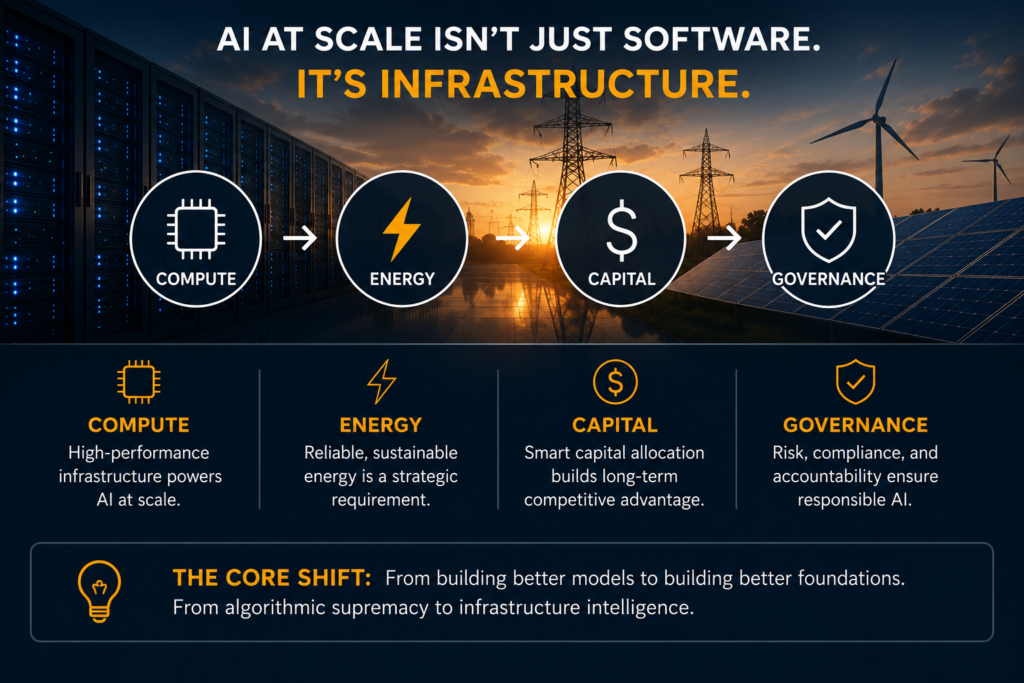
This is the “quiet thesis”: AI is evolving from primarily a software challenge into an infrastructure strategy challenge.
Beyond Algorithmic Supremacy
For much of the last decade, competitive advantage in AI was driven largely by improvements in algorithms and model capability. That remains an important source of innovation.
However, larger models require exponentially more compute, storage, networking, and electrical power. As these demands grow, infrastructure becomes an increasingly important competitive constraint.
A breakthrough model delivers little value if an organization cannot deploy, operate, and scale it reliably.
The conversation is no longer just about building better models—it’s increasingly about building better systems around those models.
Infrastructure as Competitive Strategy
Organizations investing in AI are beginning to make decisions that extend well beyond software engineering.
Capital allocation now influences compute availability.
Infrastructure planning influences deployment speed.
Energy strategy affects long-term scalability.
Vendor diversification influences operational resilience.
Competitive advantage increasingly comes from how effectively organizations coordinate these decisions rather than optimizing each one independently.
This does not diminish the importance of software innovation. Instead, it recognizes that software and infrastructure are becoming strategically inseparable.
The Convergence of Capital, Energy, and Governance
Perhaps the most significant shift is that AI strategy is no longer confined to technology teams.
Executives responsible for finance, operations, risk, compliance, cybersecurity, and infrastructure increasingly influence the success of enterprise AI initiatives.
Three areas are beginning to converge:
- Capital Allocation determines where organizations invest in compute, networking, and supporting infrastructure.
- Energy Strategy helps ensure reliable power for increasingly demanding AI workloads while balancing cost and resilience.
- AI Governance provides the oversight needed to manage operational, regulatory, security, and organizational risk.
Viewed together, these are not separate initiatives. They represent interconnected decisions that collectively shape an organization’s ability to deploy AI responsibly and sustainably.
Conclusion
The organizations that adapt to this convergence early may be better positioned to scale AI effectively over the coming decade.
Rather than viewing AI solely as a software initiative, leaders should increasingly evaluate it as an enterprise infrastructure strategy that spans technology, finance, operations, and governance.
The future of AI will still be shaped by better models.
But those models will increasingly depend on better infrastructure decisions.
Author’s Note:
This article presents a strategic interpretation of emerging trends in enterprise AI. While individual organizations will vary, the observations reflect broader shifts in compute demand, infrastructure investment, energy planning, and AI governance that are increasingly influencing enterprise adoption.
Leave a Reply