For decades, payment security has largely centered on a familiar question:
Is this transaction fraudulent?
That question will remain important, but agentic commerce introduces another question that must be answered first:
Who—or what—is actually making the purchase?
On September 10, Visa, Mastercard and Ant International announced a collaboration on a “Know-Your-Agent,” or KYA, interoperability framework. The initiative is intended to help payment networks, digital wallets, AI platforms and online marketplaces identify trusted AI agents across different payment ecosystems.
The announcement reflects a larger transition already underway. AI systems are moving beyond recommending products, comparing prices and helping customers make decisions. Increasingly, they will be capable of completing transactions on behalf of individuals and organizations.
Once an AI agent can spend money, however, convenience is no longer the only design objective.
The transaction must also be attributable, authorized, limited and auditable.
Authentication Is Not Authorization
Authentication and authorization are often discussed together, but they solve different problems.
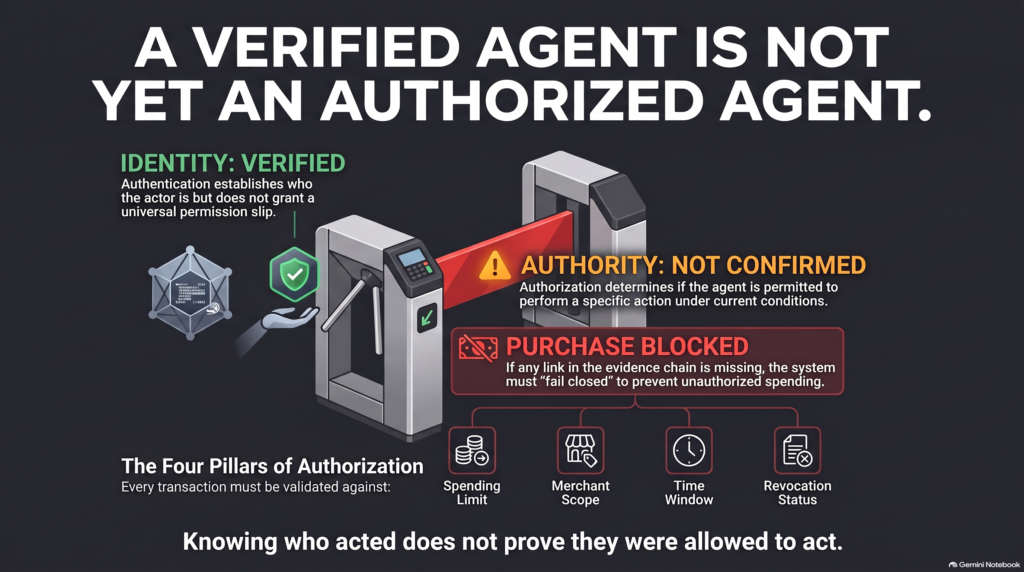
Authentication establishes the identity of the actor attempting an action.
Authorization determines whether that actor is permitted to perform the requested action under the current conditions.
An AI agent could be properly identified and still lack permission to complete a particular purchase.
For example, a company might authorize an agent to reorder approved office supplies from designated vendors, up to $500 per transaction. That does not necessarily authorize the same agent to:
- Purchase equipment from a new vendor
- Exceed the spending limit
- Change the delivery address
- Accept different contract terms
- Use another department’s payment account
- Continue making purchases after its authority has been revoked
The agent’s identity may remain valid while the requested transaction falls outside its authorized scope.
That distinction will become one of the foundational controls of agentic commerce.
A Recognized Actor Can Still Be Unauthorized
I encountered a smaller version of this issue while testing an automated governance and delivery system.
A process attempted to dispatch a completed deliverable, but the required permissions were unavailable. The system returned DISPATCH_FAILED.
At first glance, a permission failure can look like something merely broke. In reality, the event demonstrated an important control boundary.
The system recognized the process.
It understood the requested action.
It had a valid record ready for dispatch.
But the process did not possess the necessary authority to complete the action at that moment.
The correct response was to fail closed.
That experience illustrates a principle that will become increasingly important as AI agents begin initiating financial transactions:
Recognizing the actor is not the same as approving the action.
An agent should not receive authority simply because it successfully identifies itself. Its requested action must also be evaluated against the permissions delegated to it.
Delegated Spending Requires an Evidence Chain
Human payment systems already rely on delegated authority.
Employees receive corporate cards. Procurement teams receive purchasing thresholds. Account holders authorize recurring payments. Parents may permit children to make limited purchases through shared accounts.
AI agents add another operational layer between the principal and the transaction.
A defensible agent-initiated payment may therefore need an evidence chain connecting:
Principal → Agent → Delegated authority → Transaction → Outcome
That evidence should answer several questions:
- Which agent initiated the transaction?
The record should identify the specific machine actor, platform and relevant system or model version. - Who authorized the agent?
The transaction should connect the agent to the person or organization that delegated its authority. - What was the authorized scope?
Permissions might be limited by amount, merchant, product category, payment method, geography or timeframe. - Was the transaction consistent with the user’s original intent?
An agent authorized to find the lowest-priced nonstop flight should not quietly purchase a multi-stop itinerary because it optimized for a different variable. - Was human approval required?
Low-risk purchases might proceed autonomously, while unusual or material transactions may require explicit confirmation. - Was the agent’s authority still valid?
Delegated access must be revocable. A disabled or compromised agent should not retain stale purchasing authority. - Can the transaction be reconstructed later?
Organizations will need logs showing what was requested, which rules were evaluated, what the agent attempted and why the transaction was approved or denied.
Without this evidence, a company might identify the agent involved but remain unable to prove that its actions were authorized.
Identity Will Become Part of the Control Plane
The proposed KYA framework is designed to allow recognized agent trust signals to operate across payment systems while allowing individual networks to retain their own verification, approval and risk-management processes.
That structure matters.
A common identity signal should not become a universal permission slip.
Different merchants, financial institutions and platforms will still need to make their own decisions about acceptable risk. One organization may permit autonomous purchases under $100. Another may require human approval for every transaction. A third may prohibit AI agents from purchasing certain products entirely.
Interoperable identity can establish a shared foundation, but authorization must remain contextual.
This means effective agentic payment controls will likely require:
- Verified machine identity
- Explicit delegated authority
- Transaction and cumulative spending limits
- Approved merchant and product categories
- Time-bound permissions
- Human approval thresholds
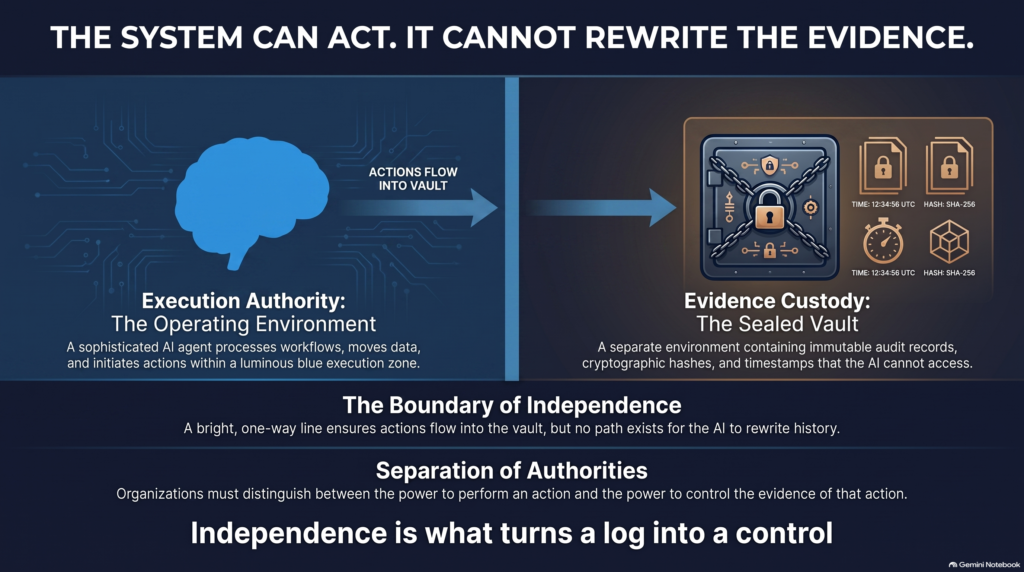
- Immutable activity logs
- Immediate revocation capabilities
- Exception handling and escalation
- Evidence connecting the original instruction to the final transaction
These are not merely payment features. They are governance controls.
Trust Requires More Than a Successful Transaction
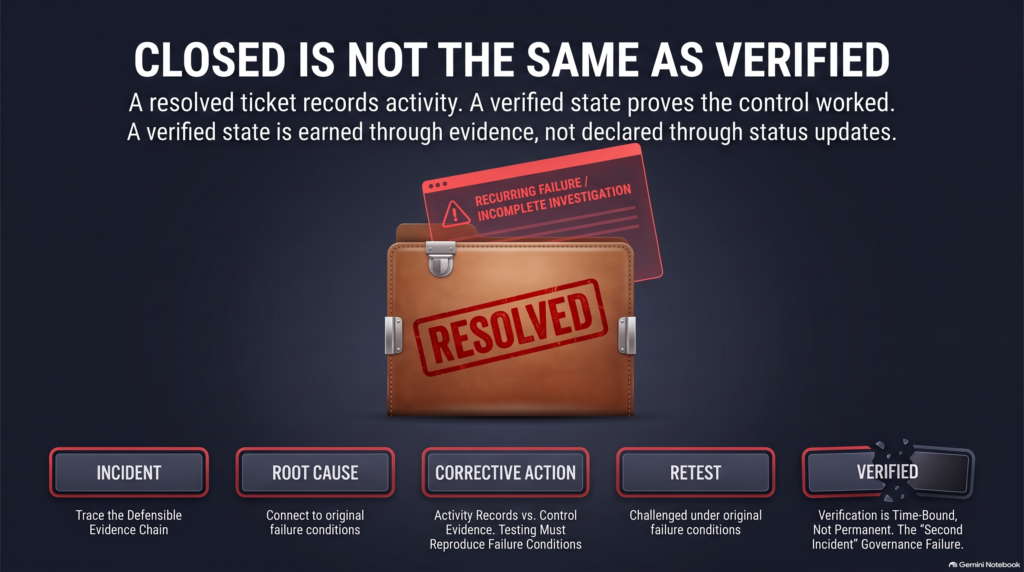
A completed payment does not prove that the right actor performed the right action under valid authority.
It only proves that the payment went through.
As AI agents gain greater autonomy, organizations will need to evaluate transactions using a higher standard:
Was the agent verified?
Was the authority valid?
Was the action within scope?
Can the decision be reconstructed?
Could the authority have been revoked before execution?
Fraud prevention will remain essential, but fraud is only one possible failure.
An authenticated agent might overspend, misinterpret instructions, select an unauthorized vendor or continue operating after its permissions should have expired. Those actions might not resemble traditional fraud, yet they can still create financial loss, regulatory exposure and disputes over accountability.
The emerging AI payment problem is therefore not simply whether a transaction is fraudulent.
It is whether the machine actor had legitimate, current and provable authority to initiate it.
In the agentic economy, the strongest systems will not treat identity as permission.
They will require a complete chain of evidence:
Verified agent. Valid delegation. Authorized scope. Traceable execution.
And when any link in that chain is missing, the system should not improvise.
It should fail closed.