AI power discussions often begin outside the data center: Can the grid serve the load? Is generation available? How long will interconnection take? Can transmission capacity reach the site?
Those questions remain central. But they aren’t the only ones.
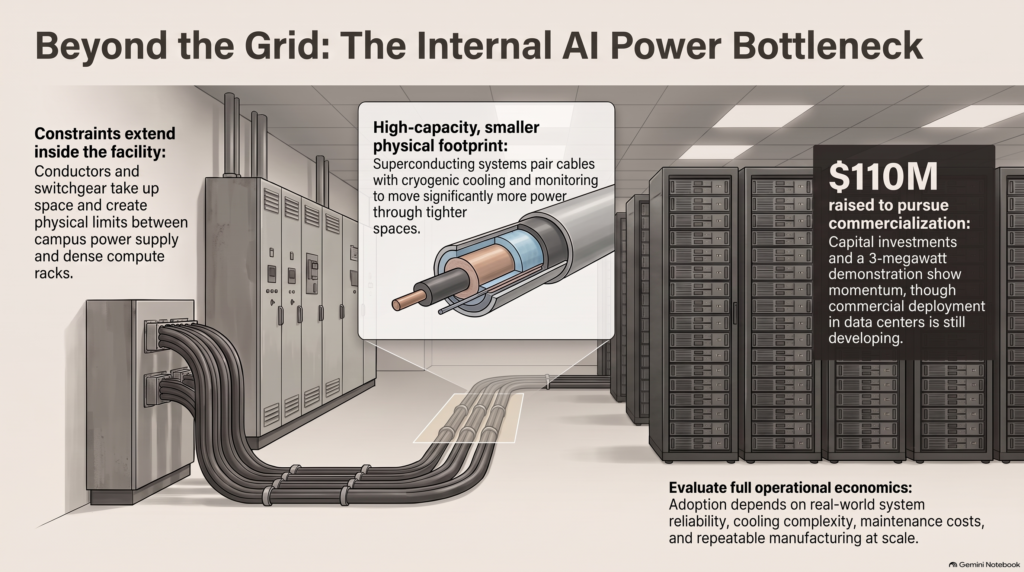
After electricity reaches a campus, it must still pass through the facility’s electrical infrastructure and arrive at the equipment that performs the computing. That pathway has physical limits. Conductors, switchgear and other equipment take up space, require installation labor and must operate reliably under demanding conditions. As data centers add more power-dense computing, the electrical system inside the facility becomes part of the scaling challenge.
VEIR’s October 8 financing announcement is a signal that investors see an opportunity in this layer. The company announced a $110 million Series C, bringing its reported total capital raised to $225 million. It says the funding will support manufacturing, product development and preparation for commercial deployments. VEIR also reports a 3-megawatt demonstration and says it is working with customers and industry partners on reference designs for AI facilities.
The approach centers on superconducting power-delivery systems. In VEIR’s description, the system includes more than the superconducting cable: it also requires cryogenic cooling, controls, terminations and monitoring. The goal is to move more power through a smaller physical footprint than conventional power-delivery infrastructure.
That could matter where space and power density are becoming linked. A smaller footprint could give designers more flexibility inside a facility or campus. But a compact cable alone doesn’t establish an operational advantage. The complete installation has to work as a system, and its economics must account for cooling, controls, installation, maintenance and the consequences of equipment failure.
The technology also addresses a specific point in the power chain. It may improve how electricity is distributed within a data center. It does not supply the electricity, secure an interconnection or expand the grid. Those are separate constraints, and they remain part of the larger project.
That distinction is useful because “AI needs more power” can make every proposed solution sound interchangeable. They aren’t. Some investments add generation. Some expand transmission. Others improve the way power is delivered inside a facility. A project may need progress at several of these layers at once.
The commercial evidence is still developing. VEIR’s reported 3-megawatt demonstration is a technical milestone, while the company’s announcement describes initial commercial deployments as something it is preparing for. Reuters reported earlier this year that superconducting cables were not yet being used in data centers and that cost and manufacturing constraints had limited adoption.
For operators and infrastructure investors, the next questions are practical:
- How reliably does the full system operate under real data-center loads?
- What does it cost to install and maintain compared with conventional alternatives?
- How does the cooling and control equipment affect operating complexity?
- Can the system be manufactured, installed and serviced repeatedly at commercial scale?
The $110 million round indicates investor confidence in the opportunity and provides capital to pursue commercialization. The test of the thesis will be what commercial deployments show about reliability, economics and repeatability.
AI infrastructure can be constrained at more than one point between the grid and the server. Power availability gets attention because it is visible and difficult to solve. Power delivery inside the facility may be less visible, but it can also shape how densely and efficiently a campus grows.
The useful question is not just how much electricity a data center can secure. It is how dependably and economically that electricity can be delivered to the compute.
Source note: VEIR’s financing and technical milestones are company-reported; treat commercial performance claims as unproven until supported by operating data.