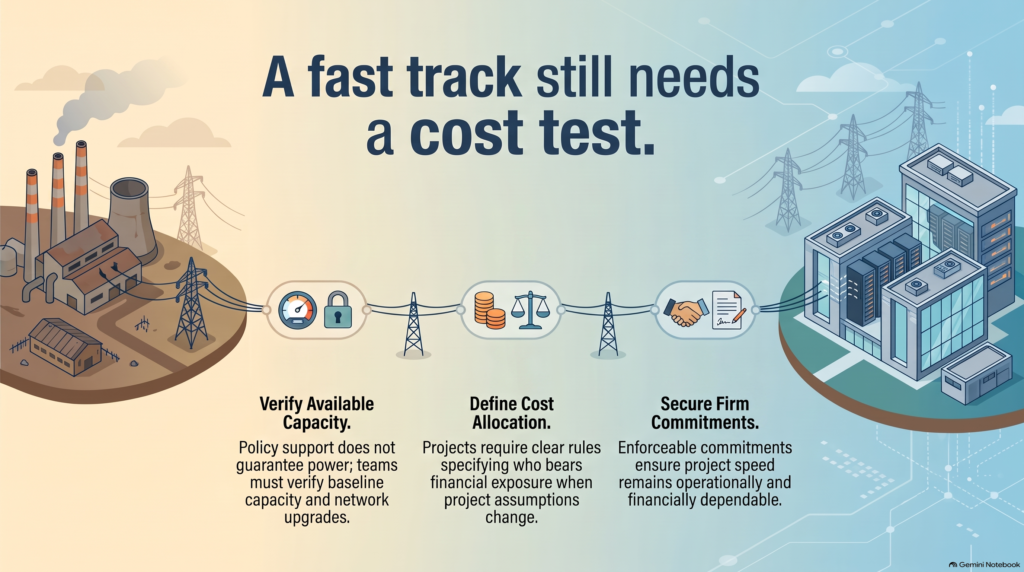
A regulatory fast-track can shorten a process. It cannot make unresolved obligations disappear.
On September 29, FERC acted on PJM Interconnection’s proposed Reliability Backstop Procurement, or RBP. PJM designed the one-time procurement to secure additional capacity after its 2028/2029 capacity auction fell approximately 6,800 MW short of the region’s reliability target. The plan was intended to help address a near-term supply gap amid rapid load growth, including demand from data centers.
FERC accepted parts of PJM’s proposal but suspended it for five months, with an effective date of February 28, 2027, while opening further proceedings on unresolved provisions. PJM confirmed that the procurement would not begin on September 30 as originally planned. The commission also asked PJM to improve its data-center demand forecasts.
The issues are practical, not procedural trivia. PJM identified concerns around cost allocation, transmission-owner exit rules, and collateral requirements for load-serving entities. Those rules shape who bears financial exposure if the procurement moves forward, and whether the obligations remain dependable over time.
That makes this a useful infrastructure-planning signal: a mechanism designed to move quickly can still be delayed if its allocation of costs and risks is not sufficiently defined. FERC did not say the region does not need new capacity. Its order accepted core elements while requiring more work on how the proposal would function.
The distinction between this case and “fast-track interconnection” also matters. The RBP is a capacity procurement. PJM’s Expedited Interconnection Track is a separate process for qualifying new generation projects, and FERC approved that track separately. Calling the RBP pause the “death of shortcut interconnections” would merge two different mechanisms and draw a broader conclusion than the order supports.
For developers and large energy users, the practical takeaway is to treat policy support as one input to a project plan—not as proof of available power. Before relying on a site or procurement pathway, teams should verify the relevant capacity, interconnection status, needed network upgrades, enforceable commitments, and who carries the costs if assumptions change.
PJM’s case illustrates a broader principle: speed can help a project move, but clear rules make that speed usable. The next advantage may belong to developers who can show not only that they have a path to power, but that the path is operationally and financially credible.