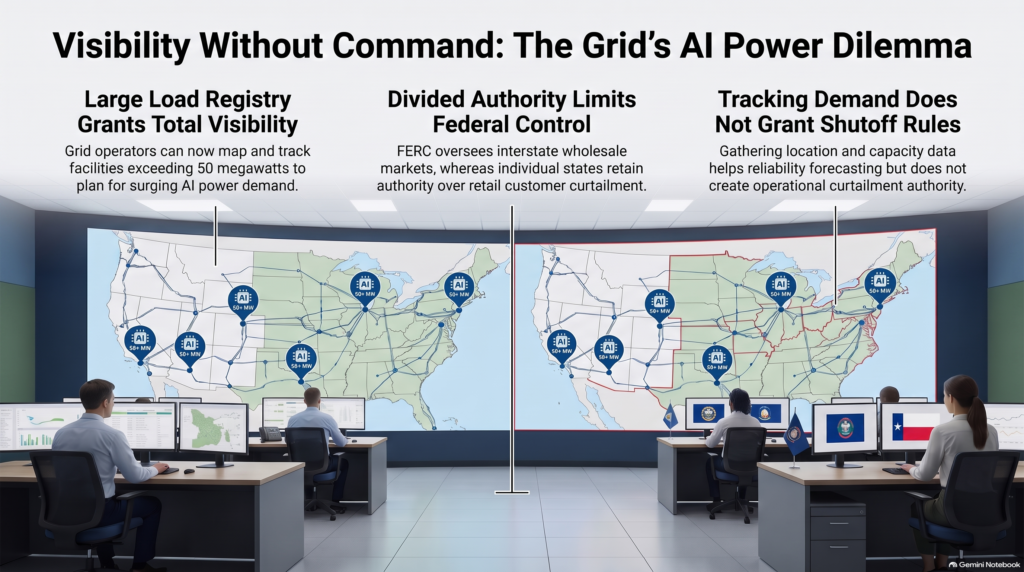
FERC’s PJM decision separates load visibility from curtailment authority
The growth of AI infrastructure is making electricity demand harder to forecast and plan around. Large data centers can require hundreds of megawatts, ramp up over time, and depend on power arrangements that affect regional reliability planning.
On October 9, 2026, the Federal Energy Regulatory Commission (FERC) took a step toward improving visibility into that demand. It approved PJM Interconnection’s definition of a “Large Load” and its proposed Large Load Registry. At the same time, FERC rejected much of PJM’s broader proposal for providing interim service to new large loads, including provisions related to curtailment. (elibrary.ferc.gov, utilitydive.com)
The decision highlights an important regulatory distinction: collecting information about large electricity users is different from deciding when their service can be interrupted.
What the registry is meant to show
PJM’s approved definition covers end-use customer load with a cumulative peak of at least 50 megawatts at a single electrical site. The registry is designed to collect information such as a facility’s location, ramp schedule and capacity supply. That information can help PJM understand how large loads may affect forecasts and reliability planning. (elibrary.ferc.gov, utilitydive.com)
A registry improves visibility. It can help answer questions such as:
- Where is major new demand expected to connect?
- How quickly is that demand expected to ramp up?
- What capacity supply is associated with the load?
Those are important planning questions. But data collection does not itself create an operational curtailment rule or settle which regulator has authority over a retail customer’s service.
Why FERC rejected the broader proposal
PJM’s filing also proposed an Interim Resource Adequacy Service framework for certain new large loads. Under parts of that proposal, eligible loads that did not bring their own new capacity could face load-reduction requests as the system approached an emergency.
FERC rejected that framework. The Commission said several provisions appeared to place obligations directly on large loads that are, for the most part, retail customers; to dictate which retail customers would be curtailed; and to establish a retail compensation rate. It also found that PJM had not adequately shown that the proposed treatment of those loads would avoid undue discrimination. (utilitydive.com)
This is where jurisdiction matters. FERC oversees interstate transmission and wholesale market rules. States have a central role in regulating retail electricity service, including determining which retail customers may be curtailed when the system is stressed. FERC’s order treated the issue as a shared regulatory challenge, not as a simple question of whether grid operators can see or manage demand. (utilitydive.com)
What the decision does—and does not—mean
The order does not mean large data centers are exempt from every form of curtailment, or that emergency load reduction is off the table. It addresses the specific tariff framework PJM proposed in this filing. FERC also gave PJM direction on issues it would need to address if it revises and resubmits parts of the proposal. (utilitydive.com, headwaterswire.com)
The distinction is between three separate layers:
- Visibility: identifying large loads and gathering information about them.
- Grid operations: maintaining system reliability as supply and demand change.
- Decision rights: determining which customers can be asked or required to reduce demand, under what rules, and with what protections.
The registry advances the first layer. The order shows that the third requires careful coordination across federal and state authority, as well as rules that can be defended as fair.
The governance question behind AI power demand
For AI infrastructure, the practical issue is not only how much electricity a facility may use. It is also whether the grid and regulators have clear, workable rules for what happens when demand exceeds available supply.
That requires a complete chain: reliable information about large loads, transparent criteria for reliability actions, clear responsibility for issuing those actions, and consistent treatment across customer classes. Without that chain, the grid may know where demand is growing while decision-makers remain uncertain about who can require it to change.
The registry can help the grid see the load. It cannot, by itself, determine who has authority to control it.
Source: FERC, Docket ER26-3515-000, order issued October 9, 2026.