Tag: EnterpriseAI

  • AI Can Help Design the Chip. Verification Still Has the Final Word.

    AI is moving deeper into technical work. The latest example is a September 30 announcement from Synopsys and OpenAI: the companies plan to develop GPT-Synopsys, a specialized model for semiconductor design.

    The model is intended to combine OpenAI’s AI capabilities with Synopsys’ electronic design automation tools and chip-design expertise. Synopsys says it is being developed to reason about chip design and verification and to operate its tools. 

    That development points to a practical question for companies adopting AI in engineering and other high-consequence work:

    How do you use AI to increase the pace of work while preserving confidence in the result?

    A design proposal is not a verified design

    Chip design is not complete when a system produces a candidate solution. A design must satisfy engineering requirements and physical constraints before it can be accepted for manufacturing.

    Reuters reported that Synopsys expects traditional computing tools to check the model’s work and determine whether a chip will function. Synopsys’ CEO emphasized the need for high-fidelity validation and sign-off. 

    That is the key governance signal. AI can help generate or refine a solution, but the model’s output does not establish that the solution is correct.

    The same distinction applies in other settings. A system may draft a code change, recommend a credit decision, identify a potential defect, or suggest an engineering configuration. Those outputs may be useful. They still need to be tested against requirements that are explicit, relevant, and independently assessable.

    Keep the roles clear

    A sound workflow gives each stage a distinct responsibility:

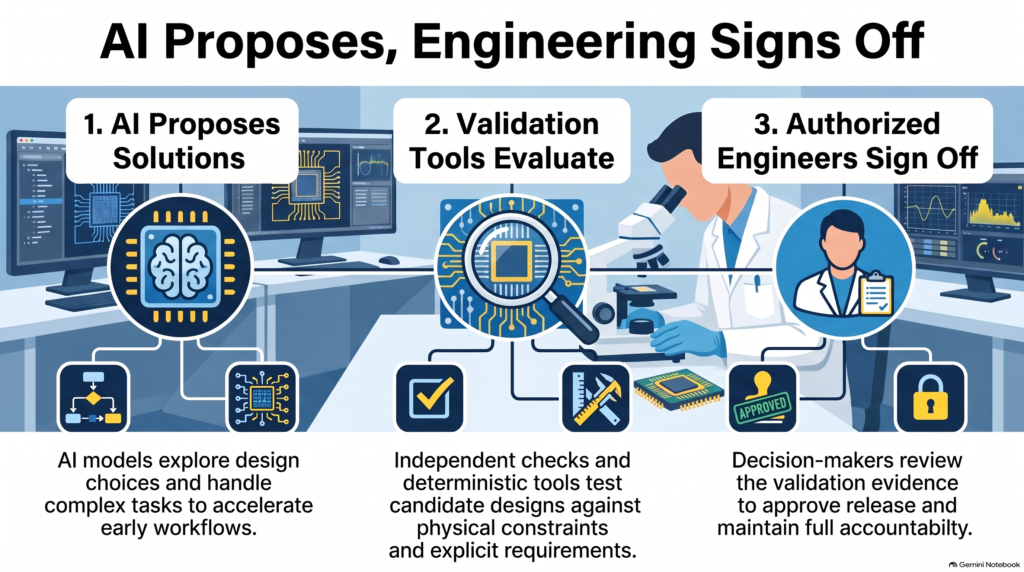
    1. AI proposes or assists. It can help explore design choices, handle complex tasks, and accelerate parts of the workflow.
    2. Validation tools evaluate. Defined checks test the output against relevant requirements and constraints. Depending on the task, that may involve simulation, deterministic checks, formal methods, or established sign-off processes.
    3. An authorized decision-maker accepts or escalates. The person or team with release authority reviews the evidence and decides what happens next.

    “Formal verification” should be used precisely: it refers to specific methods for proving properties of a system. It is not a generic label for every validation step. In this case, the broader and better-supported point is that established verification and sign-off remain part of the engineering process.

    What governance should make visible

    For a workflow like this to be governable, an organization should be able to answer:

    • What output did the AI produce, and which model or tool version produced it?
    • Which requirements and constraints were used to evaluate it?
    • What checks were run, and what were their results?
    • What happens when a check fails, produces an inconclusive result, or conflicts with another check?
    • Who has authority to accept the result or approve its release?
    • Can the organization connect the accepted result to the evidence reviewed at the time?

    These questions turn “human oversight” from a slogan into an operational control. A person’s name on an approval is not enough if the evidence, artifact, or criteria behind that approval cannot be identified later.

    Faster work still needs defensible decisions

    The point is not to slow down AI-assisted engineering. It is to keep speed from outrunning the organization’s ability to establish whether a result is fit for use.

    The emerging pattern is straightforward:

    AI proposes. Deterministic or otherwise established validation checks. Authorized decision-makers accept.

    That pattern can help organizations capture AI’s contribution while preserving accountability for outcomes. The AI may expand the range of solutions engineers can explore. Validation provides evidence about whether a candidate meets requirements. Decision authority determines whether that evidence is sufficient for release.

    The model can participate in the work. The organization still needs a process that can explain why the work was accepted.

    Capability creates options. Verification creates evidence. Authority turns evidence into an accountable decision.

    Sources

  • Regulated AI Is Starting to Look Like a System of Record

    On September 10, OpenAI launched ChatGPT for Financial Services, a specialized ChatGPT Work offering initially designed for investment-banking and equity-research teams.

    The product combines GPT-6 Astra with premium financial data, firm data connections and tools for producing research, financial models and client materials. It also builds on enterprise controls including SAML single sign-on, SCIM provisioning, role-based access, configurable retention, information barriers and the ability to export supported workspace logs into existing audit and investigation workflows.

    At first glance, this is another industry-specific AI product.

    Look beneath the feature list, however, and a more significant transition becomes visible.

    Regulated AI is beginning to acquire the architecture of a system of record.

    Intelligence Alone Is Not Sufficient

    Most public discussion about AI products still concentrates on model performance.

    Can the model retrieve the correct information?

    Can it understand complex financial documents?

    Can it build an accurate valuation model?

    Can it generate a client-ready presentation?

    Those capabilities matter. But regulated institutions face another category of questions that cannot be answered by evaluating the final output alone.

    They must also be able to establish:

    • Who accessed the system
    • What that person was authorized to access
    • Which data sources informed the output
    • Which model, tools and templates were used
    • Whether the output was reviewed
    • Whether an exception or override occurred
    • What downstream action followed
    • Whether the complete sequence can be reconstructed later

    A useful answer without a defensible history may create operational value, but it also creates unresolved institutional risk.

    That is the difference between an intelligent tool and a governed enterprise capability.

    What “System of Record” Means in This Context

    A system of record is traditionally the authoritative source for a particular category of organizational information. A bank may maintain separate systems of record for customers, accounts, trades, approvals and financial transactions.

    An AI platform does not automatically replace those systems.

    The more accurate conclusion is that regulated AI is becoming a governed record-producing layer within the larger enterprise architecture.

    It may gather information from multiple approved sources, generate analysis, support a recommendation and produce a work product. But the organization still needs to preserve the relationship between the AI activity and the authoritative downstream record.

    That evidence chain might look like this:

    Identity → Permission → Evidence → Decision → Approval → Action → Outcome

    Each stage answers a different control question.

    Identity establishes who initiated the activity.

    Permission establishes whether that person or agent was authorized.

    Evidence identifies the information used.

    Decision records what the system recommended or concluded.

    Approval demonstrates whether required human oversight occurred.

    Action records what was executed.

    Outcome confirms what actually happened afterward.

    A chat transcript by itself cannot reliably perform all of those functions.

    From AI Output to Institutional Evidence

    OpenAI’s financial-services offering illustrates how AI products are moving toward this model.

    Granular citations help users trace claims and figures back to their sources. Role-based controls help institutions determine which users may access particular capabilities, data connections or application actions. Multiple workspaces can help enforce information barriers. Compliance teams can export supported logs into their established audit and investigation processes.

    These are not decorative enterprise features.

    They are part of the mechanism that allows an institution to use AI without separating intelligence from accountability.

    There is still an important limitation: an exportable log is not automatically a complete audit record.

    A log may show that a user accessed a workspace or performed a supported action. The organization may still need to connect that activity to an approval record, a transaction identifier, a client file or another authoritative system.

    For that reason, the real control objective is not merely “capture more logs.”

    It is to maintain a traceable relationship between the AI interaction and the business event it influenced.

    The Connection to Agentic Payments

    This becomes even more important as AI agents move from producing information to initiating actions.

    Consider an agent that can:

    1. Review financial information
    2. Evaluate a purchase or investment opportunity
    3. Recommend a transaction
    4. Prepare the payment instruction
    5. Submit or initiate the payment

    The technical ability to complete those steps does not prove that the transaction was properly authorized.

    A defensible process must establish which identity controlled the agent, what permissions were active, which evidence informed the recommendation, whether required approval was obtained, what payment was submitted and whether the final settlement matched the approved instruction.

    Otherwise, the institution may know that money moved without being able to demonstrate why it was allowed to move.

    That is the bridge between governed financial analysis and governed agentic payments.

    The AI may initiate the workflow, but the evidence chain determines whether the institution can defend it.

    Enterprise Controls Are Becoming Product Features

    For years, many AI demonstrations treated governance as something to be added after the model proved useful.

    Regulated deployment reverses that sequence.

    Access control, retention, source traceability, approval boundaries, audit exports and information barriers become part of the product itself because the institution cannot safely scale the capability without them.

    This signals a broader market shift.

    AI vendors are no longer competing only on the intelligence of the underlying model. They are also competing on whether organizations can integrate that intelligence into established control environments.

    The winning product may not always be the one that produces the cleverest answer.

    It may be the one that allows the organization to answer, with evidence:

    • Where did this conclusion come from?
    • Who was permitted to rely on it?
    • Who approved the resulting action?
    • What changed afterward?
    • Can we reproduce the record without depending on someone’s memory?

    Defensible Deployment May Become the Real Moat

    Model capabilities will continue to advance, and performance differences will narrow as competitors adopt similar tools, data connections and workflows.

    Defensibility is harder to commoditize.

    It requires more than a capable model. It requires architecture that binds identity, data provenance, permissions, review, execution and outcomes into a coherent record.

    That record must remain useful after the original conversation has ended—when an auditor asks for evidence, a regulator questions a decision, a customer disputes an outcome or an internal investigation begins.

    This is why regulated AI is starting to look less like a standalone assistant and more like part of the institution’s operational memory.

    The strategic question is changing from:

    How intelligent is the model?

    To:

    Can the institution safely act on its intelligence and later prove that the action was authorized, informed and controlled?

    In regulated industries, raw intelligence may attract attention.

    Defensible deployment is what earns institutional trust.