AI is moving deeper into technical work. The latest example is a September 30 announcement from Synopsys and OpenAI: the companies plan to develop GPT-Synopsys, a specialized model for semiconductor design.
The model is intended to combine OpenAI’s AI capabilities with Synopsys’ electronic design automation tools and chip-design expertise. Synopsys says it is being developed to reason about chip design and verification and to operate its tools.
That development points to a practical question for companies adopting AI in engineering and other high-consequence work:
How do you use AI to increase the pace of work while preserving confidence in the result?
A design proposal is not a verified design
Chip design is not complete when a system produces a candidate solution. A design must satisfy engineering requirements and physical constraints before it can be accepted for manufacturing.
Reuters reported that Synopsys expects traditional computing tools to check the model’s work and determine whether a chip will function. Synopsys’ CEO emphasized the need for high-fidelity validation and sign-off.
That is the key governance signal. AI can help generate or refine a solution, but the model’s output does not establish that the solution is correct.
The same distinction applies in other settings. A system may draft a code change, recommend a credit decision, identify a potential defect, or suggest an engineering configuration. Those outputs may be useful. They still need to be tested against requirements that are explicit, relevant, and independently assessable.
Keep the roles clear
A sound workflow gives each stage a distinct responsibility:
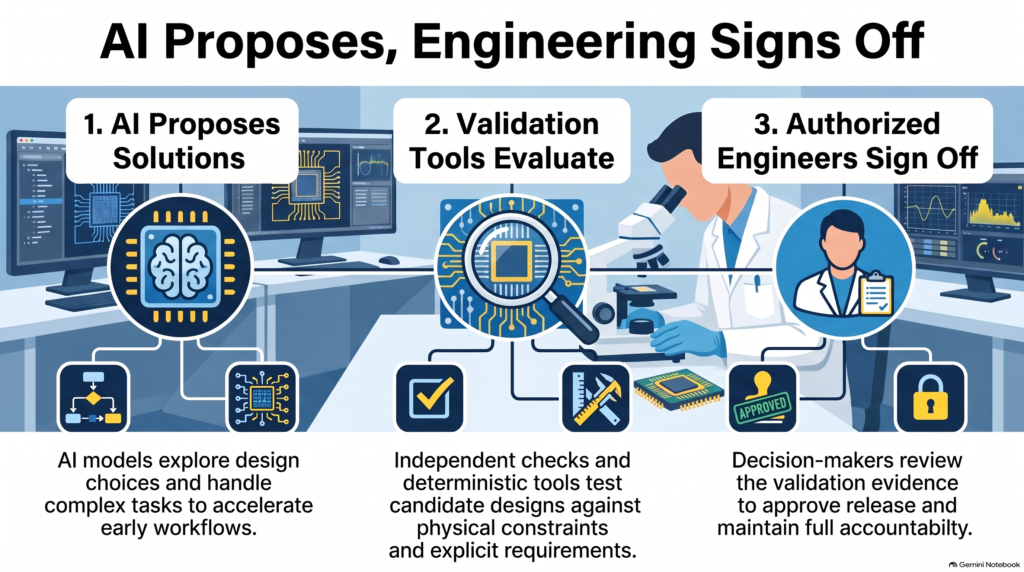
- AI proposes or assists. It can help explore design choices, handle complex tasks, and accelerate parts of the workflow.
- Validation tools evaluate. Defined checks test the output against relevant requirements and constraints. Depending on the task, that may involve simulation, deterministic checks, formal methods, or established sign-off processes.
- An authorized decision-maker accepts or escalates. The person or team with release authority reviews the evidence and decides what happens next.
“Formal verification” should be used precisely: it refers to specific methods for proving properties of a system. It is not a generic label for every validation step. In this case, the broader and better-supported point is that established verification and sign-off remain part of the engineering process.
What governance should make visible
For a workflow like this to be governable, an organization should be able to answer:
- What output did the AI produce, and which model or tool version produced it?
- Which requirements and constraints were used to evaluate it?
- What checks were run, and what were their results?
- What happens when a check fails, produces an inconclusive result, or conflicts with another check?
- Who has authority to accept the result or approve its release?
- Can the organization connect the accepted result to the evidence reviewed at the time?
These questions turn “human oversight” from a slogan into an operational control. A person’s name on an approval is not enough if the evidence, artifact, or criteria behind that approval cannot be identified later.
Faster work still needs defensible decisions
The point is not to slow down AI-assisted engineering. It is to keep speed from outrunning the organization’s ability to establish whether a result is fit for use.
The emerging pattern is straightforward:
AI proposes. Deterministic or otherwise established validation checks. Authorized decision-makers accept.
That pattern can help organizations capture AI’s contribution while preserving accountability for outcomes. The AI may expand the range of solutions engineers can explore. Validation provides evidence about whether a candidate meets requirements. Decision authority determines whether that evidence is sufficient for release.
The model can participate in the work. The organization still needs a process that can explain why the work was accepted.
Capability creates options. Verification creates evidence. Authority turns evidence into an accountable decision.
Sources