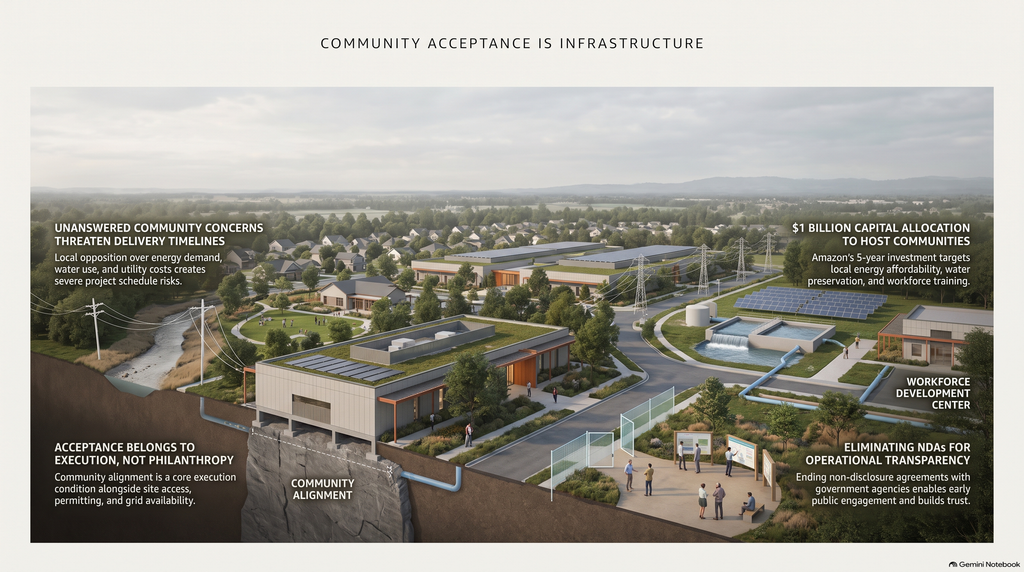
Community Acceptance Is Infrastructure
Amazon’s announcement of more than $1 billion in additional investment for U.S. data-center communities is being presented as a community-benefit program. That description is accurate, but incomplete.
The announcement also reflects a change in the conditions surrounding infrastructure development. Community concerns about power demand, utility costs, water use, transparency, and local economic benefit are becoming part of the project environment. They can influence whether a development proceeds smoothly, faces delay, or must respond to new political and regulatory scrutiny.
That makes community acceptance relevant to execution—not as a substitute for permits or engineering, but as one of the conditions developers must manage.
What Amazon has announced
Amazon says its Built Together program will add more than $1 billion over five years to existing investments in communities where it operates data centers. The company describes the program as supporting education, job training, energy affordability, water and energy preservation, and other local priorities. Reuters
The company has also published commitments on public engagement. It says it no longer uses nondisclosure agreements with government agencies it works with on its projects, plans to share information earlier, and will publish annual data on energy use, energy efficiency, water use, water efficiency, and the share of energy from carbon-free sources. aboutamazon.com
Some program details are framed as future targets. Amazon says it aims to connect more than 300,000 students with free degree access, prepare up to 100,000 workers annually through training centers by the end of 2028, and target energy-efficiency improvements for more than 30,000 homes and over 300 schools and community buildings. These are commitments to monitor, not evidence that the benefits have already been realized. aboutamazon.com
Why this is an infrastructure story
Large infrastructure projects depend on more than capital and construction capacity. They also depend on access to sites and utilities, predictable approvals, available workers, and a credible relationship with the communities that host them.
For data centers, those relationships are under pressure as the scale of development grows and residents ask who pays for additional grid infrastructure, how local resources will be used, what jobs will remain after construction, and whether the public can see the terms and impacts of proposed projects.
When those questions go unanswered, opposition can become a schedule and investment risk. Projects may face greater scrutiny, political resistance, or demands for changes to their plans. That is why community engagement is increasingly connected to infrastructure execution.
Amazon’s announcement is evidence that the company views these concerns as material. It is not proof that the program will secure community acceptance. That will depend on implementation: whether resources reach the places and people identified, whether commitments are reported clearly, and whether local concerns influence project decisions.
The difference between a commitment and an outcome
A public commitment creates a basis for accountability, but it does not complete the work.
For the program to build trust, communities will need to be able to see what was promised, where investment was made, what results followed, and how benefits relate to the costs and impacts of hosting the infrastructure. Annual reporting can help, but the usefulness of that reporting will depend on its detail and accessibility.
The same is true of transparency around project planning. Ending NDAs with government agencies is a meaningful stated change in practice. Its value will be clearest when residents can access relevant information early enough to understand a project while choices are still open.
A signal worth watching
The $1 billion announcement should not be read simply as a donation, and it should not be treated as proof that local concerns have been resolved.
It is better understood as an infrastructure signal: community acceptance has become important enough to affect how a major developer allocates capital, communicates with public agencies, and frames its responsibilities to host communities.
The next question is whether those commitments translate into measurable results—and whether communities consider those results sufficient. That is where the difference between a community-benefit announcement and durable community trust will become visible.
Source notes: Reuters’ October 2 report confirms the $1 billion-plus, five-year investment and the community focus. Amazon’s announcement provides the program targets and its stated transparency commitments. The interpretation that these commitments signal community acceptance is becoming material to execution is analysis, not a claim made directly by either source.