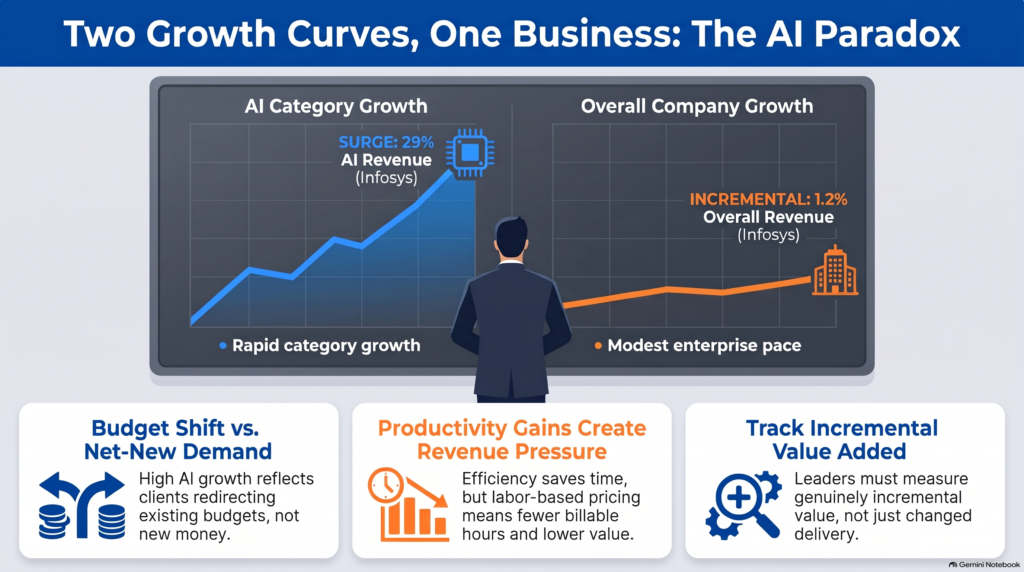
Fast growth in an AI category can coexist with modest company-wide growth. The difference between those two measures matters.
Infosys’s October 23 results offer a useful case study in how AI growth can appear inside a larger business. The company said AI revenue represented 10.5% of quarterly revenue and grew 29% quarter over quarter. Total revenue, measured in constant currency, grew 1.2% sequentially. Infosys also lowered its FY27 revenue growth guidance to 1%–2%, from 1.5%–3%.
Those figures do not show that AI caused the slower overall growth. They do show why executives need to look beyond growth within a new product or service category and ask whether it is adding to the company’s total economic value.
Category growth and company growth measure different things
A business can build a fast-growing AI practice while its overall revenue grows slowly. That can happen when the new activity is only part of the business, when other areas are flat or declining, or when AI work replaces some existing services.
The key distinction is whether AI revenue is incremental.
If a client hires a provider for a new AI project that would not otherwise have existed, that may represent new demand. If the client shifts budget from a traditional service to an AI service, the provider may be changing the mix of its revenue without increasing the total. If AI helps the provider deliver existing work with fewer hours, productivity may rise even as labor-based billings come under pressure.
These situations can look similar in an AI revenue headline. Their implications for growth and profitability are different.
Productivity gains can change who captures the value
Automation can help a services business complete work faster, reduce rework, or deliver more within the same timeframe. That may improve the provider’s cost structure. But if the contract is priced around hours or staffing levels, the client may also expect a lower price when fewer hours are needed.
Reuters reported that Infosys cited pricing pressure and client requests to pass along AI-related productivity gains among the factors reflected in its revised guidance. That is useful context for understanding the business-model challenge. It does not mean AI alone explains the company’s overall results.
When a provider saves time, the commercial question becomes: Who captures that productivity value?
The provider may retain more of the savings through improved margins. The client may capture part of it through lower prices. Or the parties may agree on outcome-based pricing, where payment is tied more closely to results than to labor hours.
Each approach changes the economics.
What executives should measure
AI revenue is worth tracking, but it should sit alongside measures that help explain its contribution to the whole business:
How much AI work comes from new customer demand versus existing budgets being redirected?
What revenue is won, retained, or replaced because of AI?
Does delivery productivity improve margins, reduce prices, or produce a mix of both?
Are customers buying additional outcomes, or receiving familiar outcomes through a new delivery method?
How are contracts and pricing adapting as the labor required for delivery changes?
These questions help separate growth in an AI category from net-new growth for the enterprise.
The executive question
Infosys’s results are a reminder that a growing AI line item and modest company-wide growth can exist at the same time. That relationship deserves attention, but it is not proof of a single cause.
The more useful question is whether AI is creating genuinely incremental value—or changing how existing value is delivered, priced, and shared.
For an entrepreneur, that distinction is practical: Can AI make the business more productive while reducing revenue from the services that built it?
The answer depends on what customers are paying for, how the work is priced, and whether the business can turn its productivity gains into new demand or stronger economics.
As enterprises move toward interconnected AI systems, the infrastructure responsible for governing agent behavior could become a strategically important part of the technology stack.
The next stage of enterprise AI adoption
Enterprise artificial intelligence is entering a more complicated phase.
For years, organizations concentrated on acquiring AI capabilities, experimenting with language models, automating individual tasks, and measuring productivity improvements.
Those activities remain important. However, the architecture of enterprise AI is changing.
Instead of deploying individual assistants that operate within relatively narrow boundaries, organizations are exploring networks of AI agents capable of interacting with multiple applications and executing increasingly complex workflows.
This creates opportunities for operational efficiency, but it also introduces new requirements for coordination, security, financial oversight, and accountability.
A recent development involving Tata Consultancy Services illustrates where this market may be heading.
TCS is developing an enterprise AI governance layer
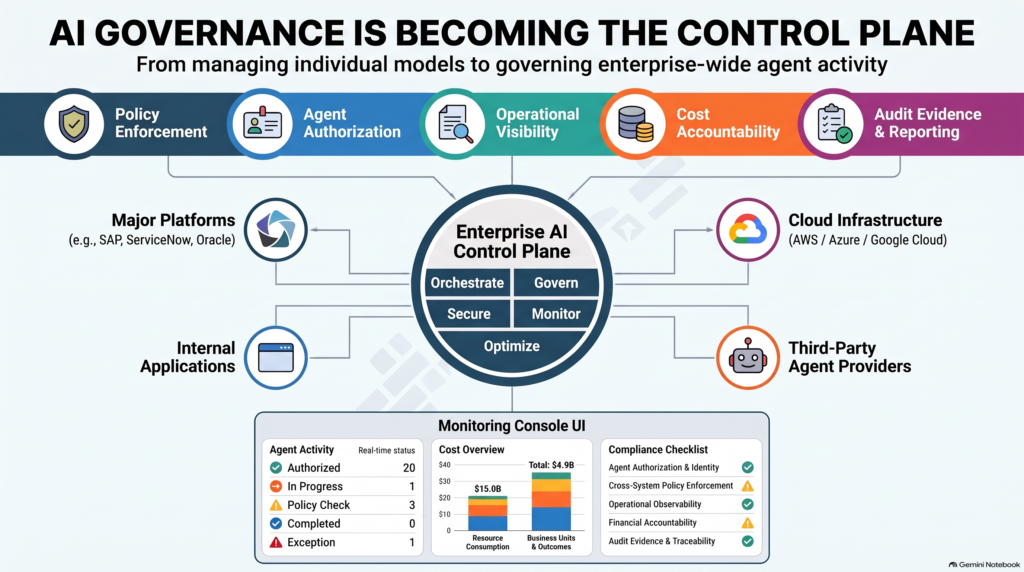
According to reporting published October 12, 2026, Tata Consultancy Services is developing a governance layer designed to manage AI agents operating across enterprise technology environments.
The proposed architecture would coordinate agents developed internally, by customers, and by third-party providers.
It is intended to support orchestration, security, deployment management, and cost oversight across enterprise applications, including platforms such as SAP, ServiceNow, and Oracle.
This is a notable architectural direction.
Instead of treating every AI agent as a separate deployment requiring independent management, an enterprise control plane can provide a shared supervisory layer.
The concept is especially relevant as organizations introduce agents from multiple vendors, each with different capabilities, permissions, and operating requirements.
The more distributed the AI ecosystem becomes, the more valuable consistent oversight may be.
From model governance to system governance
Traditional AI governance frequently concentrates on individual models.
Organizations assess model accuracy, reliability, fairness, security, and performance. These evaluations remain essential.
However, governing an interconnected system of agents requires additional considerations.
Consider a hypothetical financial institution using several AI agents.
One agent analyzes customer information. Another evaluates documentation. A third prepares a recommendation. A fourth initiates an operational workflow.
Each agent may perform its assigned function correctly.
But that does not automatically establish that the complete workflow was properly authorized, that information was transferred appropriately, or that the final action complied with institutional policy.
The governance challenge now exists between the agents as well as within them.
This introduces a need for controls that operate across applications and workflows, not merely within individual models.
Five capabilities that could define an enterprise AI control plane
1. Agent identity and authorization
Organizations need to establish which agents are operating, who owns them, what resources they can access, and which actions they are permitted to perform.
An agent’s technical capability should not be confused with its authority to act.
2. Cross-system policy enforcement
Enterprise policies should remain applicable as workflows move between applications, models, and service providers.
Centralized policy administration can improve consistency, but enforcement must occur at the appropriate execution boundaries.
3. Operational observability
Organizations need visibility into agent interactions, decisions, exceptions, and system dependencies.
Observability helps identify unexpected behavior. However, monitoring alone does not establish that preventive controls are effective.
4. Financial accountability
As agents consume computing resources, invoke external services, and initiate transactions, cost management becomes an operational concern.
A control plane could help enterprises associate AI resource consumption with business activities, departments, and measurable outcomes.
5. Evidence and decision traceability
For regulated or high-consequence environments, organizations may need to reconstruct the sequence of events behind an AI-assisted action.
That requires reliable records connecting the relevant agent, input, policy, decision, authorization, and resulting action.
Without that continuity, an organization may possess extensive logs while still struggling to demonstrate accountability.
The commercial significance of governance infrastructure
TCS reported $3.1 billion in annualized AI revenue for the quarter ending September 30, 2026, representing more than 10% of its overall revenue.
This figure covers its broader AI business rather than revenue from the governance layer specifically.
Nevertheless, the combination of growing AI-related business and investment in governance architecture is commercially significant.
It suggests that enterprise AI opportunities increasingly extend beyond model development and application deployment.
As organizations scale their AI operations, they may require specialized capabilities for integrating, supervising, and controlling those systems.
Potential sources of commercial value include enterprise platform integration, managed governance services, compliance reporting, cost optimization, and continuous operational assurance.
The strategic opportunity is not necessarily a single universal governance platform.
Different organizations will maintain different technology stacks, risk tolerances, regulatory obligations, and operational requirements.
The opportunity lies in providing consistent control across those differences.
Centralization introduces its own governance risks
A centralized AI control plane is not automatically a complete governance solution.
In fact, consolidating oversight introduces additional design questions.
What happens if the control plane becomes unavailable?
Can agents continue operating without authorization checks?
Are enforcement policies applied consistently across vendor boundaries?
Can an administrator alter policies or records without an appropriate approval process?
How does the organization distinguish between a policy that was configured and a policy that was actually enforced?
These questions illustrate why governance architecture must be evaluated on observed behavior rather than declared capability.
A control plane should not become another layer of software that reports confidence without producing evidence.
The strongest architectures will distinguish policy administration, enforcement, monitoring, and independent verification.
They will also preserve appropriate human authority over consequential decisions.
Implications for financial institutions and regulated enterprises
Financial institutions provide a particularly relevant example because their operations already depend on established accountability, risk management, and control frameworks.
As AI agents become involved in customer operations, compliance analysis, credit processes, and internal decision support, institutions will need to understand how agent activity interacts with existing governance obligations.
Model risk management, information security, operational resilience, third-party oversight, and audit functions cannot operate as completely disconnected disciplines when AI agents cross their boundaries.
An enterprise control plane could provide a valuable coordination mechanism.
However, it should complement rather than replace independent validation, human approval requirements, and established lines of accountability.
The objective is not to centralize every decision.
It is to establish consistent visibility and enforceable boundaries while preserving appropriate responsibility for outcomes.
The distinction between AI capability and governed execution
One of the most important lessons emerging from enterprise AI adoption is that technical capability does not automatically establish operational readiness.
An agent may be able to perform a task.
That does not establish whether the task should be performed, under what conditions, or with whose authorization.
Similarly, a governance platform may be able to observe activity without necessarily preventing unauthorized behavior.
The architecture must distinguish among three separate functions:
Orchestration: Coordinating which agents perform activities and how workflows proceed.
Governance enforcement: Applying permissions, policies, restrictions, and escalation requirements.
Independent assurance: Verifying that the controls operated as intended and that the supporting evidence is reliable.
These functions may be integrated technologically, but they should remain conceptually distinct.
Conclusion: The next enterprise AI advantage may be governability
TCS’s developing enterprise AI governance layer is an important signal in the evolution of the enterprise AI market.
It reflects a shift from managing isolated AI capabilities toward supervising increasingly interconnected AI operations.
The commercial implications could be substantial, particularly for organizations facing complex technology environments and significant accountability requirements.
But the value of an AI control plane should ultimately be measured by more than the number of agents it coordinates.
Its effectiveness depends on whether it can enforce boundaries, preserve accountability, manage operational exposure, and provide defensible evidence of what occurred.
The next stage of enterprise AI competition may therefore be shaped by two questions.
How effectively can organizations deploy intelligent systems?
And how confidently can they demonstrate that those systems remain under control?
Enterprise AI may scale through agents. Sustainable enterprise AI will depend on the ability to govern them.
Sources
Tata Consultancy Services, Q2 FY2027 Financial Results, October 8, 2026.
Financial Express, TCS Bets on Governance Layer to Scale Enterprise AI, October 12, 2026.
TCS, Annual Report 2025–26, enterprise AI strategy and control-plane architecture.