As demand for electricity grows, the conversation often turns to new generation: new plants, new transmission, and new infrastructure. Those investments matter. But a recent Google–Constellation agreement points to another part of the supply equation: increasing output from assets that are already operating.
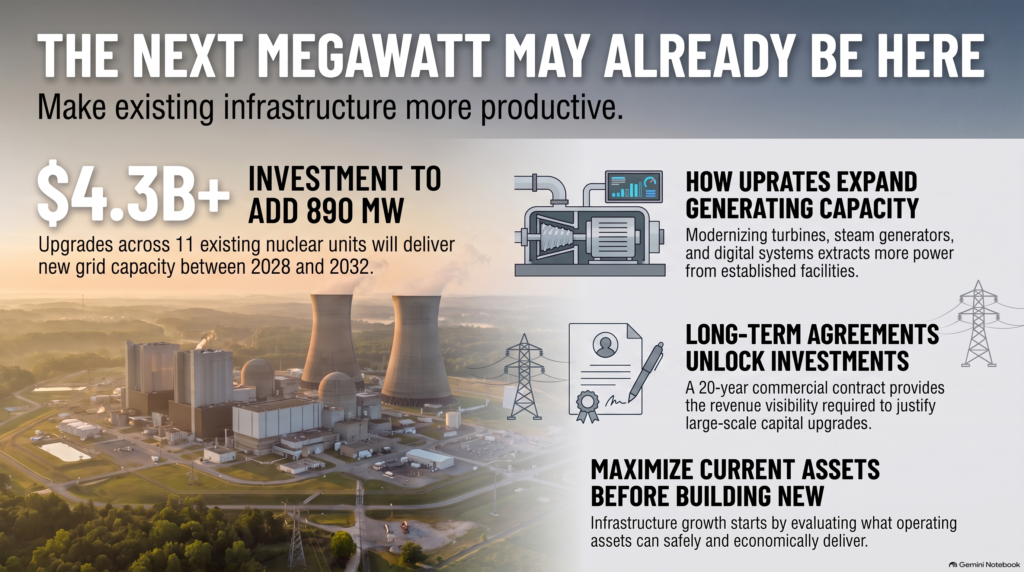
Announced October 6, the companies’ 20-year power purchase agreement supports upgrades at 11 existing Constellation nuclear units across six sites in Illinois, Pennsylvania, and New Jersey. The upgrades are expected to add 890 megawatts of nuclear capacity to the PJM grid. Constellation says it plans to invest more than $4.3 billion in the work. The first uprate is expected in 2028, with the full 890 MW planned by the end of 2032.
This is not a new nuclear plant coming online today. It is a long-term investment plan to increase output from existing reactors.
What an uprate changes
A nuclear uprate increases a plant’s generating capacity by upgrading equipment and systems. The companies cite work involving turbines, steam generators, and digital control systems. The goal is to produce more electricity from an existing facility while maintaining the requirements that govern its safe and reliable operation.
That distinction matters. An operating plant already has a site, grid connections, and much of the supporting infrastructure. Upgrading it may offer a different development path from building a new facility. But it still requires substantial capital, specialized engineering, regulatory work, construction planning, and time.
Why the commercial structure matters
The 20-year agreement provides a long-term customer commitment associated with the planned upgrades. That kind of revenue visibility can help a generator justify capital investment in equipment and capacity improvements.
The agreement also sits within a larger power arrangement. Google and Constellation signed a separate 15-year supply contract for another 2,700 MW from Constellation’s PJM generation fleet. That supply is not linked to a specific generating source, so it should not be counted as part of the 890 MW of new nuclear capacity.
The distinction between the two agreements is useful: one supports planned incremental nuclear capacity; the other provides long-term revenue certainty for existing generation assets.
The capital-efficiency lesson
Capital efficiency does not mean avoiding investment. In this case, the announced program includes more than $4.3 billion in planned investment. The efficiency question is whether targeted upgrades to existing assets can add useful capacity while making productive use of infrastructure already in place.
That is a different question from simply asking how quickly a new plant can be built. It asks whether the current system contains assets with additional potential—and what investment, operational changes, and approvals are needed to realize it.
The answer will vary by asset and location. An upgrade is not automatically faster, cheaper, or feasible everywhere. The 890 MW is a target for future delivery, with the first uprate expected in 2028 and the full capacity planned by the end of 2032.
A broader infrastructure principle
For executives assessing electricity needs, the agreement offers a useful lens: examine both new supply and the productivity of existing assets. In power, that can mean evaluating uprates, reliability, grid connections, operating performance, and demand flexibility alongside new construction.
The broader lesson applies across infrastructure. Growth does not always begin with acquiring or building another asset. Sometimes it begins by asking what the current asset base can safely and economically deliver—and what commitment will make the required investment possible.
The next megawatt may come from a new plant. It may also come from making an existing one work harder.
Source note: Constellation’s announcement says 890 MW will be added to the PJM grid through the planned nuclear upgrades; Google’s post provides the end-of-2032 target. The separate 2,700 MW agreement is not source-specific.