An AI control failure may begin as an engineering incident. It may be detected by a monitoring system, escalated to security, and reviewed by an internal governance team.
But the audience for the evidence can change.
On October 1, 2026, California Attorney General Rob Bonta announced an investigative subpoena to OpenAI as part of an ongoing inquiry into cybersecurity incidents and risks involving the company and its AI models. The subpoena is part of an investigation; it is not a finding that OpenAI violated the law. Still, it illustrates a practical shift: questions about AI system behavior can move beyond internal review and become requests for records from outside the organization.
That changes what good governance evidence needs to do.
A dashboard is not the whole record
Dashboards are useful for monitoring. They can show current status, alert counts, or whether a control appears to be operating. But an external review may ask a different set of questions:
- What happened during a particular event?
- Which model, system, and configuration were active?
- What safeguards were in place at that time?
- Did they operate as designed?
- Who reviewed the event, and what decisions followed?
- What corrective action was taken, and how was it verified?
A current dashboard may not answer questions about a past system state. A policy may describe the intended control without showing how it behaved during an incident. A summary report may present a conclusion without preserving the evidence behind it.
The challenge is to connect the pieces into a record that can reconstruct events.
Preserve the chain from control to outcome
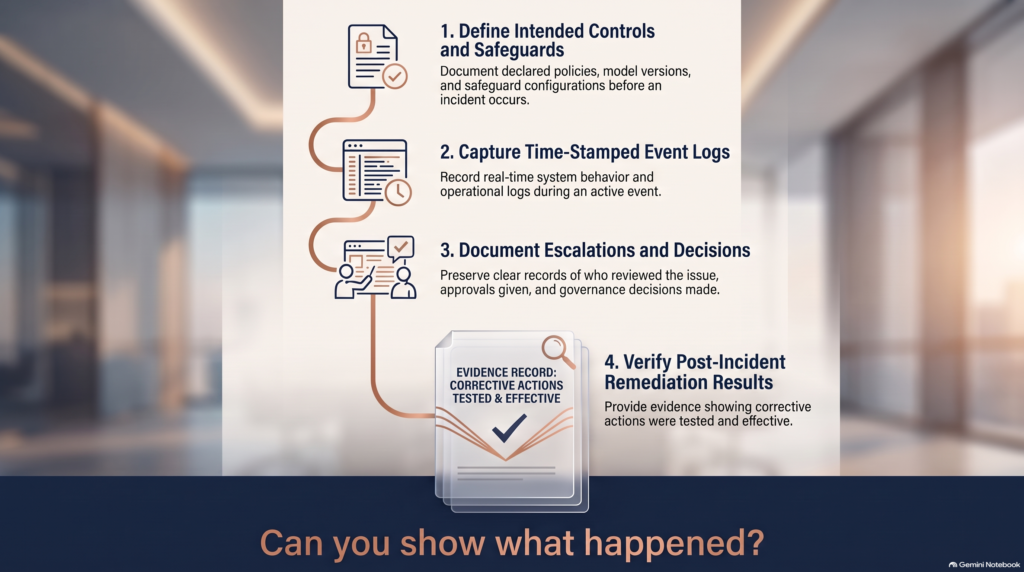
A useful governance record should link the system’s declared controls to observed behavior. Depending on the system and the incident, that can include:
- Model, software, and configuration versions
- Changes to safeguards, permissions, or deployment settings
- Time-stamped logs and incident events
- The path by which an issue was detected and escalated
- Review decisions, approvals, and ownership
- Remediation steps and evidence that they worked
The value is in the connections. A log without context may be difficult to interpret. A review decision without its supporting evidence may be hard to defend. A remediation note without a verification result may show intent, but not effectiveness.
When those records are linked and preserved, an organization can give a more reliable account of what happened and how it responded.
Test the explanation before it is needed
Organizations can make this concrete by running a simple evidence exercise:
- Select a meaningful incident or control failure.
- Reconstruct the system state at the time.
- Identify which safeguards were intended to apply.
- Compare that intent with logs and observed behavior.
- Trace the escalation, decisions, and remediation.
- Record gaps where the evidence cannot support a clear conclusion.
This exercise can reveal mismatched terminology, missing timestamps, undocumented configuration changes, or approval records that identify a request but not the specific artifact reviewed. Those are difficult gaps to repair after the fact.
Governance has an evidence burden
The move from internal review to external inquiry does not mean every incident will result in enforcement or that every organization needs the same recordkeeping system. It does mean that governance claims should be supportable.
If an organization says a control was effective, it should be able to show what the control did in the relevant circumstances. If it says an issue was contained, it should be able to show the evidence for that conclusion. If it says a fix worked, it should be able to show how that was tested.
That is the deeper lesson in an investigative subpoena: governance has to work as an operating discipline and as an evidence discipline.
The question to ask before an inquiry arrives is straightforward:
If someone outside the organization asks, “Show me what happened,” can the organization produce a clear, consistent account from its records?