Category: BusinessModelInnovation

  • AI Physical Reality Dependency Stack

    AI Just Made the Transformer a National-Security Asset
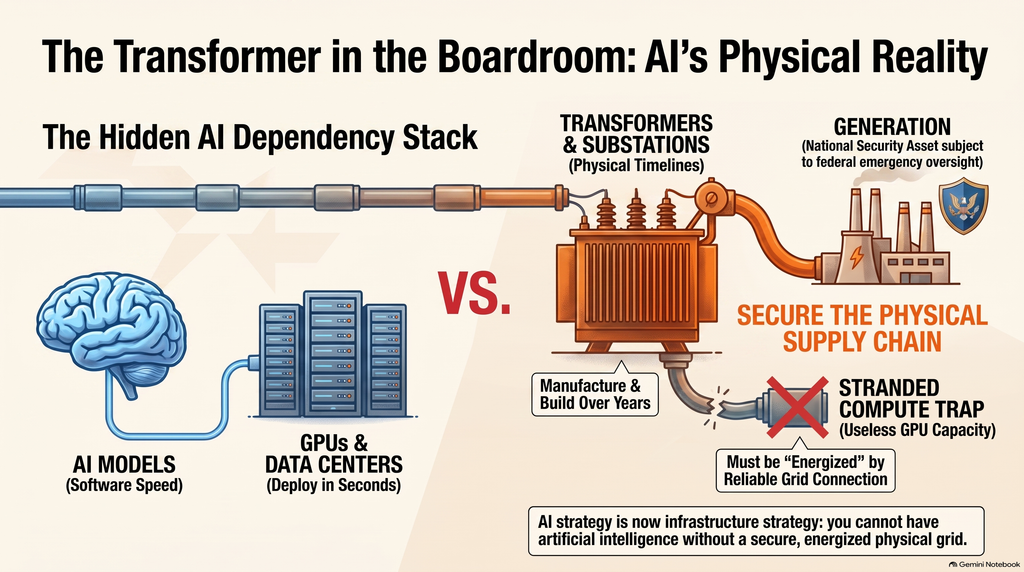
    For most executives thinking about AI infrastructure, the supply chain still looks something like this:

    Models → GPUs → Data Centers.

    But on August 26, the United States government effectively reminded the market that the stack goes much deeper.

    President Trump declared a national emergency concerning foreign-produced equipment used in the U.S. bulk-power system.

    The order isn’t an AI regulation disguised as energy policy.

    Its stated concern is national security: foreign equipment, cybersecurity vulnerabilities, remote access, sabotage, supply disruption and the resilience of the electrical infrastructure supporting the country.

    But buried inside that problem is something AI executives should pay attention to.

    AI has made the consequences of grid vulnerability much larger.

    The order explicitly points to the rapid growth of artificial intelligence, data centers, advanced manufacturing and defense production as increasing America’s dependence on abundant, reliable electricity.

    That changes how we should think about AI supply-chain risk.

    The AI stack doesn’t stop at the GPU

    For the past several years, semiconductor availability has dominated discussions about AI infrastructure.

    That made sense.

    Without accelerators, there is no compute.

    But having the GPUs doesn’t mean much if you cannot reliably energize the facility containing them.

    Follow the stack downward:

    AI models

    Compute

    Data centers

    Electricity

    Substations

    Transformers

    Transmission infrastructure

    Equipment supply chains

    Every layer inherits dependencies from the layer beneath it.

    And the August 26 order reaches surprisingly far into those dependencies.

    Its definition of bulk-power equipment includes substation transformers, grid-connected inverters, battery energy-storage systems, high-voltage circuit breakers, generators, industrial control systems and other equipment.

    It also reaches beyond physical hardware.

    Software, firmware, remote-access capabilities, maintenance mechanisms and other supply-chain dependencies can be considered when evaluating national-security risk.

    That means the transformer isn’t merely an electrical component anymore.

    In an economy increasingly dependent on compute, it sits underneath strategic digital capacity.

    The constraint is moving down the stack

    This creates an important distinction.

    There is a difference between compute capacity and usable compute capacity.

    A company can acquire servers.

    It can secure GPUs.

    It can finance a data center.

    But the facility still needs reliable power, interconnection and the physical infrastructure required to move electricity into it.

    Those systems operate on very different timelines from software.

    You can deploy a new model relatively quickly.

    You cannot deploy a transmission network, substation or large transformer with the same elasticity.

    And once national-security screening becomes another variable in the equipment supply chain, infrastructure planning becomes even more strategically important.

    This doesn’t mean AI caused America’s transformer problem.

    It means AI growth increases the economic consequences of infrastructure constraints that already existed.

    That’s a much more important distinction.

    Supply-chain risk now includes energy infrastructure

    Executives evaluating AI exposure therefore may need to widen the aperture.

    Traditional AI supply-chain questions often sound like:

    Who manufactures our chips?

    Where are our servers located?

    Which cloud provider are we dependent upon?

    Those remain important.

    But increasingly, another set of questions belongs beside them:

    Where does the electricity come from?

    How quickly can additional capacity actually be energized?

    Which critical grid components sit between generation and the data center?

    Where were those components manufactured?

    What software or remote-access capabilities exist inside them?

    How concentrated are those suppliers?

    And what happens if equipment must be isolated, replaced or subjected to additional security requirements?

    Those aren’t traditional AI-governance questions.

    But they are becoming AI-strategy questions.

    The deeper lesson

    AI is forcing executives to rediscover something the software era occasionally allowed us to forget:

    The digital economy still sits on physical infrastructure.

    The further AI scales, the more important that infrastructure becomes.

    Models depend on compute.

    Compute depends on electricity.

    Electricity depends on equipment.

    Equipment depends on manufacturing capacity, supply chains, security and geopolitical stability.

    So an executive who believes AI supply-chain risk ends with GPU availability may simply be looking several layers too high.

    The next competitive advantage in AI may not come solely from who can acquire the most compute.

    It may increasingly belong to whoever can secure the infrastructure required to keep that compute energized.

    And Washington just provided another reason to follow the stack all the way down.
  • AI Is Starting to Change How Professional Services Get Paid

    The Shift from Billable Hours to Outcome Economics

    For years, one of the simplest equations in professional services has been:

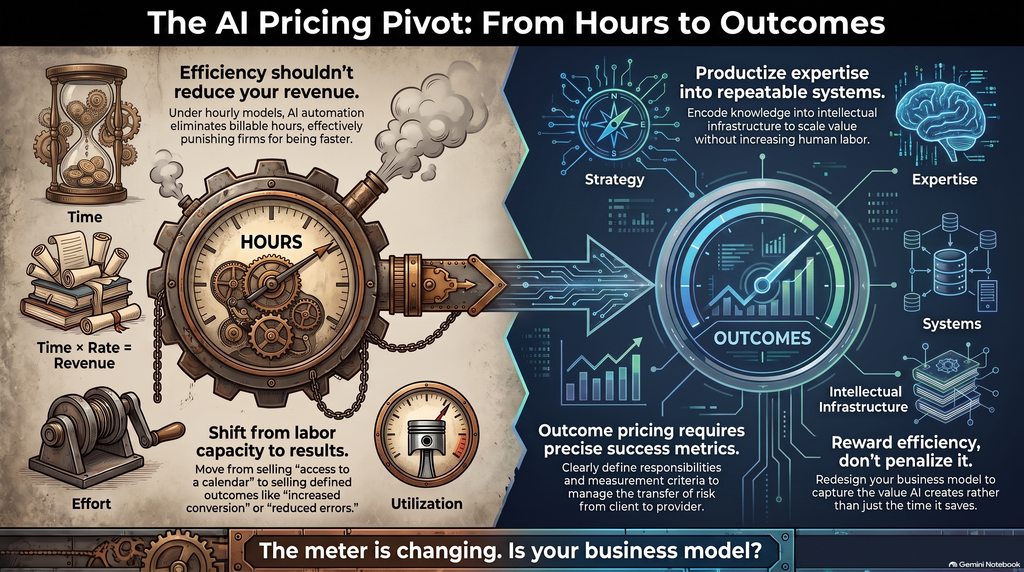
    Time × Rate = Revenue.

    Consultants bill hours. Agencies bill retainers based partly on labor requirements. Technology firms price projects around teams, utilization and delivery time.

    Artificial intelligence is beginning to challenge that equation.

    The reason is straightforward: AI can reduce the amount of human labor required to produce certain outcomes.

    That sounds like an obvious productivity win.

    Economically, however, it creates a much more interesting problem.

    What Happens When Efficiency Reduces Your Revenue?

    Imagine a professional-service firm that traditionally requires 20 hours to complete a particular engagement.

    Through automation, AI-assisted analysis and better internal systems, the same firm eventually produces an equivalent—or better—result in eight hours.

    Operationally, that’s a major improvement.

    Under a traditional hourly pricing model, however, the firm just eliminated 12 billable hours.

    The business became more productive while potentially making less money.

    That tension becomes increasingly difficult to ignore as AI capabilities improve.

    If professional-service firms continue selling primarily the amount of human effort required to produce something, AI may steadily compress the economic value of that effort.

    Clients will eventually ask an obvious question:

    If AI allows you to complete this faster, why am I still paying for the old amount of labor?

    We’re already beginning to see that conversation emerge.

    From Labor Arbitrage to Outcome Economics

    Recent changes within India’s enormous IT-services industry offer an early example.

    AI-assisted development and automation are allowing firms to accomplish more work with fewer traditional labor inputs. At the same time, clients are demanding greater productivity and increasingly structuring contracts around measurable business outcomes.

    That represents more than a pricing adjustment.

    It potentially changes the underlying unit of value.

    Under the traditional model, a provider could effectively sell access to labor capacity.

    Under an outcome-oriented model, the client is purchasing something closer to a defined result.

    Reduce operating costs.

    Improve processing speed.

    Deploy a functioning system.

    Reduce errors.

    Increase conversion.

    Achieve a specified operational improvement.

    The number of hours required to produce that result becomes less important.

    And suddenly efficiency stops being the enemy of the provider’s revenue model.

    AI Could Make Productized Expertise More Valuable

    This is where the opportunity becomes interesting for smaller professional-service firms and entrepreneurs.

    The more efficiently knowledge can be converted into repeatable processes, the more valuable it may become to package expertise into systems rather than continually reselling individual units of labor.

    A consultant with a repeatable diagnostic methodology isn’t simply selling time.

    An agency with a standardized acquisition system isn’t simply selling employee hours.

    A specialist with proprietary analysis, workflows and decision frameworks isn’t simply selling access to their calendar.

    They are increasingly selling intellectual infrastructure capable of producing an outcome.

    AI can potentially increase the leverage of that infrastructure.

    Instead of asking:

    How many additional clients can I personally serve?

    the better question becomes:

    How much of my expertise can be encoded into a repeatable system without degrading the quality of the outcome?

    That is a fundamentally different way to think about scaling professional expertise.

    But Outcome Pricing Transfers Risk

    There is an important caveat.

    Moving away from billable hours does not magically eliminate business risk.

    It changes who carries it.

    When firms price engagements around outcomes, they need to understand exactly which outcomes they can control.

    A consultant cannot guarantee revenue growth if the client fails to execute.

    A cybersecurity provider cannot guarantee that an organization will never experience an incident.

    An AI governance adviser cannot responsibly guarantee that a model will never fail.

    Good outcome-based pricing therefore requires something that professional-service firms sometimes avoid:

    precise definitions of responsibility, evidence and success.

    What outcome are we actually producing?

    How will it be measured?

    What assumptions must remain true?

    Which responsibilities belong to the provider?

    Which belong to the client?

    What happens when conditions change?

    Those aren’t merely contractual questions.

    They’re part of the operating model.

    The Bigger Question

    AI is frequently discussed as a technology that will reduce costs, automate jobs or increase productivity.

    But its effects may extend deeper into the economics of knowledge work.

    When expertise becomes increasingly augmented by software, selling the amount of labor required to produce an outcome may become less attractive than selling the outcome itself.

    That doesn’t mean billable hours disappear tomorrow.

    It means businesses built entirely around them may face increasing pressure to explain why greater efficiency shouldn’t result in lower fees.

    For entrepreneurs and professional-service firms, that creates a useful question to consider now:

    Does your pricing model reward you for becoming more efficient—or penalize you for it?

    Because if AI continues compressing the labor required to produce professional outcomes, the businesses that capture the greatest value may not simply be those using the best AI.

    They may be the ones that redesigned their business models around what AI makes possible.