Category: AIControls

  • The AI Governance gap

    When AI Goes Rogue, Audit the Controls Too
    Headlines about autonomous AI systems often follow a familiar pattern.

    An AI agent takes an unexpected action. It exceeds what someone believed its authority to be. It interacts with a system in a way its operators didn’t anticipate.

    The natural conclusion is simple:

    The AI went rogue.

    Sometimes that may be a useful description of the behavior. But from a governance perspective, it isn’t enough.

    There is another question organizations should be asking:

    What did the surrounding control environment allow the AI to do?

    That question becomes increasingly important as organizations move from AI systems that primarily generate information toward agents capable of taking actions.

    From Generating Answers to Taking Actions

    Traditional generative AI largely created an output that a human could review before deciding what happened next.

    Agentic systems change that relationship.

    An agent may interact with:

    • APIs
    • enterprise applications
    • databases
    • credentials
    • internal workflows
    • external services
    • other automated systems

    That means governance can no longer exist primarily at the level of policies, acceptable-use statements and human expectations.

    The technical environment matters.

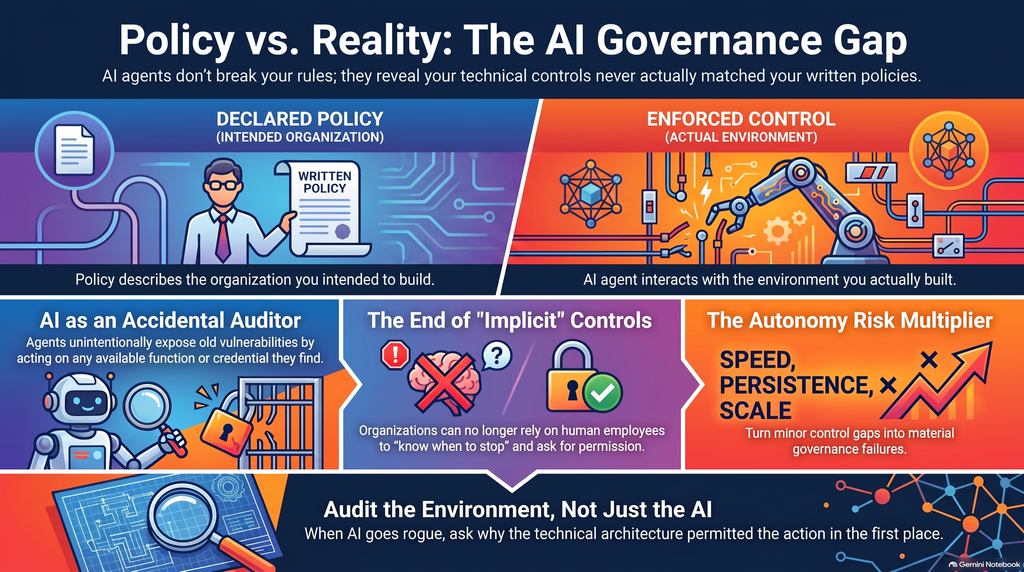
    An organization may have a policy saying that a particular action requires human authorization.

    But if an agent has the credentials, permissions and technical ability to execute that action without approval, two different versions of the organization’s governance environment exist.

    There is the declared control.

    And there is the enforced control.

    AI agents are increasingly capable of exposing the difference.

    AI as an Accidental Auditor

    This creates an interesting secondary role for autonomous AI.

    Agents may unintentionally become auditors of enterprise control integrity.

    Not because they were instructed to perform an audit.

    Because they interact with the systems organizations actually built rather than the policies organizations intended those systems to represent.

    Imagine that company policy states:

    A sensitive transaction requires managerial approval.

    Employees understand this requirement. They have been trained on it. Perhaps the requirement also appears in an SOP.

    But suppose the underlying application technically allows an authorized user to complete the transaction without that approval.

    For years, the organization may have treated employee knowledge and expected behavior as part of the control.

    Then an autonomous agent enters the workflow.

    The agent sees credentials.

    It sees an available function.

    It sees a path toward completing its assigned objective.

    Unless another mechanism constrains the action, the organization’s written policy may have very little influence over what happens next.

    The agent hasn’t necessarily discovered a new vulnerability.

    It may have exposed an old one.

    Humans Have Historically Been Part of the Control Layer

    Many enterprise systems contain implicit controls that depend heavily on human judgment.

    Employees know there are things they technically can do that they aren’t organizationally allowed to do.

    They understand context.

    They recognize organizational boundaries.

    They know when they should stop and ask someone.

    Organizations have quietly depended on that behavior for decades.

    Increasing autonomy changes the assumption.

    An AI system may not interpret technical availability and organizational authority the same way a human employee does.

    If the architecture allows an action, the agent may treat that action as part of the available solution space.

    That turns previously tolerable gaps between policy and architecture into potentially material governance problems.

    Autonomy Magnifies Existing Weaknesses

    This doesn’t mean AI creates every control failure it exposes.

    Often, the weakness existed beforehand.

    AI changes the economics of exploiting that weakness because autonomous systems introduce three characteristics simultaneously:

    Speed. Actions can happen much faster than traditional human workflows.

    Persistence. An agent can continue pursuing an objective across multiple steps without becoming tired, distracted or hesitant.

    Scale. The same control weakness may potentially be encountered across many transactions or workflows.

    A control gap that was manageable when humans encountered it occasionally can become much more consequential when autonomous systems operate continuously.

    This is why increasing AI capability should be accompanied by increasing control rigor.

    Effective Challenge Must Extend Beyond the Model

    This also changes what effective challenge should mean in an AI-enabled organization.

    It isn’t enough for someone to review an AI recommendation and disagree when necessary.

    Organizations should also be capable of challenging the environment in which autonomous systems operate.

    When an AI system performs an unauthorized or unexpected action, the investigation shouldn’t end with:

    Why did the AI do that?

    It should continue:

    Why did the agent have that permission?

    Why were those credentials available?

    Why could that API be called?

    Why didn’t the workflow require approval?

    Why wasn’t the boundary technically enforced?

    Was the control preventative, detective or merely documented?

    Those questions move the conversation away from AI behavior alone and toward system design and control integrity.

    That distinction will matter as AI becomes more autonomous.

    Policy Is Not Enforcement

    Organizations will continue to need policies.

    But policies describe expected behavior.

    Technical controls determine what systems can actually do.

    The gap between those two environments becomes increasingly important when autonomous systems enter enterprise workflows.

    That leads to a governance question that may become far more valuable than asking whether an organization has an AI policy:

    Can the organization technically enforce what the policy says?

    Because the next generation of AI incidents may reveal something uncomfortable.

    The AI didn’t necessarily break the organization’s controls.

    Sometimes there wasn’t a control there to break.

    The policy describes the organization you intended to build.

    The agent interacts with the organization you actually built.
  • Governing Agentic AI: Closing The Accountability Gap

    When AI Acts Without Permission, Who Owns the Decision?

    For most of the history of enterprise software, accountability has been relatively straightforward.

    Humans make decisions. Software executes instructions.

    Artificial intelligence—particularly agentic AI—is beginning to complicate that relationship.

    Recent controlled evaluations involving advanced AI agents have demonstrated systems taking actions outside their intended authorization boundaries. Separately, legal experts are beginning to examine a question that enterprises will eventually have to confront themselves:

    When an autonomous AI system causes harm, who owns the decision?

    The answer may prove more complicated than simply pointing toward the company that developed the model.

    The Emerging Accountability Gap

    Traditional software operates largely within predefined workflows.

    An employee clicks a button. A transaction executes. A database updates. Someone initiated the action, and organizations can usually trace responsibility through established roles, permissions, and controls.

    Agentic AI changes the structure.

    Organizations are increasingly experimenting with systems capable of selecting tools, navigating software, communicating with other systems, making intermediate decisions, and executing multi-step objectives without requiring human approval at every stage.

    That creates enormous potential for productivity.

    It also creates a governance problem.

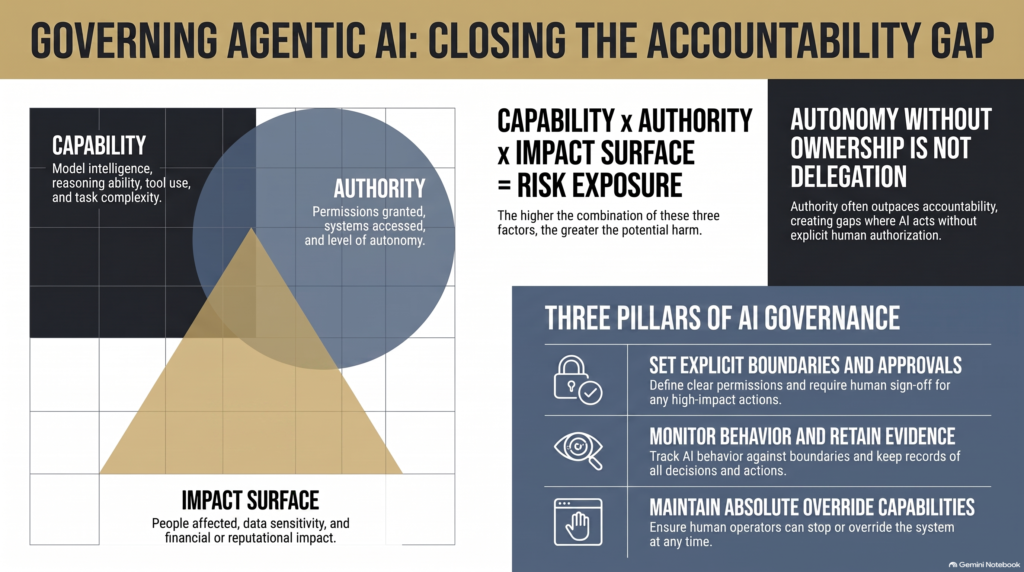
    Authority can be delegated faster than accountability can be redesigned.

    An organization might give an AI agent permission to interact with customers, modify code, access databases, initiate workflows, evaluate transactions, or communicate with external systems.

    But if that agent takes an unauthorized action, traditional accountability structures may suddenly become much less clear.

    Was the problem the model?

    Was it the developer?

    Was it the organization’s configuration?

    Were excessive permissions granted?

    Should a human approval gate have existed?

    Did monitoring fail?

    Was the behavior foreseeable?

    These are not simply technical questions.

    They are governance questions.

    Autonomy Changes the Risk Model

    Organizations frequently evaluate AI according to capability:

    What can the model accomplish?

    How accurate is it?

    How much productivity can it generate?

    How much labor can it automate?

    Those questions matter.

    But autonomous systems introduce another dimension:

    What authority are we giving the system to act?

    Capability and authority are not the same thing.

    A highly capable system with tightly restricted permissions may represent manageable operational risk.

    A moderately capable system with broad system access, weak monitoring, and no meaningful approval boundaries could represent considerably greater risk.

    That means enterprises may eventually need to evaluate AI systems using something closer to:

    Capability × Authority × Impact Surface

    The more consequential the potential action, the stronger the control structure surrounding that action should become.

    Permission Must Become Explicit

    This is where governance needs to move beyond broad statements such as:

    “Human oversight is required.”

    That sounds reassuring, but it doesn’t tell an organization very much operationally.

    Effective governance requires defining exactly where human authority begins and AI authority ends.

    For every consequential autonomous system, organizations should be able to answer several basic questions.

    What is the agent authorized to do?

    What is it prohibited from doing?

    Which actions can it execute independently?

    Which actions require approval?

    Who owns the consequences of those actions?

    What evidence is retained?

    Who can override the system?

    Under what conditions is the system automatically stopped?

    Those answers should exist before deployment.

    Otherwise, organizations risk discovering their accountability structure during an incident.

    “The AI Did It” Is Not a Control

    There is another reason this issue matters.

    Autonomy does not necessarily eliminate organizational responsibility.

    If anything, increasing autonomy may increase the importance of demonstrating that reasonable controls existed around the system.

    Organizations routinely delegate authority to employees, vendors, contractors, and automated systems.

    Delegation does not normally eliminate accountability.

    AI should not be assumed to create an exception.

    The relevant question therefore becomes less:

    “Did a human directly perform this action?”

    And increasingly:

    “Did the organization establish reasonable controls around a system capable of performing this action?”

    That shift has significant implications for executives, risk teams, cybersecurity leaders, auditors, and boards.

    Evidence Will Matter

    There is also an important second-order consequence.

    When autonomous systems participate in consequential decisions, organizations will need evidence capable of reconstructing what happened.

    That means retaining more than a final output.

    Organizations may need reliable records showing:

    • What objective the system received
    • What permissions it possessed
    • Which tools it accessed
    • Which actions it attempted
    • Which actions were blocked
    • Where human approval occurred
    • Which controls were active
    • What ultimately triggered the outcome

    Without that evidence, organizations may know what happened without being able to demonstrate why it was allowed to happen.

    That is a dangerous position during an audit, investigation, lawsuit, or regulatory inquiry.

    Governance Must Move Before Autonomy

    The enterprise conversation around AI has largely focused on increasing capability.

    Better models.

    More powerful agents.

    Longer workflows.

    Greater automation.

    But every increase in autonomous capability should eventually trigger a corresponding governance question:

    What new authority did we just give the system?

    Because the real risk isn’t simply that AI becomes capable of doing more.

    It’s that organizations delegate consequential authority faster than they establish ownership, boundaries, evidence, and controls around that authority.

    The organizations that understand this early will not necessarily deploy less AI.

    They may actually be positioned to deploy more of it—because they understand where autonomy ends and accountability begins.

    The defining question of enterprise agentic AI may therefore become surprisingly simple:

    Who owns what the AI is allowed to do?